




America | Tech | Opinion | Culture | Charts

San Francisco used to be a city where you assumed your car would get broken into. It was the kind of thing residents joked about bitterly for years — don’t leave anything visible in it, set aside part of your paycheck for repairs just in case. This was just taken as a given.
But recently something changed. Our beloved SF has experienced a “step change” (for the better) in major crimes. We are absolutely thrilled at the progress we’ve made in the past few years, and the overall shift in everybody’s mindset from “this is an unsolvable problem” to, “we’re actually getting somewhere.” Is there still a way to go? Sure. But the inflection of progress, and the renewed optimism you can sense around residents’ perception of crime and safety in SF, has felt like a miracle.
With a little investment in its tech stack, SF was able to achieve what once seemed impossible, and it’s not alone. A growing number of cities across America are experiencing the same turning point.


This is a story about Flock, and the founder who got tired of crime, and just wasn’t going to take it anymore.
After all, no one likes crime. That’s not a revelation. There’s complete bipartisan consensus that crimes going unsolved is a bad thing. But for a thing no one likes, there’s been remarkable complacency about getting better at solving the problem.
Reliable nationwide stats are hard to find, but suffice it to say it’s far from a solved problem.
If anything, crime has become a harder problem to solve:

At the same time, there’s been remarkably little innovation in crime-fighting. It’s still very much a boots-on-ground process, and as it turns out, in many departments boots-on-ground have been declining now for some time:
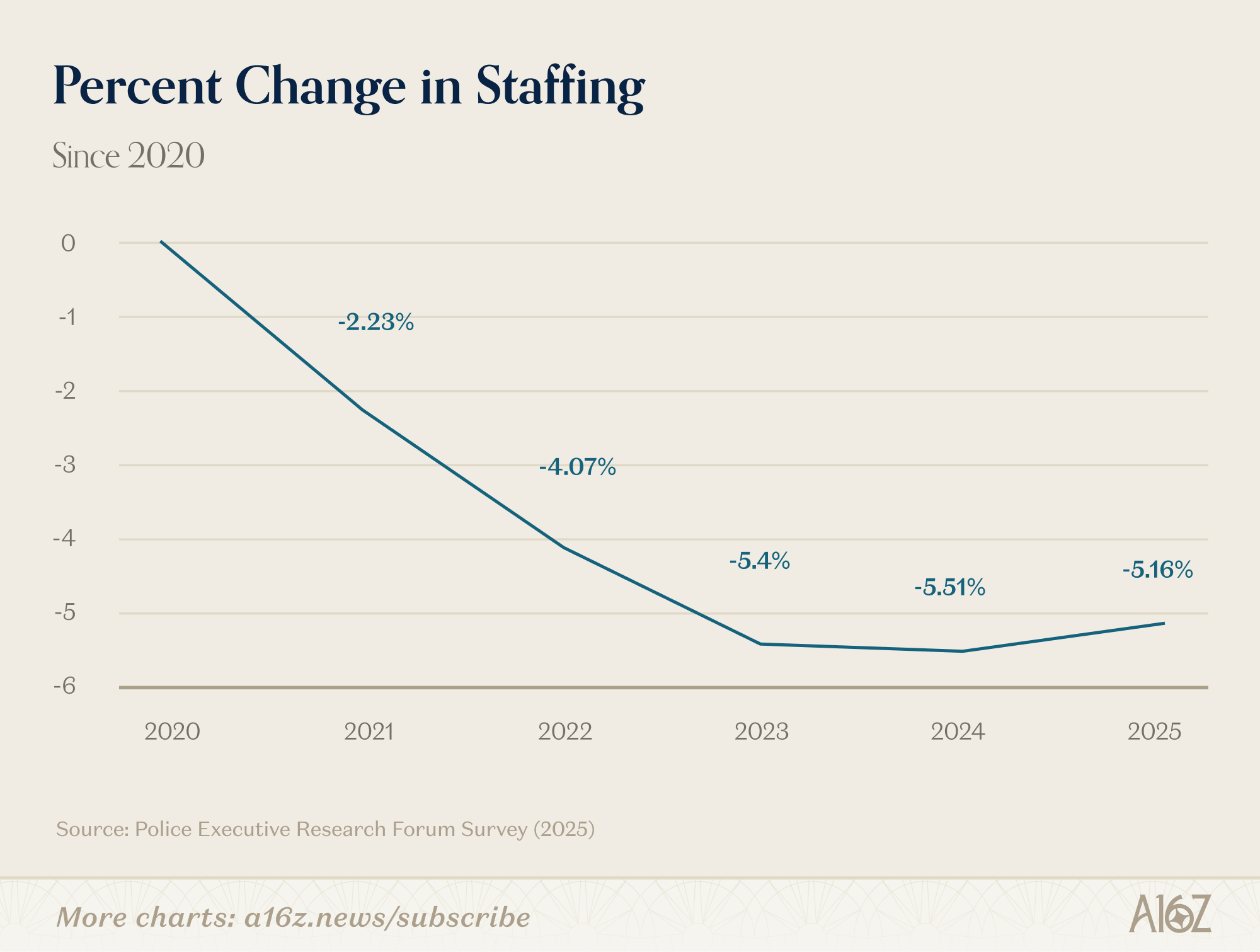
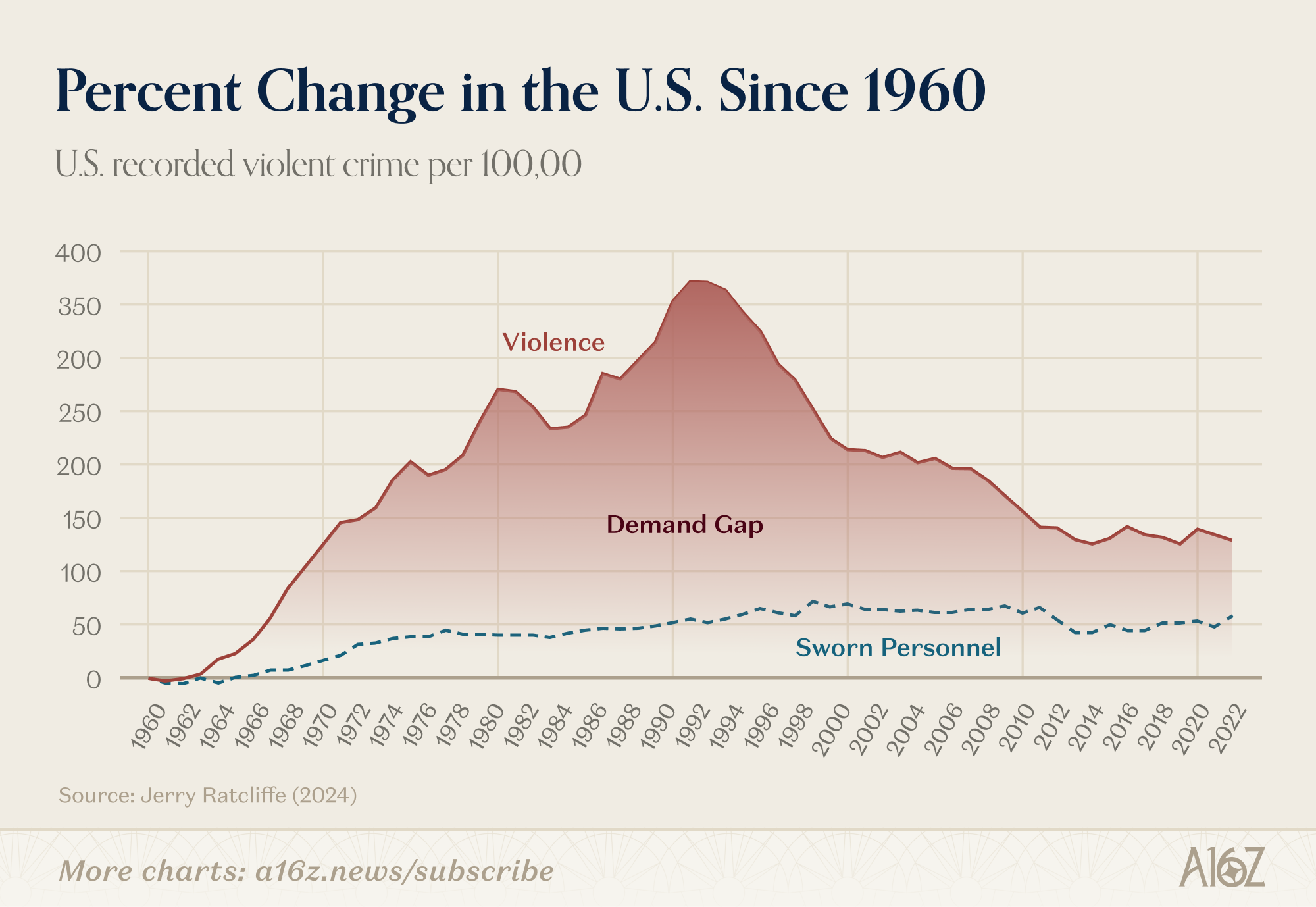
So what can we do? Fighting crime is a three-legged stool of staffing and training, community engagement and trust, and technology. Staffing, as we see, has been a pain point in recent years, and law enforcement are usually the last people to get the best technology. Community trust is an outflow of officers solving crimes, finding the right people, and keeping the communities safe without innocents getting caught in the crosshairs.
If police departments struggle to be staffed well enough to do their jobs successfully, then the next best thing they can do is strengthen the staff they do have with the help of technology — more specifically, with the help of Flock.
Crime as an information problem
For Flock, the first main insight was about cars.
None of the founding team had a background in law enforcement to guide them. They just asked police chiefs a straightforward question: Why can’t you solve more crime? Was it because the cops didn’t care? Weren’t willing to try hard? Or simply didn’t have the information they needed?



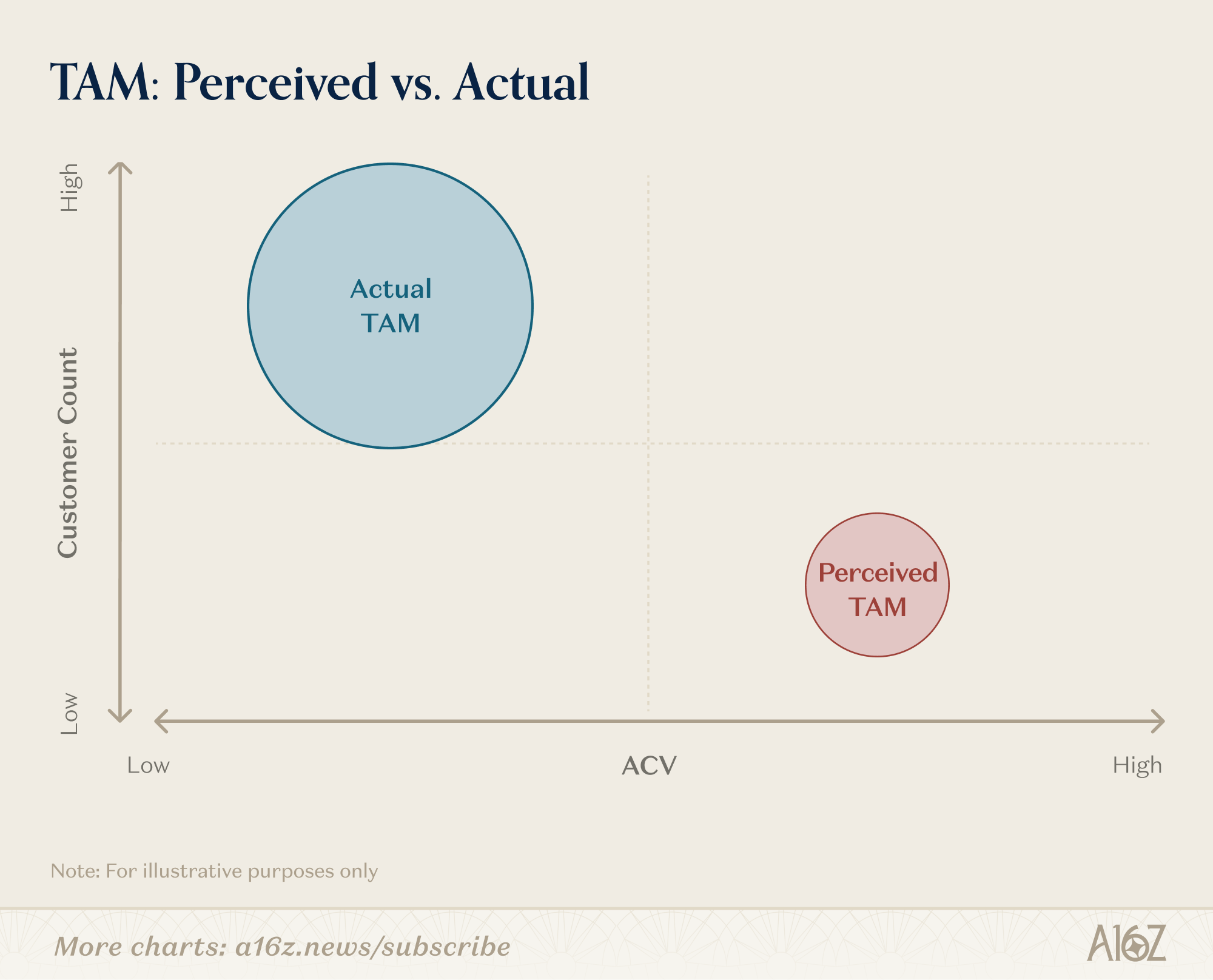
It turned out to be the last thing. Flock realized that vehicles are both frequent targets of crime, including hundreds of thousands of annual motor vehicle thefts, and commonly used in other crimes as tools for transportation, surveillance, and escape, making them a strategic point of focus for improving public safety. A camera capturing a clear plate or vehicle signature is the fastest path to an actionable lead. Police chiefs have known this for decades, but the problem was cost. Traditional ALPR systems were expensive because of two things: construction (trenching for power and fiber, permits, site work) and specialized hardware (infrared cameras, dedicated processors). Rich cities could afford a handful of chokepoints, and everyone else had nothing at all. In short, it was a price problem no one had yet solved.
If more information delivered more efficiently about cars could resolve more crimes, then that’s the problem Langley and team went to tackle.
You can’t fake a car
In 2017, a handgun was stolen out of a car in an Atlanta neighborhood. The police arrived, saw no one was hurt, and left without taking fingerprints or opening an investigation. Two months later, another handgun was stolen from a car in the same neighborhood but this time the perpetrator was caught and arrested because one camera captured one license plate.
That camera was not one of the standard street cameras set up by police. This was the Falcon – the first prototype for new LPR technology that would soon become the backbone of Flock. Within a weekend, Garrett Langley and his cofounder Matt Feury built the prototype for under $1K using an Android phone, a solar panel, and a bigger battery.
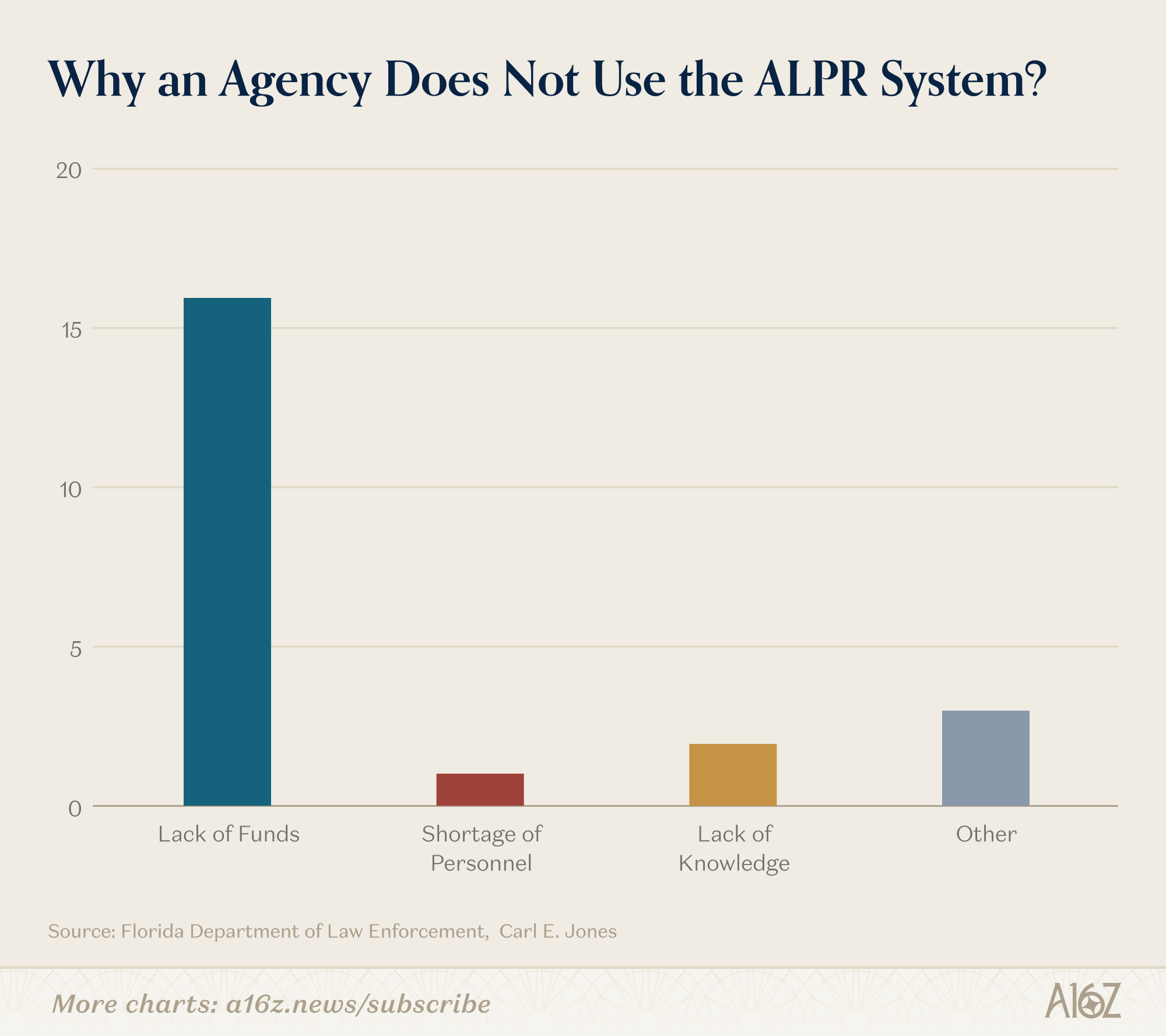
But for their first customers, it was the capabilities more than the costs that ended up mattering most. Modern computer vision, running on cheap mobile processors, could do something the old systems couldn’t. When a vehicle passes one of our cameras, it captures a vehicle signature: the plate, the make, the model, the color.
When Flock ran side-by-side comparisons with traditional ALPR systems, customers shook their heads in disbelief. “Something must be wrong with your camera,” customers would say. “You’re seeing more cars.” They’d assumed Flock would have inferior character recognition. It never crossed their minds that Flock would capture more vehicles — all the ones with plastic covers, temporary tags, or no plates at all. This mattered enormously for law enforcement as a would-be criminal could beat the old systems by simply removing their plate or printing a fake temporary tag at home. With computer vision, that car still exists in the system as a white Ford F-150 with a roof rack and front-end damage. Maybe you don’t have a unique identifier, but you have enough to find a needle in a haystack.
In tech, people talk about the “10x engineer” — the developer who’s an order of magnitude more productive than their peers. The same phenomenon exists in law enforcement. There are 10x investigators, and they’re not necessarily 10x because they work harder. They know techniques others don’t. Someone taught them investigative workflows that most officers never learn. The opportunity Flock offers to law enforcement is to democratize access to those elite techniques — not just 10x officers but 10x departments and thus exponentially safer communities.
Flock makes America safer
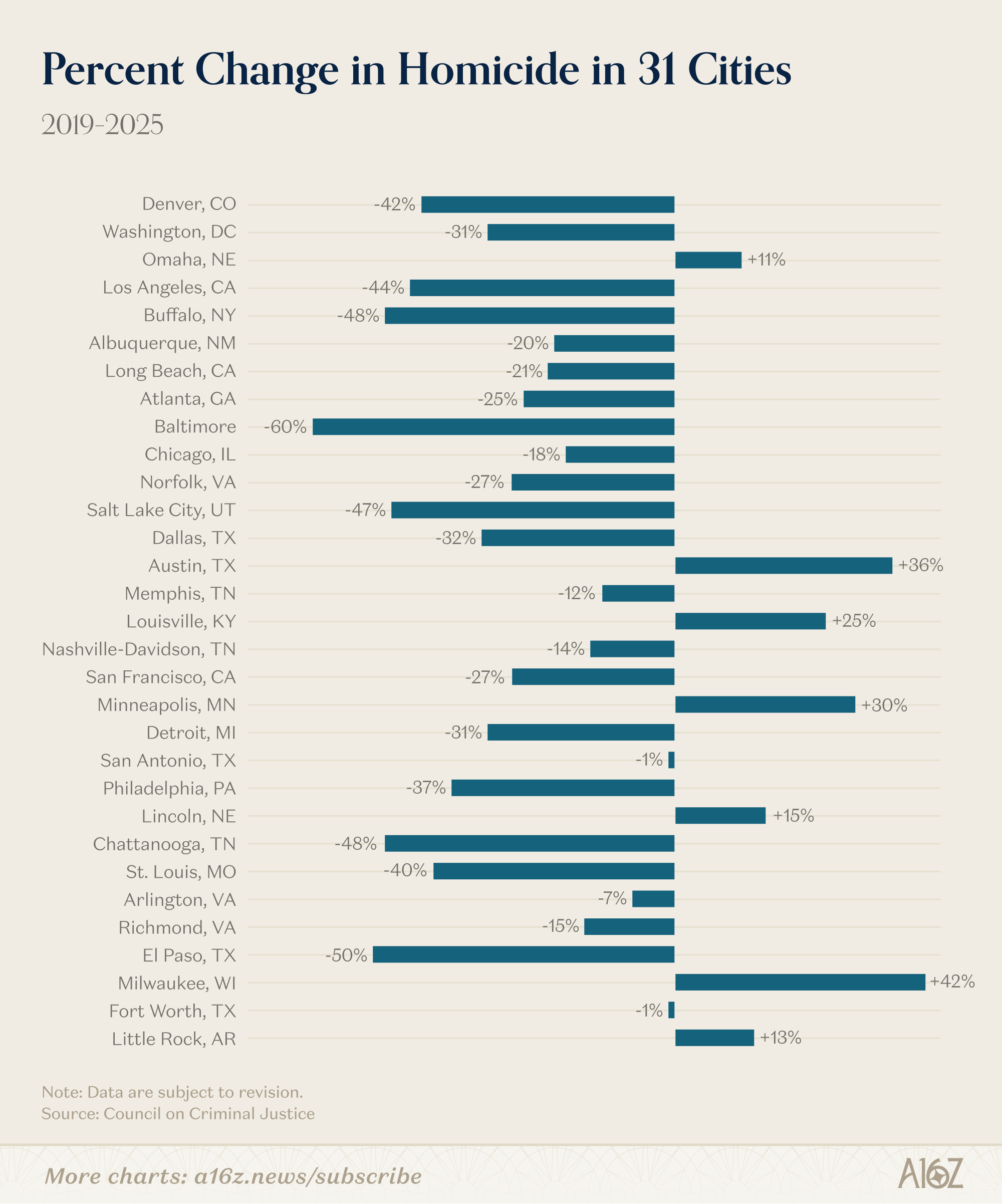
It is now eight years since the founding of Flock. All across America from small towns like Prosper, Texas to large cities like Oakland, California, Flock reports that its technology helps solve 700,000 crimes per year. But they don’t just solve crimes after the fact; they help resolve crises that are still in motion including over 1,000 missing persons cases, per Flock data. As more cities adopt their tools, that number will only grow.
When cities and police forces choose to work with Flock, the results can speak for themselves. Tulsa’s police department solved every one of their homicide cases in 2024 — something they hadn’t done in almost 50 years. In 2025, the city of Lakewood, Washington celebrated the first year in at least two decades without a single homicide. Las Vegas has enjoyed significant (often 20%+) year-over-year declines in crime rates as well.
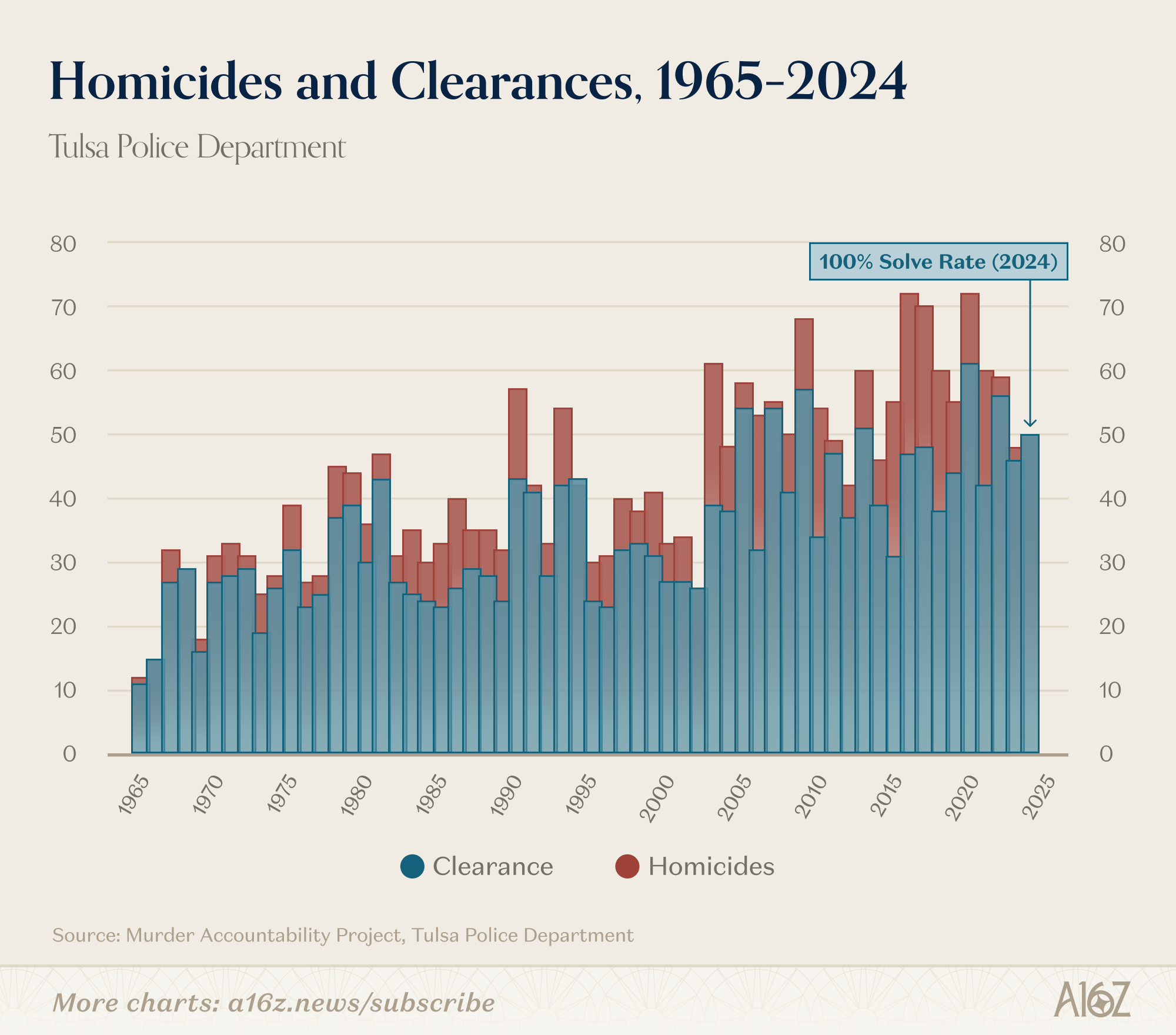
A 49% clearance rate for murder is not a fluke. We all know crime is a problem. The way to solve it is simple. If you commit a crime, you know you will get caught. That way, cities and communities are safer, yes, but young people who don’t know any better are deterred before getting swept up into the justice system.
To that end, technology in law enforcement has overwhelmingly been a force for good. Though clearance rates have dropped precipitously since the 1960s to now, even for serious crimes like murder (>90% solved in 1961 to <50% solved in 2021), there is a silver lining. The amount of accurate evidence has increased a ton in the past few decades, thanks to technology. Using fingerprint and DNA evidence is part of the standard procedure if you want to convict someone for a crime — so much a part of standard procedure that we often take it for granted. Since 1989, hundreds of people wrongly imprisoned have now been exonerated based on DNA testing in the U.S. Today, we insist that crimes are not just solved but solved accurately and with undeniable evidence. As a result, it is harder to convict someone without such evidence. People are much less likely to be wrongfully accused and imprisoned — or even simply get caught in the crosshairs of investigations.
But we still need additional layers of technology beyond DNA and fingerprinting to keep innocent people out of prison, increase the likelihood that the actual criminals are convicted, and build trust and good relations between local law enforcement and the communities they are tasked to protect.


Flock’s suite of products for law enforcement — from cameras to drones to gunshot detection systems — is that additional layer. They’ve faced backlash in a handful of cities for “surveillance” or “privacy concerns” that overlook the vigilant protections in place to ensure that Flock cannot be used for surveillance or to violate privacy. Moreover, the backlash overlooks the fact that traditional and tech-lite modes of public safety rely on subjective human assessment. Everyone deserves to feel safe in their community, regardless of their zip code, income, or background. That means not only deterring and finding criminals, but also ensuring that innocent people are protected in the process. It means giving police the tools they need to operate with precision rather than relying on profiling.
Flock is the bridge that can take us from the subjective policing of the past to the more objective policing of the future, where crimes are solved, criminals deterred, and innocent communities protected.
It doesn’t have to be this way
At the end of the day, the belief driving the team at Flock — and the belief driving each of their customers is — that it doesn’t have to be this way. Police officers work tremendously hard to fight crime, and they as well as the people they protect deserve the best tools possible. Flock is designed to help solve more crimes, more efficiently and accurately, and to protect the civil liberties all Americans expect.
Every American deserves to feel safe — whatever their background and wherever they live. Every mother or father should be able to walk children to school without fear. Every small business owner should be able to keep their doors open without worrying about a robbery. And families grieving a murdered loved one deserve to see justice served.
We believe that we’ll look back on our current era of rampant unsolved crime the same way we look back on other problems that once seemed intractable, but which we overcame through American innovation and determination.
We have the technology to dramatically reduce crime in America, and we have the will among law enforcement and communities desperate for safety. It’s time to follow through on that potential and secure a safe future for all Americans.



This newsletter is provided for informational purposes only, and should not be relied upon as legal, business, investment, or tax advice. Furthermore, this content is not investment advice, nor is it intended for use by any investors or prospective investors in any a16z funds. This newsletter may link to other websites or contain other information obtained from third-party sources - a16z has not independently verified nor makes any representations about the current or enduring accuracy of such information. If this content includes third-party advertisements, a16z has not reviewed such advertisements and does not endorse any advertising content or related companies contained therein. Any investments or portfolio companies mentioned, referred to, or described are not representative of all investments in vehicles managed by a16z; visit https://a16z.com/investment-list/ for a full list of investments. Other important information can be found at a16z.com/disclosures. You’re receiving this newsletter since you opted in earlier; if you would like to opt out of future newsletters you may unsubscribe immediately.