



America | Tech | Opinion | Culture | Charts

In March, Senate Armed Services Chairman Roger Wicker pressed a panel of four Pentagon officials during a hearing on this potentially existential issue—munitions magazine depth. “We cannot be the Arsenal of Democracy,” Wicker reminded the hearing, “if we cannot get weapons out the door.” There has been ample concerning coverage in recent months on the challenges we face in maintaining our national munitions stockpiles. Whether our next conflict is a continental land war like Ukraine, or a battle for sea control in the Pacific, we will need a spectrum of munitions—defensive and offensive, traditional and new—in the arsenal.
At its core, the deterrent quality of our magazine is a function of two factors: the disposition of munitions on hand, and the capacity to produce more. Production carries vastly more weight in any rational actor’s calculation than inventory alone. For the U.S., maintaining a warm production line of deterrent capacity has been an affordability challenge. These legacy munitions have been intricately designed and built with bespoke aerospace components, to fulfill erratic and inconsistent orders from the military. This has made our current arsenal of munitions incredibly expensive at unit cost.
New entrants to this space have recognized two opportunities to deliver quality munitions at greater volumes in less time. First, they are designing new munitions from the ground up for manufacture at high rate, drawing on readily available automobile, civil aviation and consumer electronics supply chains. Second, they have conviction in the long-term need, and are funding production with private capital now to overcome jittery government demand.
According to Wicker’s hearing, “less than three percent” of the department’s munitions plan funds low-cost munitions. The plan, assembled by the Munitions Acceleration Council, assigns 97 percent of funding to legacy munitions; the remaining three percent goes to new entrants building lower-cost, highly capable products that use modernized design and manufacturing.
This seems like the wrong ratio to us, and the Pentagon is coming around to it. We’re not advocating for completely pivoting the US Arsenal towards new entrants, but we are arguing, if we shift that spend into new options that are both privately funded and low-cost supply chains, by changing how we buy, we’ll get more for our money and be in a stronger place to defend America and her allies.
Take cruise missiles as example A: Tomahawks run about $2-4 million, on the high end. Versus a new class of commercially built strike weapons—Covenant’s Anthem or Anduril’s Barracuda family—that are only about 1/5 to 1/10 the cost.
Then examine close and short range ballistic missiles as example B: The “legacy” (brand new) Lockheed Martin PrSM Increment 1 missile—initially priced at $2.7m (now $1.7 million with scale)—is less performant than Castelion’s Hypersonic Blackbeard GL, entering with a cost under $500,000.
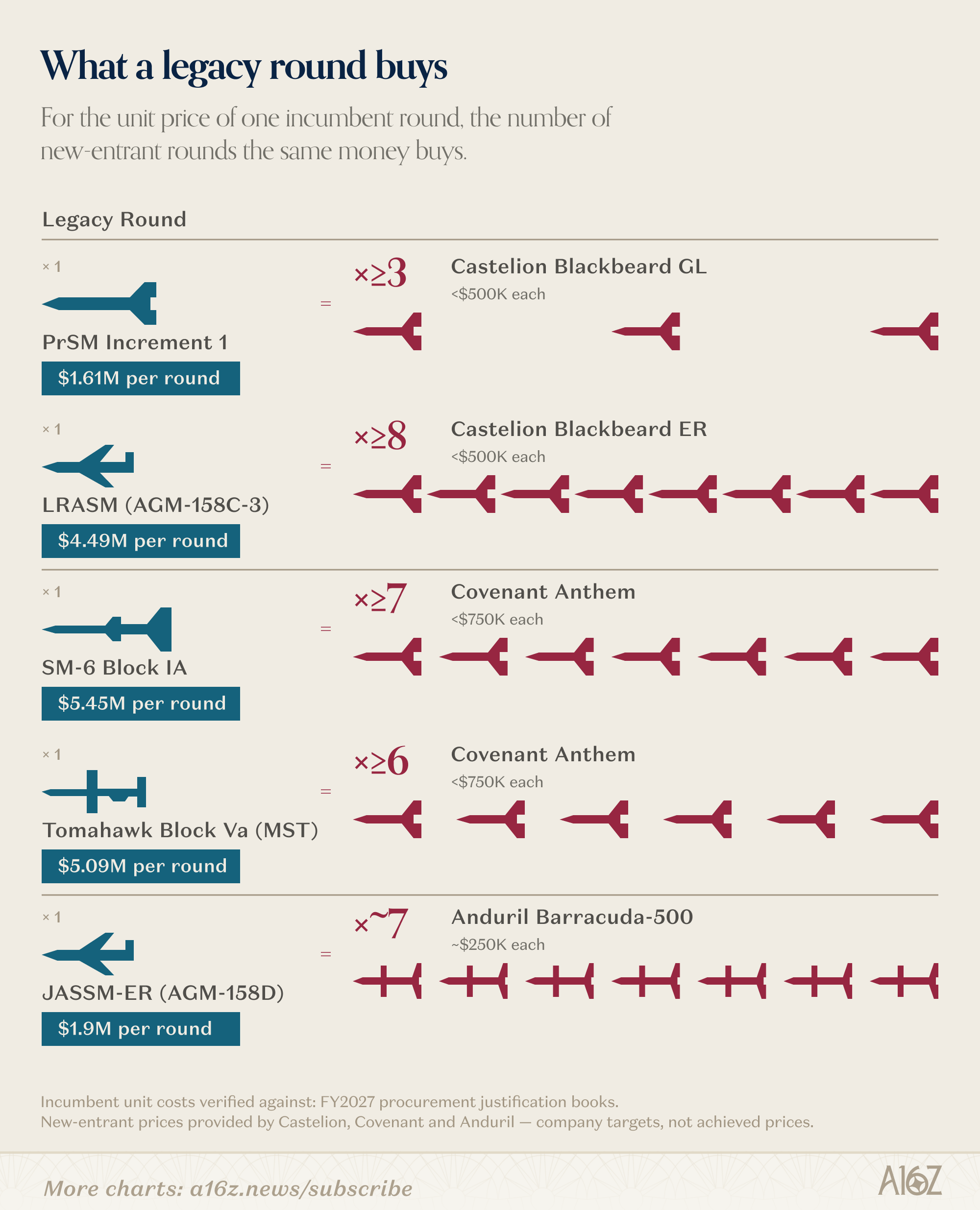
So each incremental legacy missile costs about five to ten times as much as its new entrant alternative. In practice, the gap might be closer to twelve to fifteen times, because the flyaway price on a legacy munition the government pays today doesn’t account for the RDT&E the government committed to designing it—roughly 25% of the overall cost of legacy munitions.1 The new generation of startups develops their technology from their own balance sheets, often with capital from investors like a16z. Market competition sets the ultimate price.
Buying Tradeoffs: Simplified
The budget is complicated, and people like to hide behind the complexity, so let’s just make it simple. Congress gives the Pentagon $100 for munitions. We’ll say the legacy missile price is $1 and the new entrants are ten cents. Apply the Pentagon’s current 97-to-3 split: after accounting for R&D to design the legacy missile at government expense (25+% of lifecycle costs for missiles), the $97 fields about 73 rounds and the $3 fields 30 new entrants. A CSIS study showed that between 2022 and 2024, for every costlier cruise or ballistic missile the Russians fired at Ukraine, they were firing nearly four one-way attack UAVs. As Russian capacity to build Shaheds scaled in late 2024, this ratio looked more like 1:10. We include the 1:3 ratio here as a guidepost for comparison to another major military power. No one is saying that’s the ideal mix, but we’d argue it’s a helpful proxy for the direction of future warfare. If we wanted this same ratio in our stockpile, the same $100 could buy 61 legacy missiles plus 180 new entrant missiles. The question worth putting to the people who hold the war plans — and one hopes they are asking it — is: which magazine would you rather take to war?
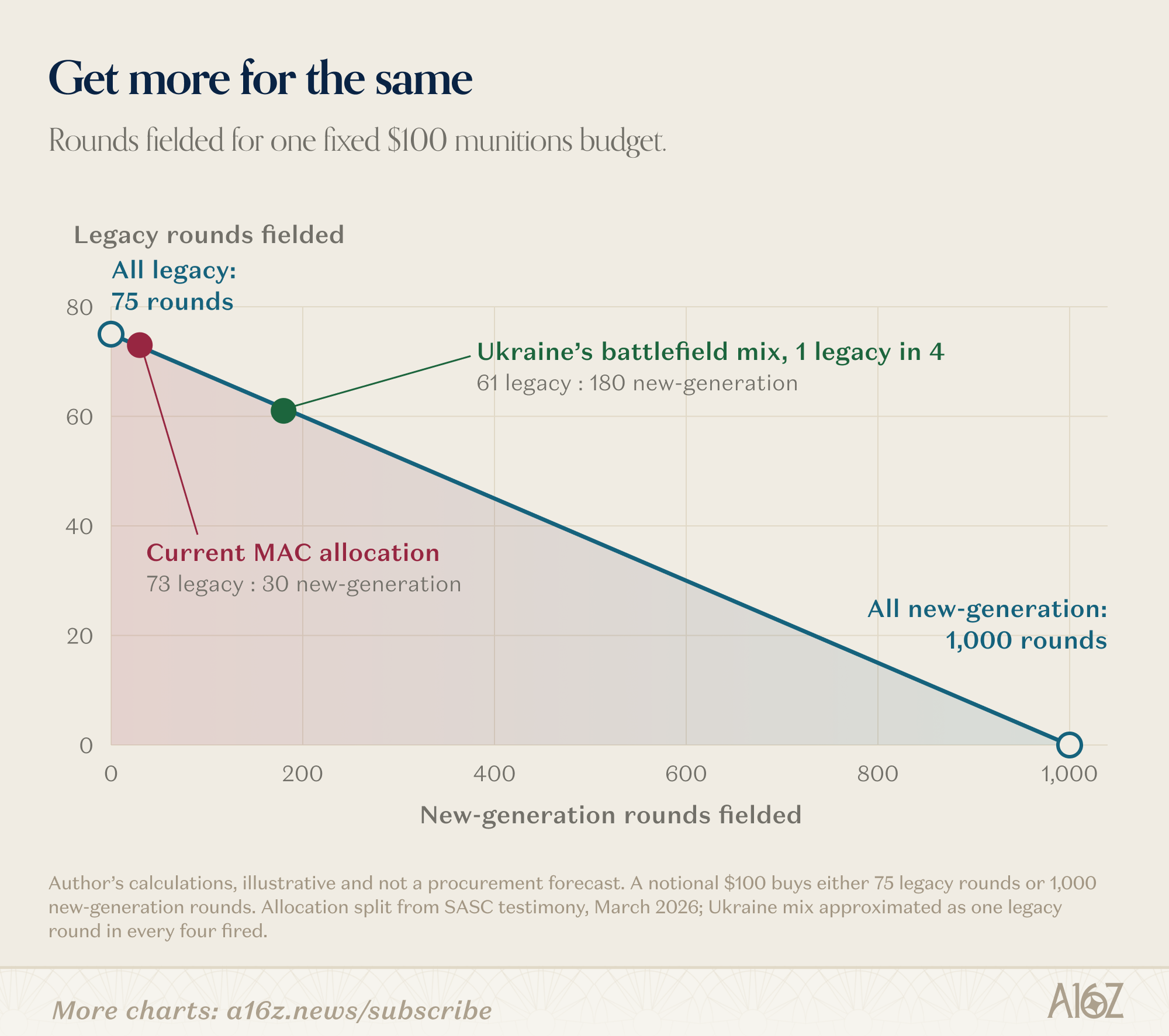
Critics will say “well, a $300,000 missile is not a $3 million missile.” We’re happy to concede that our fleet of munitions includes some true feats of engineering. But the American taxpayer should never be paying for superfluous capability. Certainly not in a world where we are $30 trillion in debt! We need to produce the required capability to win, as fast and inexpensively as possible. Ultimately, though, our claim is that the volume of effects a military force can deliver and replace across a long fight is what influences adversary decision making. The good news for the U.S. and our allies is that high-quality munitions at lower cost are an option today.
Munitions come in a variety of shapes and sizes, from mortars to intercontinental ballistic missiles. When we talk about munitions in this article, we are by and large discussing short- to intermediate-range precision strike munitions.2 There are similar magazine-depth dynamics around ground-based interceptors; we touch on those below and may return to them properly in a Part II.
Most of the shouting in the munitions-affordability debate comes from people answering different questions, because “munitions affordability” conflates several issues. Do we have enough rounds (depth question)? Are precision weapons too expensive per shot (unit cost)? Can industry build and replace them fast enough (industrial capacity)? Is it sustainable to fire a $4 million interceptor at a $20,000 drone (cost-exchange)? And is the cure buying more of the same, building munitions differently, or, everyone’s favorite boogieman, reforming acquisition (system design)? The five sections that follow take those questions in turn:
Munition magazine depth is the critical variable;
unit cost of legacy munitions is what makes depth unaffordable;
cost-exchange dilemma is best fixed by stocking up on affordable mass;
manufacturing throughput is—at least partially—a function of design;
and the remedy is to buy differently within the money we have.
1. Adversaries Count Rounds
One assumes adversary war planners in Beijing see things the same way we do. They’re asking how many rounds the United States can fire, for how many weeks, and how fast the production lines can replace what is expended. Deterrence means persuading an adversary that the operation cannot succeed at acceptable cost. Initial magazine depth, and the production capacity behind it, are a critical factor.
There is not much disagreement that our stockpiles are insufficient. One of the most widely cited set of wargames said “the U.S. will run out of preferred munitions in the early days,” and once the shooting starts, “resupply is not an option.”
Across the first thirty-nine days of Operation Epic Fury, by independent tallies, the Navy fired more than 1,000 Tomahawks from a stockpile of roughly 3,100, and the Air Force expended about 80 percent of its JASSM-ER inventory, while Patriot batteries fired 943 interceptors in the first four days — about eighteen months of output at current throughput capacity.
The counterargument is that drawing down stocks does not meaningfully erode deterrence with China, whose calculation to go to war revolves around a wider set of factors, and that the munitions spent over the Red Sea or gifted to Kyiv are not exclusively those required for a Pacific war — which would also demand torpedoes, anti-ship missiles, and guided bombs.
Those people are kidding themselves. Deterrence is weaker when the United States has fewer of the weapons needed to win a conflict, even if that weakness alone would not cause Beijing to launch. The same long-range strike weapons and missile-defense interceptors support multiple war plans, and firing them in one theater leaves every other plan with fewer rounds and less margin for error.
Operation Epic Fury consumed munition stockpiles relevant to a Pacific contingency—Tomahawk, JASSM, Patriot, THAAD, SM-2, and SM-6. Rebuilding those inventories is, per follow-on analysis, a multiyear project: at historical production rates, replacing major-program inventories takes eight to fourteen years. A bipartisan commission chartered by Congress to review defense strategy stated flatly that the defense industrial base “is unable to meet” U.S. and allied munitions needs. One school of analysts said it best—“production is deterrence.” A hot production line, capable of surging, is in some ways even more convincing to an adversary than warehouses full of missiles.
Senator Wicker closed his hearing statement with the observation that the adversary fields large numbers of low-cost systems “on purpose,” intending “to overwhelm our defenses, aware that our magazine is full of expensive weapons that we will use to defend against their low-cost systems.” Every round expended against Iran, or some other adversary, reduces the magazine available to deter China and Russia, allowing one war to consume the munitions meant to prevent another.
2. The Cost of a Legacy Magazine
We’ve found that cost data is generally piecemeal, but the comptroller’s 2027 weapons-price exhibit consolidates some of it. As mentioned, a Tomahawk, the military’s heavy warhead, deep strike cruise missile, costs about $2-4 million. LRASM, an air-launched missile designed to destroy ships at long range costs $3.2 million. At the top of the ladder sit the hypersonics: the Army’s ground-launched Dark Eagle and the Navy’s sea-launched Conventional Prompt Strike, conventionally armed weapons built to strike distant targets within minutes, cost between $41 million and $70 million per missile.
The defensive interceptors are also steep: a PAC-3 MSE, the ground-to-air interceptor used against aircraft, cruise missiles, and short-range ballistic missiles, costs $3.9 million; a THAAD round, designed to intercept ballistic missiles in their terminal phase of flight, costs between $12 million and $22 million; and an SM-3 Block IIA, the Aegis interceptor that destroys ballistic missiles outside the atmosphere, costs $28 million and up.
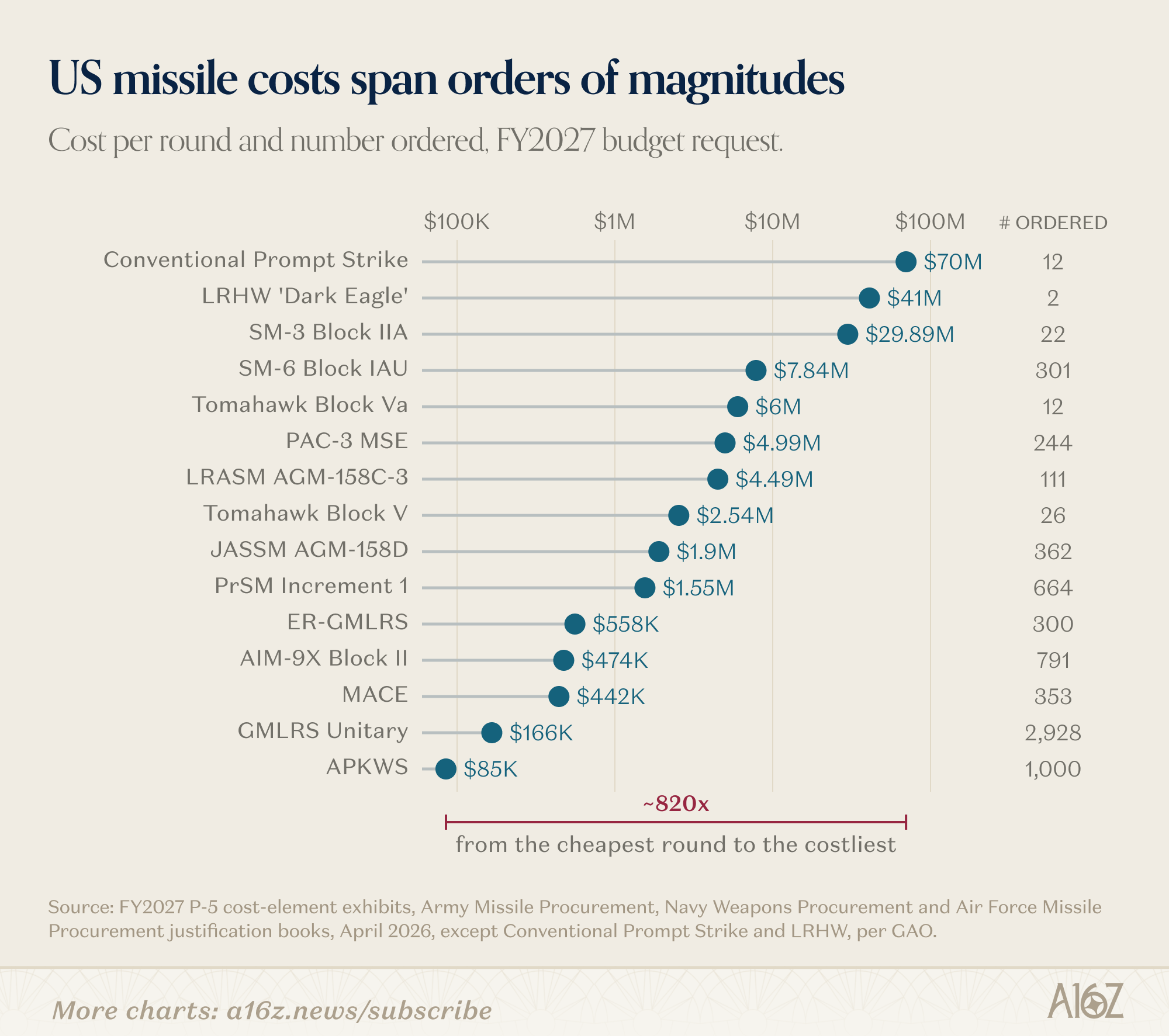
The publicly conducted wargames call for thousands of long-range land attack munitions in the opening weeks. Epic Fury consumed a thousand Tomahawks in thirty-nine days against a regional power; a Taiwan scenario would demand a multiple of that, sustained for months if not longer, with much greater constraints on the ability to deliver resupply. The same is true for anti-ship munitions: giving the joint force even four thousand LRASM-class weapons – modest for a Taiwan scenario – is a $13 billion magazine at current prices, procured at a production line throughput capacity that just reached about 1,100 missiles a year (shared with JASSM). Even the largest defense topline in American history cannot procure deterrence-sized depth at seven and eight figures a round.
There is concern that new products advertised as affordable now will get far more expensive before delivery—a phenomenon Augustine’s Law warns about. Studies of weapons cost growth have updated this for the age of autonomous weapons: the Collaborative Combat Aircraft—intended, I’ll remind you, to complement a fighter, not substitute for one—has exceeded its $3 million target to $25–30 million.
Cost inflation is a concern, but Augustine’s Law describes what happens when requirements float free under cost-plus contracts with a monopoly supplier. The new programs are built around competition and aggressive cost strategies: the Navy’s MACE program caps its hypersonic round at a hard $300,000 ceiling, the Air Force’s affordable-mass cruise missile line at about $400,000, and Senator Wicker counted several new companies now competing for the government’s business in the $300,000-to-$600,000 band.
Overall, there is strong evidence that commercially developed technology comes in far cheaper than the same capability developed under a government R&D program; for example the Falcon 9 program.
3. Measure the Cost of Effects
“For too long,” Wicker told his committee in March, “we have equated the cost of a munition with the capability of that munition.” Most of a modern target set (trucks, radars, small ships, drones, buildings, massed infantry) does not require a $3 million munition.
The now infamous cost-exchange stat from Epic Fury is the $4 million Patriots against $20,000 drones, though cost-exchange pressure of this kind has been a feature of the modern battlefield for some time. Skeptics call the ratio misleading because it ignores the value of the defended asset. When defending an asset worth hundreds of times its price, a $4 million interceptor protecting a $2 billion destroyer is a bargain. What Epic Fury exposed is a magazine without optionality: every cheap drone got the $4 million Patriot because that was the only answer in inventory. Whether that gap can be closed affordably remains an unsolved problem.
On the strike side, the inexpensive, effective option now exists as a production item. Castelion’s Blackbeard, a hypersonic strike missile targeted below $500,000, has a signed framework for 500 or more missiles per year and a Navy program of record planning 4,510 rounds across FY27–31. The Air Force’s Family of Affordable Mass Munitions plans nearly 28,000 weapons for $12.6 billion with production starting this September. Anduril will supply the Army at least 3,000 of its surface-launched Barracuda-500Ms, with first deliveries in mid-2027. Thousands of rounds are now on contract at prices an order of magnitude below the incumbents’. The Pentagon recognizes the shift, and we think it’s time to pour gas on the fire so that planners can tailor munitions to required effects.
Some critics argue that mass production should focus on ordnance rather than other classes of unmanned systems. The Pacific is a theater of brutal distances, and regardless of the ability of the drone to create an effect on target, they argue that the, now prolific, quadcopter is incapable of relevant operational reach in the Pacific. Drone-warfare studies reach a similar conclusion: distance forces you back toward more expensive, long-range systems with rocket motors and sophisticated guidance. But the low-cost class now includes cruise missiles — Barracuda-500, RAACM-ER, and Covenant’s newly launched Anthem — that compete with Tomahawk on range, on quality, and increasingly on warhead size—capable of delivering commensurate effects at lower cost per effect than the legacy munition. None of this makes the Tomahawk obsolete: it means we can launch a heterogeneous salvo from multiple directions, ultimately improving air defense penetration.
Analysts have warned against a race to the bottom on production cost because mass for its own sake is not the goal. We must remain focused on cost per effect. When we reframe targeting to consider the weapon’s end effect as the priority instead of its raw capability, the round of choice will skew overwhelmingly towards the cheaper option—preserving our exquisite legacy rounds for the most hardened, heavily defended targets. This decision becomes even more imperative when a single Tomahawk replenishment becomes a multiyear proposition.
Simply put, new entrant rounds will cover the bulk of targets based on the cost per effect model.
4. The Factory Is the Product
The most useful definition of affordable mass treats it as a property of the production system rather than the price tag. Affordable mass is the condition in which a force replaces munitions as fast as it expends them with the caveat that “a $200K weapon with half the reliability is really a $400K solution.”
By that standard, the new class was designed for the right war. Anduril’s Barracuda assembles in about 30 labor-hours from roughly 70 percent commercial components. The supply chain the production line draws from is the small-aviation and automotive industries rather than aerospace sub-tiers. Castelion runs flight tests monthly and makes supply chain and design choices for manufacturability from the get-go. The LUCAS drone went from obscurity to combat employment in Epic Fury at $35,000 a copy. It’s harder and more expensive to scale the legacy production lines—but still necessary. PAC-3 MSE is headed from about 600 interceptors a year toward 2,000 under a seven-year framework, THAAD from 96 toward 400, SM-6 from 125 toward more than 500. Unfortunately, the American people are going to have to shoulder much of the burden for those capex projects.
The greatest challenge to maintaining warm production capacity is unreliable government demand. One study of two decades of munitions budgets found funding swinging more than 50 percent year-over-year across eighty programs, and survey work on defense entrants identifies those inconsistent signals as a principal driver of perceived risk.
The government’s capricious buying decisions drive unit cost. When the Army bought only 23 JAGM missiles in FY25, the unit price hit $360,000 against a program-life average of $212,000. Jittery buying is itself part of what makes munitions expensive.
When the Deputy Secretary of War began calling missile-industry CEOs weekly to push for increased output, the executives’ answer was the same one they have given for a decade: the targets are not realistic without contracts to finance them. The new entrants are funded largely on private capital precisely to avoid such constraints.
Critics counter that at this point, money alone cannot fix the production lines: “the problem today isn’t money; it’s time.” Complex missiles take two years to build, plant expansions take three, and no appropriation compresses the queue for solid rocket motors, seekers, and energetics. But that two-year build time only applies to old-style missiles—custom-designed, built from parts that come from a single specialized supplier, and assembled by high skill technicians at a workbench. There are fewer (but admittedly perhaps still some) bottlenecks for a missile built from plentiful automotive, consumer electronics and civil aviation supply chains, on lines built and paid for ahead of need by private capital.
5. Allocation Is the Only Decision Left
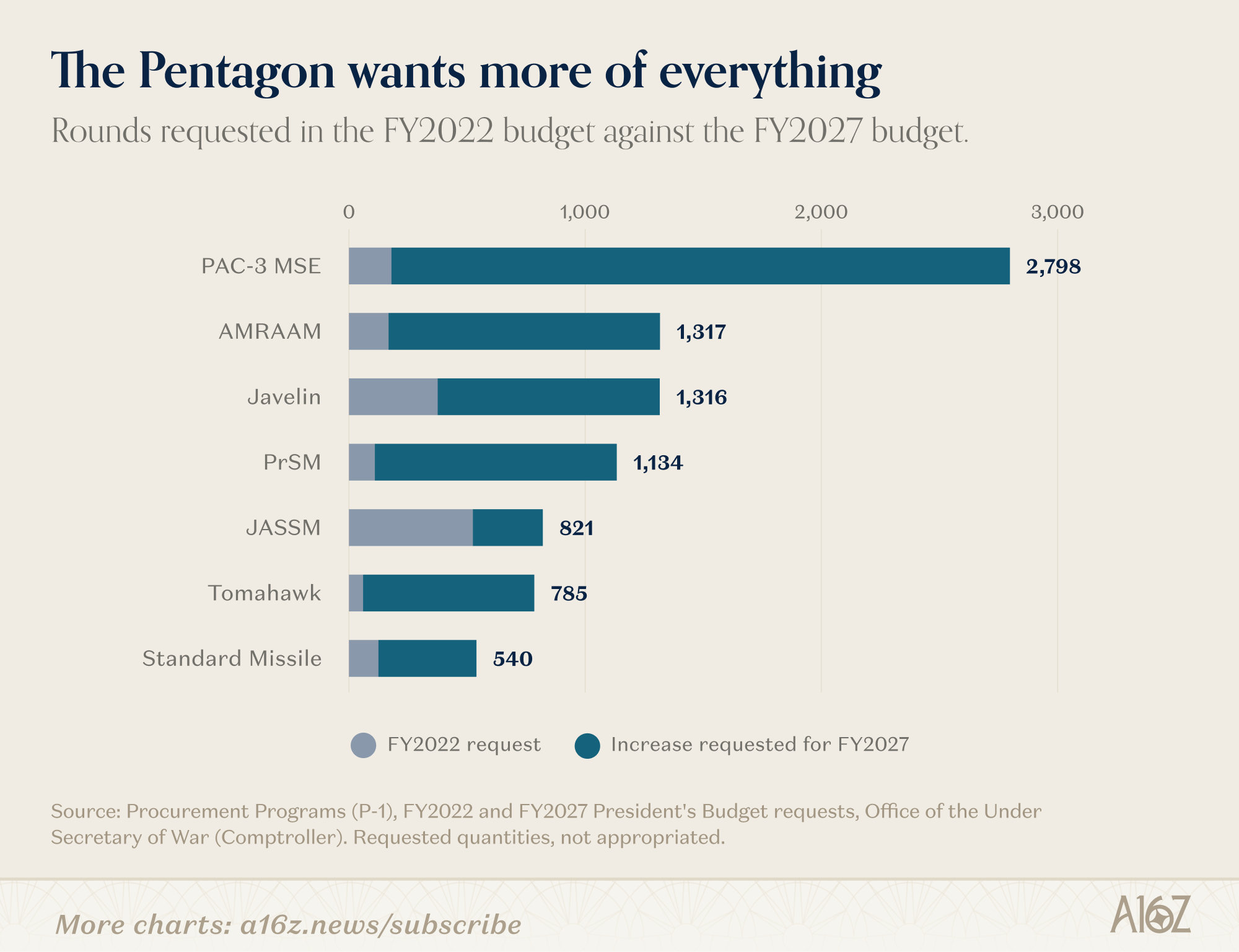
The FY27 NDAA that cleared the Senate Armed Services Committee in June authorizes $1.15 trillion for national defense, the largest topline in history. The administration asked for a 188 percent increase in missile procurement.
The Munitions Acceleration Council’s priority list is over $47 billion, and official budget projections show missiles and munitions climbing toward 41 percent of Army procurement. Congress has already granted multiyear procurement authorities. The department spent the 2010s explaining that it lacked the money, the demand signal, and the authorities to buy munitions at scale. As of this budget, it has all three.
Yet under the current plan, the vast, vast majority of spending goes to legacy technology. That is how a historic topline can still produce an insufficiently deep magazine. It would be a generational mistake to take the largest pool of resources the Pentagon has ever been handed and simply stock up on 1970s technology.
The committee, to its credit, has proposed a remedy. The markup it advanced 18–9 on June 11 requires the department to accelerate the adoption and purchase of low-cost munitions, directs accelerated acquisition programs for low-cost alternatives in eight critical categories, authorizes multiyear munitions procurement, and requires second sources for the solid rocket motors that bottleneck every line (though we believe liquid propulsion technologies as a complement to solid motors are the only way to truly unstick this logjam).
The fact that our sovereign demand outpaces supply has a knock-on effect on foreign military sales. Our allies and partners face five- to seven-year backlogs for some traditional munitions—and are growing weary of the wait. Facing existential threats of their own, our allies cannot afford—in both time and money—to wait for US legacy rounds and are now turning to non-US component manufacturers to bridge the gap.
“We cannot be the Arsenal of Democracy,” Wicker reminded the hearing, “if we cannot get weapons out the door.” A $300,000 missile built from commercial components is one an ally can actually afford in quantity and, where policy allows, license and co-produce. The bill’s directed U.S.–German co-production program and its war-reserve stockpile authority for Taiwan represent progress, so long as the underlying designs are manufacturable affordably at scale.
The authorization addresses some key cost levers such as hard unit-cost ceilings, fixed-price awards, two or more vendors, commercial components unless waived, and multiyear orders big enough to justify a factory. Over the last two years, price has followed the size and steadiness of the order.
Air Defense Is Next…
This article focused on offensive strike munitions, where the low-cost alternative has already matured — more than half a dozen competitors in the $300,000–$700,000 band, production contracts signed, deliveries scheduled. The interceptor market is further behind. Senator Wicker called lower-cost air defense interceptors “perhaps, our greatest area of need,” demanding “a Manhattan Project-type effort, which should develop affordable alternatives to the current Patriot, THAAD, and Standard Missile series and do so rapidly.”
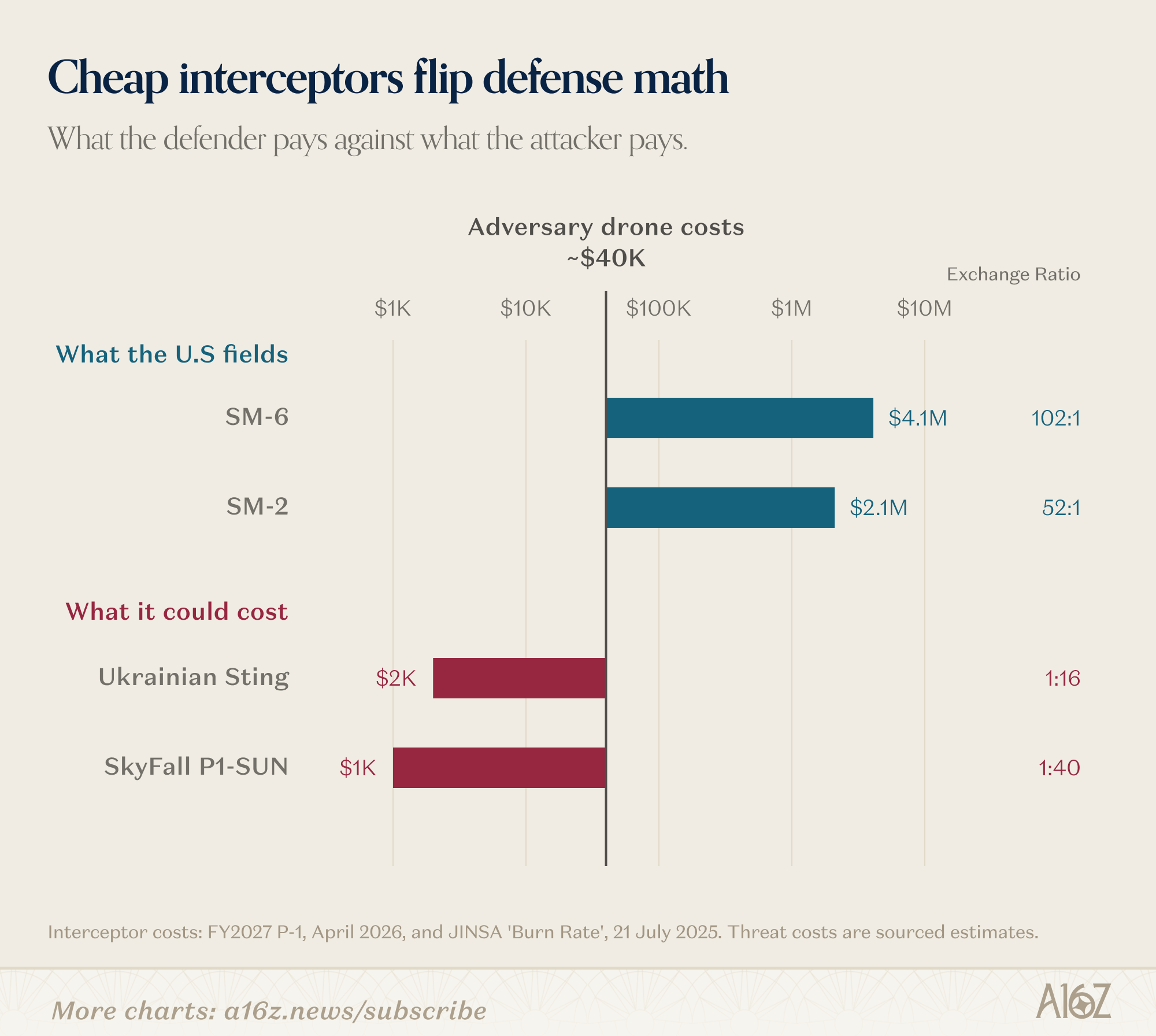
CBO puts the Golden Dome homeland-defense architecture at $1.2 trillion over twenty years if it is built the way we build interceptors today; the administration’s proposed budget is a fraction of that, and General Guetlein has been emphatic that we cannot bankrupt the country to build it. Whether interceptors can follow strike weapons down the cost curve is an open question — the engineering problem is harder, and no one has demonstrated the answer yet.
Place the Order!
So, back to the opening question: is 97-to-3 right? We’re skeptical. Whatever minimum number of legacy rounds the war plans demand, the current plan buys them and little else. Depth has been affordable at current prices for a while now. We know which magazine we’d rather take to war.



Anduril, Covenant, and Castelion, discussed throughout, are portfolio companies of Andreessen Horowitz. All figures cited are from public budget documents, government statements, and press reporting. This newsletter is provided for informational purposes only, and should not be relied upon as legal, business, investment, or tax advice. Furthermore, this content is not investment advice, nor is it intended for use by any investors or prospective investors in any a16z funds. This newsletter may link to other websites or contain other information obtained from third-party sources - a16z has not independently verified nor makes any representations about the current or enduring accuracy of such information. If this content includes third-party advertisements, a16z has not reviewed such advertisements and does not endorse any advertising content or related companies contained therein. Any investments or portfolio companies mentioned, referred to, or described are not representative of all investments in vehicles managed by a16z; visit https://a16z.com/investment-list/ for a full list of investments. Other important information can be found at a16z.com/disclosures. You’re receiving this newsletter since you opted in earlier; if you would like to opt out of future newsletters you may unsubscribe immediately.
In Fiscal Year 2025, the Pentagon’s missile and munitions request ran about two-thirds procurement to one-third research and development — money spent designing weapons rather than building them. Self-funded development also spares a company the oversight machinery required in government R&D programs (the cost-plus audits, the cost accounting system implementation, the requirements reviews, the program-office apparatus), a second reason commercially developed rounds price like commercial products.
Using the formal range definitions: close and short range is under 1,000 km, medium 1,000–3,000 km, intermediate 3,000–5,500 km, and “long-range” AKA intercontinental is reserved for systems that fly beyond 5,500 km. By that taxonomy everything discussed here sits at or below intermediate range — including systems with “long-range” in the name, like the Army’s Long-Range Hypersonic Weapon, and deep-strike focused new entrants like Anthem.
These are all fair discussions but ignores the role of cognitive warfare and the ability to avoid kinetic warfare with cognitive (non-kinetic). Defense will always be needed. Some offense as well. But arsenal allocation without accounting for the new state of cognitive leads to bad math.