




America | Tech | Opinion | Culture | Charts

Orbits are now battlefields — and it’s time we admitted it.
Russia is jamming GPS satellite receivers across most of Eastern Europe. Iran has launched hundreds of ballistic missiles through outer space. China has openly contemplated destroying Starlink satellites. Plainly: our adversaries are waging wars in space.
We can ignore this fact and naively hope that China and Russia will abide by treaties for the peaceful use of outer space. If we do, we will cede the orbital high ground to our adversaries — and lose secured access to the space-based communications, reconnaissance, targeting, positioning, navigation, and timing services that shape the modern battlefield.
Or we can choose to treat space as the warfighting domain that it is — and figure out how to win a space war.
Both authors of this report have seen first-hand how America’s adversaries are waging war in space, which is why we thought this subject worthy of spilling this much ink.
Christian spent seven years as a satellite manufacturer and operator, working on both commercial and military missions and closely tracking America’s adversaries in space. Alex Oliver was a military officer for 16 years. Both of us are now at Andreessen Horowitz as partners on the American Dynamism team
So we remember when a Chinese satellite threw another satellite out of geostationary orbit, the many times they buzzed US satellites, and the aggressive lawfare they waged within the International Telecommunication Union. We watched Russia slowly and surely fall behind in the modern space race, only to make headlines with a rumored nuclear weapon on orbit.
But if our time in the space industry has taught us anything, it is to be wary of conflating the way things are done with the way things ought to be done. Over the past 20 years, the space industry has been upended by companies like SpaceX that care little about precedent — Elon Musk famously fired the original Starlink executive team for their traditionalism and associated slowness — and given SpaceX’s success, the space world must surely have learned the difference between a physical law and an industry convention.
In the first part of this report, we will therefore take a page from the Book of Elon and focus not on what is being deployed into space today, but instead on a first-principles understanding of what space is: meaning, how outer space works as a physical domain, and what those physical laws imply for the prospects of fighting and winning a war in space.
Then we will take a more practical look at the ways, means, and ends that are necessary to win a space war. We’ll discuss the importance of maximizing upmass, proliferating military space architectures, winning the cold war in space, and wielding such fearsome offensive capabilities that our adversaries don’t test our resolve.
In order to understand those strategic considerations, we’ll need a firm theoretical footing — so first we will establish three facts about the physical reality of outer space:
Space is close to earth, but it’s hard to get there.
Orbits are predictable, but tracking objects in space is hard.
Space is physically massive, but operationally small.
PART ONE: FIRST PRINCIPLES OF SPACE WARFIGHTING
#1: Space is close to earth, but it’s hard to get there.
The first principles
You are standing on top of a massive mountain, above the atmosphere, with a baseball in hand.
You throw the ball and it lands 100 feet in front of you. You try again, shooting the ball out of a cannon, and it lands 1,000 feet in front of you. Then you go for broke and attach the ball to a rocket — and the ball never lands. You have launched it “into orbit,” meaning so fast that by the time gravity has pulled it down to “ground-level,” it has already whizzed beyond the horizon.
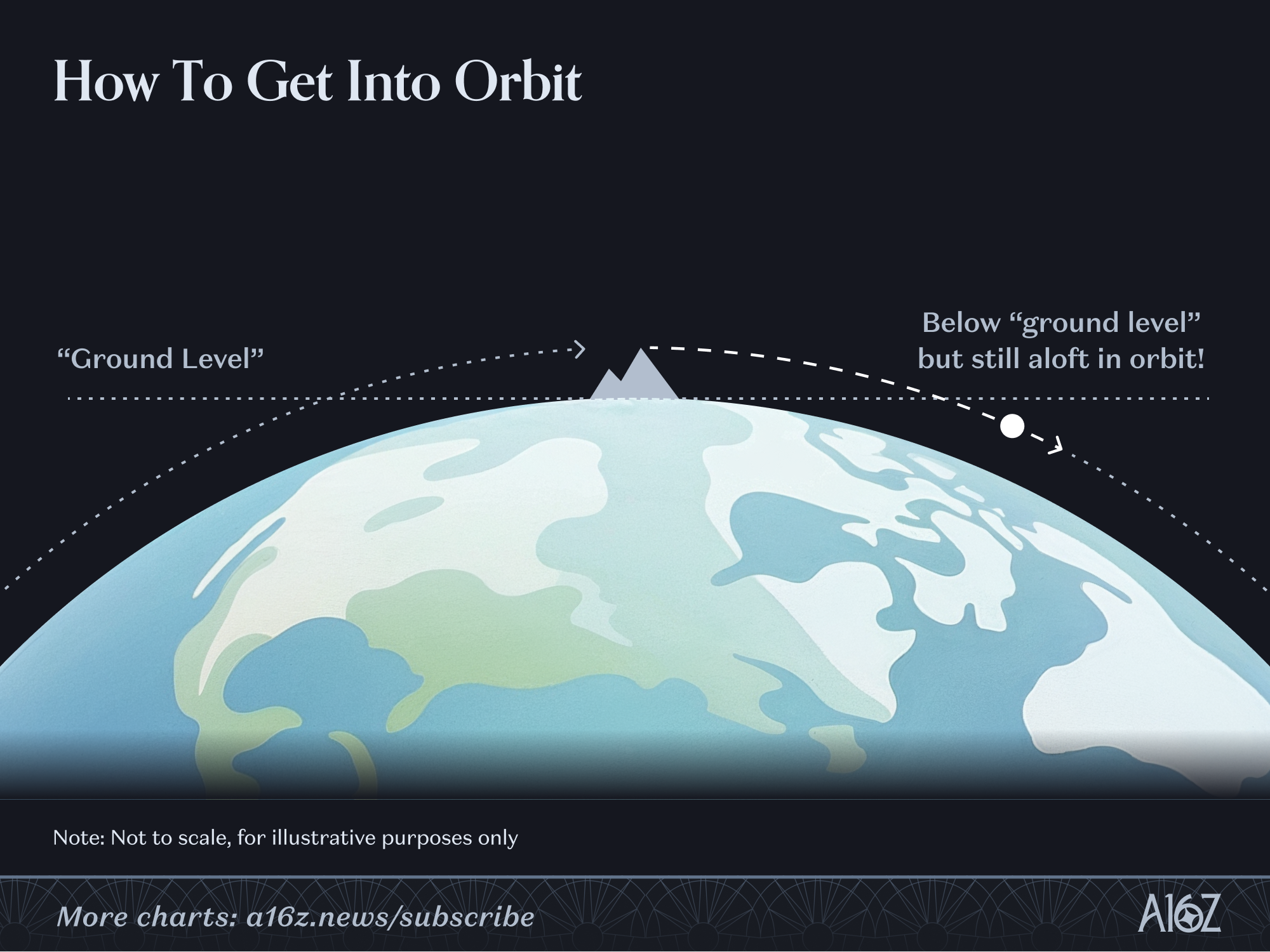
It turns out that “sufficiently fast”, meaning the specific amount of change in velocity (“delta-v”) needed to get an object into orbit around Earth, is around 9.4 km/s.
That’s not easy. As Christian’s favorite astronaut, Don Pettit, wrote (emphasis and link ours):
All our rockets are governed by Tsiolkovsky’s rocket equation.
The rocket equation contains three variables. Given any two of these, the third becomes cast in stone. Hope, wishing, or tantrums cannot alter this result. Although a momentum balance, these variables can be cast as energies. They are the energy expenditure against gravity (often called delta V or the change in rocket velocity), the energy available in your rocket propellant (often called exhaust velocity or specific impulse), and the propellant mass fraction (how much propellant you need compared to the total rocket mass)...
If the radius of our planet were larger, there could be a point at which an Earth escaping rocket could not be built. Let us assume that building a rocket at 96% propellant (4% rocket), currently the limit for just the Shuttle External Tank, is the practical limit for launch vehicle engineering. Let us also choose hydrogen-oxygen, the most energetic chemical propellant known and currently capable of use in a human rated rocket engine. By plugging these numbers into the rocket equation, we can transform the calculated escape velocity into its equivalent planetary radius. That radius would be about 9680 kilometers (Earth is 6670 km). If our planet was 50% larger in diameter, we would not be able to venture into space, at least using rockets for transport.
When you build a rocket, you load it with as much fuel as possible (max propellant mass fraction), you make the best engine and choose the best fuel you can (max specific impulse), and the equation solves to give you a certain amount of delta-v. That delta-v allows you to perform a certain set of maneuvers in space — like escaping from the surface of a planet, rocketing between stars, changing the angle of your orbit, and so on.
Delta-v is counterintuitive. It takes 9.4 km/s of delta-v to get from the surface of Earth into a circular orbit 350 km up. If you then spent another 9.4 km/s of delta-v, where do you think you’d end up? The answer is the surface of Mars. A satellite on Mars is therefore just as close to Low Earth Orbit as a satellite on Earth, even though the latter is 140 million miles further away by straight-line distance. As sci-fi legend Robert Heinlein wrote, “If you can get your ship into orbit, you’re halfway to anywhere.”
Developing an intuition for delta-v takes a while, but for now, you just need to know two rules of thumb: (a) straight-line distance between two points means very little in space, and (b) it’s hard to get to orbit.
The implications for space warfighting
First, upmass is everything. It’s hard to get mass into orbit, so if you can do it better than your adversaries, you have a massive advantage.
Only 14 organizations in the entire world successfully launched multiple orbital-class rockets in 2025: four from the US, six from China, and four from the rest of the world combined.
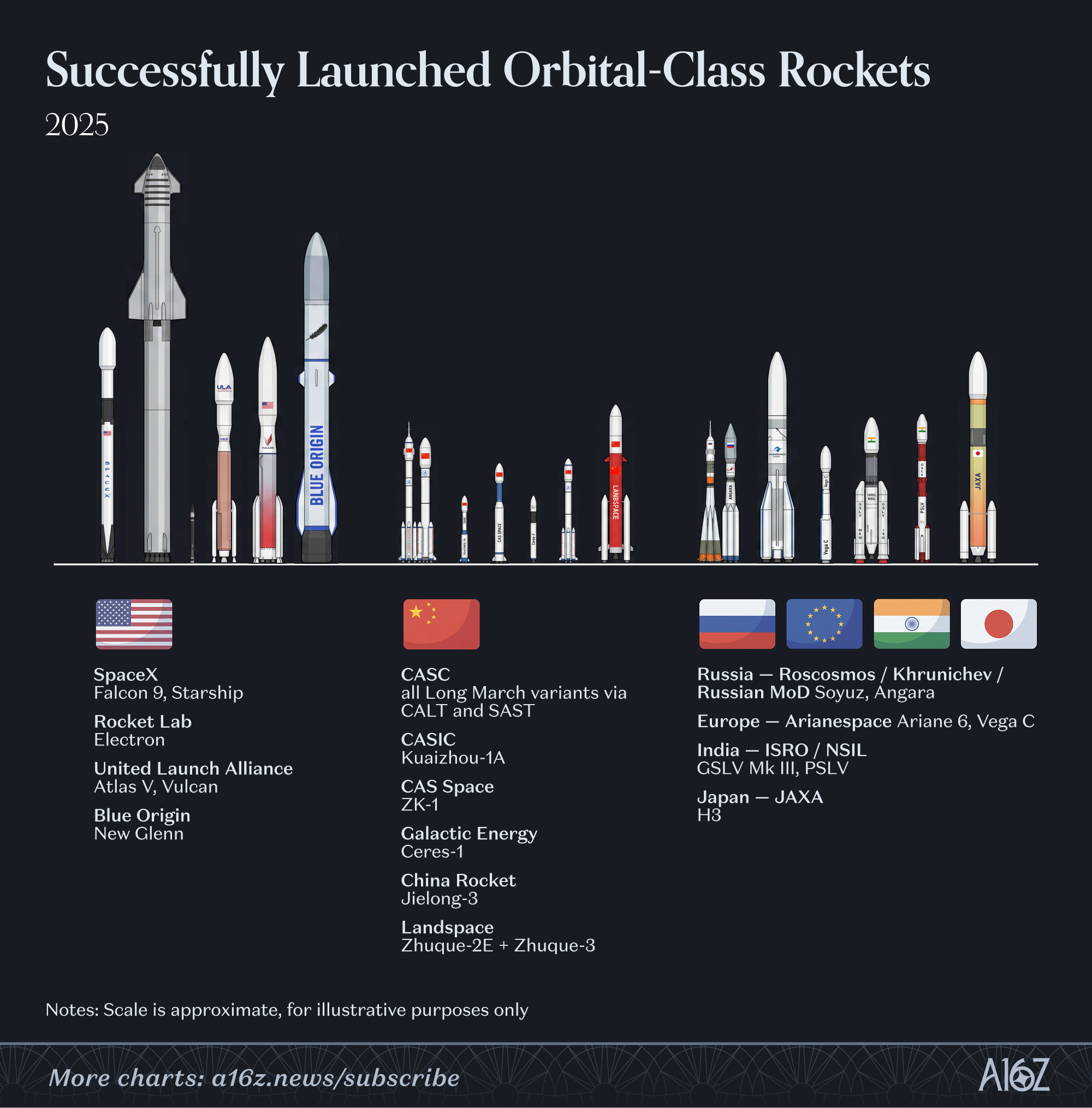
As such, securing your access to orbit is a Tier 1 priority: designing more rockets and bigger rockets, scaling rocket production, improving rocket component supply chains, developing more launch sites, developing technology to launch rockets on the move, and so on. Hopefully you start doing these things a decade before a war breaks out.
In a space war, you also want to deny your enemies the ability to launch rockets. This is a more controversial priority, as many of the rockets listed above are commercial, not government-owned — but there is unfortunately precedent for attacking commercial space systems in wartime. Launch infrastructure is, with unfeeling military logic, a bottleneck and therefore a choke point. There are only about 40 active rocket launch pads in the entire world, and only so many factories building new rockets. That’s why Christian made this prediction:


If you lose your ability to launch, you lose your ability to replenish your space fleet and run the risk of being completely shut out of the space domain. This is why General Chance Saltzman called the freedom of movement to (and in) space “the formative purpose of the Space Force,” and why denying your adversaries that freedom is the most straightforward way to win a space war.
Second, upmass limitations affect satellite design. Because getting mass into orbit is hard, each gram is precious and engineers must constantly fight against increasing the mass of their satellites. This is no easy task. A satellite has to survive the violent, loud environment of a rocket launch, and then must survive in the vacuum of space while being bombarded with radiation, with no maintenance, for years. Satellites often have limited physical redundancy (which limits their fault tolerance), limited propellant (which limits their delta-v), and only enough shielding to resist radiation, if they have any shielding at all.
Practically, this means that satellites tend to be fragile, immobile objects — or, in the words of former vice chairman of the Joint Chiefs of Staff, General John E. Hyten, “big, fat, juicy targets.” Satellites generally cannot survive direct strikes of any kind.
Another offshoot of this mass-sensitivity, perhaps counterintuitively but certainly true historically, is that it’s tempting to make each individual satellite as large and as “exquisite” (read: decked out with the best sensors/radios) as possible. This was the dominant strategy pre-Falcon 9, when the U.S. was only launching a few dozen rockets per year, and when those satellites therefore had to be able to do their jobs independently.
This is not a physical law, but rather a constraint to design around. Would you rather have one bulletproof satellite, or ten normal ones? Do your satellites need to survive a nuclear blast, like the AEHF satellites, or would you rather have attritable assets scattered across many different orbits? You have to choose.
Third, space-to-ground weapons are inevitable. In one of Christian’s favorite sci-fi books, Robert Heinlein’s The Moon is a Harsh Mistress, a rogue lunar colony bombards the Earth by flinging lunar rocks down the gravity well — where they ultimately impact Earth going around 11 km/s, delivering as much kinetic energy as a small nuclear weapon. Such weapons are still in the realm of science fiction, but might not remain that way for long.
The prospect of keeping weapons perched on a cliff above one’s enemies will likely prove too tantalizing for all space powers to avoid — so the more important question is whether we expect those weapons to take the form of traditional munitions, rods from God, or something more exotic still. All of these options, however, require so much delta-v to get off of Earth’s surface that they will likely only make sense once they can be made on orbit. Say, by a rogue lunar colony.
#2: Orbits are predictable, but tracking objects in space is hard.
The first principles
It’s hard to launch anything into space without the entire world noticing, tracking, and therefore watching as it traces predictable orbits around the Earth.
Rockets are violent, loud, bright events that take place from predictable locations on Earth, and are therefore extremely noticeable. Starship launches are occasionally mistaken for earthquakes; Falcon 9 launches at twilight create massive alien jellyfish in the sky. Even beyond the seismic, auditory, and visual signals, rocket launches get so hot that they flash bright in infrared — a fact that global superpowers learned early in the Space Race, and exploited by launching infrared-sensing early-warning satellites. Still today, global powers maintain IR satellites given their importance to defense: the U.S.’s Space Based Infrared System has cost America more than $20 billion to operate and maintain, and its replacement, Next Generation Overhead Persistent Infrared, was expected to cost $14.4 billion from 2021-2026.
Once in space, satellites travel along regular and repeating orbits; the International Space Station (ISS), for instance, completes a full orbit roughly every 90 minutes, and systematically passes over the entire Earth.
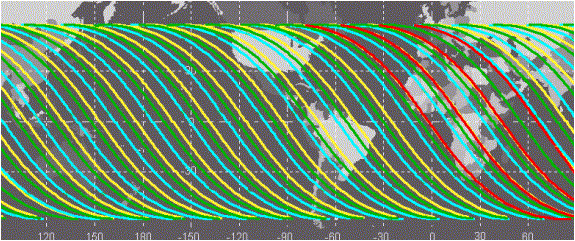
The ISS, therefore, is visible to about 90% of the world’s population at least once every three days. Amateur astronomers can use the well-known orbit of the ISS to point their telescopes, hoping to catch the Station as it transits (passes in front of) the Moon or the Sun. This same principle — the predictability of orbit — holds true for every satellite on orbit today, and means that tracking the physical locations of most satellites is trivially easy.
It’s also easy to pick up the radiofrequency (RF) signals the ISS constantly transmits — you can listen to astronauts in your backyard with a $15 handheld radio. The ISS intentionally sprays RF indiscriminately over the ground, but the same observability extends even to other satellites. Most spacecraft carry two radios: one for the “payload” signals (comms traffic or images taken on orbit), and another for “telemetry, tracking, and command” (TT&C; signals used to drive the satellite and get its vitals down to mission control).The goal of a TT&C antenna is not to maximize throughput, but to be able to command the satellite no matter what’s happening to it — even if it’s a very bad day and the satellite is tumbling uncontrollably — so TT&C radios are omnidirectional. That makes satellites quite visible on orbit, letting anyone on Earth track one if they’re motivated enough.
Less physically, there are strong international norms around disclosing rocket launches and on-orbit satellite maneuvers before they happen. The UN maintains a register of all space objects, and the Space Force’s 18th Space Defense Squadron maintains space-track.org to share what it knows about every object it’s tracking.
So, normally, it’s easy to keep track of satellites — but space war would certainly be an abnormal time. If someone wants a satellite or especially a satellite payload (read: sensor or effector) to remain hidden, they can easily make it so.
It’s exceptionally difficult to track every satellite constantly; normally, you would follow a satellite long enough (using radar/RF if you can, or a telescope if you can’t) to determine its orbit, then leave it be while you tend to other satellites. But if a satellite maneuvers (or releases a subsatellite payload) while you’re looking away, it can take a long time to “re-acquire” the satellite. It’s also far, far harder to track satellites the further they get away from Earth — especially if they’re in cislunar space or beyond. Speaking from experience, determining where a satellite is on orbit is hard even when you fully control the satellite — the first hours after separation from the rocket, when you’re trying to locate the satellite that you built and launched, are among the most stressful of any satellite operator’s career.
So, satellite orbits are normally predictable. Except when our adversaries don’t want them to be.
The implications for space warfighting
First, attribution in space is extremely hard. If you’re in a plane flying over Kuwait, and you get shot down by ground-based air defenses, Kuwait probably did it. If you’re in space, and your satellite stops working, it’s hard to know why.
For example, a Starlink satellite recently broke into multiple pieces. It now seems that the breakup was due to an “internal energetic source,” but to confirm that (and rule out foul play) took a detailed investigation — which took time and effort, because satellites are always flying blind. Imagine you are SpaceX and your satellite suddenly stops sending you telemetry (read: data on its vital signs). You don’t know why. You cycle through a set of procedures designed to get back in touch with the spacecraft (e.g., spin up a backup ground antenna, command resets to the satellite in the blind, and so on), and only after getting deep into the investigation does “maybe the satellite exploded” become a serious theory.
In a war, perhaps you’d know about this possibility and have a series of telescopes ready to assist with visual inspection early into any anomaly investigation. Even if you did, however, it would be very difficult to know (and harder to prove) who hurt your satellite doing what. Certainly the clues to solve that attribution won’t come from the satellite that was lost, and probably any investigation will take precious time that you don’t have to spare — especially if it’s not one satellite, but dozens or hundreds, that suddenly stop transmitting.
Delays in combat are deadly, and due to the lack of attribution, space has a thicker fog of war than any other domain.
Second, the “dynamic space operations” dream has obvious appeal. If you can move your satellites at will, you can not only relocate them — say, to mass satellites in a particular position at a particular point in time — but also make them considerably harder to track. Which means that your adversaries need to spend, and will spend, more resources making sure they know where they are at all times.
China, for instance, has demonstrated large maneuvers with their Shijian-21 satellite and some suspicious operations with Shiyan 12-01 and Shiyan 12-02 (more on those later). Russia has some “interestingly” maneuverable satellites in Resurs-P3 and Luch Olymp K-2. And the United States has Geosynchronous Space Situational Awareness Program (GSSAP) which explicitly requires maneuverability, and the RG-XX program that will replace it.
Space planners would love all of their satellites to be maneuverable, but it’s physically challenging. You have to carry your fuel with you throughout your lifetime on orbit, and there’s no free lunch — today, you choose between chemical propulsion (fast acceleration, bad gas mileage) and electric propulsion (slow acceleration, good gas mileage). Thrusters that can move quickly and efficiently are exciting but still in the realm of science fiction.
Third, winning an advantage in Space Domain Awareness requires constant one-upsmanship. All three space superpowers intend never to get surprised on orbit — and all three want to have technologies that surprise each other.
The exact tit-for-tat of this game gets classified quickly, but the game’s existence is a matter of public fact. America deploys satellite-sensing satellites to look at the satellites of our adversaries. Then our adversaries create satellite-sensing satellites to look at our satellite-sensing satellites. And so on. The Washington Post reported on an incident in which USA 270 and Shiyan 12-01 / Shiyan 12-02 played out a game of cat-and-mouse on orbit — but it’s still unclear to us, having read everything public on the encounter, who was the cat and who was the mouse.
Winning an intelligence advantage on orbit normally requires new technologies that are withheld from the public eye (see: secrecy around national spaceplane programs). But a more modern strategy has emerged recently: scale. The more you put on orbit, the more your adversaries have to track.
Today, the United States has roughly an order of magnitude more satellites in orbit than any other country — a massive advantage — but China’s space program is nothing to laugh at. China’s rockets occasionally fall on rural villages, sure, but their recklessness is evidence of their maniacal resolve to rival the United States’ capabilities on orbit. They are launching many different kinds of payloads: from spaceplanes, to communications satellites, to their own Space Station. You can laugh at China’s failures, but do so at your own peril. Failures are how you learn in the space industry. Just ask SpaceX.
#3: Space is physically massive, but operationally small.
The first principles
Yes, we know, space is huge. Low Earth Orbit is about 260 billion cubic kilometers1, and there’s the rest of the known universe beyond it. Still — we want to advance the argument that the peculiarities of orbital dynamics make outer space effectively small.
For example, take geostationary orbit (GEO), where satellites take precisely one day to orbit the Earth and therefore seem to hover, stationary, in the sky. GEO is extremely far from Earth; you can fit 2.8 Earths in between the surface of Earth and geostationary satellites.
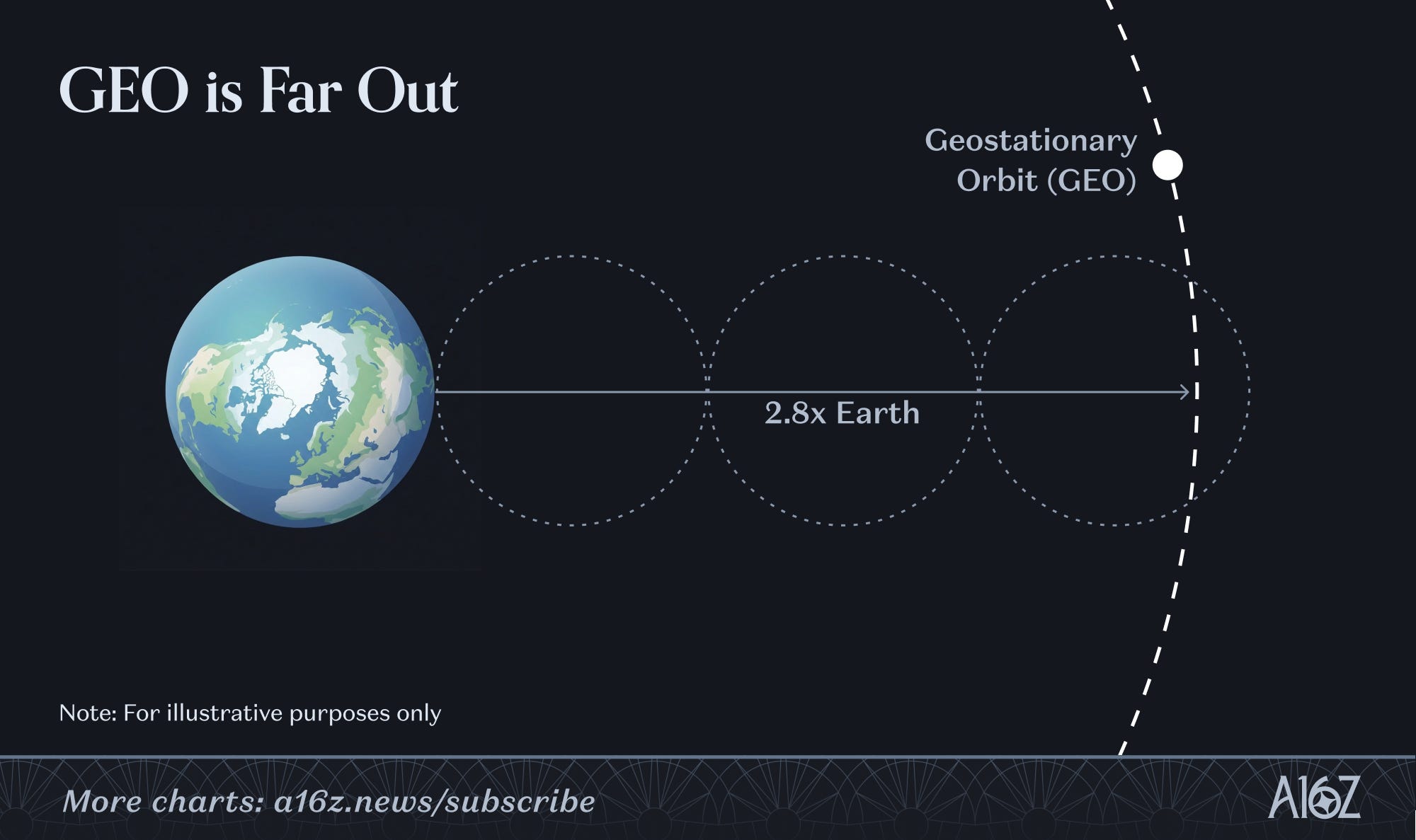
And yet, the right way to think about GEO is not as a massive, 3-dimensional volume of space, but as a single, 1-dimensional line.
You can only stay stationary relative to Earth if you are exactly 35,786 km away from Earth and exactly at the equator. If you end up one km closer to Earth, you’ll orbit faster than the surface rotates and drift east; if you end up one km further away from Earth, you’ll orbit slower than the surface rotates and drift west. So, with only one acceptable latitude and only one acceptable altitude, the only dimension left is longitude. Granted, that dimension is still large — 264,924 km long — which gives an average distance of 720 km between each active geostationary satellite. But the point stands: space is operationally small despite being physically large.
Space’s smallness is also a result of Kepler’s first law, which means that every circular orbit is centered on the Earth’s center of mass. Most satellites today are in circular orbits, which means in practice that satellites orbiting at a particular altitude must be tightly coordinated.
The SpaceX Starlink constellation is a great example, and a sight to behold. The public is now familiar with the Starlink satellite “trains” that glint at dawn and dusk, and space enthusiasts may even have played around with one of the beautiful Starlink visualizers, of which there are many.

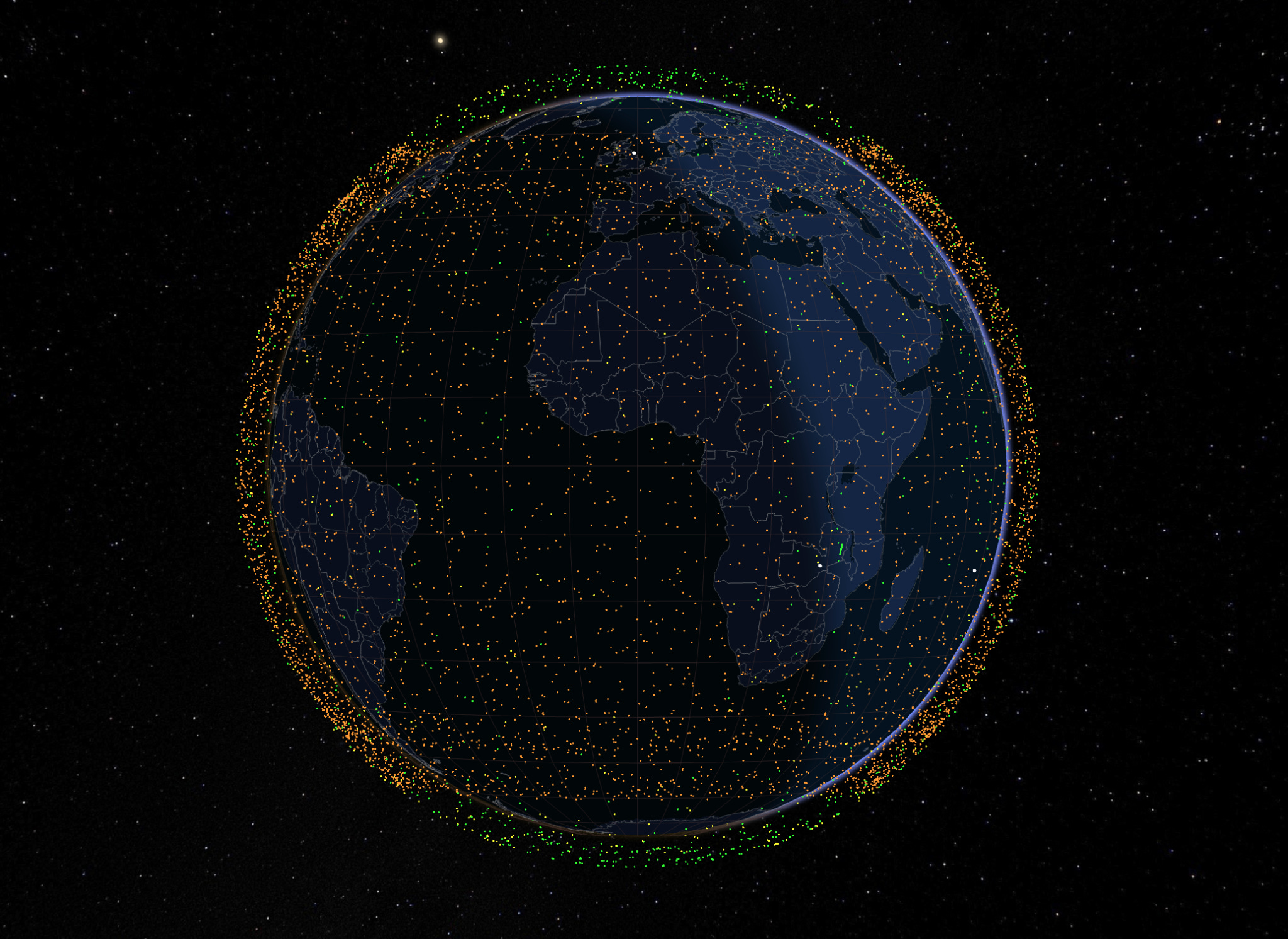
But when we look at the constellation, we see something like this:
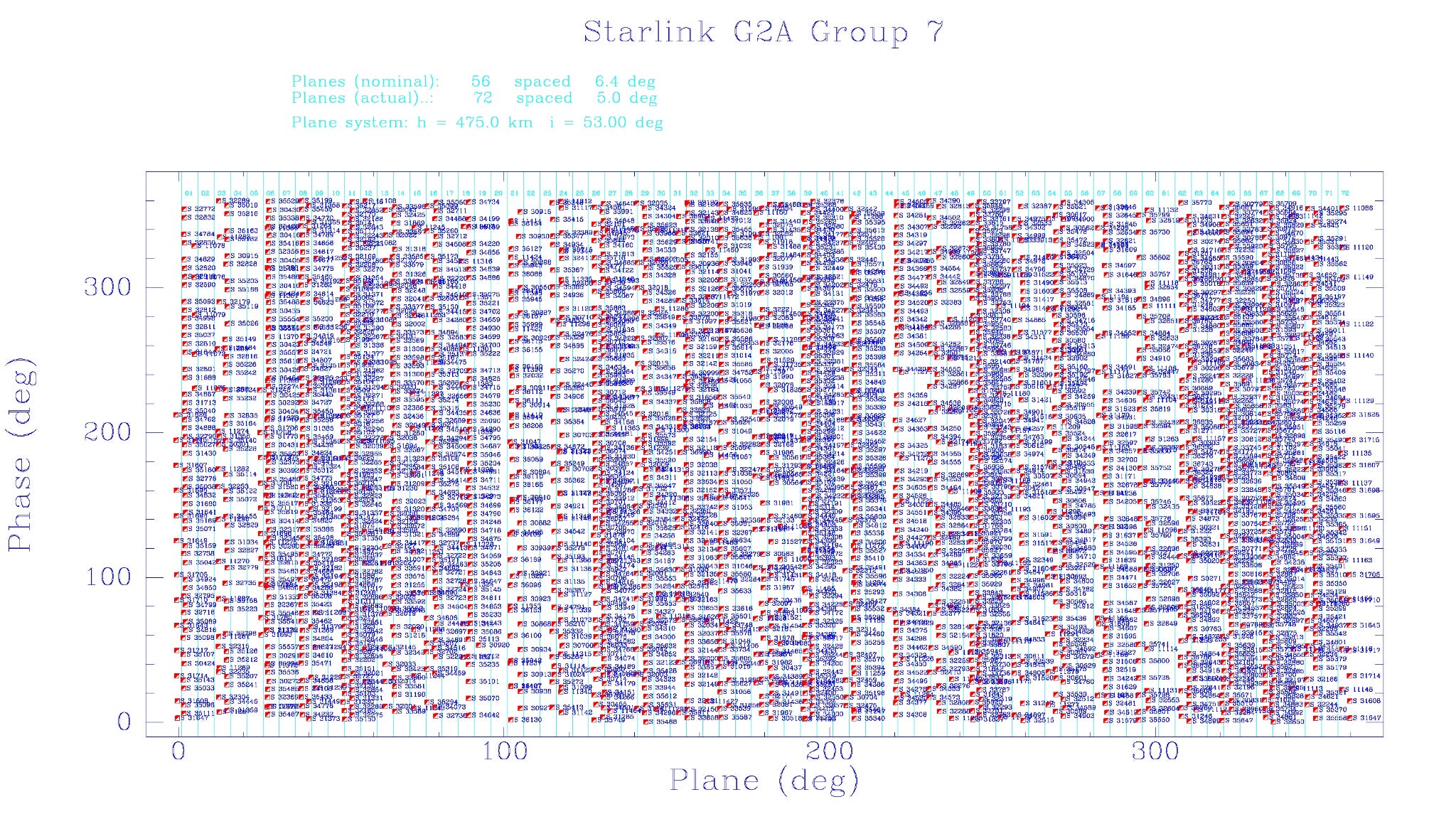
Hell of a chart — but it’s illustrating something quite simple. The cyan numbers at top say that the satellites in this “Group” are 475 km above Earth at 53 degrees “inclination,” meaning tilted up 53 degrees relative to the equator. Each red thing is a Starlink satellite, the “planes” of the X axis separate the different trains of satellites, and the “phase” of the Y axis shows in what position an individual satellite sits in its train. Even if we lost you there, observe one thing that should be obvious from a scan of the chart — because the vertical lines of satellites are non-overlapping, they will not run into each other.
But now imagine that another satellite operator wanted to use that same altitude, 475 km, but at a different inclination. It would be chaos! The two trains would intersect twice, once on each side of the Earth, and would therefore be at constant risk of collision. Avoiding collision would take an unrealistic level of coordination, and so in practice, Low Earth Orbit constellations tend to operate at different altitudes. This, again, makes a large, 3D slice of space look 1-dimensional: LEO’s altitudes are GEO’s longitudes.2
Unfortunately, however, even this 1-dimensional picture understates the problem. These rival constellations must co-exist not only in physical space, but also in radiofrequency space.
Coordinating radiofrequency spectrum is a topic on which entire dissertations have been written and for which entire government agencies have been created. It’s also a topic Christian is personally extremely interested in, having led the regulatory team at Astranis for a number of years, and having worked on terrestrial spectrum auctions in his early career as a consultant.
In the same way that each Starlink satellite needs its own swimlane to avoid hitting other satellites, each packet of RF energy emitted from a satellite needs its own spectrum to avoid interfering with other packets. Anyone older than 30 will remember this from using the car radio on a road trip: as long as channels operate at different frequencies (e.g., 98.5 and 97.1 FM), they can both operate in the same area, but if you are driving across town boundaries and each one has a station broadcasting at 98.5, they will interfere with each other.
Satellites primarily operate in high-frequency bands, like S, C, Ku, and Ka. The former three are the legacy bands. Ka band is a more modern, higher-frequency band,3 and satellite operators are even pushing into still-higher frequencies. The point of going higher frequency is that you can push down more data per second; the risk is that it’s generally harder to build the radio equipment and your signal is more sensitive to things like clouds. The higher frequency bands are generally more open with fewer operators broadcasting within them, and the legacy bands are more heavily contested — and spectrum licenses to operate in those legacy frequencies can be extremely valuable. Amazon, for instance, is trying to buy a satellite company for $11.5 billion, presumably more for their spectrum than their satellites.
We will leave our spectrum overview there. Christian could talk more about how the FCC recently modernized its spectrum sharing rules, wax poetic about the possibility for lasers to save us, or share war stories about how Astranis snatched geostationary orbital slots from incumbents who were asleep at the wheel — but for now, it’s enough to just know that spectrum availability also makes space seem small.
The implications for space warfighting
First, access points to space can be controlled. We talked earlier about how there are only a few dozen launch sites in the world, and if you can control these sites, whether from orbit or with conventional, terrestrial forces, you can control the entire space domain.
Spectrum is a similar bottleneck. If you know what frequency someone is operating on, you can control, or at least deny, their signals. Radiofrequency jammers are extremely common in modern wars — the frontline of the Russia-Ukraine conflict has been called the “most signal-dense combat zone in human history” due to drones and the electronic warfare systems being used to combat them. Russia has also jammed and spoofed GPS satellite signals around the conflict zone, creating issues so prevalent as to have become commonplace for commercial airline pilots.
Ground stations can also be a controllable access point to space. In order to receive signals from, or transmit commands to, a satellite, you need an antenna on the ground. These antennas have historically been 9-, 12-, or even 24-meter (diameter) behemoths, and because parabolic antennas shine brightly with a distinctive “glint” when viewed through Synthetic Aperture Radar, they are difficult to hide as potential military targets. Modern ground stations, like those of a16z portfolio company Northwood Space, are generally smaller, flat-panel, phased-array antennas that use many coordinated modules to achieve the same performance as a single, gigantic antenna — which can go a long way toward solving this problem, but which have not yet been deployed broadly.
Second, single entities can have outsized control over the entire domain. SpaceX is the obvious example. Starlink has control over its chosen altitudes in Low Earth Orbit, which “only” took them seven years and around $12 billion of outside capital to achieve. (The Space Force budget request for 2026 alone is $71 billion, for comparison.)
It would be easy to imagine another company achieving similar control over other altitudes in Low Earth Orbit, over other special orbits in LEO like the sunsynchronous orbits, over choice longitudes in geostationary orbit, or even over stable gravitational anchors: planets, moons, and Lagrange points. There just aren’t that many unique places in space around Earth, so a sufficiently motivated actor — say, a geopolitical rival — can act fast to take control of a large percentage of them.
Third, one small domain with global overwatch is extremely valuable. Space has been called the “ultimate high ground” for decades, and for good reason — from one place, you can see the entire world.
This vantage point is extremely valuable. Modern warfare is deeply reliant on space not only for the obvious services like communications and GPS, but also for overwatch: global missile warning, munitions targeting, battle damage assessments, analyzing troop movements, and far more. It is powerful to have your assets deployed to a location from which they can see and cause effects anywhere in the world. All of this is to say nothing of the incredible commercial services that rely on the space domain, of course. Space is worth preserving.
Fourth, and by far most importantly, space is a fragile domain. As in any small domain, attempts to take out a single object in space might have cascading downstream impacts. To illustrate the risk, let’s do some spherical cow-grade simulation and assume a satellite is struck by a munition that explodes in its precise center of mass.
Instantaneously, two things happen: the single object becomes many smaller objects, and the single orbit becomes many diverging orbits. On average, these orbits will still have the same orbital velocity as the original satellite, and given another peculiarity of orbital mechanics, they will all end up returning back to where they originally exploded. As we know, introducing thousands of random objects in random orbits into a dense orbital shell is dangerous. If one satellite explodes, other satellites will have to diverge from their planned orbits and (God forbid) may themselves get hit by debris, and eventually cause a runaway effect.
The picture is even more dire if the satellite was struck by a nuclear weapon. This is true both for obvious reasons — bigger blast, intense x-rays, and more — and less obvious reasons, like that the radiation from the blast would get trapped by Earth’s magnetic field and cause satellites to fail, potentially extremely quickly and at massive scale.
While we think the odds of accidentally triggering a Kesslerian doomsday scenario during normal operations are wildly overblown, a malicious actor could probably find a way to hit the “reset” button on a dense orbital shell, and potentially on all of near-Earth space.
As America continues to deploy more assets into space, life on Earth — both civilian and military — grows increasingly dependent on the space domain. And by the brutal logic of war, this makes space a better target for America’s adversaries. As Colin S. Gray said:
“It is a rule in strategy, one derived empirically from the evidence of two and a half millennia, that anything of great strategic importance to one belligerent, for that reason has to be worth attacking by others. And the greater the importance, the greater has to be the incentive to damage, disable, capture, or destroy it.”
Simply: the more powerful one nation becomes in their control of outer space, the greater the temptation for other nations to hit the reset button.
The way to win a space war is to achieve normal wartime objectives — achieve freedom of maneuver; secure lines of communication; deter and prevent coercion — and to deny those objectives to your adversaries, while preserving the space environment. You can’t create massive fields of debris or render the environment otherwise unusable, and you also have to prevent a sufficiently aggrieved adversary from doing the same.
In a space war, America must fight on the side of order. And in the rest of this report, we’ll discuss how we can fight that war — and win it.
PART TWO: MEANS, WAYS, AND ENDS
Russia just mobilized a fleet of satellites to surround a commercial Earth-imaging satellite: ICEYE-X36, a Finnish satellite that sells imagery to Ukraine.
Over the course of a week this May, five Russian satellites fired their thrusters and burned a remarkable amount of fuel4 to match the ICEYE satellite’s orbital inclination. In plain English, this means that the satellites are now extremely close to each other, with a closest pass of just 500 meters — all while the satellites orbit 550 kilometers above Earth’s surface.
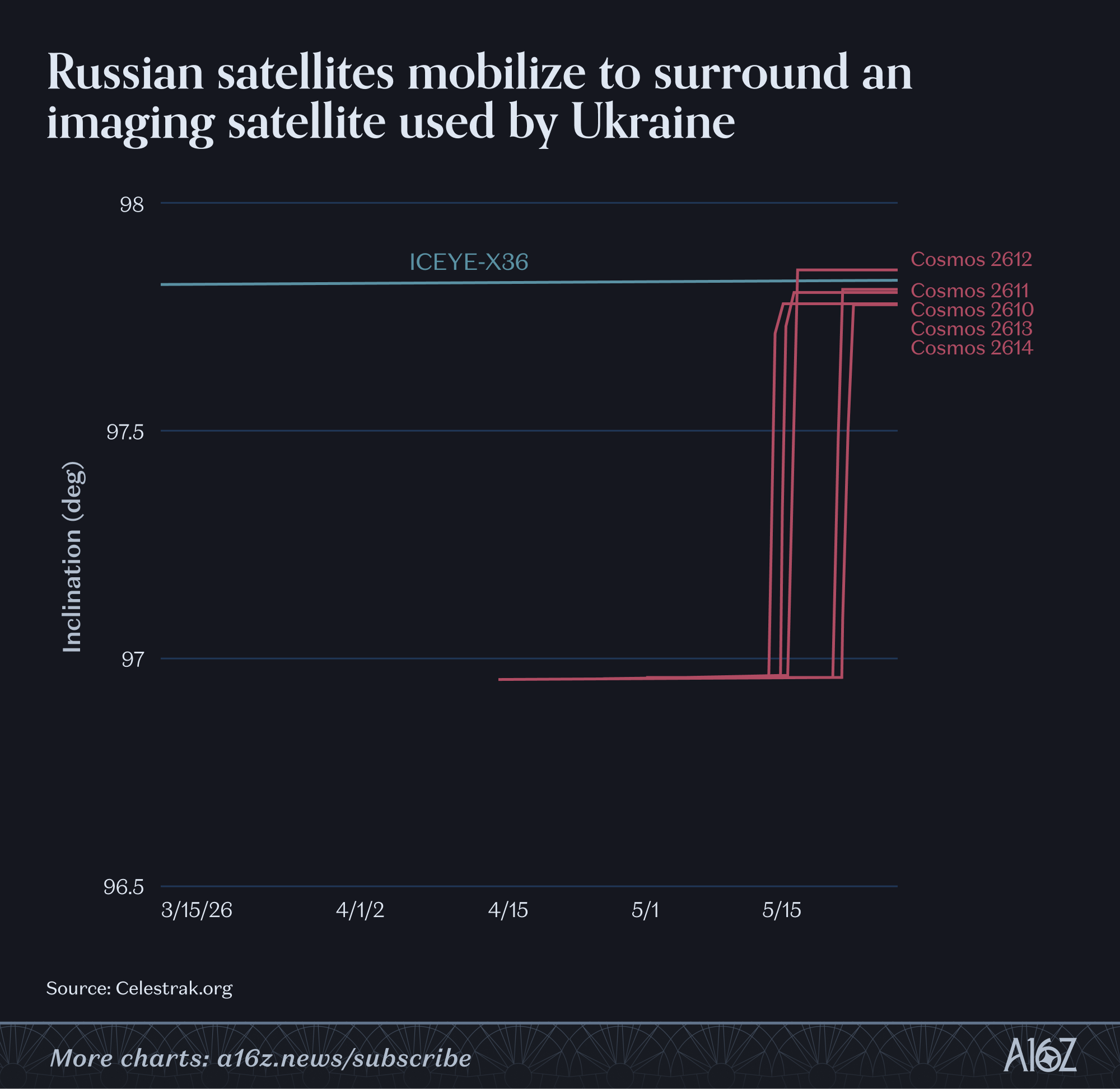
It’s hard to interpret Russia’s behavior as anything less than a threat, with the not-so-subtle subtext that the Kremlin is not pleased with ICEYE supporting the Ukrainian Ministry of Defense. And when Russia feels threatened, they have historically shown their willingness to attack
commercial satellites — it is official Russian policy that commercially-owned infrastructure that aids in military efforts may be “legitimate target[s] for a retaliatory strike.”
All five Russian satellites reached their target orbits as of May 21, so this situation is fast-developing — but it is just as accurate to note that this act of aggression on orbit is many years, and indeed decades, in the making.
As we discussed earlier, the United States, Russia, and China are actively at war in orbit. Russia is intimidating commercial satellites and threatening to launch a nuclear weapon; China is dead-set on seizing the water ice on the lunar south pole; both nations interfere with U.S. military satellites “every single day.”
The undeniable militarization of space motivated our deep dive into the physics of outer space. As we learned, those physical laws constrain our development of warfighting technologies for the orbital domain, and must guide any future, theoretical development project for space.
Now, we undertake a more practical analysis of the present-day technologies and strategies of space warfighting. In other words, how to win a space war.
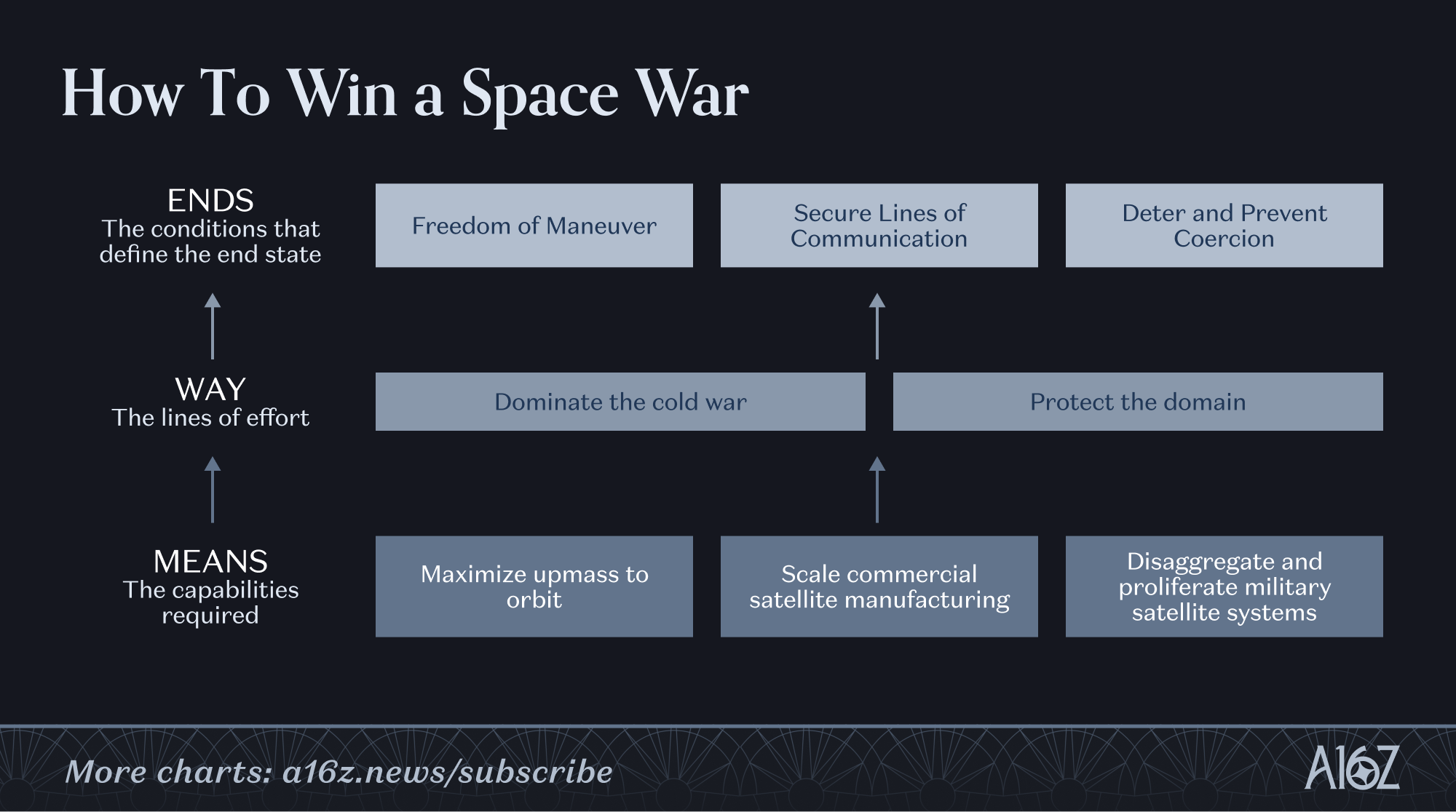
This means expanding our desired end state of winning the space war, which will require means, ways, and ends: means are the capabilities required; ways are operating logic; and the ends are the conditions that define the end state.
To begin, therefore, we will start with the means — three operational goals that highlight the capabilities the United States needs to successfully wage a space war. These are maximizing upmass to orbit, scaling commercial satellite manufacturing, and creating a resilient military space architecture.
These means enable the ways we intend to win the war: to proliferate capabilities and effects across orbits, and to protect the domain from enemy aggression.
And, in turn, these means and ways should bring about our desired ends. We must ensure freedom of maneuver, both from Earth to orbit and in orbit; we must secure lines of communication for our space and other fighting forces; and we must deter and prevent coercion of allied commercial and military assets.
If we do, we will win the space war.
Means: Maximize upmass to orbit.
If you want to win a space war, you need to get a lot of mass into space — and that means developing launch infrastructure: rockets, component supply chains, pads, testing infrastructure, and more.
Current state
Every part of the rocket supply chain is hard, but the rockets themselves remain undeniably the hardest. To date, humanity has only invented one launch vehicle capable of delivering mass to orbit repeatedly, reliably, and cost-effectively: SpaceX’s Falcon 9 rocket.
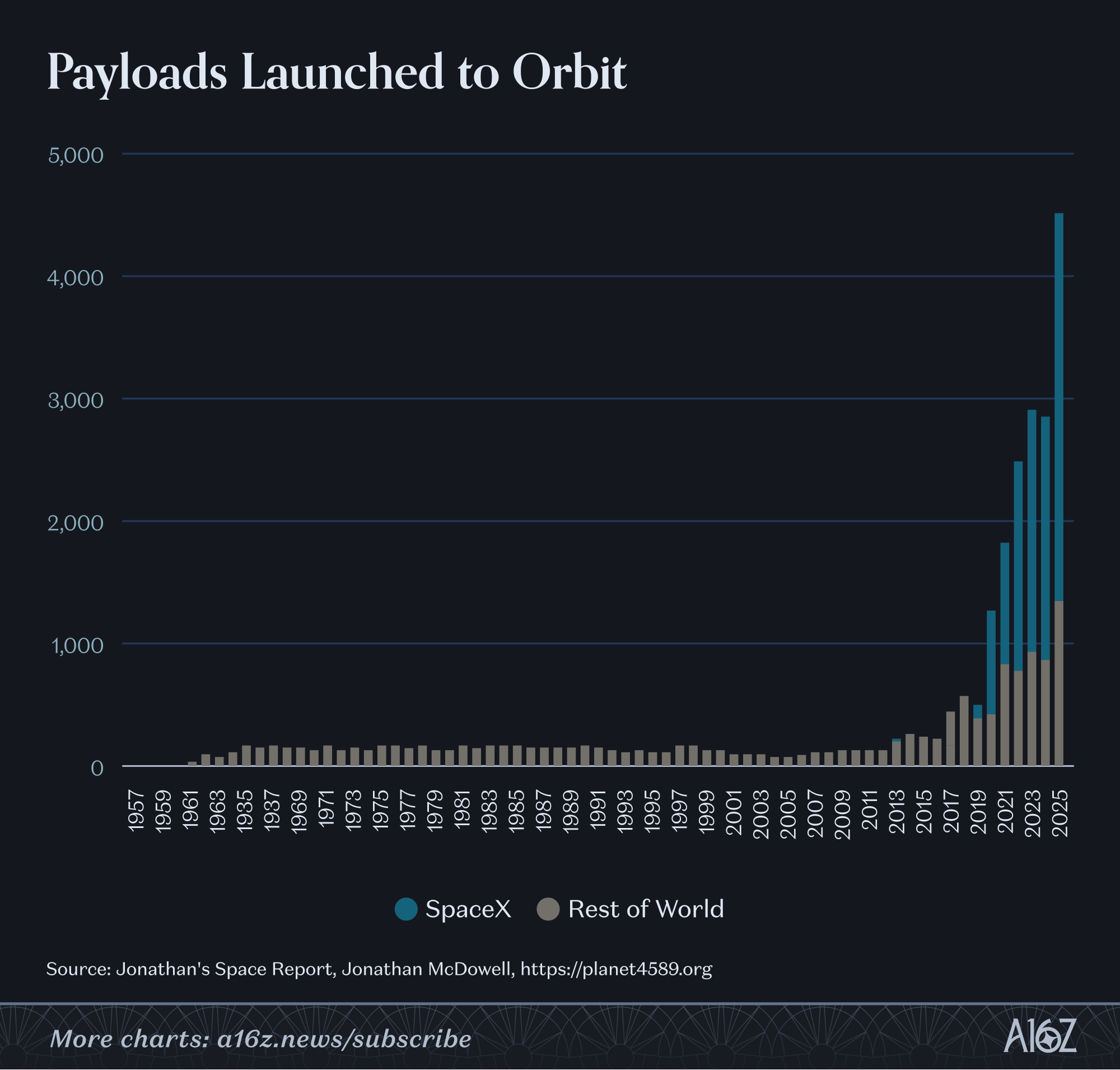
Last year Falcon 9 launched more than every other rocket on Earth, combined, and its secret ingredient is reusability: if you don’t throw away the airplane after every flight, you dramatically reduce the cost of orbital launch. The precise scale of this cost advantage is not public knowledge, even following SpaceX’s S-1 filing, but in 2013, Elon Musk said that the first stage of a rocket is 75% of a rocket’s cost — so reusing it up to 30 times is a huge deal.
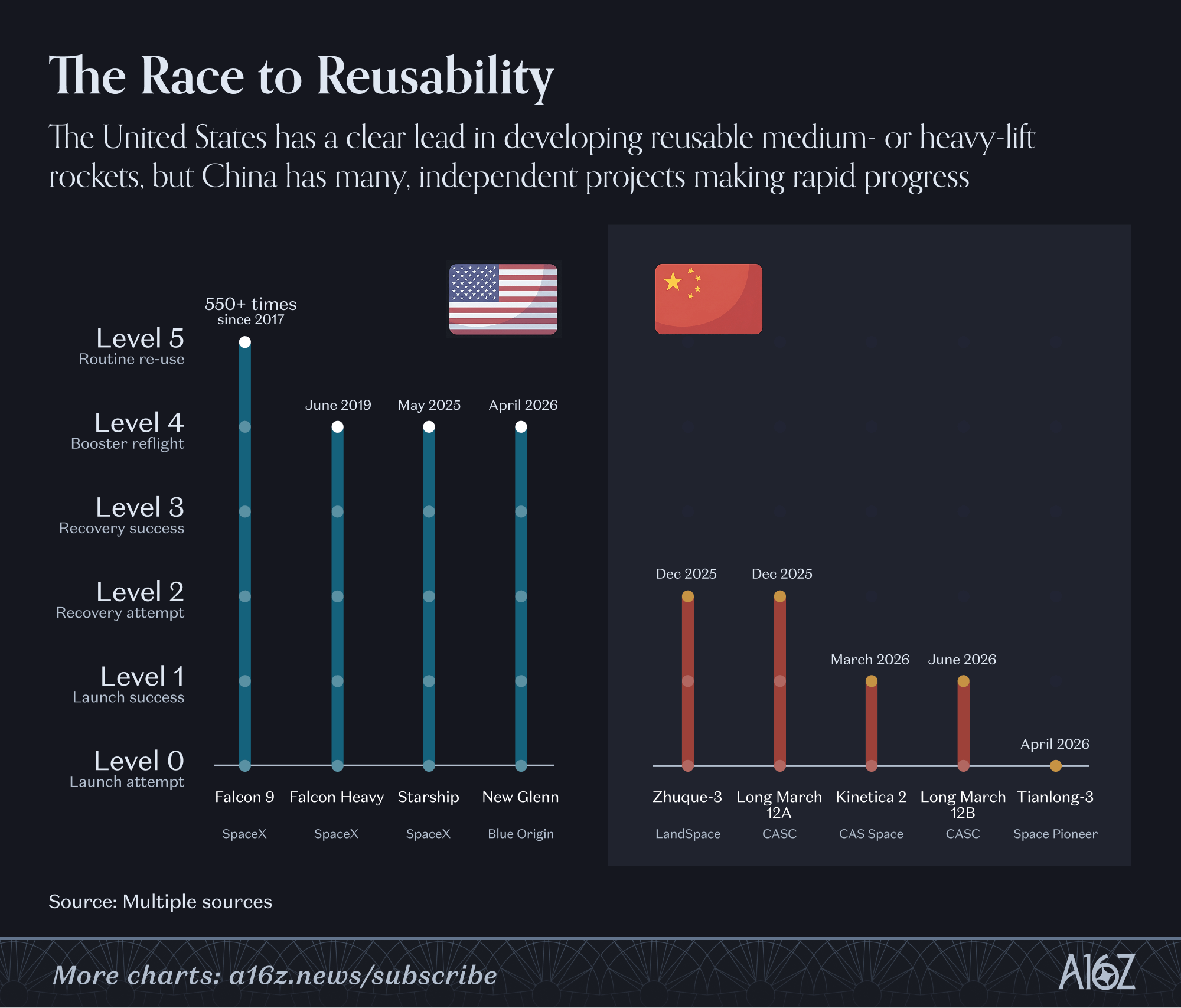
SpaceX landed its first booster in 2015, and today, more than 10 years later, they are still the only entity in the world, company or country, to land orbital-class boosters repeatedly at scale.
Blue Origin, the American rocket company owned by Jeff Bezos, is tantalizingly close to matching SpaceX’s achievement. Blue today has a reusable suborbital rocket, New Shepard, which flies paying customers like Katy Perry to the Kármán Line and back, and a heavy-lift orbital rocket, New Glenn, which can carry 45,000 kg to Low Earth Orbit (roughly 2x of Falcon 9, and ½ of Starship). In November 2025, Blue successfully landed a New Glenn booster after carrying a NASA payload to orbit, and launched/landed that same booster again in April 2026 — but unfortunately, the second stage of the rocket (which sits on top of the booster and carries the payload to orbit) failed, making it difficult for Blue to claim complete victory. And in May 2026, just as Blue seemed to be gaining momentum and preparing to launch 100 New Glenn launches per year, they suffered the “worst disaster in the history of [the company]” when a New Glenn rocket exploded during a test-fire and destroyed the pad on which Blue’s orbital (and, notably, lunar) rocket launches rely.
Rocket Lab, a New Zealand-founded and US-domiciled rocket company, is also close: they are already launching at volume today — with 46 consecutive successful launches over a period of 2.5 years — but the Electron rocket is small (just 320 kg to LEO) and not reusable. Rocket Lab is working on a bigger rocket, Neutron, which would rival Falcon 9’s payload capacity to orbit, but it has not yet launched and recently had a setback that delayed the schedule to Q4 2026. (A timeline that does not yet account for Berger’s Law.)
Other exciting attempts to develop reusable orbital launchers in America include those of Stoke Space, Relativity Space, Firefly, Astra, and Cowboy.
China today has by far the largest and most active space launch industry outside of the United States, with multiple independent projects underway. The state project to develop the Long March rocket family lives under many different organizations (CASC as the parent; SAST and CALT as nested subsidiaries); the five major “non-public” companies — known as the “space dragons” — are CAS Space, LandSpace, Galactic Energy, iSpace, and Space Pioneer. No Chinese entity has successfully recovered an orbital rocket booster to date, but these efforts are well-funded, moving extremely quickly, and notably unhindered by environmental reviews as are common in liberal democracies.
There are also a number of non-reusable rockets still on the market, invariably national projects massively subsidized by their respective governments. The American SLS and Vulcan, the Russian Soyuz rockets, Chinese Smart Dragon-3, the French Ariane, the Indian PSLV and GSLV, the Japanese H3 — these rockets would struggle mightily in a commercial competition against any reusable rocket, but have been kept alive for political reasons.
Importance to space warfighting
In 2025, the United States launched about 9.3 tons to orbit per day, China 1.8 tons, and Russia 0.4 tons.5 We have a commanding lead, but that lead is not safe.
Just ten years ago, the United States also held a commanding lead in upmass, but with 10x less launch capacity: just 0.9 tons to orbit per day against China’s 0.4 and Russia’s 0.4. Russia stagnated, China 4.5x-ed, and we 10x-ed. Standing still is not an option if we want to maintain our launch advantage. Starship, New Glenn, Neutron, Nova, Eclipse — we need them all, and more.

Holding a launch advantage is powerful in a space war. If you can put the most mass into orbit, you can “spend” that mass however you want — on better shielding from debris or radiation, on more propellant for your vehicles, on more experiments to prove out new technologies, on massively proliferated constellations of assets, or even on simple redundancy.
Upmass capability also allows you to replenish on-orbit capabilities quickly in the event of disaster. Winning a replenishment sprint is not exactly the same thing as winning a decade-long upmass marathon, but both require more launchers, more factories to build those launchers, and more spaceports.
Spaceports in particular are often neglected. SpaceX has started on the path towards building additional launchpads, which is incredibly difficult in America. China has built launchpads in the center of the country — a strategy which has downsides but also makes those assets easier to defend in wartime. The FAA in the United States has so far proven unwilling to consider spaceports being established with overland flight paths, despite precedent from the Space Shuttle era.
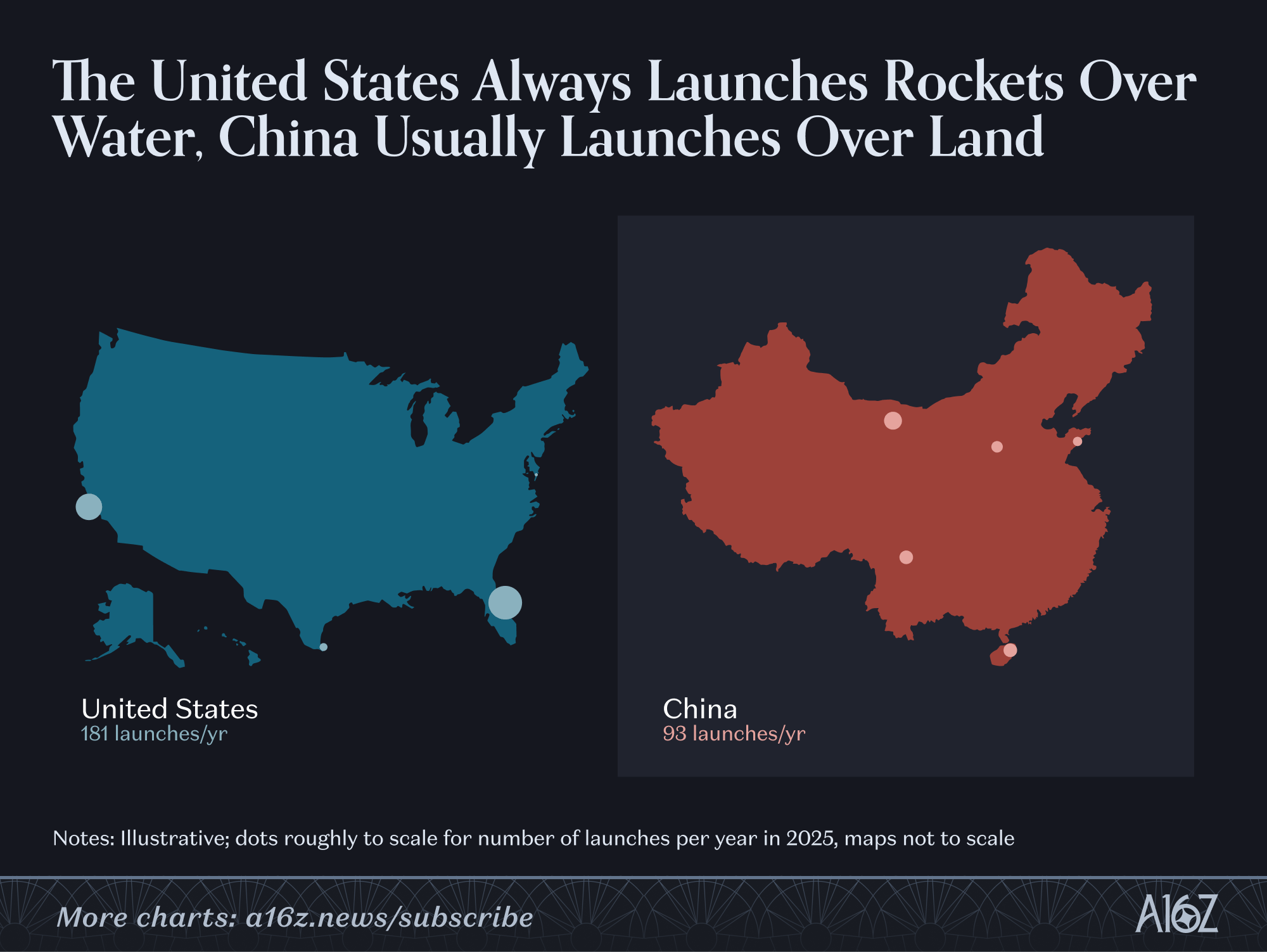
This means in practice that all of our spaceports are on the water, and therefore relatively easy to attack with air, sea, or subsea vehicles in a time of conflict. At the very least, the United States needs an inland launchpad for redundancy and national security missions, but we see no strong argument against having a fleet of launch sites across the sparsely populated American West.
Means: Scale commercial satellite manufacturing.
If winning a space war requires mass on orbit, we will need to fill up our rockets with useful satellites, which means making massive factories that build spacecraft by the hundreds or thousands.
Current state
Most objects in orbit today are Starlink satellites. SpaceX has launched more than 12,000 Starlink satellites to date, of which 8,600 are active.
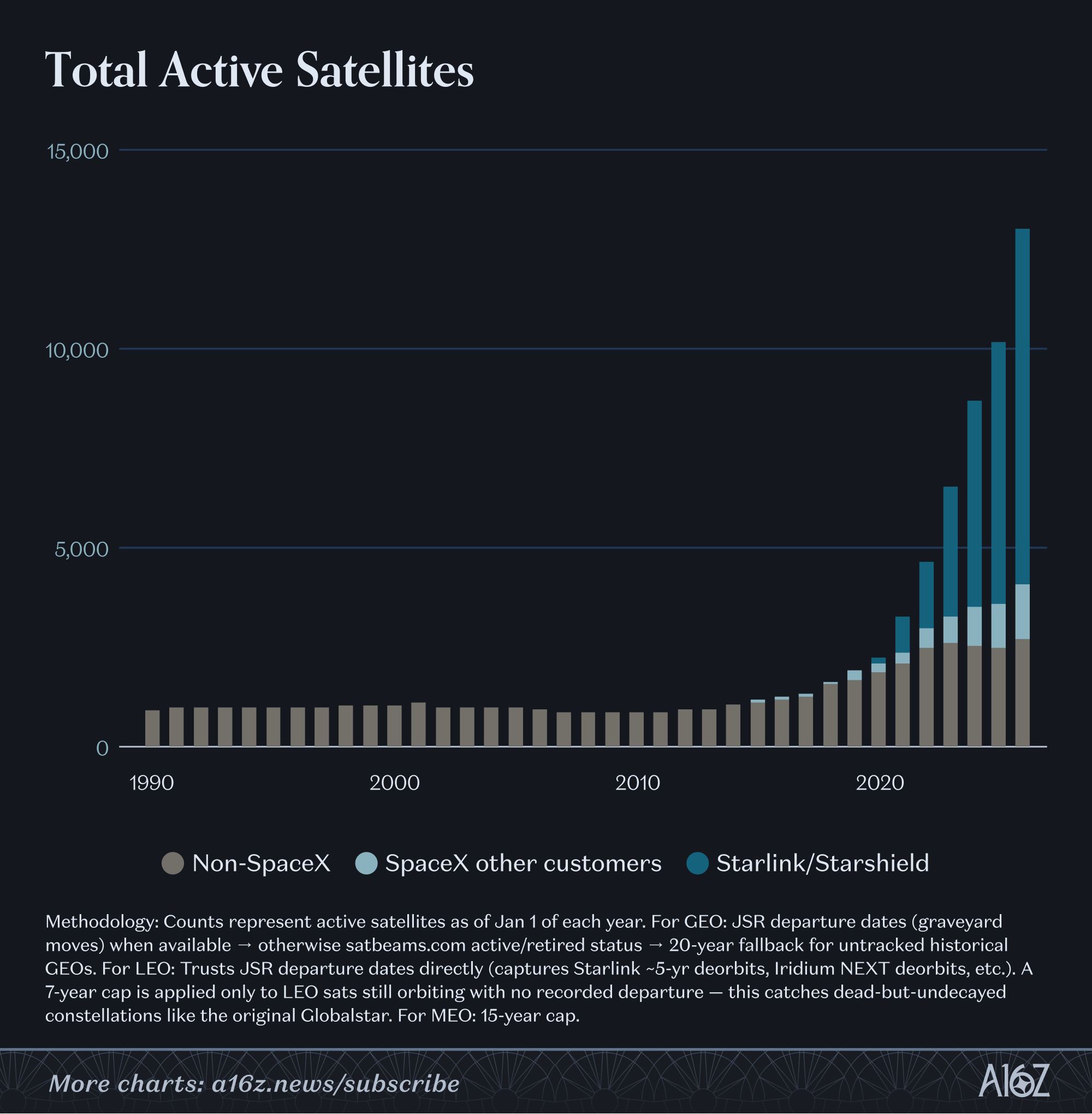
This is a remarkable achievement. SpaceX is only a few hundred satellites away from having launched as many satellites as the rest of the world combined, all time, despite having given the world a 61-year head start. SpaceX uses these satellites to provide fast, low-latency, global connectivity, and the constellation is still growing — Elon tweeted that he wants to launch over 10,000 Starlink satellites per year in the near future.
As with launch, however, there is a wide gulf between SpaceX and the field. The rest of the top ten biggest constellations have less than 1,600 satellites active on orbit, combined.
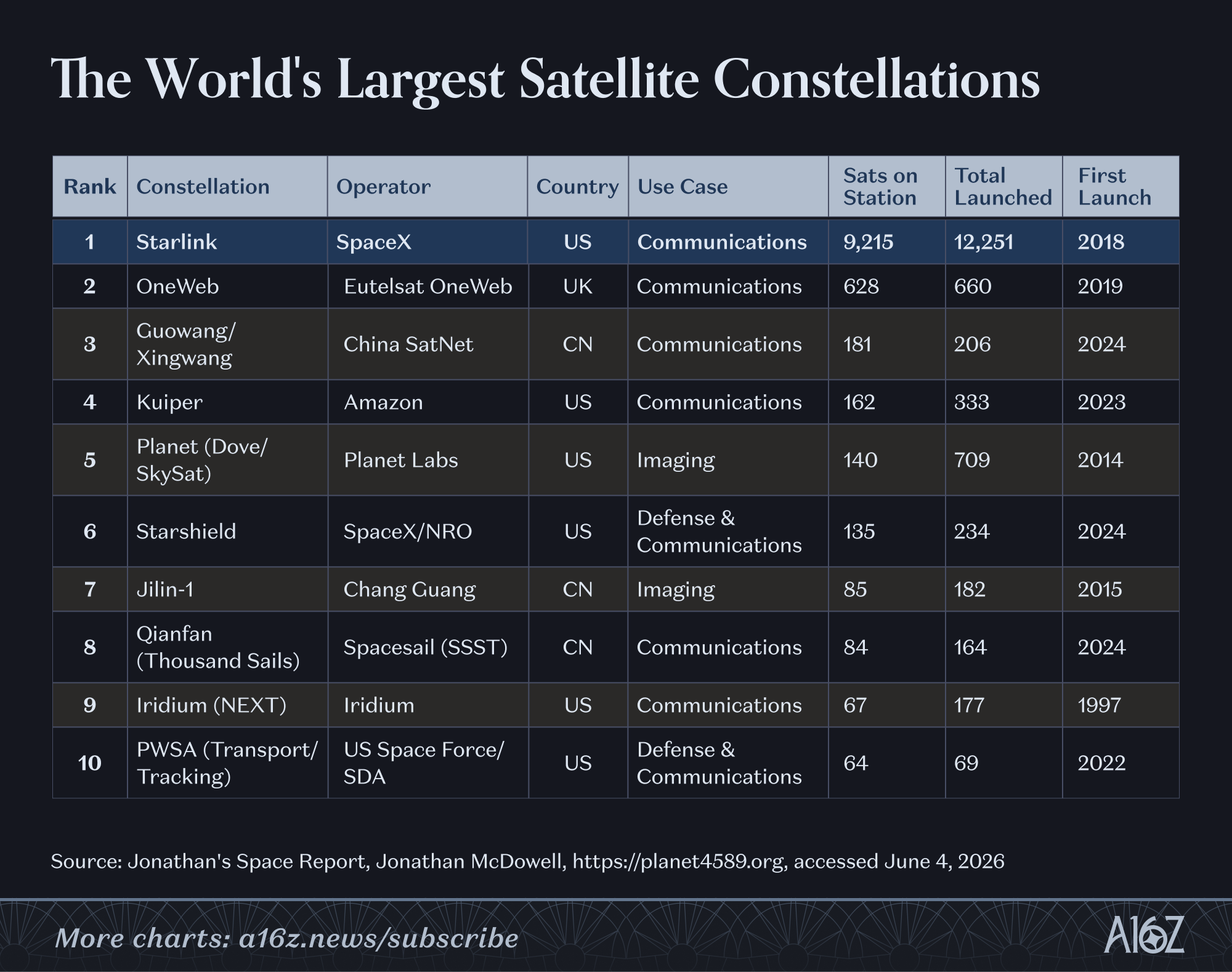
These constellations (and the rest of the world’s on orbit satellites) divide into three applications relatively cleanly: communications, imagery, and defense.6
Communications
The most obvious feature of space — that it’s high up, and objects there can see a wide swath of the Earth’s surface — is hugely beneficial for radiofrequency communications, which generally require a direct line-of-sight between transmitter and receiver. A 30-meter-tall cell tower can only transmit and receive out to the horizon, roughly 20 km away; a satellite in Low Earth Orbit might be 550 km up, and therefore be able to see out to a horizon more than 2,500 km away.
It should be no surprise, then, that communications has always been the dominant industry in space, whether for broadcast, broadband, or, soon, direct-to-cell services.
The world’s first (and perhaps still the coolest) communications satellite was launched in 1960, less than three years after Sputnik. It was known as “Echo 1” and measured a massive 30 meters in diameter — but it was little more than a mylar balloon, acting as a mirror for communications signals in Low Earth Orbit. NASA engineers beamed a message up from California, bounced it off the balloon’s metallic surface, and successfully received the reflected message at Bell Labs in New Jersey.

Subsequent generations of communications satellites got more technologically advanced as they moved into higher orbits — either in medium-earth orbit (where the GPS satellites operate today), or in geostationary orbit (where a single satellite can hover “stationary” in the sky). Up high, you need to deploy fewer satellites for consistent coverage, which was a huge boon for the first truly successful space businesses, like DirecTV. In 2001, DirecTV generated about $10.3 billion of revenue (in 2026 dollars) with just five satellites on orbit, which you can compare to SpaceX generating $11 billion in revenue with Starlink in 2025 with an average of 6,000 satellites in orbit.
LEO has always had appeal — it’s closer to Earth, which shields satellites from radiation and reduces their communications latency with the ground — but before Starlink, satellite constellations only had one principal difference from high-orbit, independent satellites: they were incredible incinerators of cash. Iridium raised $5 billion, Globalstar raised $4 billion, ICO Global raised $2.6 billion, Teledesic raised $1 billion, and all of them failed. Even 20 years later, OneWeb went bankrupt after raising $3.4 billion in its struggle to deploy a LEO broadband constellation. It turned out that having a reusable, orbital-class launcher was a necessary precondition for a successful satellite megaconstellation.
Imaging
Imaging satellites, in contrast to communications satellites, have been dominated by defense use cases since their creation. Nations want surveillance over their adversaries — and, perhaps obviously, you can see a whole lot from space while being very hard to shoot down.
In the early days, imaging satellites like Landsat 1 were fielded not for commercial purposes, but for their strategic importance.
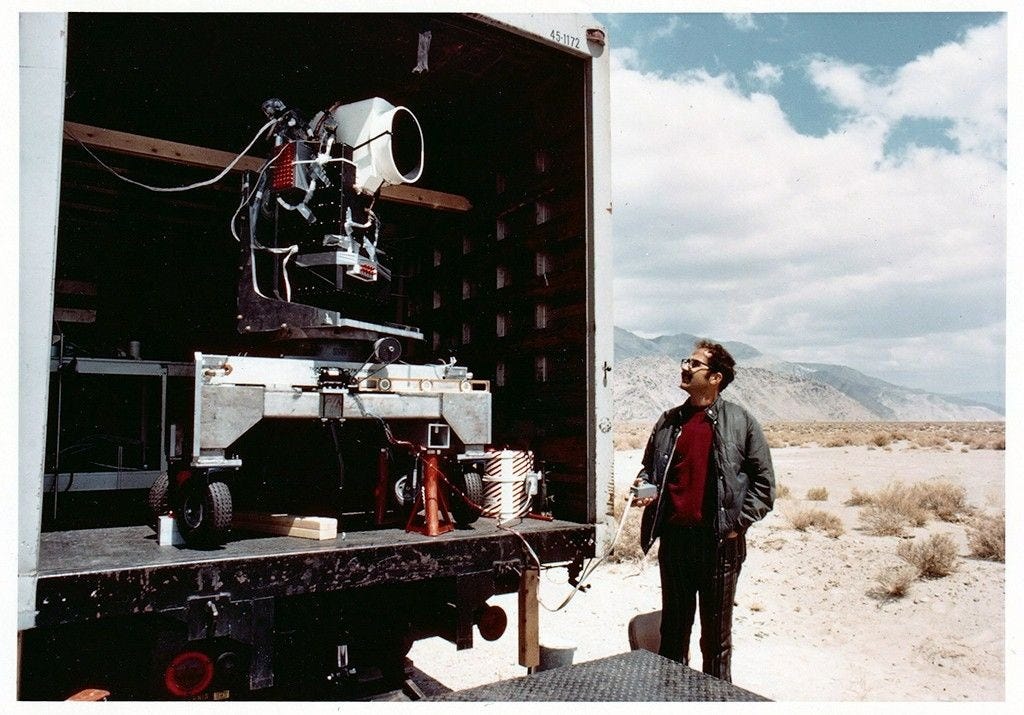

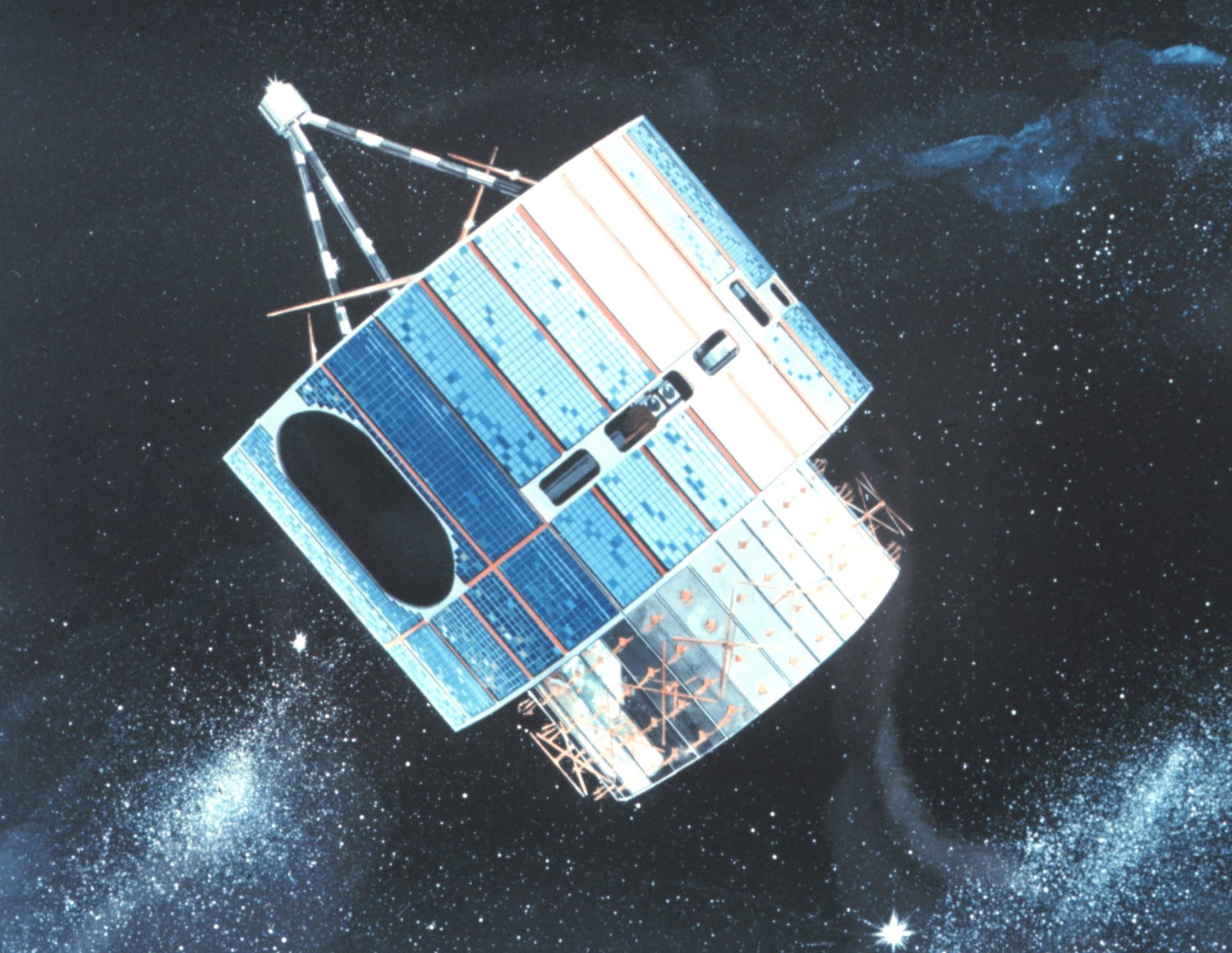
Landsat was followed by GOES, the NOAA-operated Geostationary Operational Environmental Satellite that launched in 1975 to capture weather imagery over the Western Hemisphere.

Even with innovation driven and funded by defense applications, the commercial market in those early days was tiny — perhaps on the order of $100 million total global sales in 2000, one-fiftieth the size of DirecTV alone at the time.
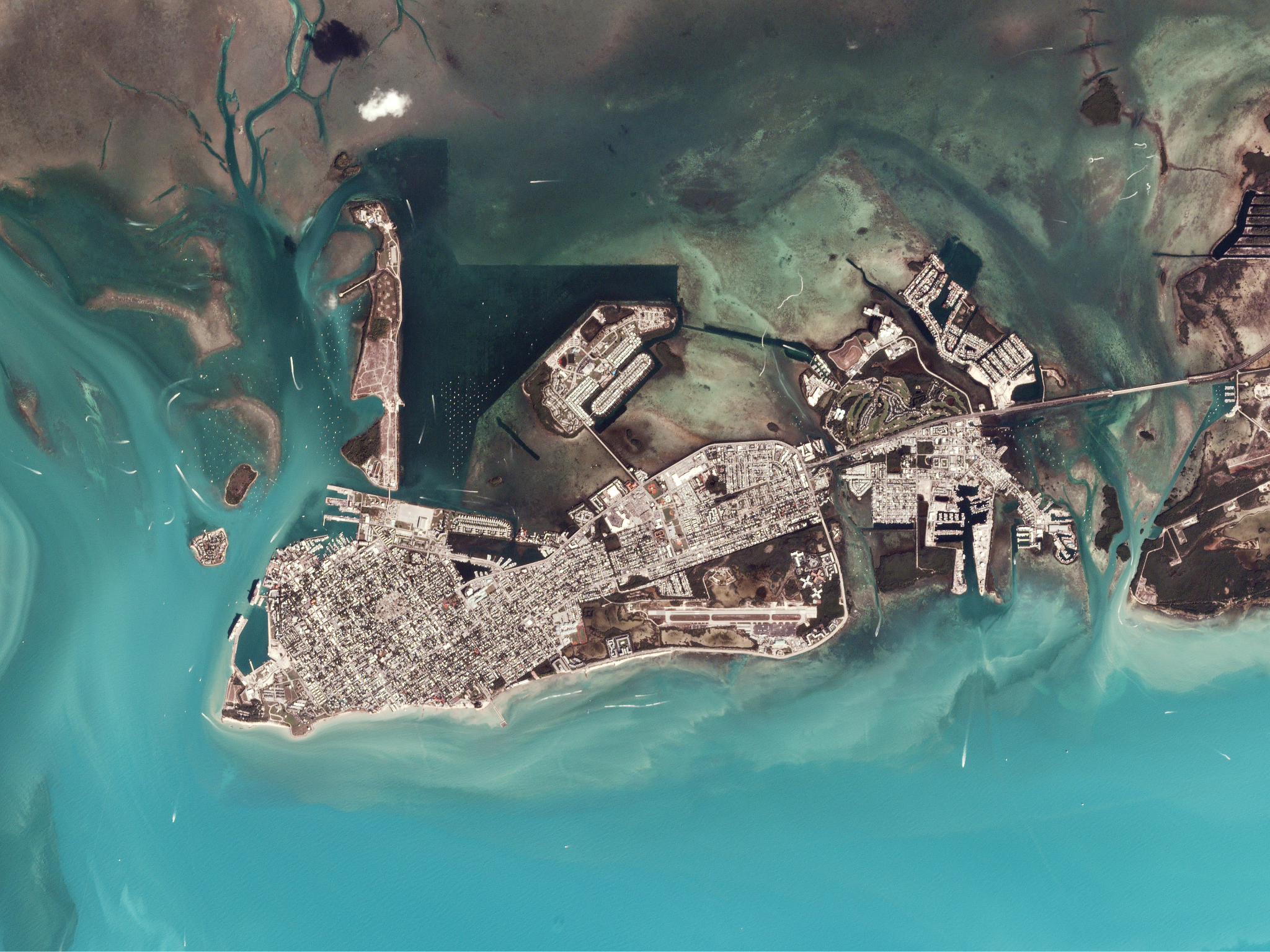
In the 2010s, small satellites breathed some life into the commercial industry; shoebox-sized sensors, launched by reusable rockets, suddenly made the business case possible to close. Skybox Imaging was the first player to take a real shot on goal, raising $91 million and launching just one satellite before getting acquired by Google in 2014 for $500 million. Planet Labs was the big winner of this cohort, going public in 2021 at a $2.8 billion valuation. Today, the company images the entire surface of the Earth every day at 3-meter-per-pixel resolution.
Even so, satellite imaging is still dominated by defense customers: the rule of thumb in the US industry is that 50% of Earth observation revenue comes from the US government, 25% from allied governments, and just 25% from commercial buyers.
Importance to space warfighting
Commercial satellite systems have both direct and indirect uses in space warfighting.
Some space systems are “dual use” — in which the same system is used by government and commercial buyers alike. The intelligence community buys commercial satellite imagery; SpaceX launches satellites for the NRO using normal Falcon 9 rockets; and so on. The more robust the domestic space economy of a nation, the more opportunities it has to use commercial systems for direct military services.
Similarly, nations with leading private space enterprises can work with those companies to build systems for exclusive government use. The best example of such a system is Starshield, an independent constellation of Starlink-like satellites that are built by SpaceX and operated by the U.S. Government. This also occurs at the component/sub-system level, of course: companies like Apex have stood up factories that can build dedicated satellites for government and commercial customers alike, and companies like K2, Endurosat, and Impulse Space are similarly ready to scale up to match government demand. This is the modern equivalent of Ford’s Willow Run bomber plant during the Second World War — if you have production capacity and manufacturing know-how in your country, you can build for a war effort.
Deploying commercial satellites at scale also provides indirect benefits to a space warfighting effort. As noted above, plain old scale — launching more stuff into space — makes it harder for your adversaries to track exactly what you’re doing on orbit. This benefit also has a dark side, of course, in that commercial assets might be suspected to be military assets in disguise, or treated as military assets despite having dual-use missions. The latter seems to be the case with the ICEYE-X36 satellite, as described earlier; the former is our suspicion for effectively every Chinese rocket and satellite program, given the scale of the CCP’s military-civil fusion.
The lines are blurry between military and commercial space operationally, and even legally. Under Article 1 of the Outer Space Treaty, no nation can claim territory in orbit, which means no nation can lawfully keep any other nation away from its satellites. Russia surrounding ICEYE at 500 meters, or tailing an NRO satellite, is provocative and reckless — but under current law it might not be illegal. France accused Russia of an identical maneuver in 2018. Nations are also still responsible, and financially liable, for any satellite that launches from their country — commercial satellites included — so there is technically no such thing as a purely “private” asset in orbit. And, finally, the principle of proportionality of armed conflict forbids any strike whose expected collateral damage is excessive relative to the military advantage gained, but that might apply to nearly every kinetic attack in space. If a single hit can spawn a cascading debris cloud that lingers for years, perhaps no attack in space, even one made in self-defense, can be proportionate.
In practical terms, however, these treaties historically mean little once conflicts emerge. If you care about maintaining international norms on orbit, you have to prevent a conflict from going hot in the first place — because once shots are fired on orbit, nobody’s going to think twice about violating the Outer Space Treaty as an act of defense.
One hopes that commercial activity in space acts will act as a deterrent to hot conflict. If a nation shoots something in orbit, they are putting at risk their own military and civilian satellites — and the astronauts onboard the International Space Station and China’s Tiangong. Even for Russia and China, that is not an easy amount of collateral damage to sign up for, so the proliferation of commercial and civil activity in space — even from China and Russia! — may deter space-to-space offense.
But relying on that deterrent effect is risky. What matters most is not the absolute amount of dollars in hardware a nation has on orbit, but the relative value of orbit to that nation versus its adversaries. Russia, for instance, has just over 300 satellites on orbit today, compared to about 1,200 from China and about 11,500 from the United States. Iran has 14. You’d therefore expect that Russia or Iran would have a lot more to gain from hitting the orbital reset button than China, which only makes Russia’s purported nuclear threat all the more credible.
Means: Disaggregate and proliferate military satellite systems.
Current state
In 1957, Sputnik ignited the Space Race, a manic techno-geopolitical competition between the world’s two rival superpowers. History has now whitewashed those tense, belligerent years, but the real reason Sputnik terrified the United States into spending $300 billion (2025 USD) on the Apollo program was that it proved the USSR had better intercontinental ballistic missiles than we did. If the Soviets could launch a basketball-sized satellite into space, they could land a thermonuclear warhead in downtown Manhattan.
This fact alone has caused space and national security always to be deeply intertwined. From Sputnik’s launch through the fall of the USSR, the Americans and Soviets frantically developed space-based nuclear weapons delivery systems, reconnaissance satellites, and orbital military outposts — the USSR even launched a literal space cannon.
Today, decades later, not much has changed. Russia is jamming GPS satellite receivers across most of Eastern Europe, Iran has launched hundreds of ballistic missiles on trajectories through outer space, and China has openly contemplated destroying Starlink satellites. All three nations are jockeying for control of strategic orbits and water deposits, trying to take pictures of each other’s spy satellites, and demonstrating anti-satellite weapons, both non-kinetic and kinetic.
Every space-faring nation is now building its own independent military infrastructure on orbit. For navigation, the United States has GPS, Russia has GLONASS, China has BeiDou, the EU has Galileo, India has NAVIC, and Japan has QZSS. For weather imaging, the United States, China, Russia, India, Japan, and South Korea have their own on-orbit assets. The nations also have their own geostationary data relay satellites, missile warning satellites, lunar exploration plans, and, of course, launch vehicles. Even the International Space Station, which was once a symbol of unity for all mankind, will soon be deorbited. China has permanently crewed its replacement, Tiangong, and Russia is working on a space station of their own as well.
That there exists a premium on sovereignty in today’s world should not be a surprise. Geopolitics is real again, and nations know that overreliance on international, shared space assets can be punished — like when Starlink allegedly turned off over Ukraine in 2022. In building this sovereign infrastructure, nations have tended to treat each individual satellite as a grand national project, which has therefore turned these satellites into exquisite assets — absolute behemoths that are so expensive, nations can only afford to field a few of them. America has only ten workhorse satcom satellites, ten more missile warning satellites, and 32 GPS satellites on orbit today.
In response, many nations around the world have demonstrated the ability to shoot satellites out of the sky.
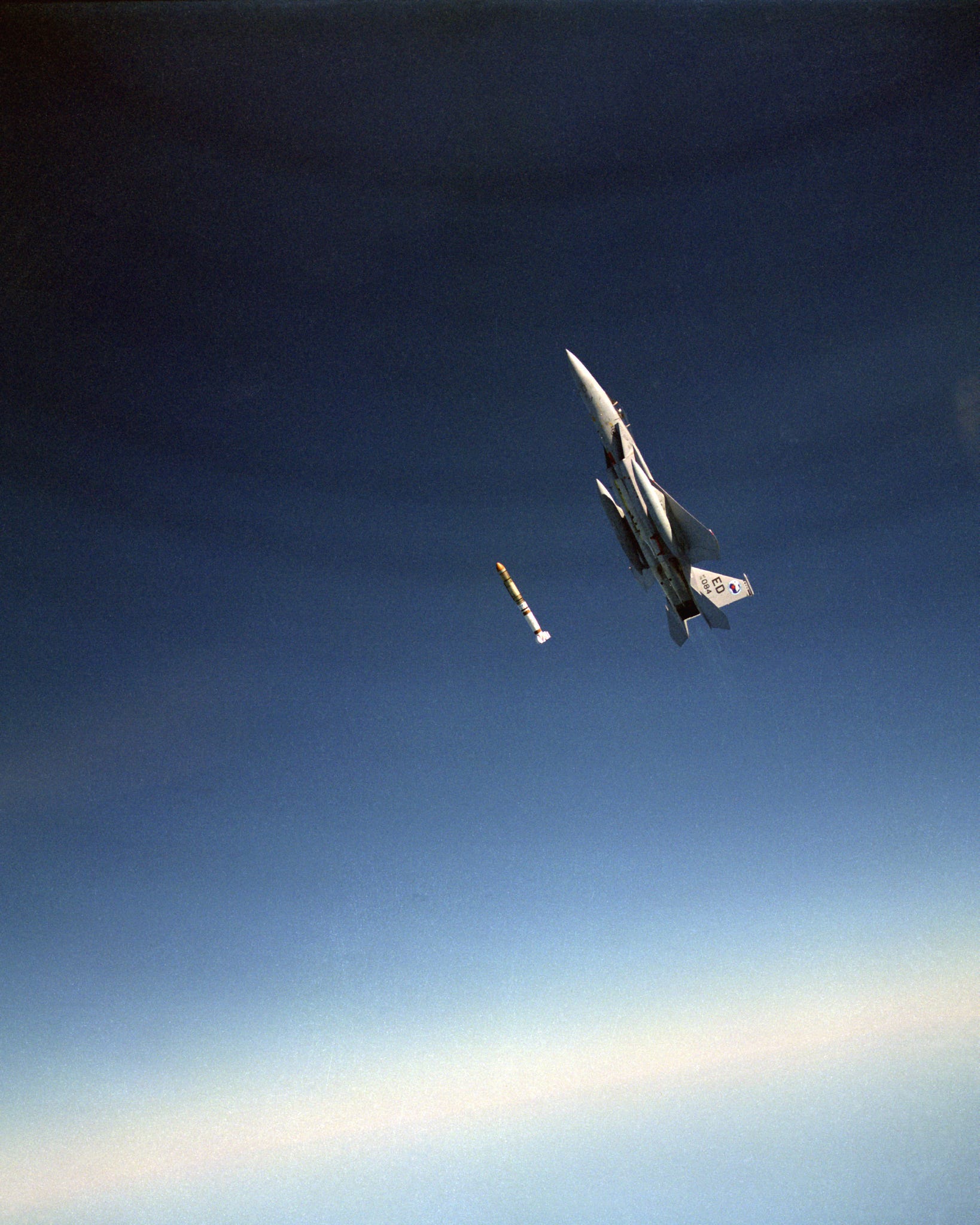
On September 13, 1985, Air Force test pilot Doug Pearson launched a missile from an F-15A and shot the Solwind P78-1 satellite out of the sky. The missile, an ASM-135, struck the satellite at an altitude of about 525 km with a closing speed of 6.7 km/s (or 15,000 miles per hour, in freedom units). The attack took just under three minutes from missile release to impact.
The Secure World Foundation maintains a comprehensive catalog of kinetic anti-satellite missile tests, and has logged 33 by the United States (ending in 2008), 26 from Russia (most recently in 2021), 14 from China (most recently in 2023), and two from India (both in 2019).
The ability to shoot satellites out of orbit is now well-documented, and the U.S. Defense Intelligence Agency believes that China now has the ability to strike space targets in higher orbits, possibly even extending all the way out to GEO.
Importance to space warfighting
Because today’s military space assets tend to be exquisite, but few in number, degrading or destroying even a few satellites would make prominent and predictable holes in global coverage that an adversary could exploit.
Recently, the United States and other nations have started to invest in making their space systems more resilient, which — per Space Force General Chance Saltzman — can and must take many forms:
Disaggregation — today, satellites tend to be loaded up with sensors completely unrelated to their primary missions. GPS satellites, for instance, also have Nuclear Detonation Detection sensors on board. This sounds wise in theory, but in practice means that losing a single asset can impact multiple missions — and often means that programs are delayed when extra sensors are delayed in delivery, necessitate more testing, or at least require additional time to integrate and test. It’s better to have dedicated, smaller satellites — one for each mission — that you can build and launch quickly.
Diversification — As we will discuss later, space itself is fragile, which makes overreliance on any particular orbit unwise. Even if LEO was rendered unusable, we would still need missile warning, comms, and other missions to continue; building hybrid, multi-orbit architectures can make our on-orbit capabilities dramatically more resilient.
Distribution and Proliferation — Simply launching more satellites, with missions split across many smaller assets rather than single larger assets, meaningfully changes the engagement math to the benefit of the defender. Each smaller asset is both harder and less impactful to destroy, which makes an attacker less likely to bother attacking in the first place.
Maneuverability — Stationary satellites are vulnerable, so the Space Force really wants to be able to “maneuver without regret.” This complicates targeting, makes anti-satellite missions more costly for potential attackers, and can proactively help mass forces in particular orbits when they are needed. This likely requires developing new propulsion technology; modern electric propulsion is too low-thrust, while storable chemical propulsion gives high thrust but low specific impulse, so it burns through propellant too quickly for frequent and long-duration maneuvers.
Protection — Active and passive measures are necessary to defend existing assets, as we will discuss in detail later.
Systems like SDA’S PWSA and RG-XX are evidence that America is moving in the right direction, but fielding these new capabilities will take time and discipline. You not only have to create the right programs with the right requirements and to overcome the organizational inertia to change nothing at all, but you also have to resist the allure of higher power, more sensors, more capabilities, more delta-v, and the like. It’s very hard to argue in favor of a less capable system, but often that is the right choice: adding capabilities adds cost and complexity, for one, but most importantly, it adds risk to the system and risk to the schedule. Proliferation is still the right solution: we need more satellites doing more independent missions to make the math favor defenders, not attackers.
That said, exquisite satellites will always have their place, and we need to defend them. There are no publicly acknowledged “protect and defend” satellites on orbit today, but it is public information that the USSF has a Delta-level organization responsible for orbital warfare — and building new technologies to serve that Delta will be important over the years to come.
Finally, it is worth noting here that a distributed, proliferated space architecture is one in which autonomy is of paramount importance. Satellites will need to be able to react autonomously to identified threats, whether from intentional attacks or inert debris — so we expect to see technologies like “dogfighting” become more prevalent in the near future, and are highly supportive of efforts to modernize space operations.
Ways: Dominate the cold war
Perhaps the simplest way to understand what’s happening in orbit today is to model it as a Cold War.
In a cold war, each combatant wants to jockey for advantage without making the conflict turn hot. This can include either avoiding acts of war, engaging in acts of war under covert cover, or selectively revealing the existence of exquisite technologies that deter adversaries from wanting to start fights. In a space-based cold war, covert action is either exceptionally difficult or exceptionally easy: it’s next to impossible to disguise an anti-satellite missile attack or a maneuver to bring one satellite close to another; it’s similarly difficult to find the origin of a cyberattack, a satellite-blinding laser, or plain-old RF interference. As a result, modern space war is full of grey-zone tactics that are either hard to attribute or hard to classify as outright acts of war.
Electronic warfare and radio-frequency-enabled cyber operations are grey-zone tactics already central to modern combat. The front lines between Russia and Ukraine have been called the “most signal-dense combat zone in human history,” with both sides fielding extremely powerful GPS jammers and other EW weapons. In the United States raid to capture Nicolas Maduro, we rolled out the nearly-forgotten EA-18G Growler, a jet that carries large EM sensing and jamming/spoofing payloads. Similarly, the United States experimented with anti-satellite lasers as early as 1997, and China wants the world to think it’s doing the same today: China repeatedly opened a retractable roof to reveal laser gimbals precisely when they knew foreign satellites would be passing overhead.
Lasers are capable of blinding (“dazzling”) satellite sensors without destroying the satellite itself; hacking is capable of disabling ground equipment or satellites without in-space explosions; jamming and spoofing are similarly in a grey zone, temporary effects that deny but do not destroy space assets. These tactics seem to be the primary way in which space war is being waged today; they are meant to achieve military goals without escalation and without generating debris.
We should not forget, however, that satellite systems extend far beyond space vehicles — including ground infrastructure, secure access to spectrum, cybersecurity, regulatory clearance, and more — and these often-neglected components are critically important both to fielding new capabilities and to winning the cold war.
As a case in point, consider Raytheon’s GPS Next-Generation Operational Control System (“OCX”). The goal of the program was to make a ground system that could support a jam-resistant waveform (“M-Code”) to fight through the ever-present jamming of a space cold war. OCX was kicked off in 2010 and was expected to be completed for $3.7 billion by 2016. Sixteen years and $6.3 billion later, the program was cancelled because Raytheon was unable to deliver. The great irony — and Raytheon’s shame — is that the M-Code waveform is successfully on the new GPS satellites, but it can’t yet fully operate because of OCX’s failure to deliver ground software.
This is far from an isolated incident: satellites are sexier than support systems, so everything beyond or downstream of the space vehicle often ends up neglected, understaffed, underbudgeted, and burdened with accumulated technical debt. We could share stories of cybersecurity failures (like the 2022 hack of Viasat’s satellite network) or testing failures (like that of the Soviet lunar program), but a far less commonly discussed issue are the cold war tactics currently being used in the halls of the International Telecommunication Union.
The ITU is the United Nations agency responsible for global radio spectrum coordination. Its massive set of Radio Regulations spans thousands of pages and is maintained much like ancient religious texts, with lifelong scholars who dedicate their lives to ensuring this or that word changes or does not change. The Radio Regs simultaneously have immense influence — as there are many nations around the world that follow them to the letter — and no teeth. China and Russia ignore the rules and have been accused of registering “paper satellites,” meaning fake satellite filings, with the ITU to block other, law-abiding countries from deploying real satellites to key orbits. China, in particular, seems to have realized that if they control the ITU politically, they can both act with impunity and shape the rules to make life difficult for other countries. China held the ITU presidency for years, and is set to host the quadrennial ITU World Radiocommunication Conference in China in 2027.
We need to fight this cold war more effectively, and that means dominance in the domains listed above — and preventing the war from going hot.
Ways: Defend the domain.
On July 9, 1962, the United States detonated a thermonuclear warhead in Low Earth Orbit.

In a fraction of a second, 10²⁹ electrons were released into the magnetosphere at near-light speed — generating an electromagnetic pulse powerful enough to blow out street lights and knock telephone systems offline in Hawaii, nearly 900 miles away. The detonation ultimately created a new, artificial radiation belt that persisted for years and caused the premature deaths of more than one-third of all satellites operational at the time. An unreleased paper from UC Berkeley suggests that this is actually an underestimate of the destruction that could result from the use of a modern nuclear weapon in space today — the preliminary number that we read is that a single nuke could destroy 93% of all satellites, across all orbits.
The United States and the Soviet Union banned atmospheric and exoatmospheric nuclear testing in the Nuclear Test Ban Treaty of 1963, but — recklessly and unbelievably — Russia now seems ready to ignore the Treaty and deploy a nuclear weapon on orbit. In February 2024, the White House publicly confirmed House Intelligence Chairman Mike Turner’s warning that Russia is developing a nuclear anti-satellite capability. NSC spokesman John Kirby acknowledged the program; Assistant Secretary of State Mallory Stewart later told a CSIS audience that U.S. intelligence has tracked Russia’s pursuit of this capability for years and now assesses its progress with new precision.
This is a massive problem for obvious reasons, and the risk is not contained to Russia alone — nine nations have nuclear weapons today, all of them have the ability to loft those weapons to orbital altitudes, and some of them have very limited space infrastructure, which means no risk of friendly fire. The potential impact of a nuclear detonation on orbit is hard to overstate; for a rough comparison, imagine if it were possible to light the entire ocean on fire, thereby destroying every ship in the sea. There are plenty of reasons why nations wouldn’t do such a thing — just as there are reasons they don’t use nuclear weapons in conventional wars today — but nuclear weapons still hang like a Sword of Damocles over commercial and military operations in space.
Conventional munitions and anti-satellite weapons also have the potential to cause significant damage on orbit. As we discussed above, when a single object in space explodes, it becomes many smaller objects, each with a new and diverging orbit. On average, these new orbits will still have the same orbital velocity as the original satellite, so they will not fall out of the sky, but instead will stay in a dispersed cloud at roughly the same altitude as the original blast. Introducing thousands of random orbits into a dense orbital shell is obviously dangerous. If one satellite explodes, other satellites will have to diverge from their planned orbits at best and may get hit by debris at worst, which could cause a runaway effect.
Simply, space is fragile. This is perhaps the single most salient fact that distinguishes space from other warfighting domains. It is scary, but true, to say that many nations around the world have the ability to hit “reset” on humanity’s exploration of near-Earth orbits.
This is why we chose to elevate the protection of the space domain to a “way” within our framework. We must defend the orbital domain to win a space war — and to do so will require strategies and tactics that look completely alien to other, terrestrial forms of combat.
Gen. Chance Saltzman, then the highest-ranking officer in the U.S. Space Force, framed the problem simply in his 2023 “Competitive Endurance” white paper:
“Historically, domain control on land, at sea, and in the air has been achieved by the threat or application of overwhelming destructive military force. Applying this same approach to the space domain would create hazardous debris that jeopardizes the ability of the Joint Force to exploit the very space capabilities these drastic measures seek to protect. It would also disrupt the activities of civil, commercial, and scientific space operations worldwide. Consequently, unlike in other domains, our concept for domain control in space cannot rely on overwhelming destructive force.”
The way we see it, if anyone successfully fires an anti-satellite missile, everyone loses.
Once things go hot, all hell has broken loose, you will likely see a conflict bridge to the ground — with spaceports and ground stations at most immediate risk — which will therefore make it extremely difficult to stop anywhere short of orbital reset. Even if you win every “dogfight” and shoot down every enemy satellite, you have created an exceptional amount of debris and you are still vulnerable to ground-based counterattacks.
This means that the capabilities you need to defend the domain are two-fold.
First, you need defensive technologies that can intercept anti-satellite missiles or otherwise render them ineffective. This could come from an active denial system like Golden Dome, or left of launch operations, propulsion powerful enough to dodge missiles on orbit, or dedicated protect-and-defend satellites — but it has to come from somewhere.
And second, you need offensive space capabilities so capable that they convince every other nation they are woefully overmatched in conflict.7 We should endeavor as a nation never to use these capabilities, but they should both exist and be publicly acknowledged. The world must know that you cannot wage a space war against the United States and win, which means developing technologies capable of taking out many adversarial satellites in one fell swoop — without generating significant and cascading debris.
These offensive technologies will take many forms depending on the mission they are intended to deny, degrade, or disrupt. Directed energy weapons could be used to destroy electro-optical, infrared, radar, or other sensors, or to create precise structural damage to functionally destroy a satellite. Concentrated RF energy can damage radio receivers for communications satellites. And any number of reversible and irreversible effects are possible if you can maneuver your offensive satellite close to a target: robotic manipulation, deployment of chemicals, and low collateral-effect kinetic weapons are all technically feasible.
The trouble, of course, will be making the attacker-defender math work. If you need one attacker for every defender, not only would an offensive attack be costly, but also it would be extremely hard to disguise — you’d have to match your orbits to those of your adversaries, which takes time. The even harder math to close is the propulsion budget. At the end of the day, an orbital “dogfight” will be won by whoever has more delta-v. Better spacecraft control and autonomy can help, but more often than not at the margins between matched systems — and because we’re still in the early innings of maneuvering without regret, big potential technological advantages are still out there to be seized.
ENDS: How to win a space war
The days of space as an idyllic, peaceful reserve for science are decidedly over.
Russia tested an anti-satellite missile in 2021, hacked a commercial satellite in 2022, jammed GPS throughout the Ukraine conflict, tailed an NRO satellite with a potential “counterspace weapon” in 2024, and is intimidating a commercial imaging satellite in 2026. China hauled a dead satellite out of geostationary orbit in 2022, practiced “dogfighting” maneuvers in 2024, and deployed an electronic warfare satellite to orbit in 2025.
In 2021, Gen. David Thompson said that Russian and Chinese systems were interfering with military satellites “every single day.” And in 2025, Gen. Stephen Whiting told the Senate Armed Services Committee that China is building counterspace capabilities at “breathtaking pace“ to deny U.S. and allied access on demand.
Space is now a warfighting domain, and the only remaining question is how to win a space war.
Most imminently, America can focus on developing the means of winning the war. A nation that can launch more mass, more often, from more places, and reconstitute faster after losses cannot be easily denied access to the domain. Commercial satellite manufacturing is the way we fill those rockets with useful capacity, build wartime depth, offer valuable services to consumers, and make the lives of our adversaries more difficult on orbit. Proliferation, disaggregation, diversification, maneuverability, and protection all change the basic math of attack and defense for our military systems. They make it harder for an enemy to know what to hit, and less likely that any single successful attack will create a decisive military effect.
The ways to win the war matter just as much. Dominating the space cold war — across electronic warfare, cyber, spectrum, ground systems, regulation, and more — is how we fight every day below the threshold of open conflict. Defending the domain is how we prevent that conflict from crossing the threshold where everyone loses.
Together, those means and ways lead to the ends we desire. Freedom of maneuver means America and its allies can get to orbit, move in orbit, reinforce in orbit, and continue operating even in the face of threats. Secure lines of communication mean that the joint force can see, talk, navigate, target, warn, and coordinate, even when an adversary most wants to blind and isolate them. Deterrence means that Russia, China, Iran, and any other hostile power looks at American and allied space systems — commercial and military alike — and concludes that coercion will fail and attack will invite consequences they cannot accept.
This is the central lesson of modern space warfighting: fragility and weakness invite coercion; resilience and strength deter it. If America can launch at unmatched scale, manufacture satellites at unmatched volume, distribute capability across thousands of assets and multiple orbits, fight and win the cold war, and credibly defend the domain without destroying it, then we will win.
The stakes are as high as they sound. Russia has shown a willingness to threaten commercial satellites and flirt with weapons that could imperil the entire orbital environment. China is racing to build sovereign space power and to shape the rules, or ignore them, when doing so serves its interests. The United States is the only nation capable of protecting space for all mankind. If space is to remain usable for commerce, science, exploration, and the defense of the free world, America must know how to win a space war — and must be strong enough that no adversary doubts that it would.
Special thanks to our friends in the space industry who helped improve our thinking and shape this piece: Adam Cohen, Andrew Reddie, Charlie Horowitz, Mike Grace, Ian Chun, Payam Banazadeh, Rishay Jain, Nato Saichek, and Zak Kirstein.



This material is solely for educational purposes and is not investment advice or an offer of investment advisory services. This material should not be used as the basis for an investment decision. a16z is an investor in SpaceX and Cursor through its managed funds, and thus has a financial interest in the company’s performance and future prospects. In particular, a16z benefits if the company grows in value; and a16z funds will receive any customary dividend payments in connection with their status as a shareholder of the company. However, a16z is not being compensated by SpaceX or Cursor for this material.
This newsletter is provided for informational purposes only, and should not be relied upon as legal, business, investment, or tax advice. Furthermore, this content is not investment advice, nor is it intended for use by any investors or prospective investors in any a16z funds. This newsletter may link to other websites or contain other information obtained from third-party sources - a16z has not independently verified nor makes any representations about the current or enduring accuracy of such information. If this content includes third-party advertisements, a16z has not reviewed such advertisements and does not endorse any advertising content or related companies contained therein. Any investments or portfolio companies mentioned, referred to, or described are not representative of all investments in vehicles managed by a16z; visit https://a16z.com/investment-list/ for a full list of investments. Other important information can be found at a16z.com/disclosures. You’re receiving this newsletter since you opted in earlier; if you would like to opt out of future newsletters you may unsubscribe immediately.
Calculated as +/- 60 degrees North-South, and from 300 km to 800 km altitude.
This simple picture doesn’t even get into the fact that particular combinations of altitude and inclination are more highly-coveted than others — specifically, the Sun-Synchronous Orbits in LEO.
You’d have to tune your car radio to >17,700.0 to hear Ka-band transmission!
105 m/s of delta-v, to be precise. The total amount of delta-v and mass of the Russian satellites is not known, but because this was clearly a chemical/monoprop burn given its speed, and the mass is probably on the order of 500 kg, this was probably a burn of ~5% of the satellites total wet mass on a single week-long maneuver.
Technically, this should be “could have launch,” because this analysis standardizes on total possible payload to LEO. Some missions go to different orbits with less mass, or are just underfilled, but because we care about capacity, we went with the maximum possible mass to orbit based on the number of launch vehicles that flew per year.
Other future space applications like orbital data centers and in-space manufacturing are not yet deployed at scale, but may soon be equally relevant for the deterrence conversation below.
For a comprehensive review of our adversaries’ counter-space capabilities, see the Defense Intelligence Agency’s periodic Challenges to Security in Space assessments.
The only war to better Humanity here on earth is to exterminate Oligarchs . Let’s not get distracted.
If you mention the problem with Larry Fink and BlackRock here on earth, I will believe you. But unfortunately, your narrative fails to convince me .