




America | Tech | Opinion | Culture | Charts

Happy Stripe annual letter day!
Stripe published its 2025 letter and announced a tender offer to provide liquidity to employees at a $159 billion equity valuation. We’ve been investors since the Seed and significant investors along the way since, including in this tender.
Stripe’s longstanding mission is to grow the GDP of the internet. They’re at a scale where Stripe’s data is economic data, period, and these letters are a great look into how big businesses, small businesses, online businesses, and all kinds of businesses grew in 2025.
Allow us to quote Stripe quoting us:
Alex Immerman, General Partner at a16z, said:
“Stripe has consistently aligned itself with the most important technology shifts—first e-commerce and software-as-a-service, and now agents and stablecoins—and has set a relentless pace of innovation for fifteen years and counting. As Stripe continues building the financial infrastructure of the internet economy, the company has become a default platform for the next generation of ambitious builders and enduring companies. We are thrilled to have been their partners since 2010 and even more excited to deepen our partnership today.”
What follows are some of our favorite graphs and excerpts from this year’s letter.


Stripe is powering businesses, big and small
From Stripe:
Today, the most profitable third of publicly listed companies in the US account for two-thirds of total market capitalization . . . the top 10% of the S&P 500 by market cap now account for roughly 59% of the index’s total profits.
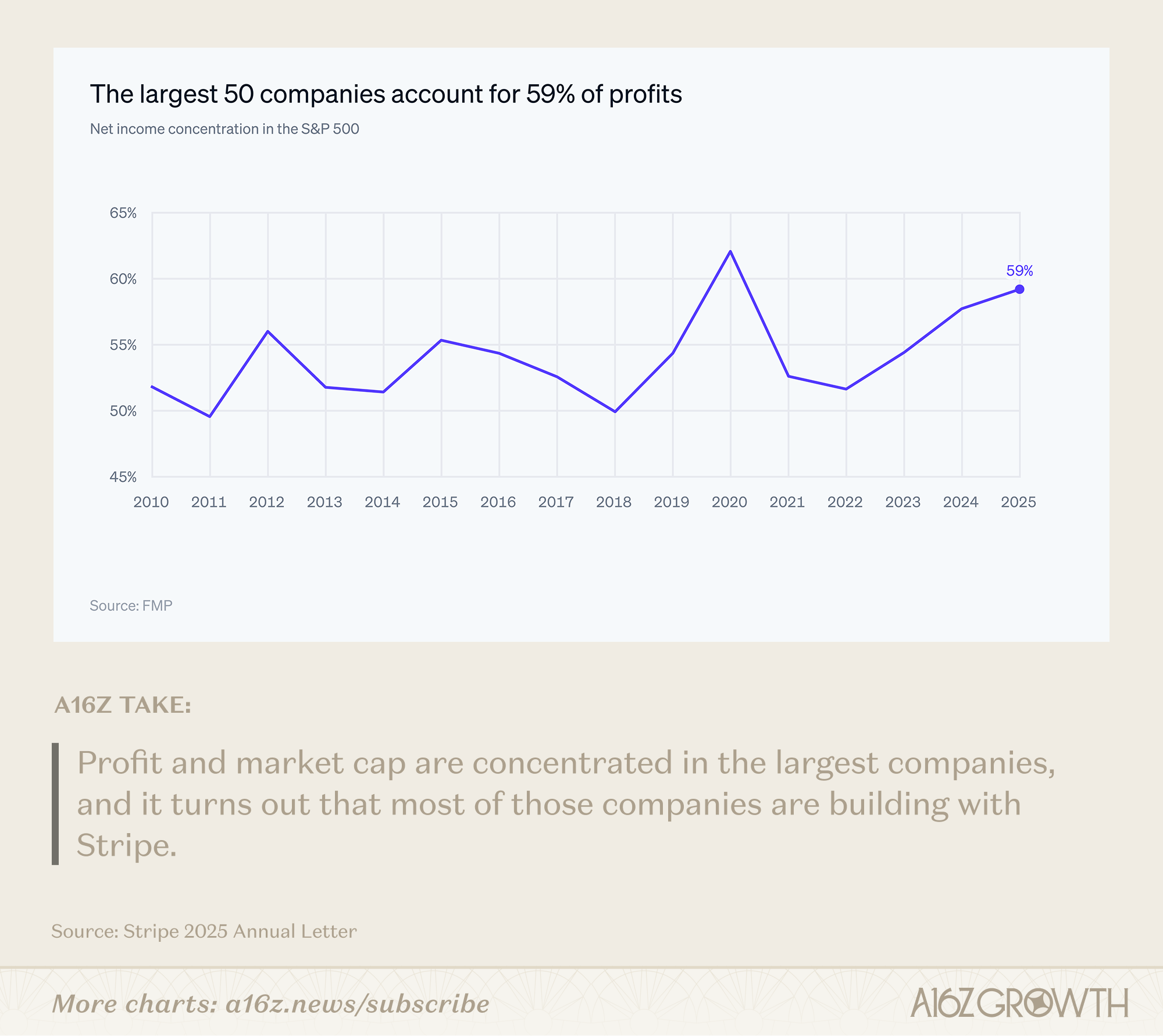
Profit and market cap are concentrated in the largest companies, and it turns out that most of those companies are building with Stripe:
Last year, businesses running on Stripe generated $1.9 trillion in total volume, up 34% from 2024, and equivalent to roughly 1.6% of global GDP.
Our programmable financial services now power more than 5 million businesses directly or via platforms, including all of the top AI companies, many of the largest blue-chip companies (90% of the Dow Jones Industrial Average), most of the biggest tech companies (80% of the Nasdaq 100), and a significant fraction of freshly minted startups (25% of all Delaware corporations are now created with Stripe Atlas).
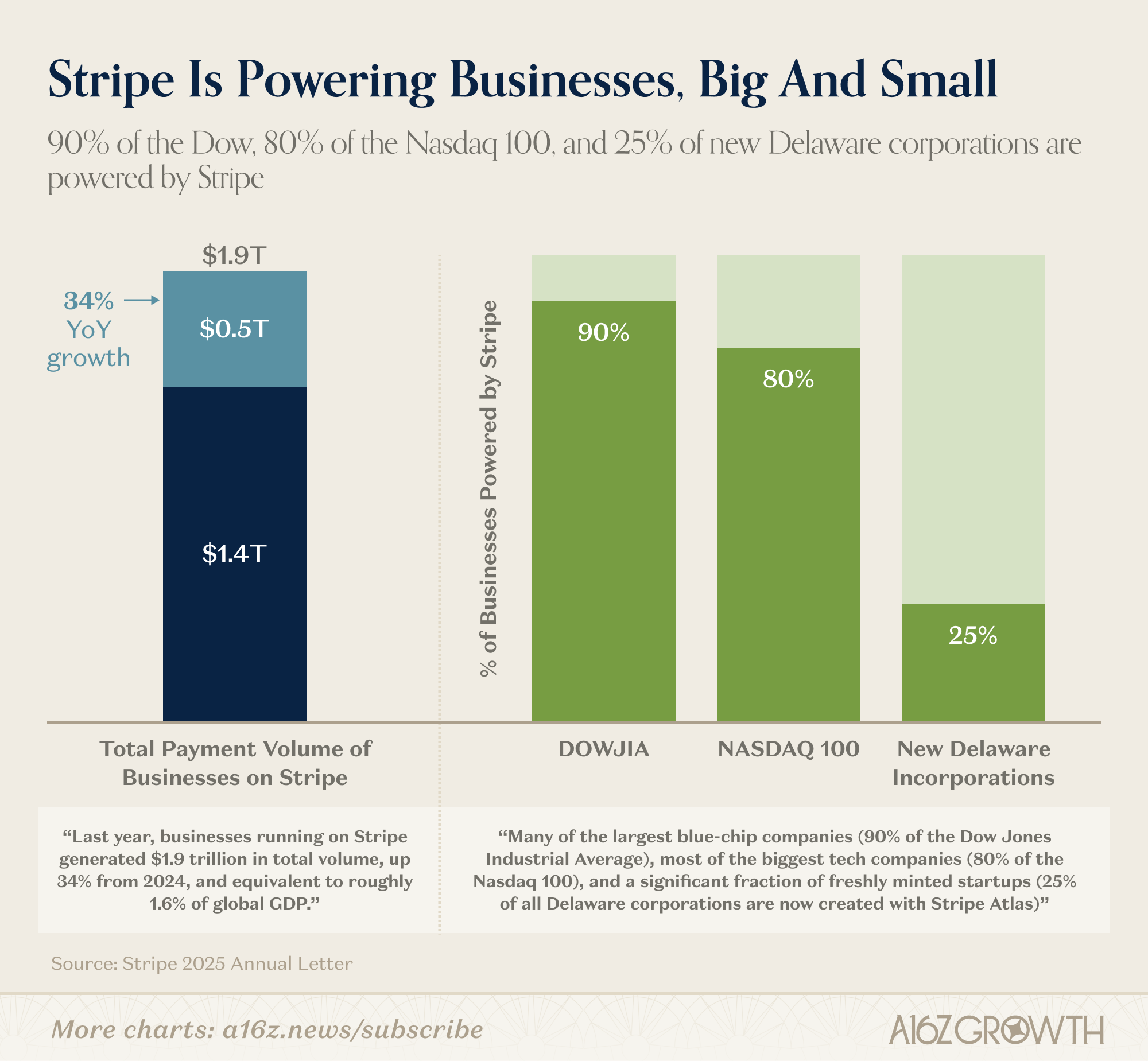
What started as “if you are a startup and you charge customers, you build on Stripe” has increasingly become “if you’re any company of consequence and you charge customers, you build on Stripe.” And we have observed with this next wave, “if you are an AI company and charge customers, you build on Stripe.”
You also grow with increasing alacrity. Again, Stripe:
In 2025, many more new companies joined Stripe than ever before, with more than half of them (57%) based outside the US. This new cohort is by far the highest performing and fastest moving we’ve ever seen, growing around 50% faster than the 2024 cohort. The number of companies reaching $10 million ARR within 3 months of launch was double the 2024 count… Atlas companies are monetizing sooner: in 2025, 20% of Atlas startups charged their first customer within 30 days, up from 8% in 2020.
“Highest performing and fastest moving” indeed.
Internet is driving retail
Ecommerce is all the commerce:
In retail, for example, US brick-and-mortar sales grew just 5% over the past three years, whereas ecommerce sales grew 30% over the same period (both in inflation-adjusted terms).
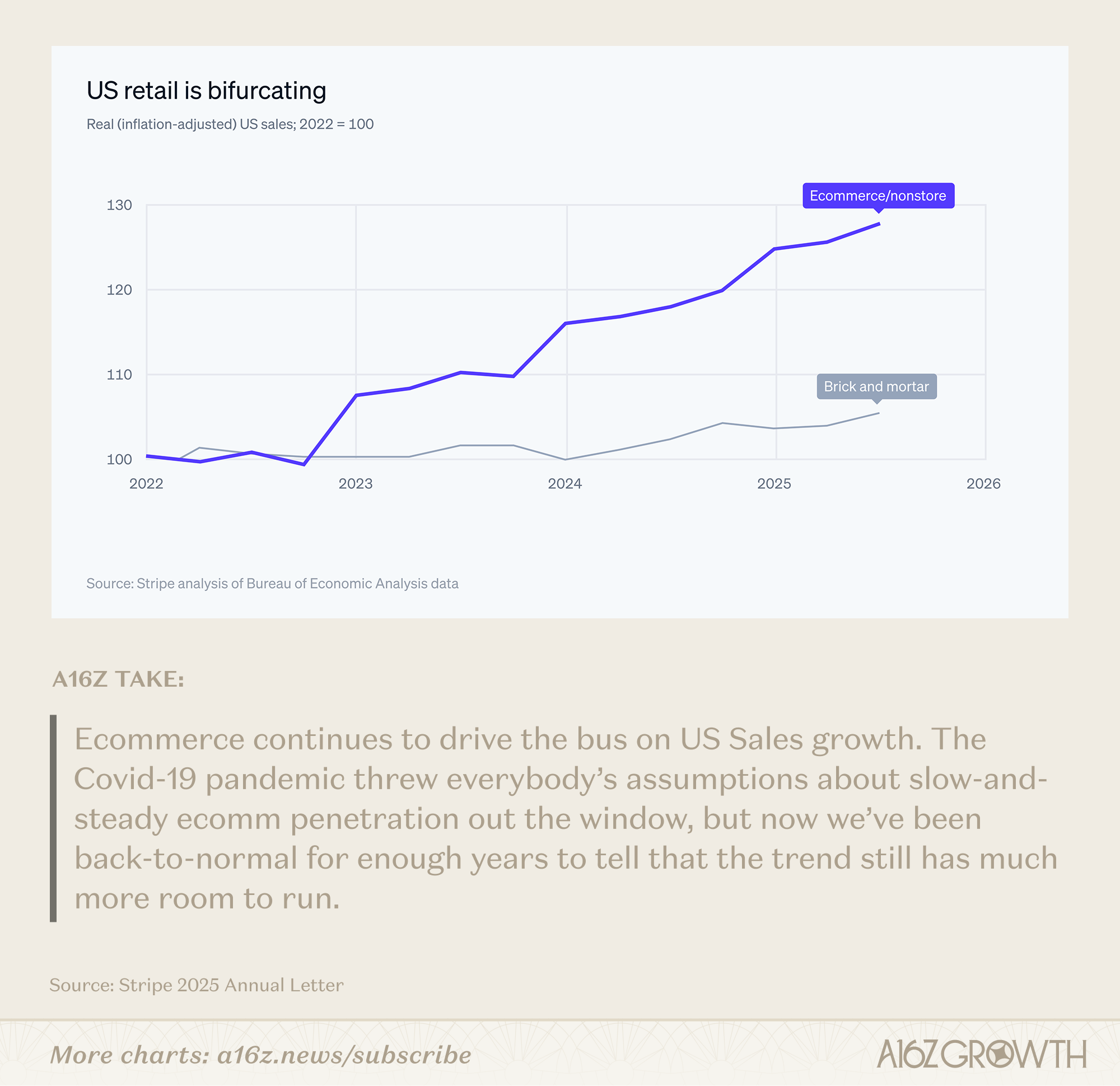
Ecommerce continues to drive the bus on US Retail Sales growth.
The Covid-19 pandemic threw everybody’s assumptions about slow-and-steady ecomm penetration out the window, but now we’ve been back-to-normal for enough years to tell that the trend still has much more room to run.
Software (and hardware) is eating the economy
2025 included a record-breaking contribution of tech to GDP
Economy-wide, demand for software, computers, and data center investment drove nearly half of all US GDP growth in 2025 and will likely soon be the majority of US growth:
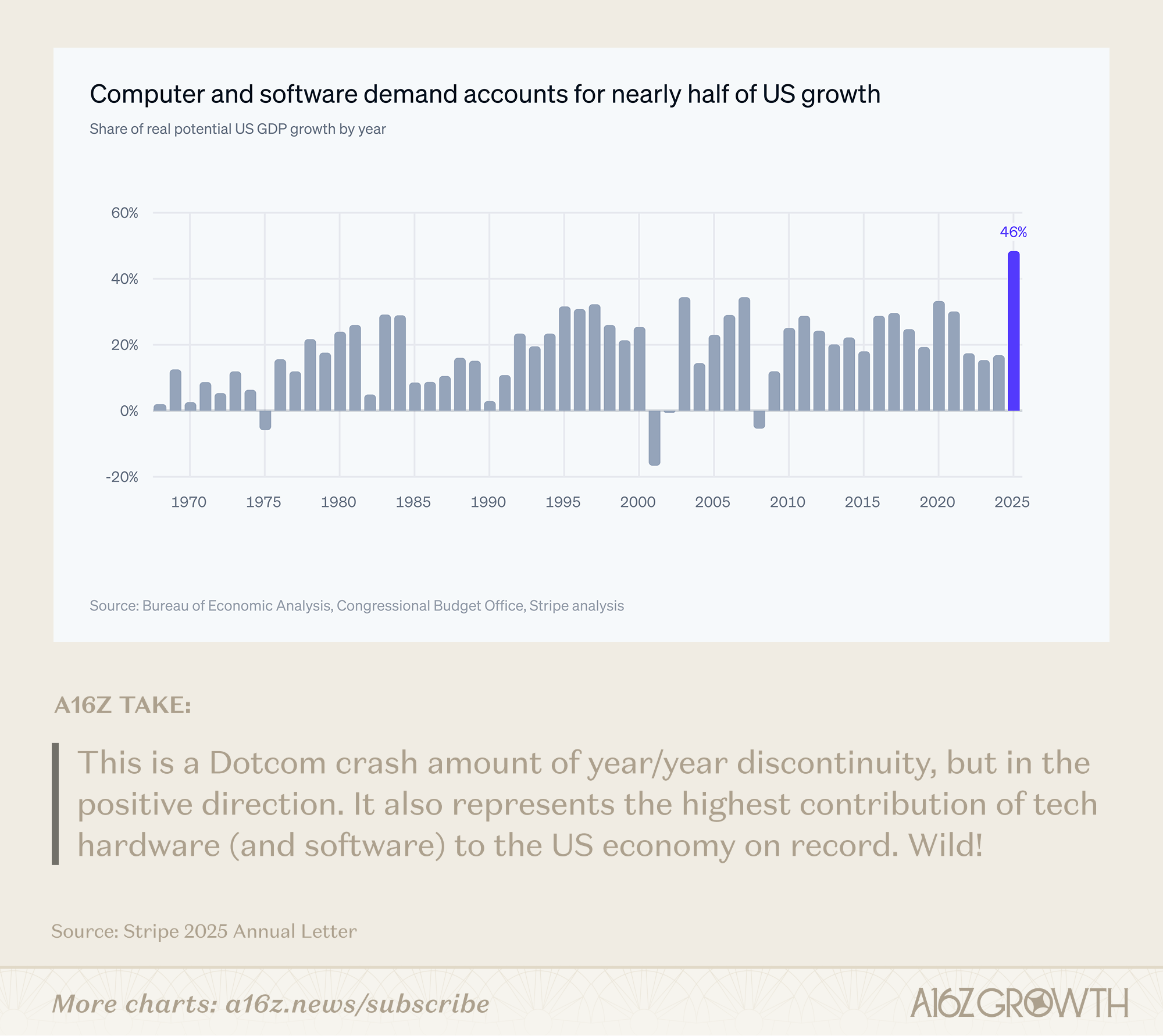
We love this chart because it tells so many stories at once.
First (this is beside the current topic, but still very neat), you can see how computers had two completely distinct “takeoffs,” (1) in the 70s as businesses adopted “computing” and then (2) from the 80s onwards, as people and businesses adopted personal computers.
Second, while you can see the Dotcom crash on this graph from across a room (as you’d expect), 2008 also sticks out a little bit on the general malaise front - although it wasn’t quite R.I.P. Good Times if you made software, in hindsight.
But the main event of this chart is what’s happened since 2010. Computer & software demand just clocked steady 20% or so contribution to GDP growth, year after year, until it absolutely exploded upwards in 2025. That’s a Dotcom crash amount of discontinuity, but in the positive direction. It also represents the highest contribution of tech hardware to the US economy on record. Wild!
Now, while not all of this “Computer & Software” GDP is powered by Stripe (though they hopefully will get all the data centers eventually…), the economy that’s built on all this hardware is most definitely powered by Stripe, and that’s a pretty big deal.
Stepping into the small business lending void
After the GFC, small business lending changed, but Stripe has offered a fix.
The broad trends, post-Dodd-Frank, are the same: tightening of bank rules and reduced access to capital for small businesses. Since 2010, loans above $1 million are up 68%, while loans under $1 million are down 5%. Only 41% of small business loan applications were approved in the US last year, down from 50% in 2015.
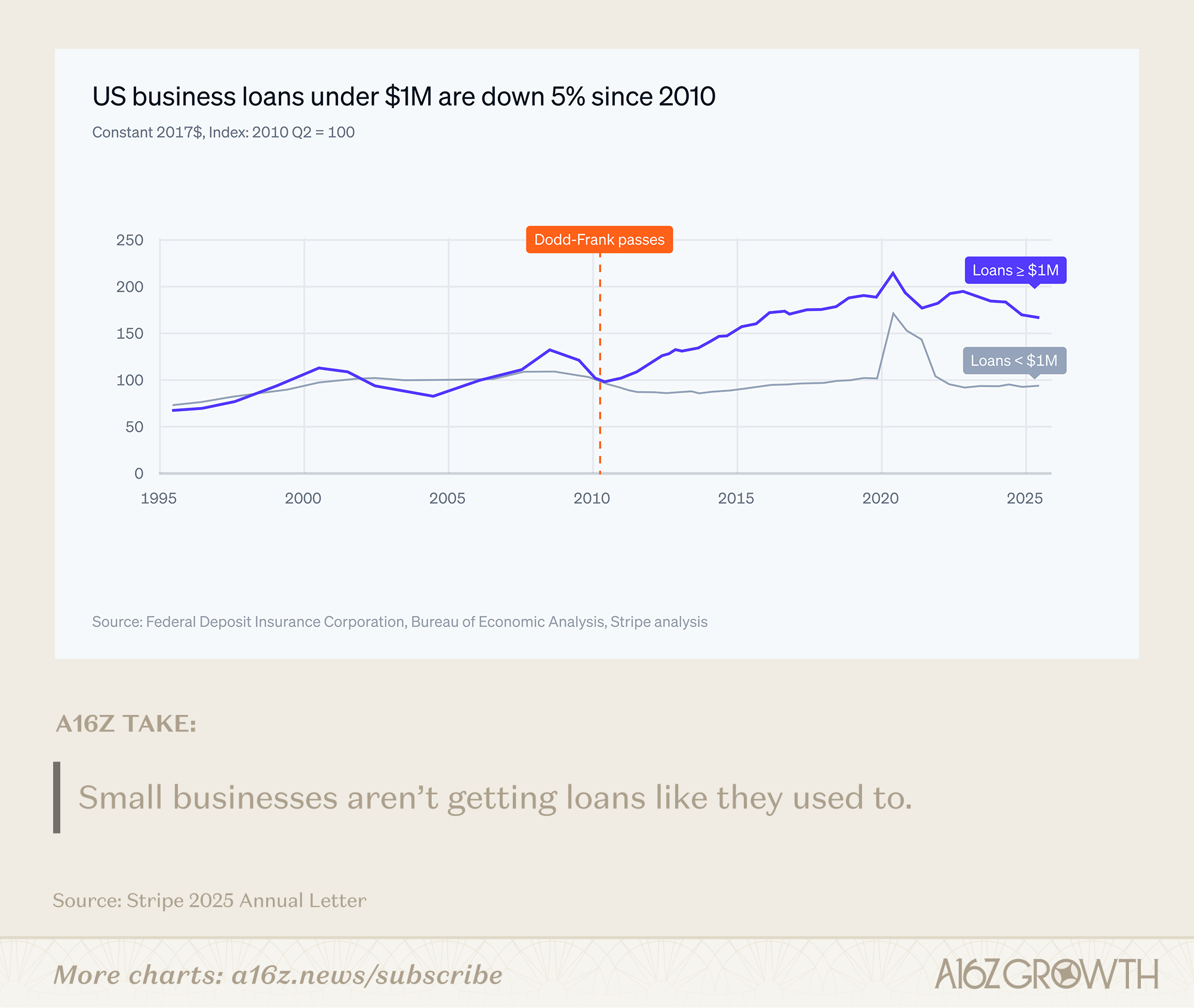
. . . We created Stripe Capital to help solve the global paucity of access to capital, especially for small businesses. For businesses that use Stripe to accept payments, their real-time revenue data makes for a simple input to a lending decision . . . Funding volume grew 45% from 2024 to 2025, with Stripe Capital supporting more than 81,000 businesses . . .
Over the last two years, we ran a randomized study to understand the impact of Capital: when we help businesses grease their wheels, how fast can they grow? Turns out, a lot faster. Businesses that received and accepted Capital offers grew, on average, 27 percentage points faster over the following year than otherwise equivalent businesses who didn’t. The averages conceal a wide spread. The fastest-growing decile of financed businesses grew more than 3× faster than comparable peers; the next decile grew nearly 100 points faster.
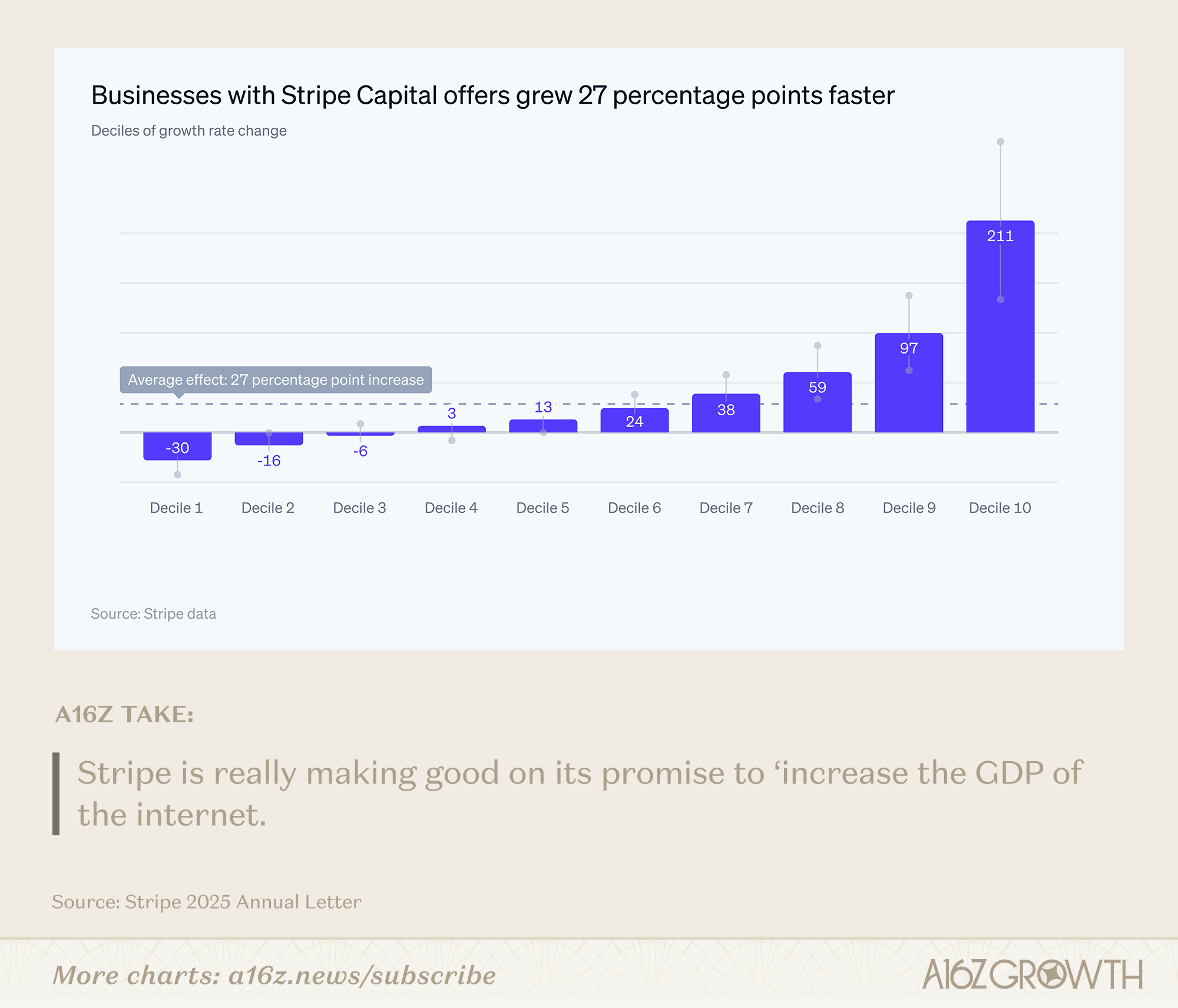
There’s really two points to be made here.
First is that by stepping into the small business lending void, Stripe is powering the “startup” economy, with a far-more diversified base of investments than any VC, but is also underwriting these loans with visibility into revenue that no bank could really emulate.
Second is that Stripe quite literally making good on its promise to “increase the GDP of the internet,” by financing the growth of its customers—at the high end, that growth is 2-3X the rate of peer companies.
Good stuff.
Thanks to Stripe for all of the work that went into this report, and for all the work that goes into powering the digital economy.


This newsletter is provided for informational purposes only, and should not be relied upon as legal, business, investment, or tax advice. Furthermore, this content is not investment advice, nor is it intended for use by any investors or prospective investors in any a16z funds. This newsletter may link to other websites or contain other information obtained from third-party sources - a16z has not independently verified nor makes any representations about the current or enduring accuracy of such information. If this content includes third-party advertisements, a16z has not reviewed such advertisements and does not endorse any advertising content or related companies contained therein. Any investments or portfolio companies mentioned, referred to, or described are not representative of all investments in vehicles managed by a16z; visit https://a16z.com/investment-list/ for a full list of investments. Other important information can be found at a16z.com/disclosures. You’re receiving this newsletter since you opted in earlier; if you would like to opt out of future newsletters you may unsubscribe immediately.
The K shaped economy lives!
I am particularly interested in their Minions project. Will it move into the space along side with Anthropic, ChatGPT, Gemini?