



America | Tech | Opinion | Culture | Charts

You know the line: “We shape our tools, and thereafter our tools shape us.” (It’s often attributed to Marshall McLuhan, but it’s actually from John Culkin, a Jesuit priest who became friends with McLuhan, and eventually became a notable media critic.) We say it in tech a lot, because that’s the long arc of technology: the long term impact is the behavior that changes, and the new ways we organize ourselves.
Accounting is a slow-moving practice where technology seems to move at a glacial pace. This isn’t always a bad thing; common accounting principles and practices are a shared public good, and they can’t evolve too quickly for that reason. But still, there’s no reason why bookkeeping can’t get better, as technology gets better.
The big change happening in corporate bookkeeping today, which is actually quite profound if you think about it, is that “closing your books” - a centuries-old practice - is becoming obsolete. Month-end, which used to be a scramble to reconcile everything and get the numbers to zero out, is now just another day.
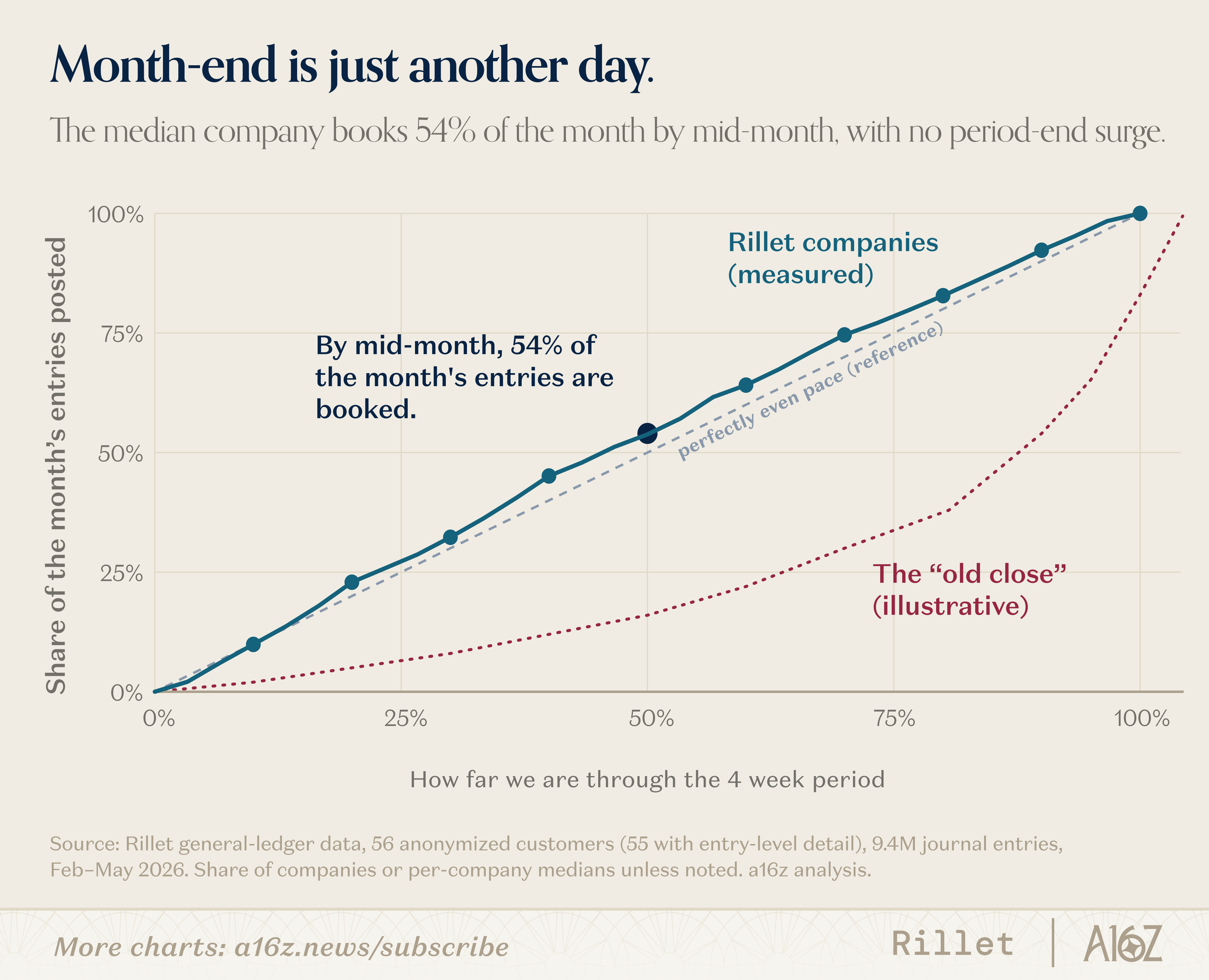
We learned this and more by going into the numbers with Rillet, the AI-native ERP system, who made this chart deep dive with us this week. We sampled 56 companies that run on Rillet, who are early adopters of an AI-native ERP (and obviously not a random sample of finance teams!) So think of these numbers as a guide towards where we’re heading, and where “the future is unevenly distributed”, with this in mind.
RIP “The old close”
Rillet makes an ERP system that’s very different from competitors like NetSuite and Microsoft Dynamics: they built it from scratch to process transactions the moment they arrive, and “continually close” a ledger that’s always accurate, complete, and reviewable. Internal corporate controls and audit trails (important for SOX compliance and the like) move upstream, meaning the team is still reviewing, approving, and exercising judgment; just continuously, rather than in monthly scrambles.
It seems obvious that things should work this way; but oddly enough, this was a technology limitation until recently. (Both human bookkeepers and traditional software would rather batch-process a system like this, whereas AI that never gets tired is fine with doing it continuously.) This means that the “continuous close,” an accounting practice that everybody wants, as soon as they see it, is actually a tech product. Funny how these things work.


For companies using Rillet’s ERP system, the “Old Close,” meaning the bookkeeping entries that get manually reviewed and reconciled at the end of the period, is now just a tiny sliver of the ledger. Only a tiny fraction of the journal entries we surveyed were manual. An important fraction, absolutely: no business of a meaningful size will ever operate at 0% adjustments; you need that slack in the system to operate a company in the real world. But most of the entries (99.86% of what we saw) are just… done.
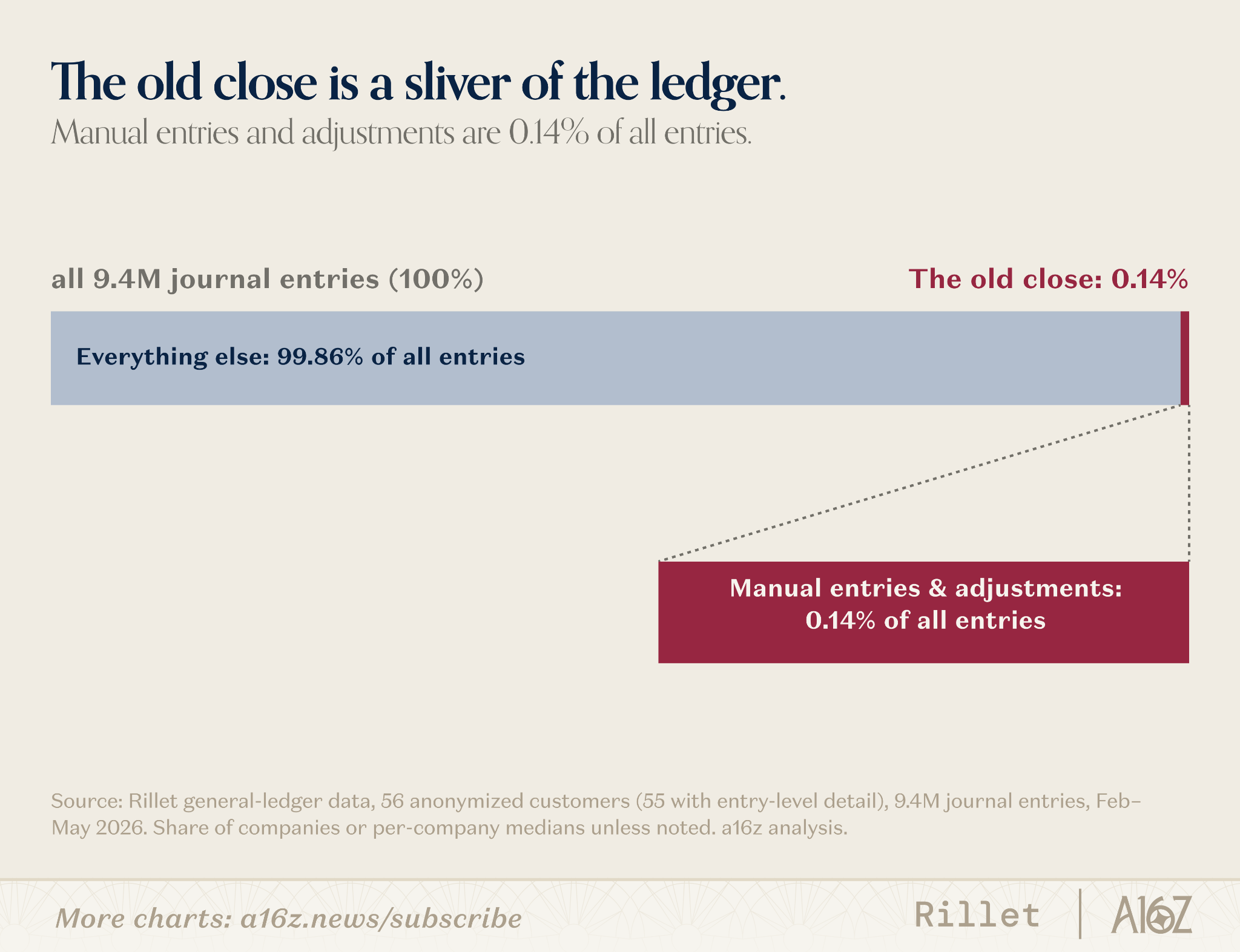
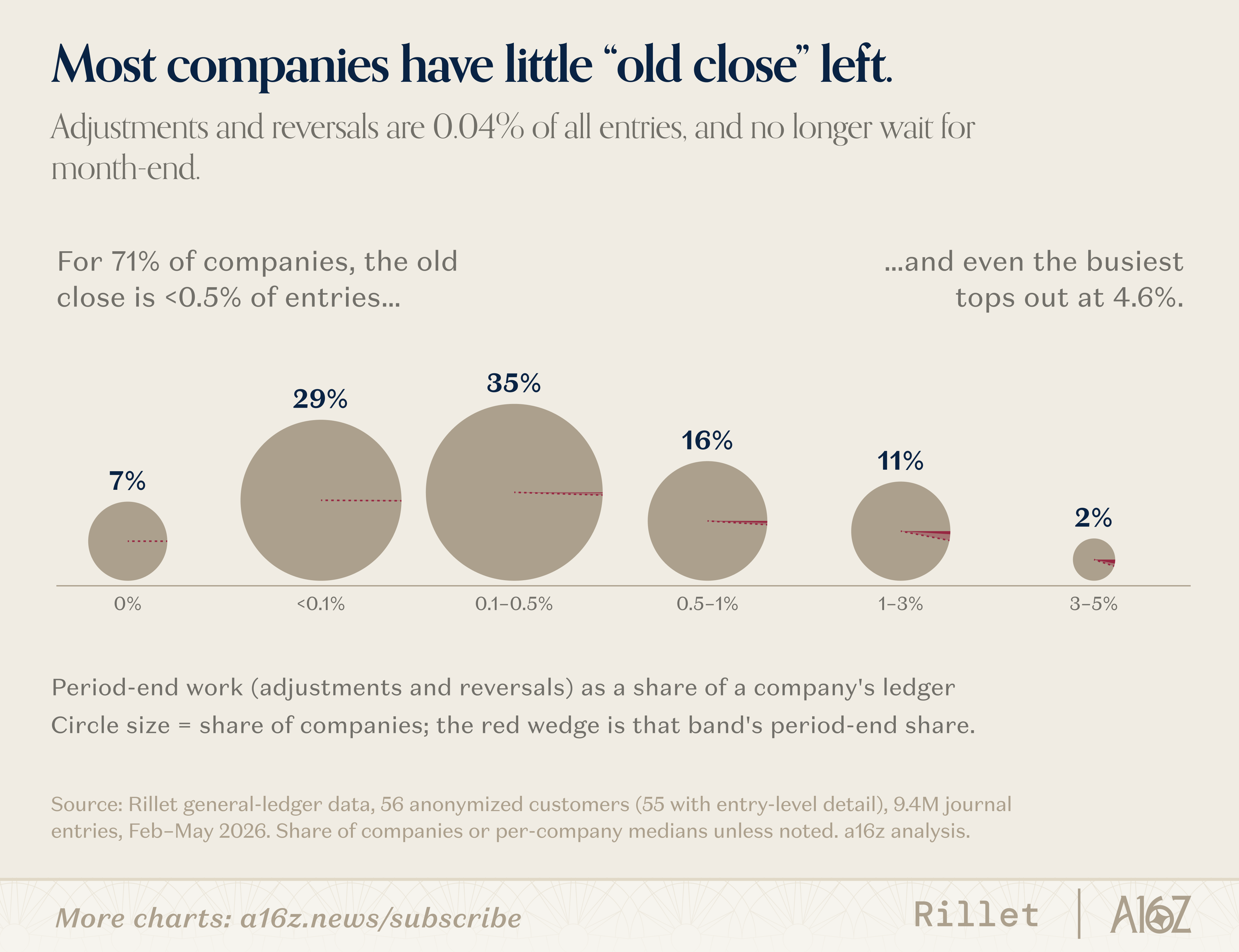
Of course, not all companies are alike. Even among Rillet’s customers, there’s a pretty wide distribution. 87% of companies are looking at less than 1% of bookkeeping entries that have to be looked at during month-end, whereas 2% are still doing more of an “old-fashioned close”.
If you’re a software company, your books were getting automated anyway
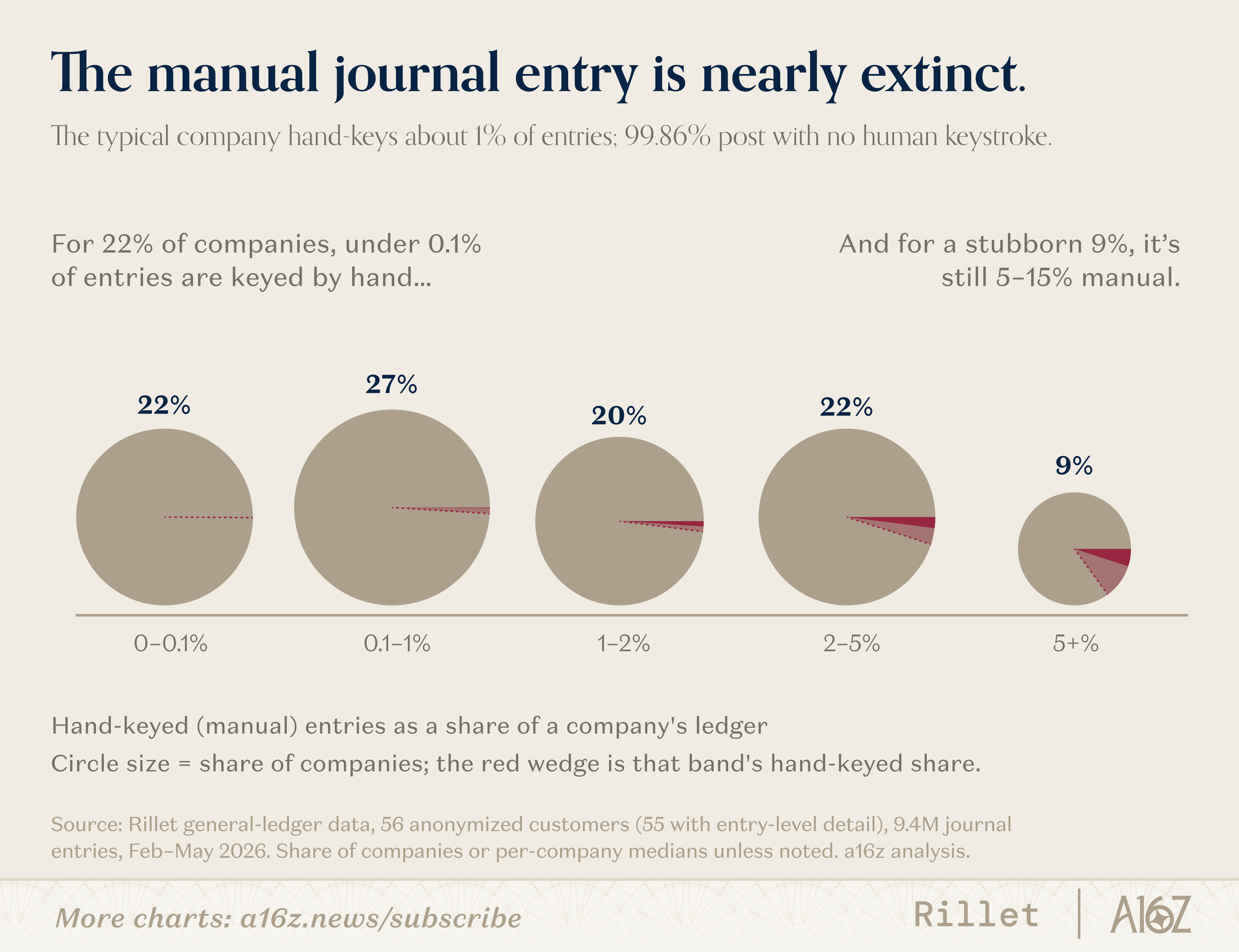
The other meaningful bookkeeping change, which is pretty inevitable for modern companies, is that almost all bookkeeping entries at this point are getting automatically pulled in from various data sources, as opposed to getting hand-keyed in by a person. (“Non-manual” here means an entry posted without a human keystroke, covering recurring, system, integration, and AI-generated entries. It does not mean a model contributed or reviewed each line.)
But as before, the future is unevenly distributed! Some companies are still keying in 5, 10, even 15% of entries manually.
That’s because, in these businesses, there’s a common tech stack pulling everything in, with some familiar names:
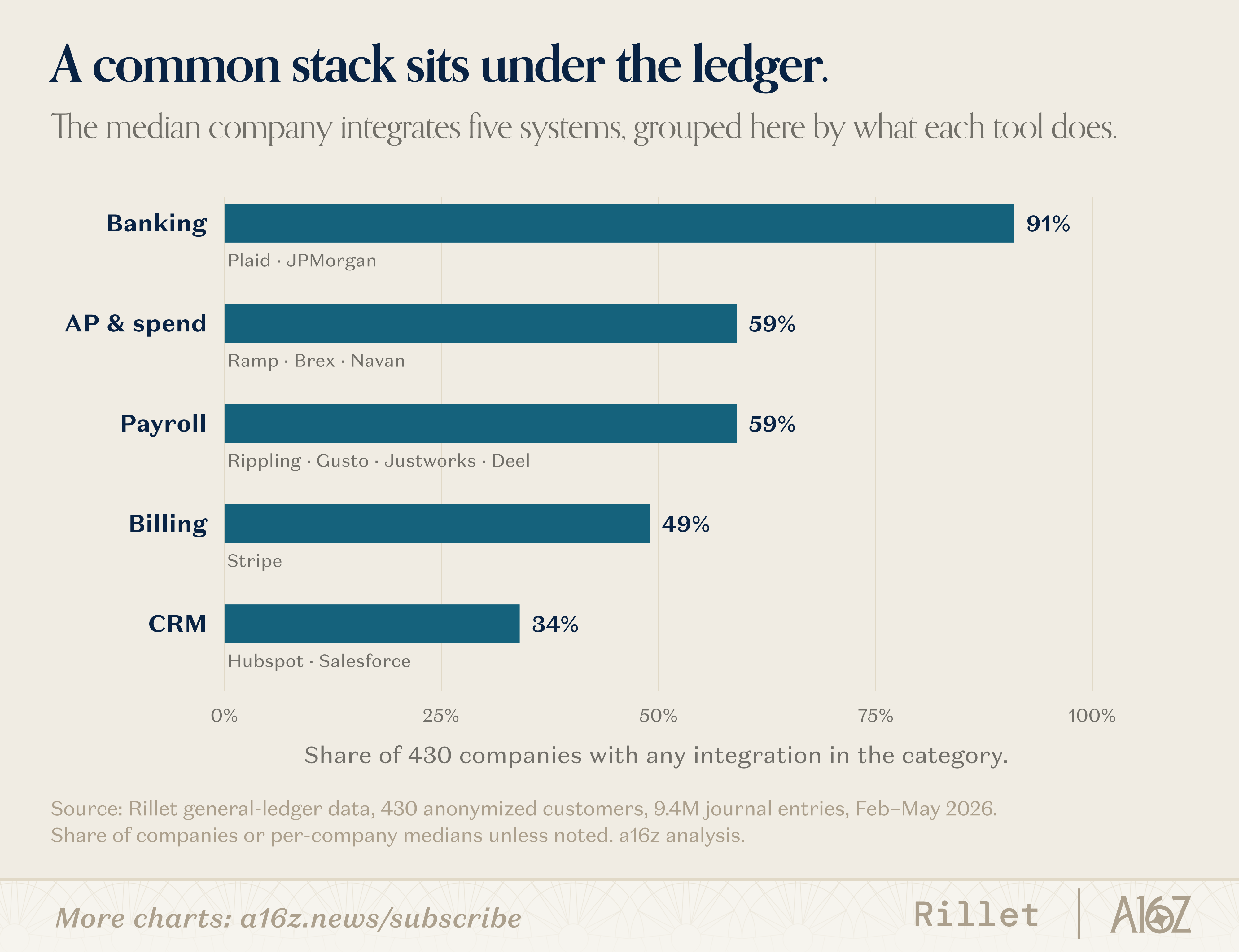
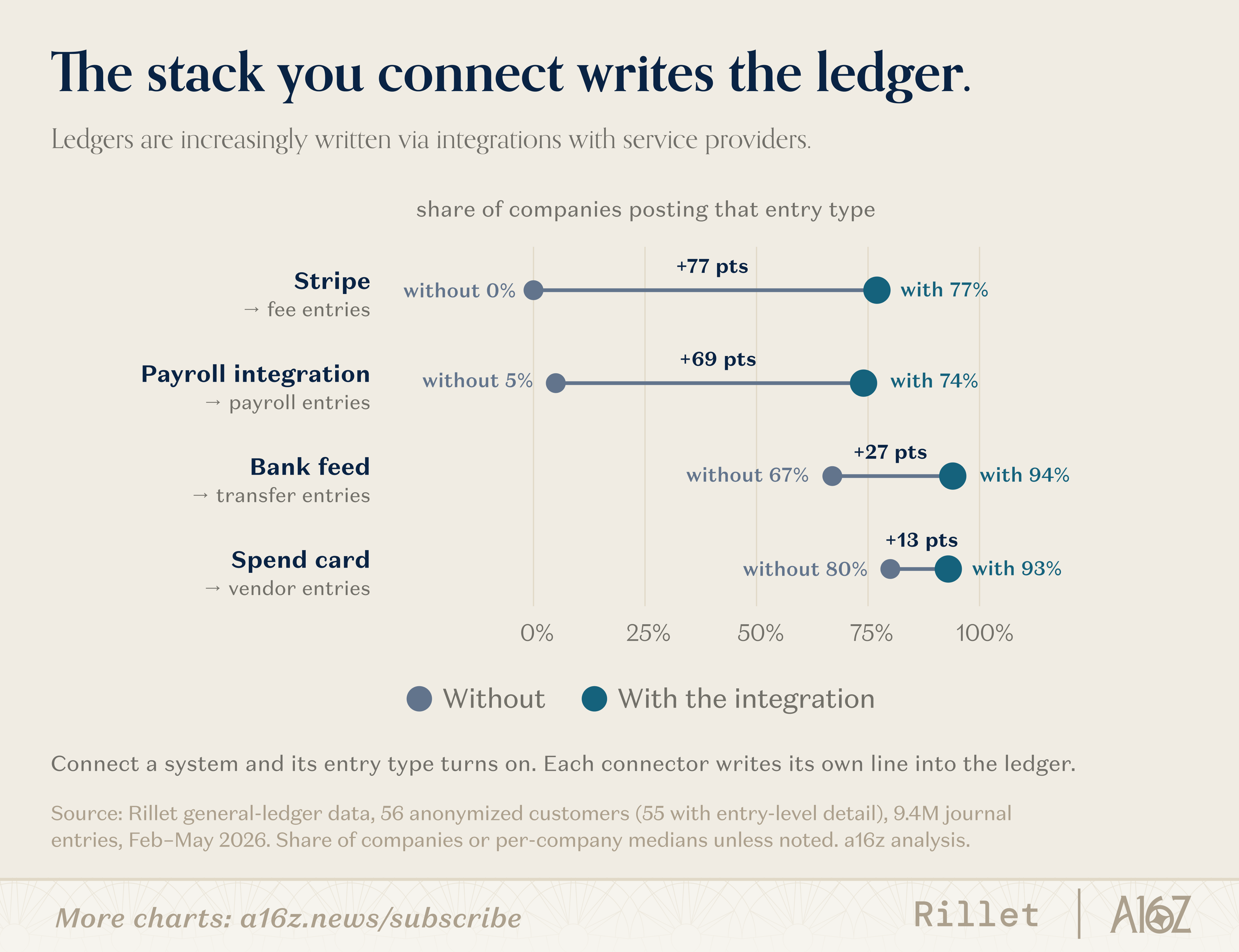
And, sure enough, the type of entries you see on a ledger maps pretty reliably to what kind of data integrations are hooked up to the ERP:
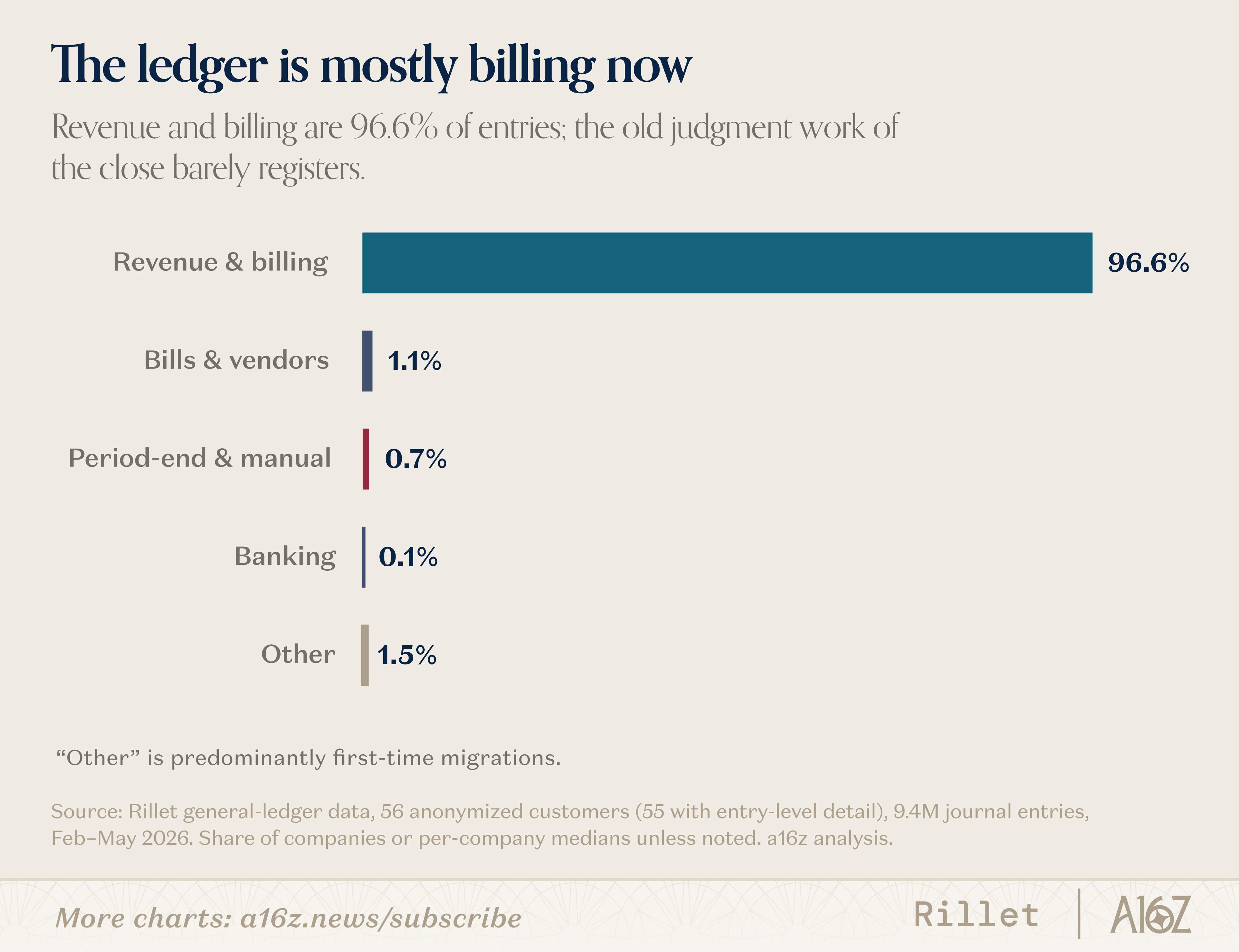
What’s in those entries? Revenue and billing, pretty much, if you look at it by total volume. (Which makes sense; you probably have more individual entries coming in than coming out, unless you’re a highly complex service provider with a small number of big clients!)
A note on our data here: The small share of “Other” is mostly one-time migration reversals from companies moving onto Rillet.
RIP period-end? Not quite.
The “old-fashioned close” isn’t entirely gone, though; even with a modern setup like Rillet, there’s still some work going on at period-end. Unsurprisingly, B2B companies have more than four times as much period-end work as B2C companies. (Although the data ranges are comparable!)
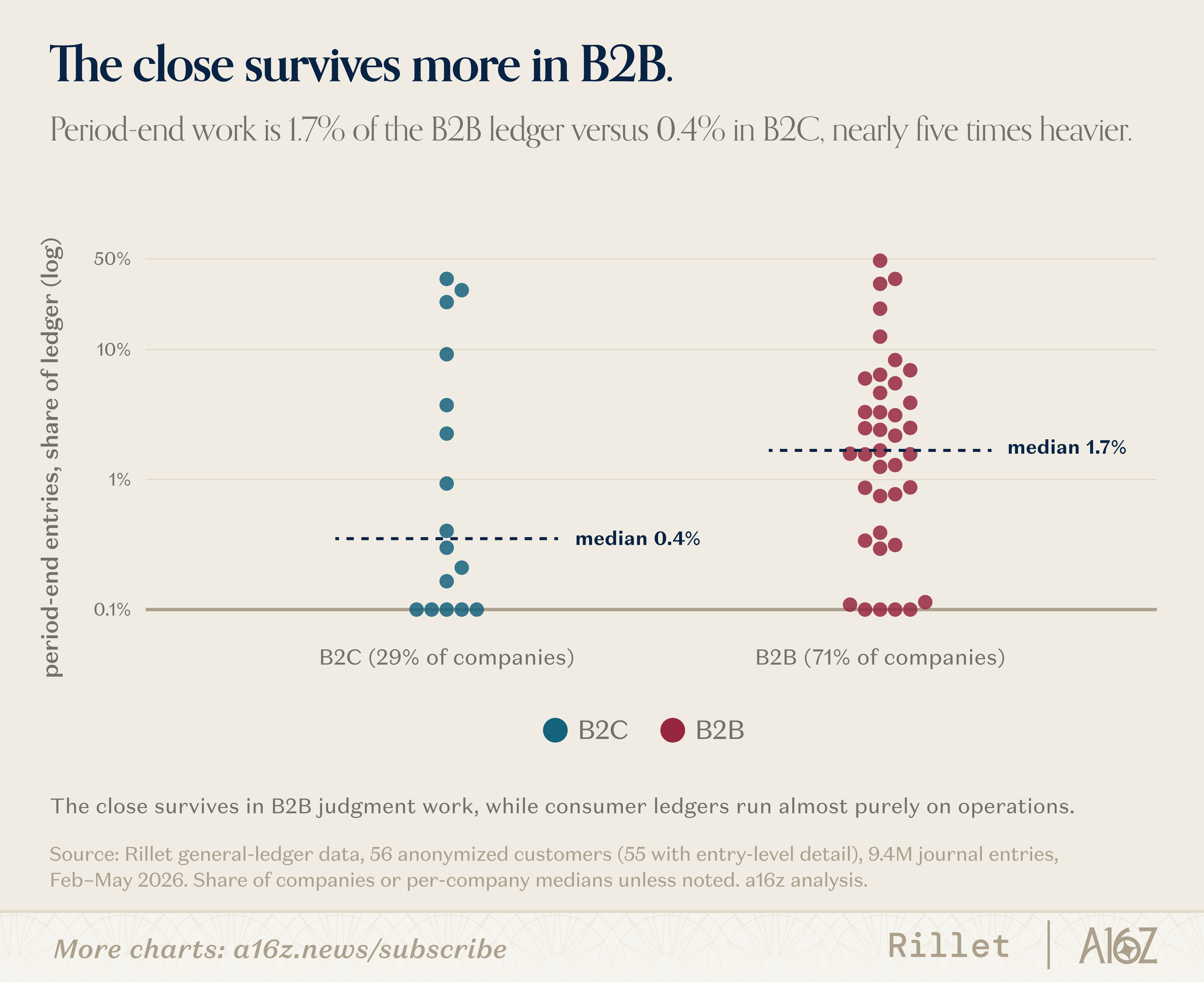
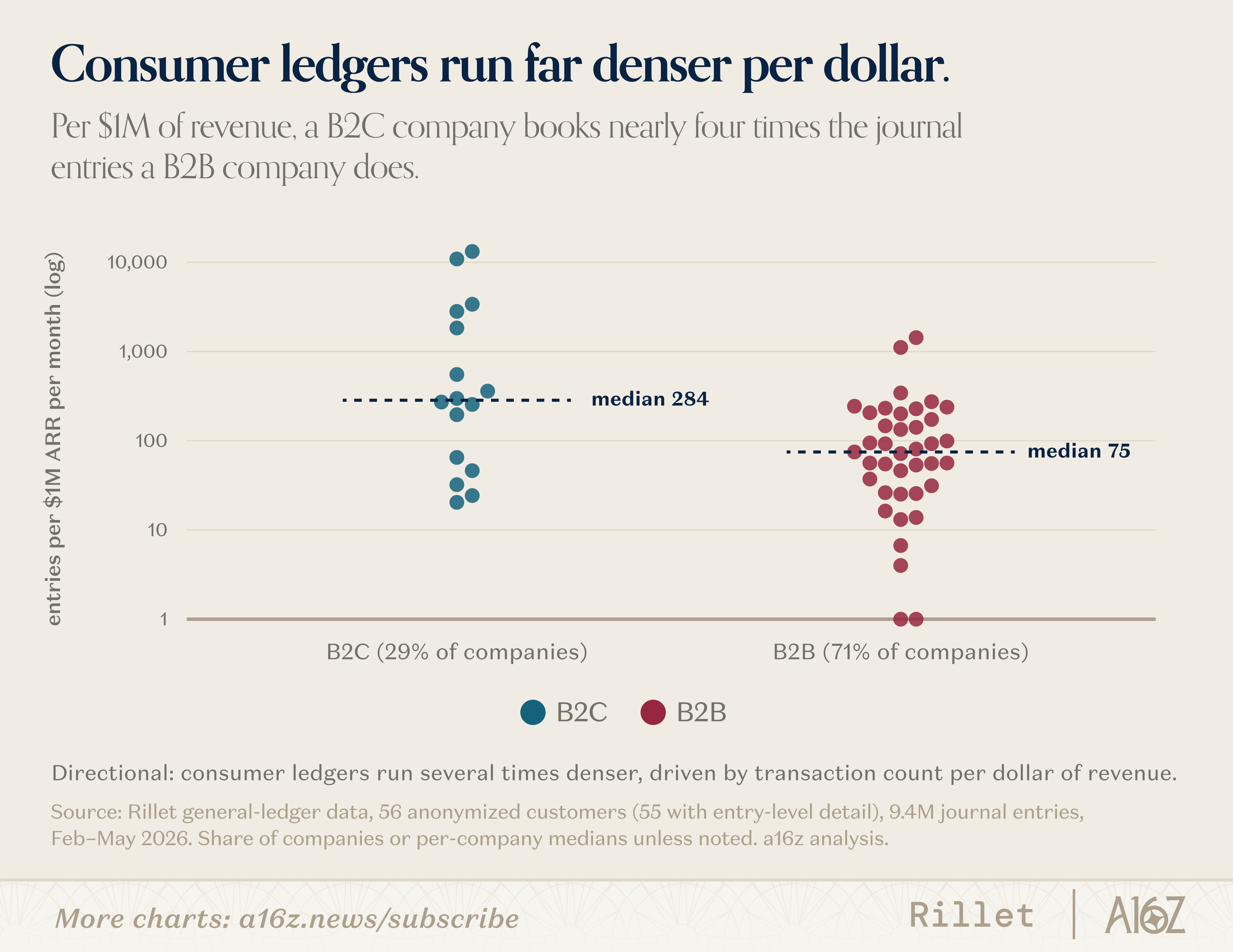
Although this isn’t because of the quantity of entries. Consumer ledgers actually have a lot more entries, per dollar of revenue, than B2B companies. B2B products, by their nature, have more complex service in them versus consumer products and therefore have more reason to make sure that more human judgment goes into finalizing the accounting.
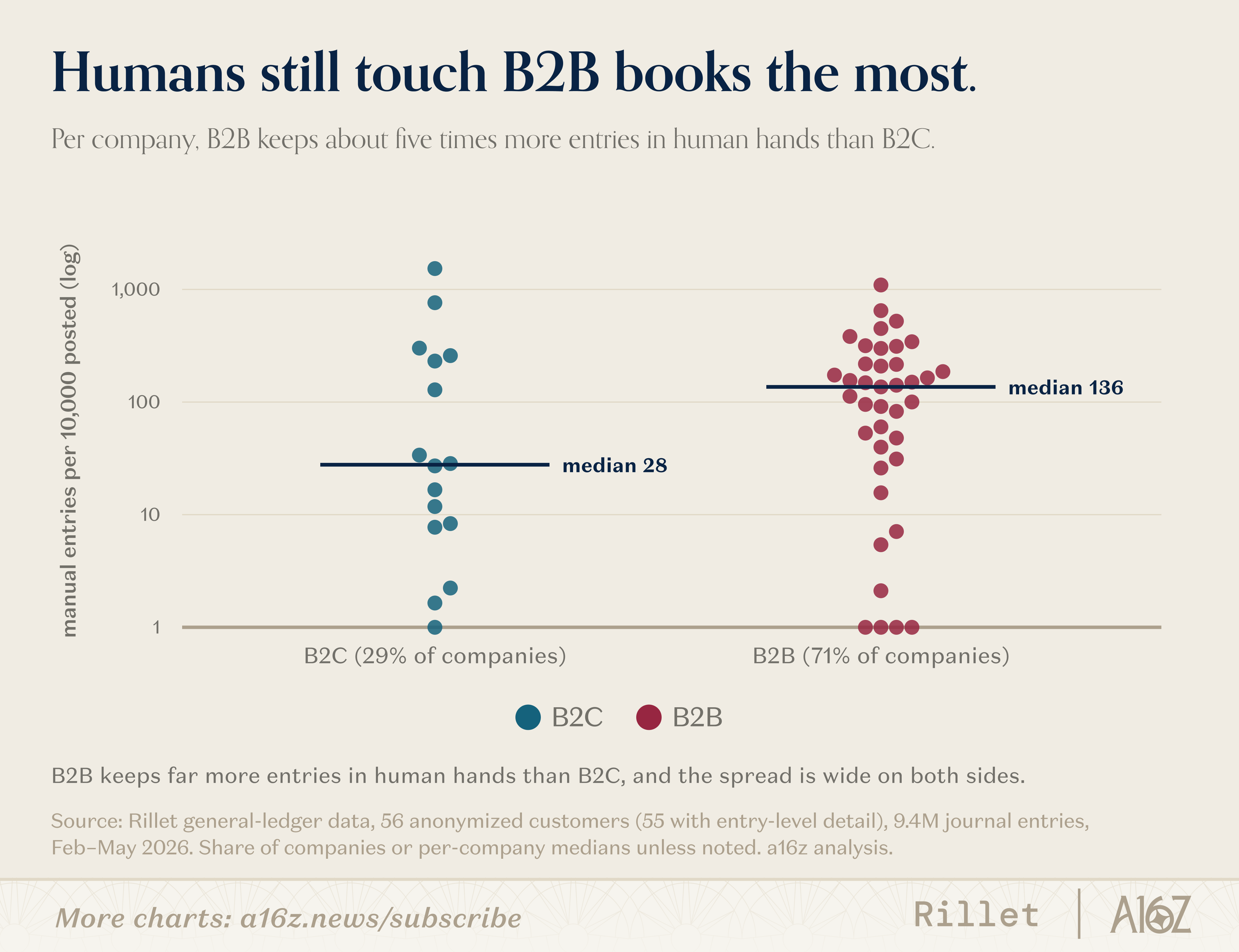
So, just as B2B books have ~5x more period-end work, they also have ~5x more human-keyed entries, compared to consumer companies. (Although, again very interestingly, the ranges of the data are actually pretty comparable!)
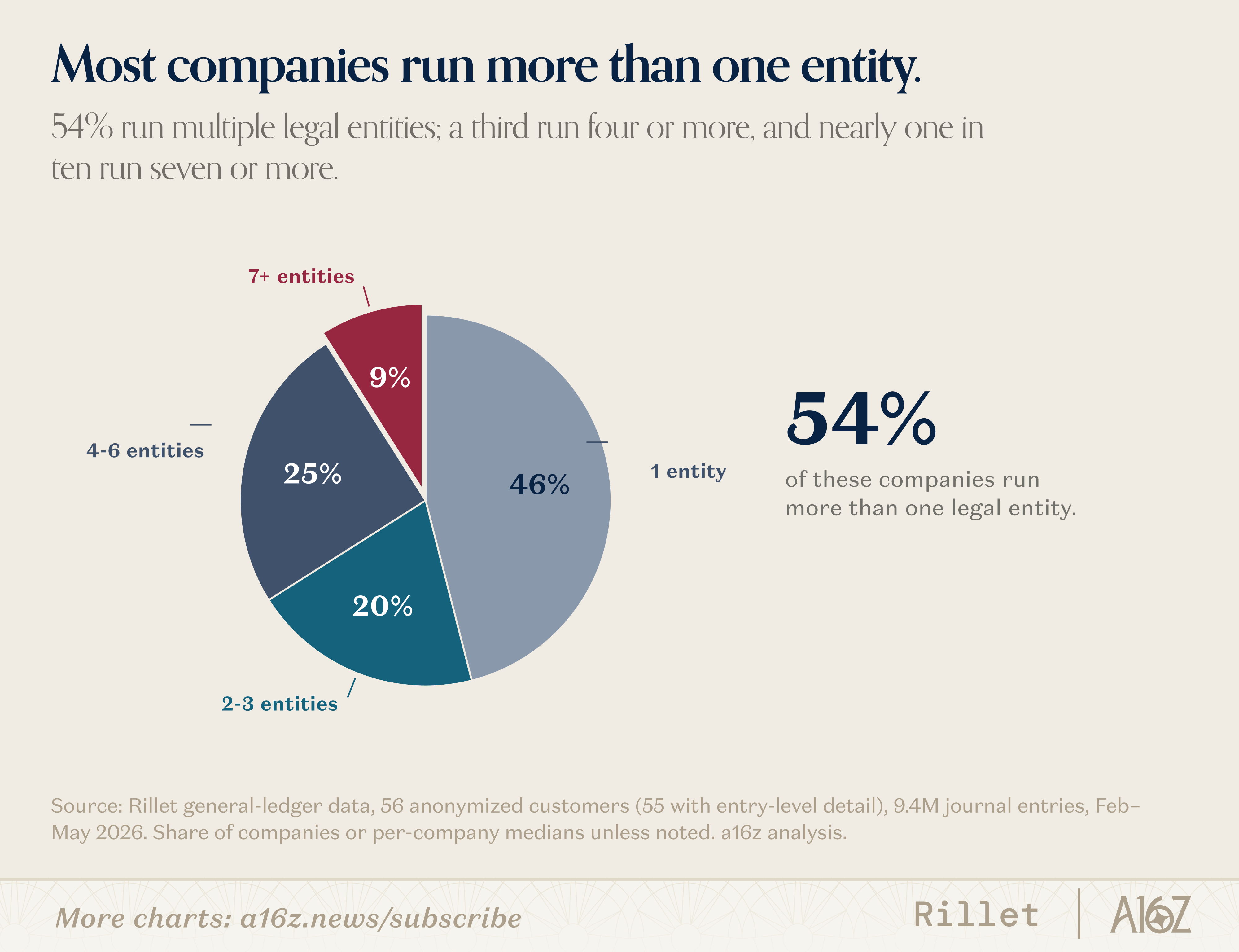
The other big factor that influences your ledger is how many corporate entities you have. Most businesses, as they grow, expand beyond a single corporate entity. And as you do, your bookkeeping gets more complicated.
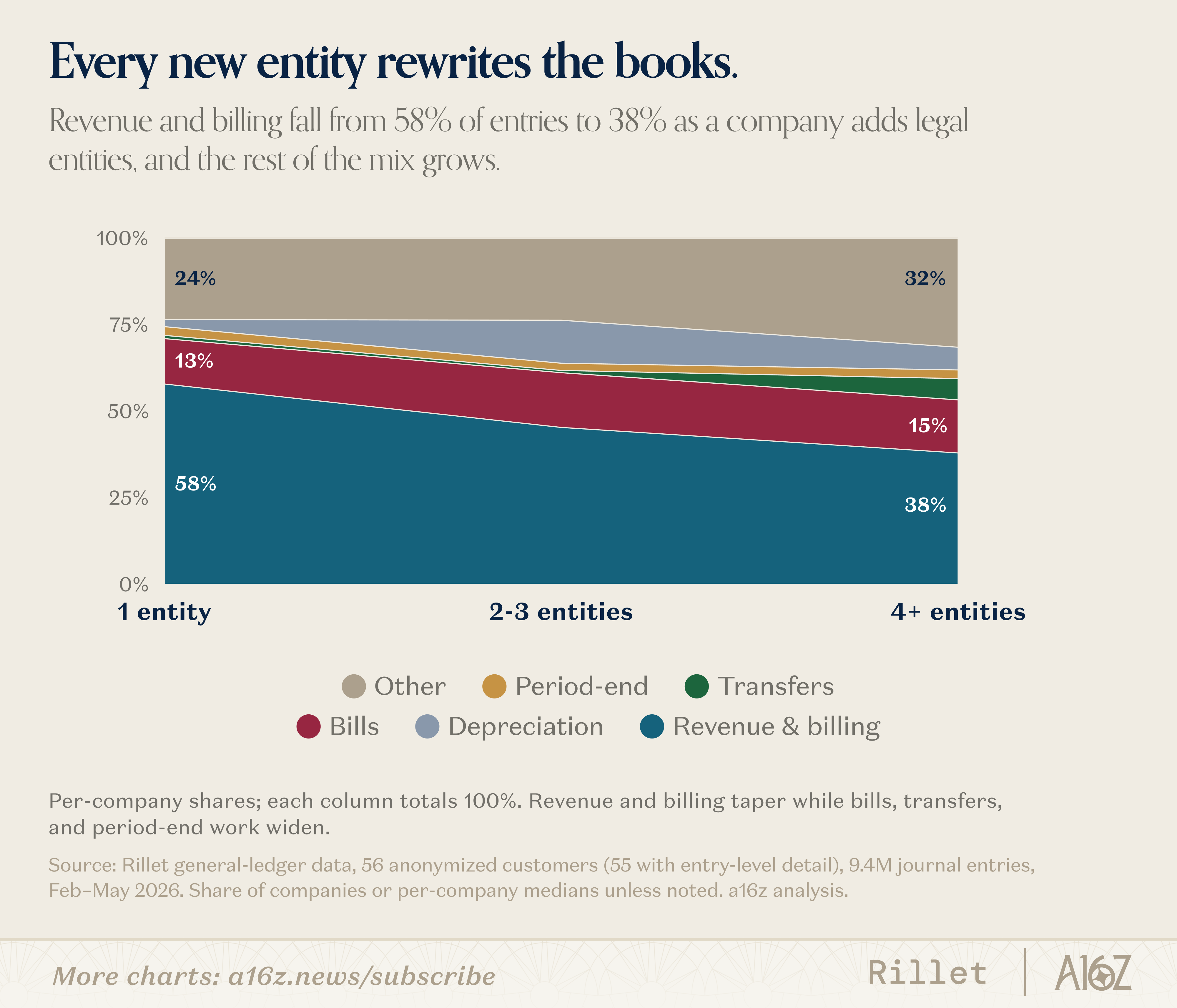
As you add more entities to a business, the composition of your books will start to change. As businesses on Rillet scale from 1 entity to 4+, Revenue and Billing as a fraction of the ledger decreases from 58% down to 38%. (This makes it all the more impressive, honestly, that their books can still continuously close!)
Back in 2020, a16z’s Angela Strange and Seema Amble drew the finance function as a pyramid: strategy on top, a broad base of transactional and reconciliation work below. They argued you could automate that base and let people climb, and called for “a new general ledger” that pulls in operational data in real time. Rillet’s data is what that base looks like once it’s automated: the rote entries write themselves off a connected stack, the manual journal entry is nearly extinct, and the close didn’t get killed; it got distributed across the month and shrank to a sliver. The work that’s left climbed the pyramid, into the judgment that still clusters in B2B and multi-entity books.
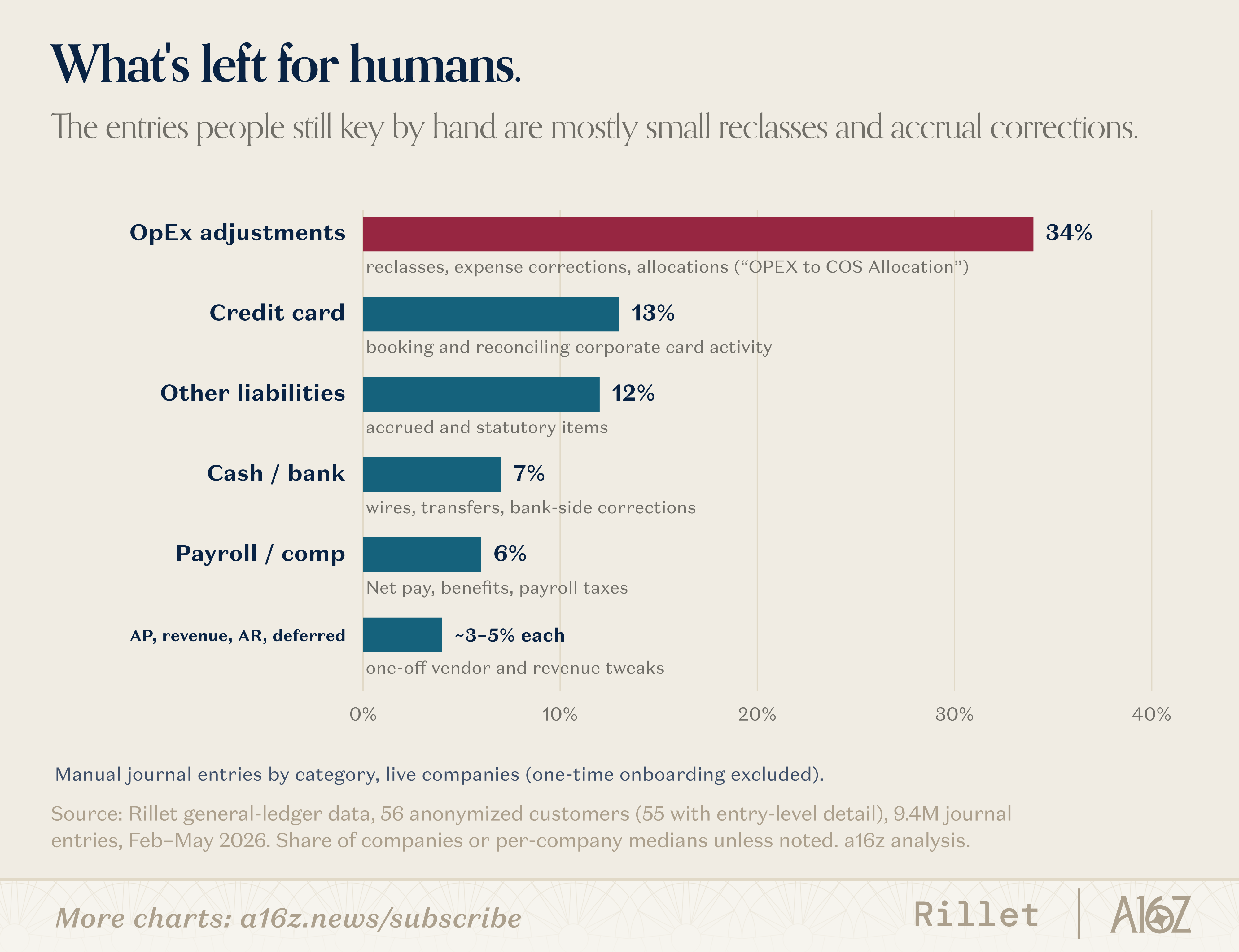
We shape our tools, and then they shape us: Rillet’s data shows that a ledger that never needs to rest turns the month-end event into a daily habit. As the tooling improves and more companies start out AI-native, we’d bet these lines keep running, and that the back office is just the first function rebuilt this way.
Subscribe for more from a16z, including weekly data on how sectors are evolving, straight from the companies operating at the frontier.


This newsletter is provided for informational purposes only, and should not be relied upon as legal, business, investment, or tax advice. Furthermore, this content is not investment advice, nor is it intended for use by any investors or prospective investors in any a16z funds. This newsletter may link to other websites or contain other information obtained from third-party sources - a16z has not independently verified nor makes any representations about the current or enduring accuracy of such information. If this content includes third-party advertisements, a16z has not reviewed such advertisements and does not endorse any advertising content or related companies contained therein. Any investments or portfolio companies mentioned, referred to, or described are not representative of all investments in vehicles managed by a16z; visit https://a16z.com/investment-list/ for a full list of investments. Other important information can be found at a16z.com/disclosures. You’re receiving this newsletter since you opted in earlier; if you would like to opt out of future newsletters you may unsubscribe immediately.
It would be interesting to see the same numbers based on the posted amounts rather than a simple count of journal entries.
The important shift here is not that month-end disappears. It is that the work moves upstream.
Close pain has always been a diagnostic for operating architecture: integrations, source-system discipline, approval paths, entity structure, billing complexity, and where human judgment still has to sit.
AI-native ERP can shrink the scramble, but only if the company has enough process integrity to trust the standard path. Otherwise finance just gets a faster cleanup crew.
The close is becoming less of an accounting event and more of an operating-system test.