




America | Tech | Opinion | Culture | Charts
For more news from the a16z policy team, subscribe to their Substack.

Almost everyone in American public life learned how a bill becomes a law from the same place: a three-minute animated segment on Saturday morning television. The Schoolhouse Rock version is not wrong, exactly. But it leaves out nearly everything that matters in determining whether a bill becomes a law in today’s Congress.
Members of Congress have introduced hundreds of AI bills. What is their path to becoming a law? What kinds of bills are likely to survive the legislative process?
We’re fortunate at a16z to have a whole team of people who know exactly how an AI bill becomes a law, including Ben (one of the authors of this piece) who served as floor director for House Majority Leader Steve Scalise for several years. This piece breaks down the whole process from start to finish, including:
The funnel dynamics of proposing and passing bills (only 1.5% make it through!)
The structural hurdles and constraints of Congress, and how they shape AI legislation
How to evaluate the political viability of an AI proposal
What to watch for, if you think a bill will move (or won’t)
“Don’t just stand there, do something!”
Since the public emergence of generative AI tools such as ChatGPT in late 2022, there has been a frenzy among lawmakers at both the state and federal level to regulate artificial intelligence. While the states have successfully enacted a growing web of AI laws, the federal government has been slower to act. This is not for a lack of ideas. AI regulation is one of the most discussed topics among policymakers in Washington. In just the past two years, over 100 AI-related bills have been introduced in Congress, yet only one stand-alone bill, the Take It Down Act, has been signed into law.
At first glance, this gap invites familiar explanations. Some point to industry lobbying as the primary obstacle, arguing that technology companies have successfully blocked or weakened legislative proposals. Others cite partisan gridlock or the inherent difficulty of regulating a rapidly evolving technology. These arguments are frequently raised, and each may describe a real dynamic in specific cases. But none of them accounts for the more fundamental pattern: even proposals with broad bipartisan support and no organized industry opposition struggle to advance through Congress. The barrier is not simply political. It is structural, rooted not in how the legislative process looks on paper, but in the reality of how it plays out.
The US Congress is not designed to translate policy interest into law quickly or easily. It is a system defined by multiple inflection points, fragmented jurisdiction, and procedural hurdles that make legislative success the exception rather than the rule. Any given bill must navigate committee gatekeeping, secure leadership support, survive floor consideration in both chambers, and ultimately be reconciled into a single text before it reaches the president’s desk for signature. These features are built into the design of the Constitution.
But they have particular consequences for emerging technologies like artificial intelligence, where policy cuts across numerous committee jurisdictions, lacks settled partisan alignment, and often requires comprehensive rather than incremental solutions. Even widespread agreement that “something should be done” does not translate into legislative outcomes.
The legislative filter
A sub-1.5 percent enactment rate
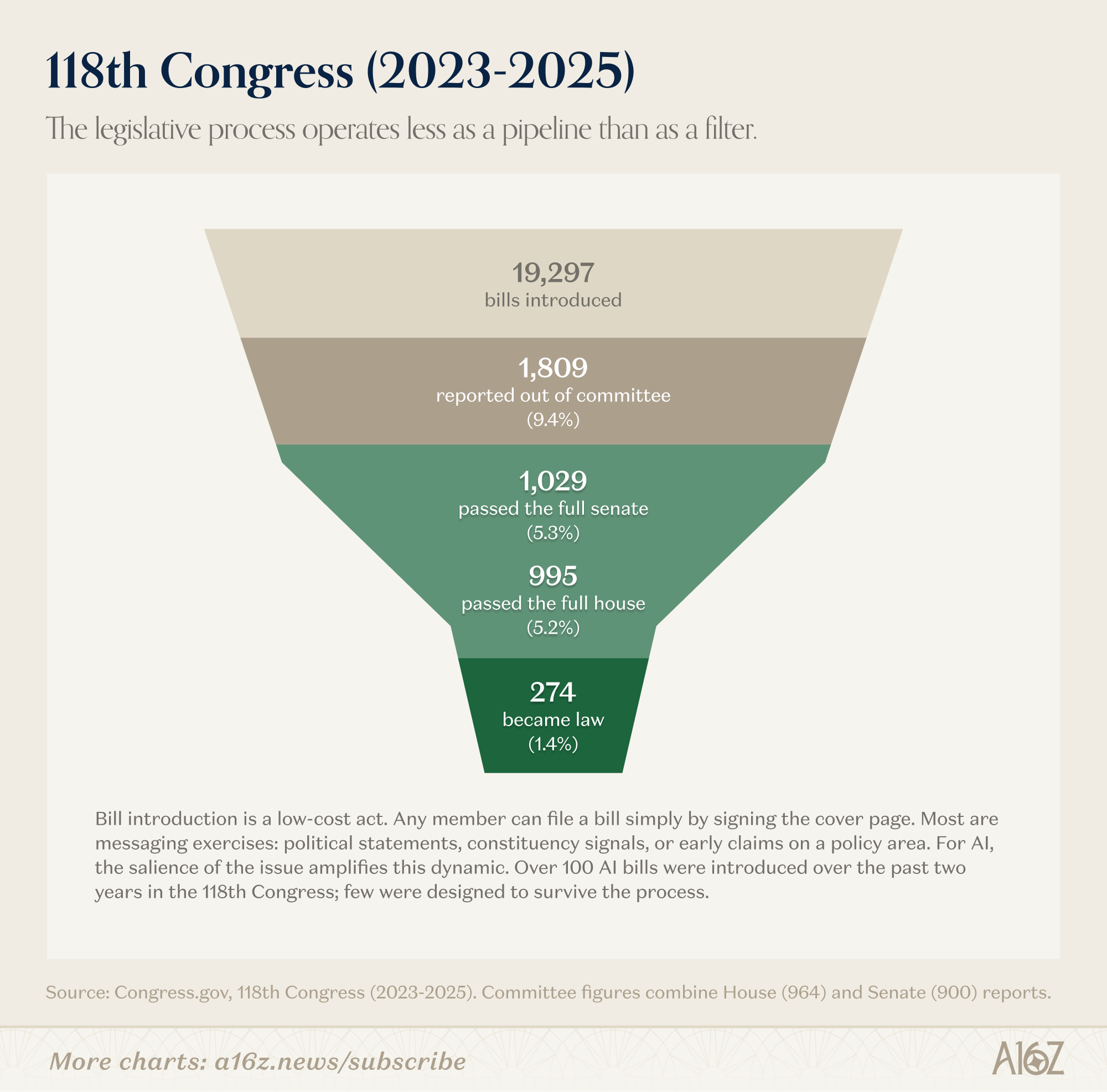
The modern federal legislative process operates less as a pipeline than as a filter. Consider the numbers from the 118th Congress (2023-2025): 19,297 bills or resolutions were introduced across the House and Senate. Of those, only 1,809 were reported out of at least one House or Senate committee. 1,029 bills or resolutions passed the full Senate, 995 passed the full House and, ultimately, just 274 bills cleared both chambers and were signed into law.
That is an enactment rate below 1.5 percent. At each stage of the process, proposals are winnowed down through a combination of institutional constraints and political incentives. For most legislation, these hurdles are substantial. For AI legislation, they are particularly acute. The interesting question, then, is not what bills are being introduced. It is what separates the 274 that made it through from the 19,000 that did not.
Why so many bills are introduced if most will die
It is not difficult for a bill to be introduced. Any one of the 535 members of Congress need only reduce an idea to writing, sign the upper right corner of the cover page, and submit it while the chamber is in session. This low barrier to entry helps explain the sheer volume.
It also reflects a deeper reality about how Congress operates. Most bills are not introduced with the expectation that they will become law. In the modern Congress, members often introduce what might be called “messaging bills”: legislation designed to make a political statement, generate media attention, or signal responsiveness to particular interest groups or constituencies. A messaging bill can function as little more than a press release in legislative form. It can also serve a more strategic purpose: by introducing legislation on a narrow issue, a member can stake out early ownership of a policy area and position themselves as a relevant voice in subsequent negotiations. Even proposals with little chance of passage can help establish credibility and secure a seat at the table when broader legislative efforts take shape.
More serious proposals intended to move through the legislative process typically require more preparation. Members work closely with their staff and with legislative counsel to draft statutory text, often incorporating input from committees, leadership, and external stakeholders. When done in an intentional manner, this process can take months; sometimes years. But even well-developed AI proposals face significant obstacles once they leave the introduction stage.
What do the bills that make it through have in common?
Before examining each stage where bills stall, it is worth asking what the small number of proposals that emerge from the legislative funnel tend to share. The patterns are remarkably consistent.
Bipartisan commitment. Not merely bipartisan co-sponsors on a press release, but genuine bipartisan investment in moving the bill forward. There is a meaningful difference between a member lending their name to a bill and a member spending political capital on it. Successful legislation typically involves a bipartisan coalition who have decided to co-own the issue and drive toward its enactment.
External urgency. Legislation tends to advance when the political cost of inaction exceeds the cost of acting. This can take several forms: a crisis that demands a response, a looming lapse in funding or authority, a court decision that creates regulatory uncertainty, a growing state-level patchwork that imposes compliance burdens on national industries, or international competitive pressure. In the AI context, the proliferation of state AI laws, international competitiveness, and growing public concern are generating pressure on Congress to act. Whether and when that pressure reaches the threshold necessary to move legislation is one of the central questions of the current moment.



Committee and leadership buy-in. Bills generally do not move unless the relevant committee chair or ranking member wants it to. Committee chairs control the hearing calendar, the markup schedule, and whether a bill is ultimately reported favorably to the full chamber.Following a successful committee process, Leadership must then decide which bills should and should not be considered by the whole chamber. This is perhaps the most underappreciated variable in legislative outcomes.
Executive branch buy-in and shepherding. While the legislative process formally ends with the President’s signature or veto, the executive branch often shapes legislation from the outset. Through policy frameworks, public statements, and agency engagement, the White House can signal to Congress that it is seeking legislative action in a given area, helping to define the contours of the debate and catalyze movement on Capitol Hill. Sustained executive branch engagement is often essential for any major proposal to survive the process.
Connection to a legislative vehicle. A bill does not need to pass on its own if it can attach to something that must pass. This dynamic is important enough to warrant its own discussion below.
Where AI bills get stuck
The committee problem
The committee stage represents the first major bottleneck. Committees serve as gatekeepers, deciding which bills receive hearings, markups, and ultimately a vote to be reported to the full chamber. Most bills never make it past this stage.
For AI legislation, committee gatekeeping is particularly consequential because of the issue’s inherently cross-cutting nature. Artificial intelligence touches on commerce, consumer protection, national security, intellectual property, labor, and more. Jurisdiction over AI policy is fragmented across multiple committees in both the House and Senate.
Compare this to a policy area with a single committee home. Higher education legislation moves through Senate Health, Education, Labor, and Pensions and the House Education and Workforce committee. Tax legislation moves through Senate Finance and House Ways and Means. A single chair can drive the process from hearing through markup to floor. For AI, no single home exists. A comprehensive AI bill falls within the jurisdiction of several committees, each with its own priorities, expertise, and political incentives. Committees may compete for jurisdiction, decline to act, or advance conflicting approaches. Rather than producing a single, coherent legislative pathway, this structure disperses authority and makes standalone AI legislation difficult to advance.
This fragmentation is not a bug that can be fixed with better coordination. It is an accurate reflection of how broadly AI implicates existing regulatory structures. The implication is significant: comprehensive AI legislation is more likely to move through leadership-driven coordination across committees than through any single committee acting on its own.
It’s important to note that bills are not strictly required to move through a formal committee process before receiving a floor vote in either chamber, but it is relatively uncommon for sweeping policy proposals—such as a federal AI framework—to advance without some committee action. That said, AI as a topic has already been extensively debated at the committee level through hearings and markups of bills with a more limited scope.
The floor: agenda control and scarcity
Even if a bill is reported out of committee, it must still secure time on the chamber floor. This stage is where many observers, including those who follow AI policy closely, underestimate the difficulty of enactment. A bill can have strong committee support, bipartisan backing, and genuine policy merit, and still never reach a vote in either chamber. The constraints differ meaningfully between the House and the Senate, but in both, floor time is a scarce resource allocated through collective judgment, not policy merit alone.
In the House, floor access turns first on whether a bill appears capable of securing a simple majority of support for passage—218 votes when the chamber is at full occupancy and attendance. That is only part of the threshold question. An equally as important question is whether the measure is supported by a substantial majority of the majority party. House Leadership often tries to operate under what is sometimes referred to as the “Hastert Rule” after former Speaker Dennis Hastert: bills that significantly divide the majority party’s own conference or caucus are rarely brought to the floor, even if they could pass with bipartisan support. A Republican Speaker who would need to rely on 20 Republicans and 200 Democrats to pass an AI bill would be falling short of core party leadership obligations in scheduling that vote. The same dynamic applies regardless of which party holds the majority.
The Rules Committee adds another layer of control and complexity. Unless 2/3rds of the House agrees to suspend the rules and pass a bill, the Rules Committee issues a special rule governing the terms of floor consideration: how long the bill will be debated, which amendments will be allowed, and under what conditions. The majority party controls the Rules Committee, and the rule it produces can shape the outcome of floor consideration as much as the substance of the bill itself. A restrictive rule can block amendments that might fracture a delicate coalition; an open rule can expose the bill to politically difficult votes. For a cross-cutting issue like AI, where members may have competing priorities and comprehensive bills bring with them wide germaneness, the structure of the rule is itself a significant variable.
As a result, the House floor is not simply a venue for considering bills that have left committee. It is a screening mechanism for measures that are both passable and manageable within the majority party’s internal and external politics.
In the Senate, the constraints are different but no less severe. Floor time itself is often the binding constraint. The chamber’s rules permit extended debate and, absent the unanimous consent pipeline, effectively require multiple votes at a super majority threshold to advance legislation. Because any single senator can object to a unanimous consent request, and because invoking cloture consumes up to 30 hours of post-cloture debate time, Senate leadership must be highly selective about which measures receive consideration. The opportunity cost of bringing any bill to the floor is measured in terms of everything else that cannot be considered during that time. For a Senate Majority Leader with a limited number of legislative weeks, this calculus is unforgiving. A bill that would consume a week of floor time for uncertain prospects will almost always lose out to measures with clearer paths to passage or more pressing deadlines.
The filibuster compounds this dynamic. Even a bill with simple majority support in the Senate can be blocked unless 60 senators agree to end debate. For AI legislation, which lacks settled partisan alignment and where individual senators may have strong views shaped by their state’s technology sector, labor constituency, or ideological orientation, reaching the 60-vote threshold is a significant challenge. This makes the Senate the chamber where promising AI legislation is most likely to stall, not because of opposition to the substance, but because of the procedural cost of moving it.
These dynamics interact in particular ways for AI legislation. In the House, assembling a stable coalition of 218 votes requires resolving competing interests across committees and constituencies before a bill ever reaches the floor. Members from different committees may have advanced different or conflicting approaches, and reconciling those approaches for floor consideration is itself a negotiation. In the Senate, the scarcity of floor time favors proposals that are either broadly supported enough to pass quickly or important enough to justify the procedural effort.
Finally, before a bill can be sent to the president’s desk, both chambers must agree on identical text. Reconciling differences between the House and Senate requires additional negotiation, sometimes conducted through formal conference committees, but more frequently through informal bicameral negotiations of the kind that produced the FY2025 NDAA. This work is most effective when it begins before either chamber commits to a final position, and it adds yet another stage at which legislation can stall or fail entirely.
How laws frequently get made: the must-pass vehicle
Given these constraints, it is worth being direct about how much federal law actually gets made. For many policy areas, the likeliest path to enactment runs not through standalone bills but through attachment to legislation that Congress must pass.
The National Defense Authorization Act, annual appropriations bills, and budget reconciliation packages are the workhorses of enacted legislation. The NDAA alone has been enacted for 64 consecutive fiscal years. According to the Congressional Research Service, the bill is “frequently used as a vehicle for legislation under the jurisdiction of committees other than the House and Senate Committees on Armed Services.” The FY2025 NDAA, for example, spanned 794 pages and incorporated the Department of State and Intelligence Authorization Acts along with provisions touching the Departments of Justice, Homeland Security, and Veterans Affairs. These vehicles must move on a predictable schedule, and they create opportunities for provisions that might never survive the process on their own.
This is not a cynical observation. It reflects the design of the system. Congress faces collective action problems in moving standalone legislation on cross-cutting issues, and must-pass vehicles provide a mechanism for overcoming them.
The political landscape
Stakeholders and outside coalitions
Beyond formal procedure, federal legislation typically must also survive negotiation among outside groups, industry stakeholders, advocacy organizations, and political constituencies. For most major policy areas, these actors play a meaningful role in shaping legislative outcomes, as Congress often draws on outside expertise and firsthand industry knowledge to inform policy.
For artificial intelligence, this landscape is unusually broad. AI policy implicates technology companies of vastly different sizes and business models, labor groups concerned about workforce displacement, civil society organizations focused on civil rights and consumer protection, national security stakeholders, creators worried about intellectual property, and consumers. Each brings distinct and often competing priorities. Crafting federal legislation that can attract sufficient support across this landscape is inherently difficult. A provision that satisfies large technology companies on preemption may alienate state attorneys general. A transparency requirement that satisfies civil society groups may impose disproportionate compliance burdens on startups. A licensing or registration regime that benefits established incumbents may raise barriers to entry for smaller competitors.
Larger legislative packages provide a mechanism for managing these tensions. By combining multiple provisions, each addressing different stakeholder concerns, such packages allow policymakers to assemble a broader base of support than any one proposal could achieve on its own. This is one reason, beyond the procedural dynamics discussed above, that coordinated, multi-issue frameworks may be better positioned to advance than narrow, standalone proposals.
Transparency and the cost of legislating
Federal lawmaking takes place under conditions of intense and increasing public visibility. Congressional activity is subject to constant scrutiny from the press, advocacy groups, and an increasingly engaged online audience. The 24-hour news cycle, combined with real-time commentary on platforms like X, ensures that even early-stage proposals are quickly amplified and debated in full public view.
Political science research has examined how this level of transparency affects legislative outcomes. Tim Groseclose and Nolan McCarty, in their influential study “The Politics of Blame: Bargaining Before an Audience,“found that public-facing negotiations incentivize position-taking over compromise, reducing legislative efficiency. When legislators know their moves will be immediately visible to outside audiences, the incentive shifts from finding workable deals to staking out defensible positions. The result is that the same transparency designed to promote accountability can make it harder to assemble the kind of pragmatic, cross-partisan agreements that complex legislation requires.
For AI, where public interest is high and the stakes are easily dramatized, this visibility raises the political cost of every legislative choice. A vote on an AI bill is not just a policy decision; it is a public statement that can be framed, clipped, and circulated. Members must weigh not only the substance of a bill, but also how it will be received by constituents, advocacy groups, and national media.
The contrast with state legislatures is instructive. States have become increasingly active in AI policymaking, and their processes receive far less sustained national attention. Proposals can sometimes advance with fewer external pressures, even when the underlying policy questions are similarly complex. This is not an argument against transparency. It is an observation about the asymmetry it creates: Congress faces higher political costs for legislating on AI than state legislatures do, which partly explains why the states have moved faster.
What to watch for
Given these structural dynamics, how should someone following AI legislation distinguish signal from noise?
Signs a bill might move
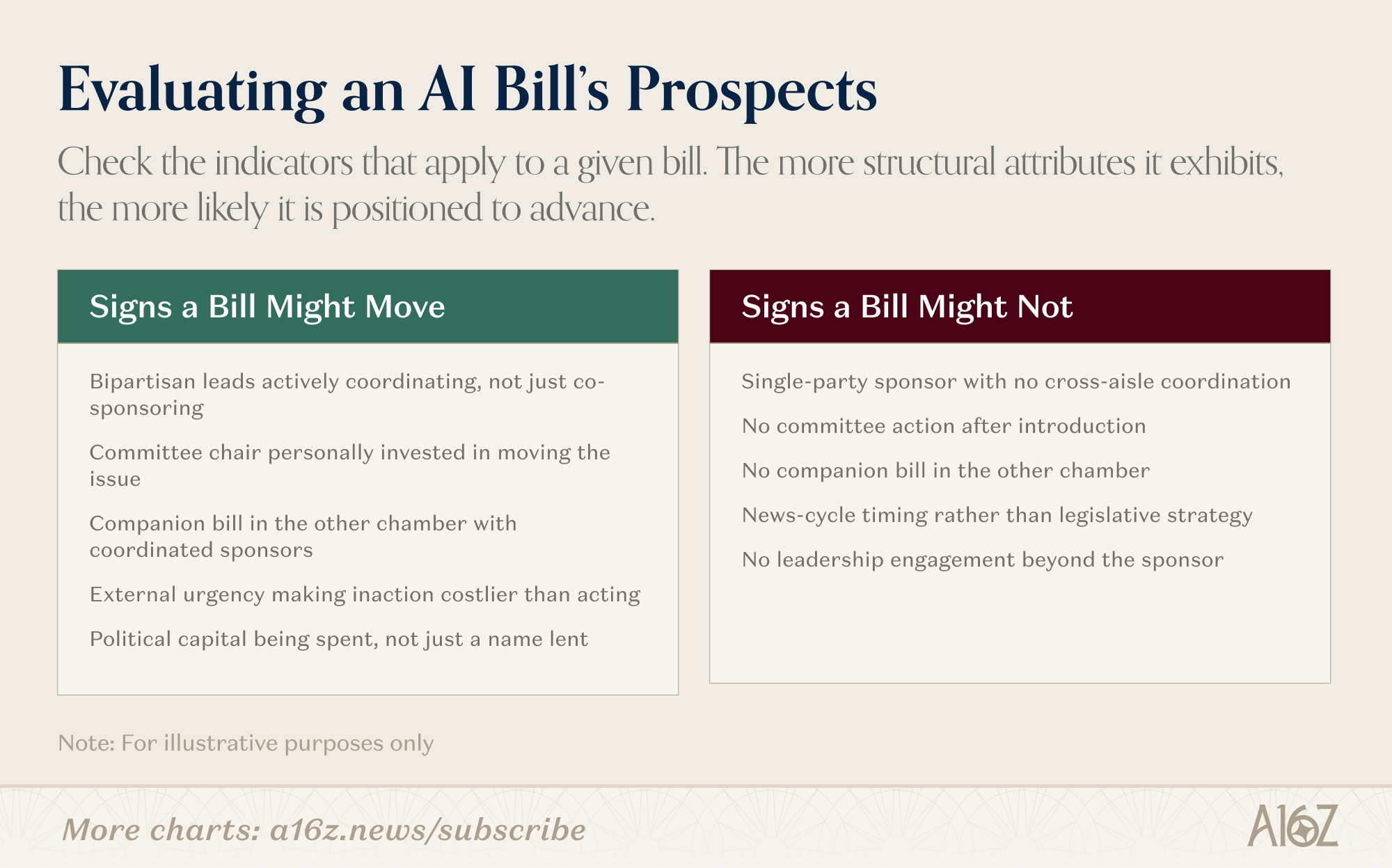
The indicators that matter track the structural attributes described throughout this post. A bill is more likely to advance when it has bipartisan lead sponsors who are actively coordinating, not merely co-sponsoring. When it has the engagement of a committee chair who is personally invested in moving the issue. When a companion bill exists in the other chamber, with sponsors working together across the bicameral divide. When it’s being discussed for attachment to a must-pass bill. When an external forcing function is generating urgency, such as a growing state patchwork, a court decision, competitive pressure from abroad, or a salient public harm. And, most relevant now, when Administration and Congressional leadership coordinate on a single legislative push.
Signs a bill might not
Conversely, a bill introduced by a single-party sponsor, with no committee action, and no companion bill, is more likely a messaging bill than a legislative effort, regardless of how much attention it receives. A bill introduced in direct response to a news cycle, without the months of preparation that serious legislative text requires, is another signal. So is the absence of committee leadership engagement after introduction. These indicators do not make a bill irrelevant; messaging bills can shape the terms of debate and position members for future negotiations. But they should calibrate expectations about near-term outcomes.
For technology companies, startups, and others in the AI ecosystem, these indicators provide a practical framework for deciding where to focus attention and engagement. Not every bill that generates a headline warrants a response. The proposals that matter are the ones that exhibit the structural attributes associated with legislative success, and they are almost always a small fraction of the total.
So how does an AI bill become a law?
By navigating a process that is designed, by its nature, to prevent most bills from doing exactly that.
The structural constraints described in this post are real: jurisdictional fragmentation at the committee level, the scarcity of floor time in both chambers, the complexity of bicameral reconciliation, an unusually broad stakeholder landscape, and the heightened cost of legislating under public scrutiny. These are not temporary obstacles. They are features of the system.
But the current legislative environment has several features that make federal AI legislation more plausible than it has been at any prior point. The White House released a National AI Framework in March 2026, signaling executive branch interest in shaping the legislative agenda. House and Senate Committee leadership are actively scoping comprehensive AI legislation. The state-level patchwork of AI laws continues to grow and the high-stakes competition with China for AI leadership is sharpening, generating increasing pressure on Congress to establish a federal baseline. Many stakeholders, including firms like a16z, have publicly advocated for Congress to pass a federal framework to govern AI. And public demand for AI regulation remains high and bipartisan.
The question is no longer whether Congress is interested in AI legislation. It is whether the political conditions will align to move a proposal through a process that filters out more than 98% of everything that enters it. The most likely path runs through a highly coordinated, comprehensive framework of bipartisan provisions, supported by committees of jurisdiction in both chambers, and guided through the process by White House and Congressional Leadership. That may not be precisely how Schoolhouse Rock described it. But it is how an AI bill is most likely to become a law.



This newsletter is provided for informational purposes only, and should not be relied upon as legal, business, investment, or tax advice. Furthermore, this content is not investment advice, nor is it intended for use by any investors or prospective investors in any a16z funds. This newsletter may link to other websites or contain other information obtained from third-party sources - a16z has not independently verified nor makes any representations about the current or enduring accuracy of such information. If this content includes third-party advertisements, a16z has not reviewed such advertisements and does not endorse any advertising content or related companies contained therein. Any investments or portfolio companies mentioned, referred to, or described are not representative of all investments in vehicles managed by a16z; visit https://a16z.com/investment-list/ for a full list of investments. Other important information can be found at a16z.com/disclosures. You’re receiving this newsletter since you opted in earlier; if you would like to opt out of future newsletters you may unsubscribe immediately.
You guys put out great stuff. This is an incredibly informed piece. I'm curious if there are any moonshot legislative proposals that could gain momentum to have a chance at the 1.5%! I recently outlined a few including a Displacement Compact: https://skylerscoggan.substack.com/p/the-menu-no-one-is-ordering-from
Connects to two things this piece doesn't reference: @robertbryce's data center rejection database, which tracks hundreds of state and local AI infrastructure pushbacks, and the federal Mythos anxiety about losing the AI race to China. Layer in the constrained-grid reality — interconnect queues, transformer lead times, transmission bottlenecks — and the federal AI bill that actually moves may not be about regulating models at all. The binding constraint is megawatts deployed, not the number of supervised training runs. Does the legislation ultimately end up preempting state and local infrastructure obstruction rather than model governance?