



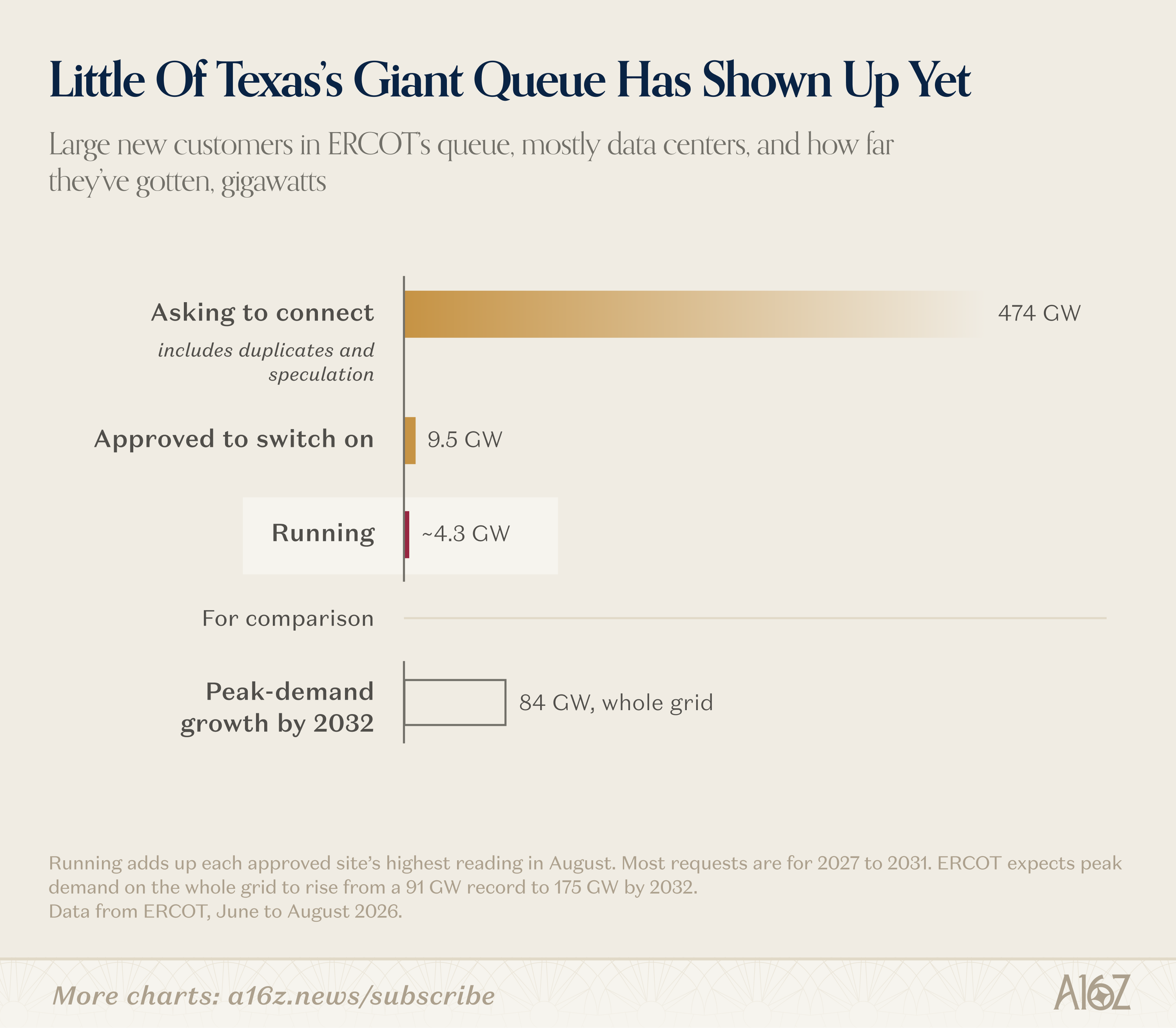
At the end of 2024, Texas’ grid operator had 63 GW of large new customers in its queue. By this June, that figure reached 474 GW, more than five times record peak demand, about 90% of it data centers.
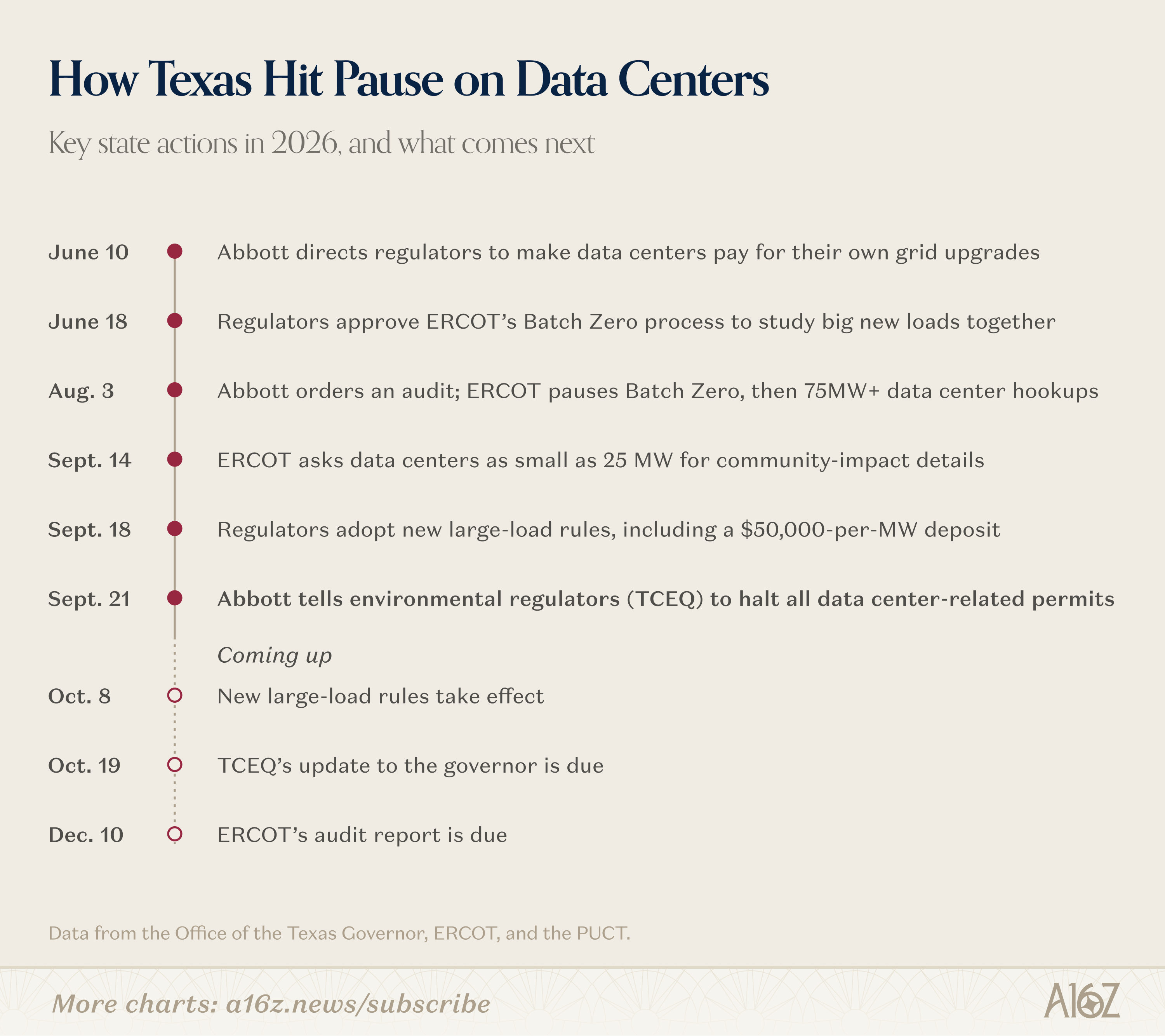
Then Texas hit pause. What began as directions for data centers to pay for their own grid upgrades has since escalated to a freeze on all new permits. If you care about AI and American reindustrialization, this is important to understand. Why did it do this?
The upcoming election is part of it, but the underlying issues are worth digging into. The first is the interconnection queue. This pause is just as much about how projects apply for approval as it is about the projects themselves. Developers routinely spam requests across several sites, and many are speculative builds with no customer yet. Often these new developers have never even plugged in a GPU, let alone a power plant. So dealing with these low-quality submissions puts ERCOT, which runs most of the state’s grid, in a tough spot. Planners can’t tell which are real, and they don’t want ratepayers covering upgrades built for projects that never show up.
The second issue is community alignment. Noise, water, emissions, and power bills are top of mind for anyone who lives nearby. And regardless of the reality of these issues, people deserve straight answers when a data center comes to town, and they haven’t always gotten them (as of June, only 28 of 377 companies had answered a state survey on their resource use). In Hood County, commissioners were asked to support a tax waiver for “Project Patriot” without knowing who it was. To be fair, code names are common while companies shop for sites since a famous buyer can drive up prices, but that logic becomes tougher to defend once officials vote on tax breaks.
This broader political backdrop is important, but I’ll be focusing on just the energy side: why it’s so hard to power a data center, all the ways developers are trying to do it anyway, and where things are likely headed from here.
What connecting to the grid actually means
How Amazon purchases power helps illustrate what’s changed. For the last decade, they’d find a utility with network capacity, sign up as a large load, then enter long-term contracts to match their use on paper. These were often purely financial, meaning you didn’t always have to prove the power could reach you, and the grid connection was easy because utilities typically had spare network capacity.
That’s no longer true. The grid is stretched thin, and almost any new large load or generator now requires an upgrade. Power flows across every connected path, so buying from one plant doesn’t reserve a route to your building (there are even markets for transmission congestion rights).
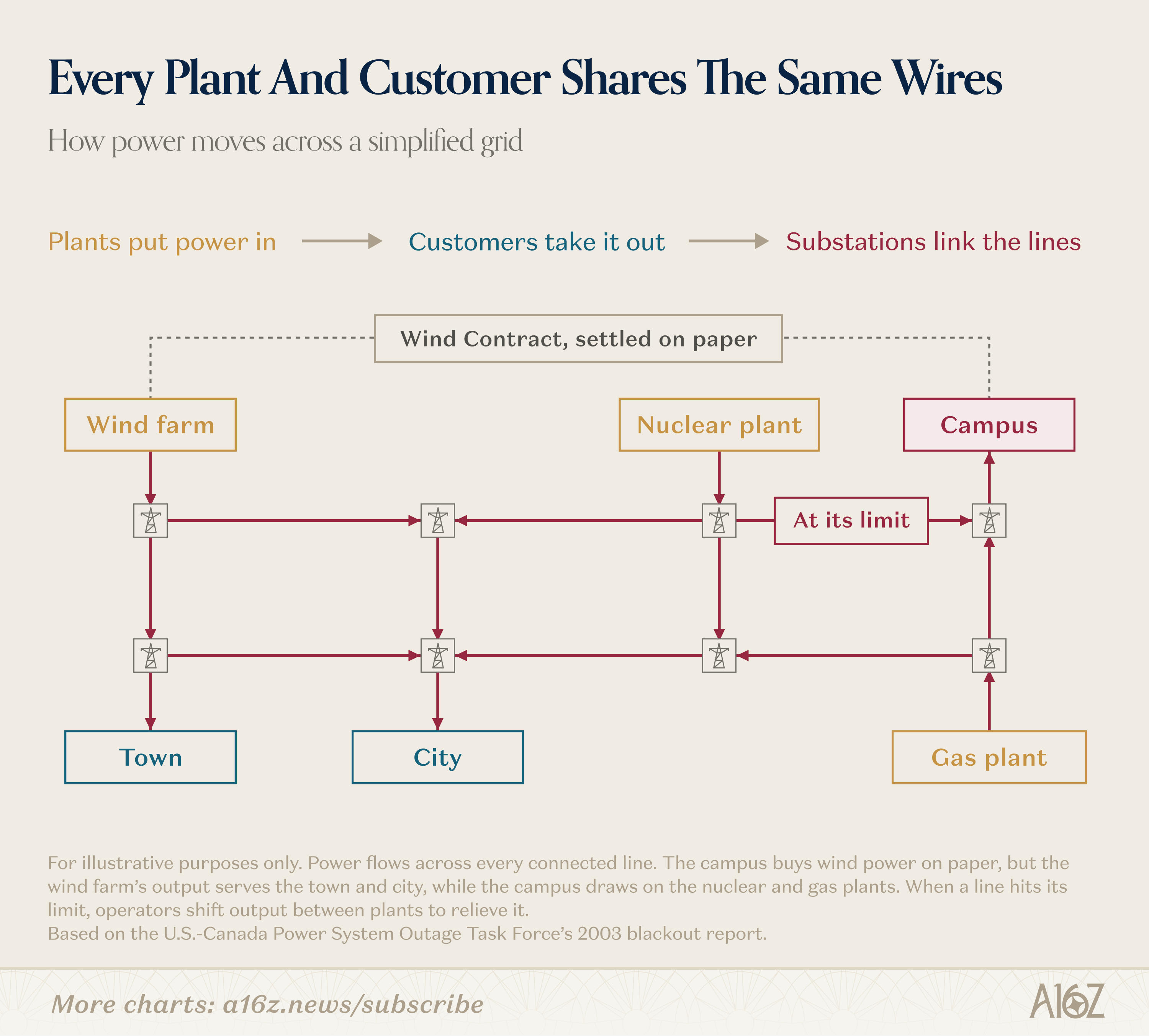
So buyers first went after firm power (available around the clock) they could claim more directly, typically by restarting retired plants or by building next to existing ones. Neither was a true escape, and some of the loudest fights are over “colocation,” which ERCOT describes as drawing power from a neighboring plant before it reaches the grid:
Susquehanna: Amazon bought a campus next to Talen’s nuclear plant, but FERC, the federal grid regulator, rejected Talen’s bid to send it more power directly. Utilities had argued it would let the campus dodge grid fees and push fixed transmission costs onto everyone else. Under the restructured deal, Amazon pays for delivery like any other customer.
Freestone: CyrusOne’s 760 MW campus beside Constellation’s gas plant needed approval from the Public Utility Commission of Texas (PUCT), since it effectively takes much of the plant’s output from everyone else. The PUCT said yes in May, as long as the campus can cut its use or switch to backup power within 30 minutes of an ERCOT call.
Armstrong County: Two Crusoe data centers, of 265 MW and 260 MW, share a wind farm that can produce at most about 265 MW. Both got the same rule as Freestone, so each must shed its entire load when ERCOT calls. Together, they'd cut nearly twice what the wind farm can actually produce, which Crusoe called excessive, but the PUCT kept it.
Interconnection studies are how grid planners identify the wires and substations that need upgrades for any addition to the network. ERCOT used to review studies individually under rules built for up to 50 large loads at a time, but 2025 brought 225 new requests by mid-November. So this June, the PUCT approved a new batch approach. Under “Batch Zero,” ERCOT studies large loads of 75 MW or more together and allocates grid capacity among them.
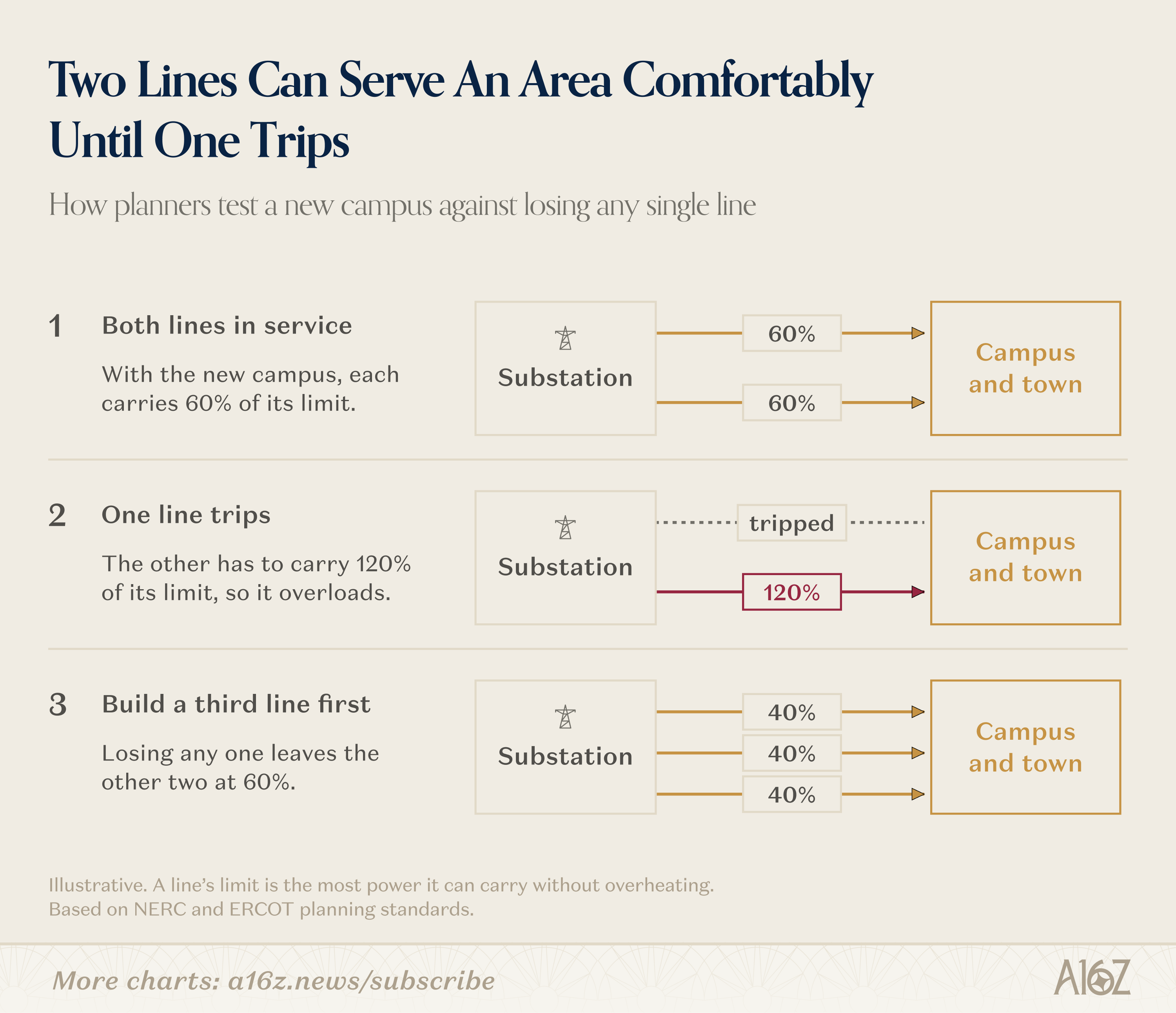
Primarily, the studies ask what happens when something breaks. NERC’s standard, the baseline for reliability across North America, covers a broad set of outage scenarios, with ERCOT adding its own requirements. Planners might simulate a transformer outage, then knock out a line or generator on top of that. Maintaining that reliability standard without shedding more load often means building additional infrastructure.
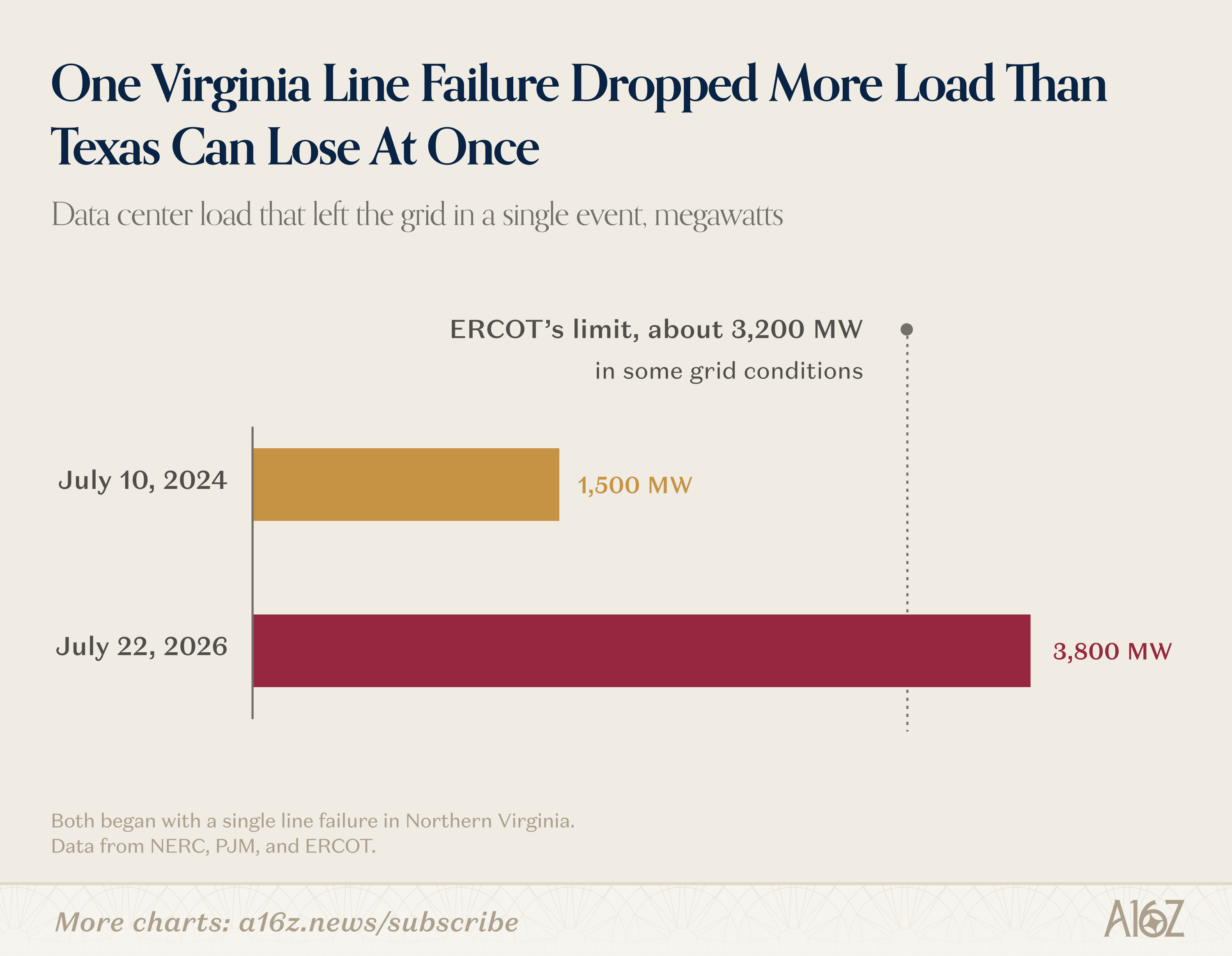
A newer risk is load unexpectedly dropping off the grid all at once. Many data centers switch to backup power at the first voltage dip to protect their hardware, so one bad fault can pull an enormous load off the grid in seconds. This happened earlier this year in Virginia, but was fortunately handled well.
Texas has even less room for error since ERCOT’s grid is largely isolated. Under some conditions, ERCOT can lose only about 3.2 GW of load at once before causing serious issues. A new voltage ride-through rule now requires new data centers to stay connected through routine faults, and I’ve even heard of labs running dummy jobs after a training run fails just to keep load from dropping abruptly.
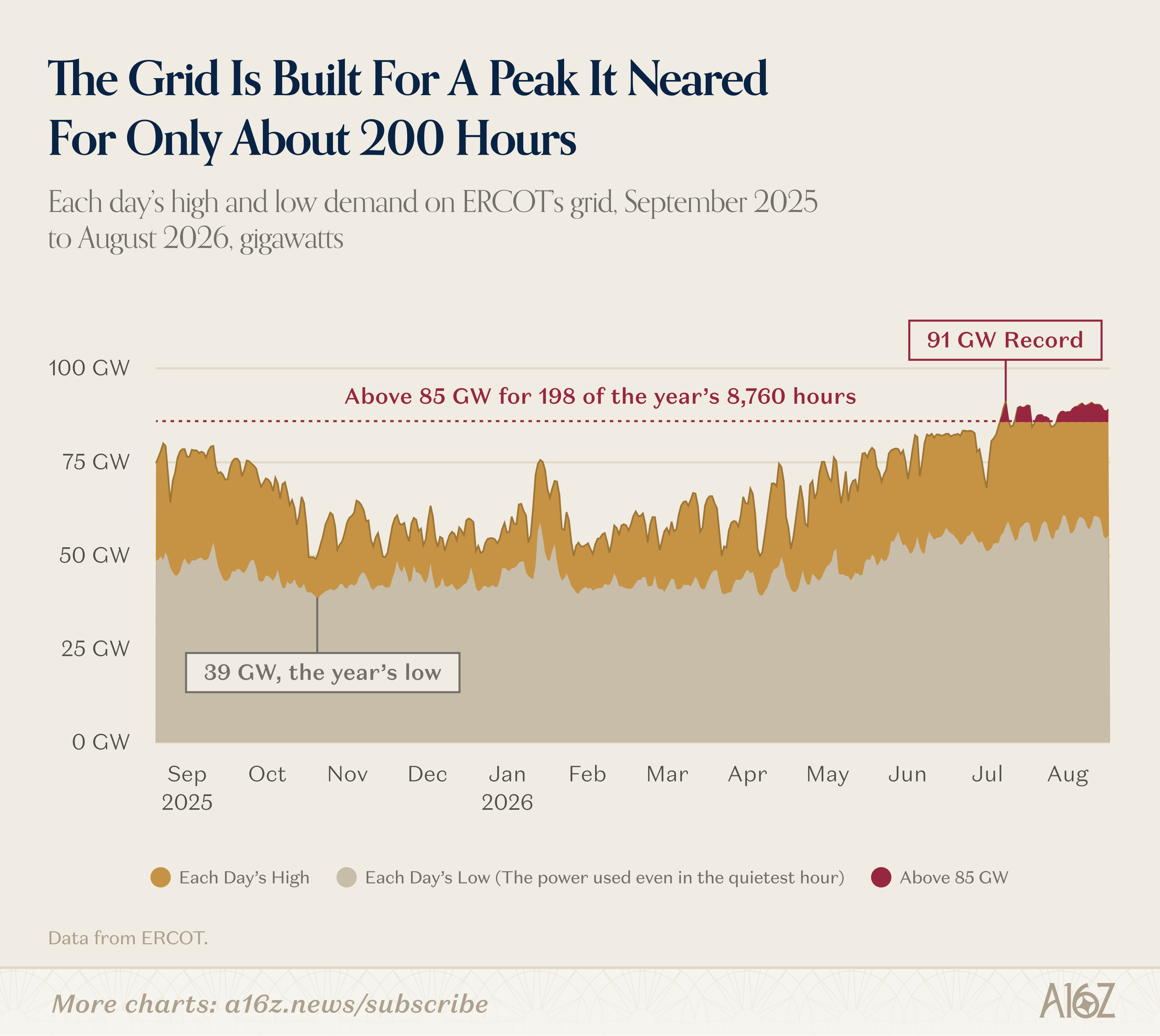
All of this can sound overly conservative, but the system was designed to put reliability ahead of cost. Put simply, the grid is built for the hot summer days and frigid winters when failure can mean life or death. That duty is what makes sizing the grid so hard; you build for a few peak hours but pay for it all year.
So who does pay for all this resilience? Texas typically splits transmission costs by each large customer’s demand during the grid’s summer peaks, so a big load that ramps down on the hottest afternoons can skip much of its share of the transmission bill. In July, regulators proposed counting all 12 monthly peaks instead and charging large loads as if they ran at full size. In other words, large buyers would pay in proportion to how big their electricity pipes need to be, not how much is flowing through them.
Sounds simple enough, but splitting up costs is often the slowest part of interconnection. An upgrade built for one campus may also improve reliability for existing customers or make room for future growth that’s hard to value up front. And if any new development runs over budget or its load never shows up, everyone else is forced to cover whatever the developer’s commitments didn’t.
And those commitments are surprisingly cheap to make. The PUCT’s new large-load rules, effective October 8, charge a flat $100,000 study fee plus a $50,000-per-MW deposit. The deposit weeds out some speculative projects, but it’s a thin filter. ERCOT can reassign a project’s capacity if it falls two years behind, but even a project that loses its capacity forfeits just 20% of the deposit (~$10 million on a 1 GW campus), plus whatever the utility has already spent. Most importantly, the deposit typically only backs the upgrades built for that project, not the more expensive regional lines whose cost everyone on the grid shares.
Fully connecting a large data center can take 5 to 10 years. So to accelerate deployment, a phased connection approach is becoming more common, which gives the utility more gradual targets to plan around, as well as a way for the developer to prove they can handle everything they’ve asked for. All of this also assumes Batch Zero is moving, which it isn’t right now. ERCOT has even paused approvals for data centers of 75 MW or more to switch on, including 17 that had finished every other ERCOT step. Until the audit’s December report settles which projects are eligible, ERCOT can’t study them together, so the timeline is “TBD” and the load forecast is on hold.
What bringing your own power solves
For a developer facing the interconnection queue, skipping the grid entirely looks appealing. Idle GPUs cost far more than the electricity to run them, so speed matters most — what folks call “time to power.” That’s why developers are planning to bring their own power on site (“behind-the-meter”), but almost always alongside a connection to the grid, or as a bridge to one:
Abilene: The Oracle campus runs on grid power with gas backup. Next door, Crusoe announced a 900 MW Microsoft campus with its own on-site plant, but the CEO of Lancium, Crusoe’s partner on the site, has described gas generation as backup.
Shackelford County: Vantage is building a campus with 1.4 GW of compute for Oracle and OpenAI, designed to run off-grid with on-site gas. But its site plan includes a switchyard beside a high-voltage line — curious!
Pecos County: Pacifico describes its planned microgrid (a behind-the-meter setup) at GW Ranch as never drawing from ERCOT, yet the site’s new owner, Amazon, says it’s designed to join the grid once it can connect.
West Texas: Under a 20-year agreement, Chevron plans to build a dedicated gas plant beside a planned Microsoft campus that won’t initially touch the ERCOT grid, though Chevron has applied for a connection. Chevron now says the permit freeze could push its final investment decision into 2027, but it still expects first power by 2028.
Armstrong County: The Google campus Crusoe is building beside a wind farm is tied to both the farm and the grid from day one, with Crusoe calling it “across the meter,” which I’ll admit is catchy.
SemiAnalysis is already tracking 75 GW of equipment orders for behind-the-meter assets, but every site I’m aware of intends to connect to the grid as soon as it can, chiefly because on-site power almost always costs more. So, once the grid is available, say in year five, you switch.
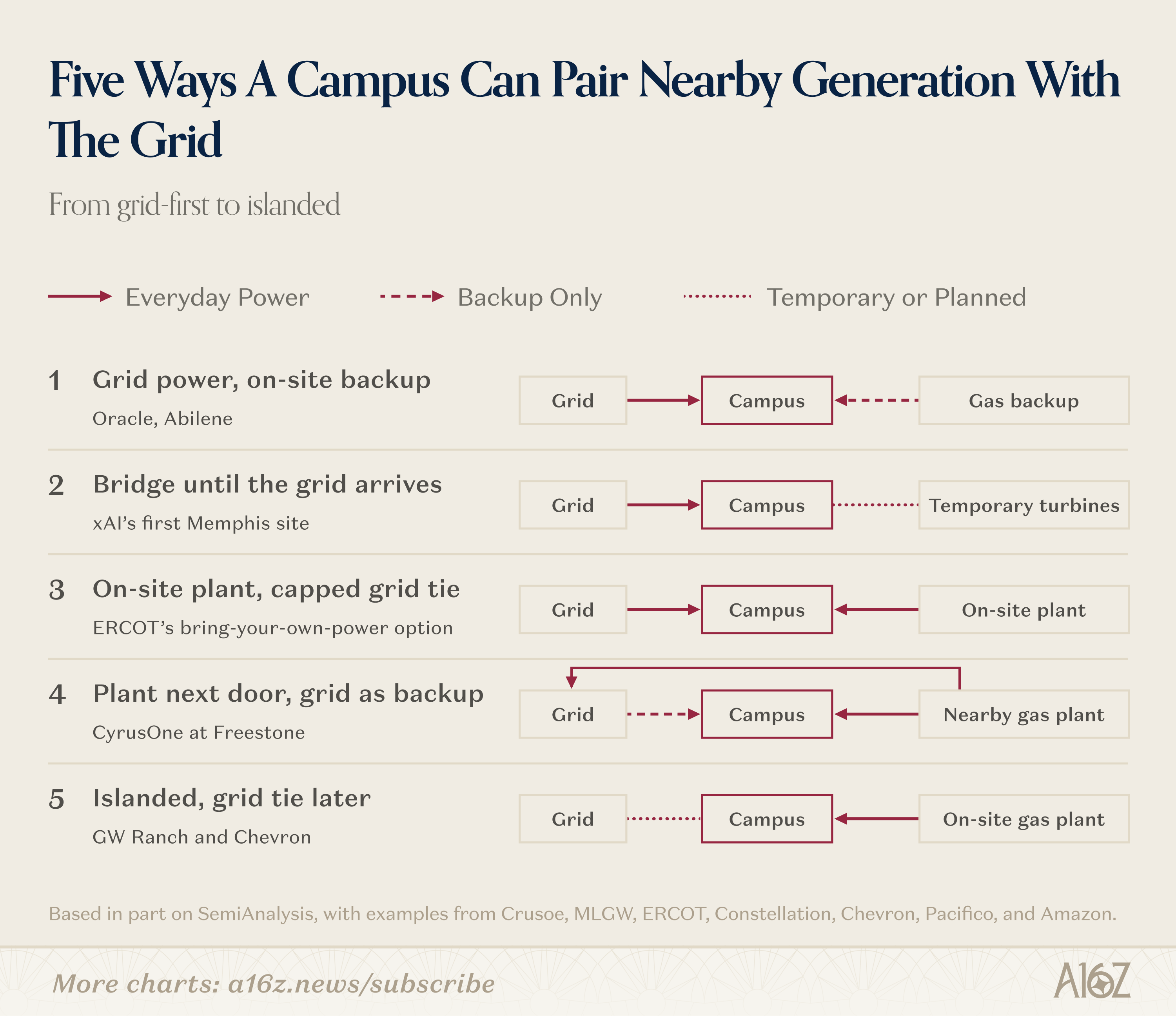
In the meantime, pairing on-site assets with even a partial connection is smart for the same reasons we built a grid in the first place. When one plant trips, the rest of ERCOT’s 1,460-plus generating units cover for it, but an islanded load (cut off from the grid) doesn’t have that luxury. The grid also provides things we take for granted, like inertia, fault current, steady voltage, and black start. An island has to supply all of that itself — power systems folks know how hard this can be.
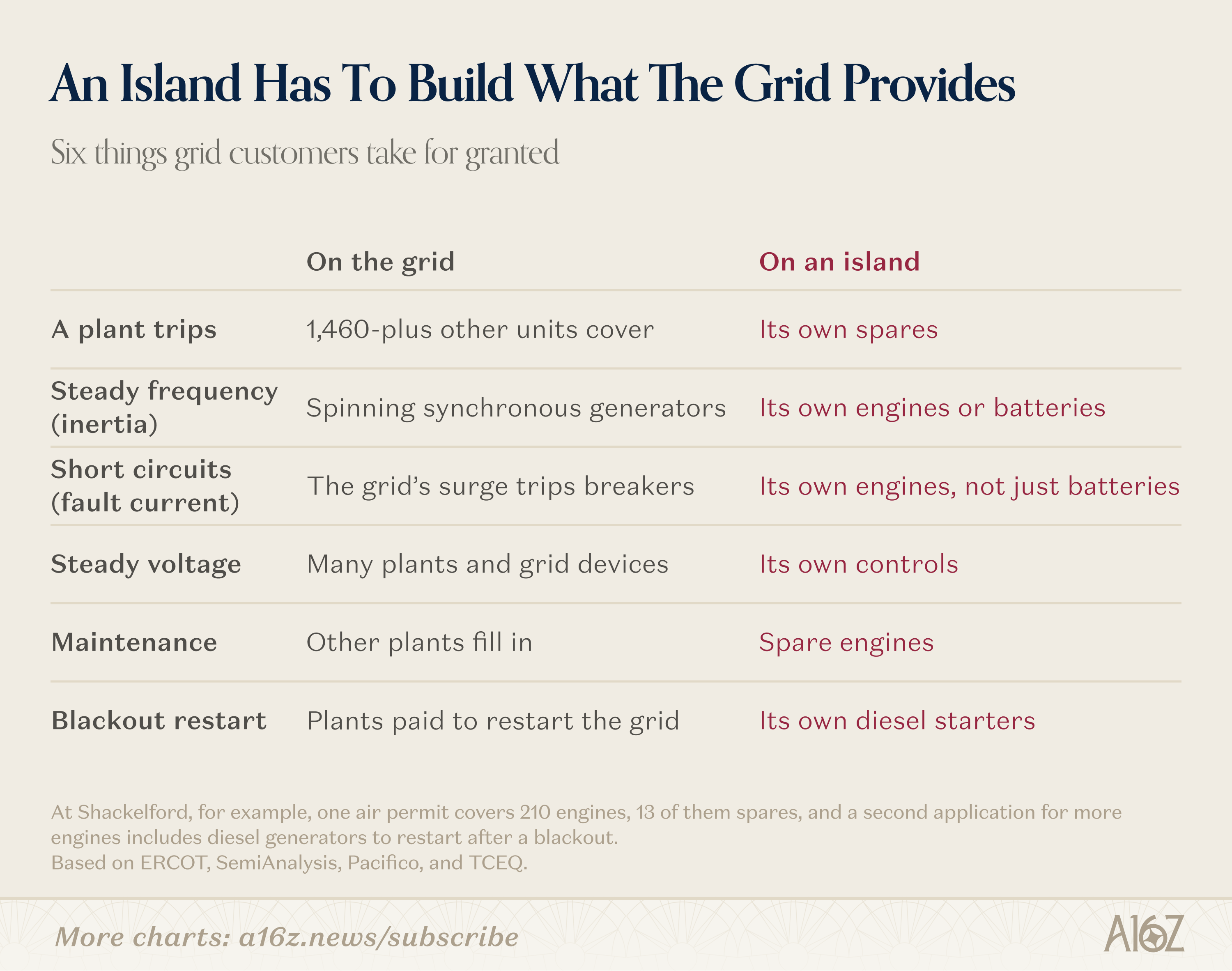
AI workloads make the job even harder. At xAI’s first Memphis site, swings of 10 to 20 MW several times a second were wearing out turbine shafts until xAI added 150 MW of Tesla Megapacks. A grid ERCOT’s size dilutes swings like that, but on a private plant the turbines really feel it. Expect more batteries and other energy storage as rack-level power density grows and swings become more dramatic.
Then there’s fueling a site. Winter Storm Uri’s lesson is that gas plants can fail together. And since they tend to keep little fuel on site (NERC calls gas a “just-in-time” fuel), spare turbines don’t always help. Sometimes the pipeline doesn’t even exist yet. Solar trades that fuel risk for the sun and weather, and at gigawatt scale, you need a lot of batteries. Keeping a 1 GW campus running through one 14-hour winter night takes 14 GWh from batteries, about half of all the battery storage on ERCOT’s grid as of June. For an island seeking 100% uptime, covering rare events like a cloudy week or another Uri gets expensive.
Whatever the fuel, you want an island that fails gracefully and predictably, with no single point of failure. Even nuclear, about as reliable as power plants get, runs only about 92% of the time, mostly because each reactor goes offline for weeks to refuel. Redundancy in this case means effectively an entire second power plant. Thus, behind-the-meter setups favor modularity, like the more than 500 gas engines of about 4 MW each planned for Shackelford, though hundreds of engines can be a pain to maintain.
Full reliability for an island is very, very hard, but some labs and hyperscalers have shown that, forced to choose between reliability and speed, they’ll pick speed. Meta has turned to tents with no backup generators, and SemiAnalysis finds buyers growing more willing to accept outages, with some island designs aiming for as little as 99% uptime, or about 88 hours of downtime a year. With GPU time this expensive, that still beats years of waiting, so for many buyers a temporary island makes sense even if it’s messy.
A “private grid” that ties several plants and campuses together can take back many of the benefits a lone island gives up, at least in theory. But today Texas, like most states, only allows building your own power within tight limits:
Supplying yourself: You aren’t a utility if you supply only yourself, your employees, or your tenants, and nobody resells the power.
Running a private use network: You can also run on colocated generation, sell the surplus into the grid, and draw from it when you fall short. This is the model for the Armstrong County campus, and for the West Texas one once it connects.
Selling to a neighbor: If you sell to the factory across the road, you need a retail electric provider certificate.
Stringing a wire: Build your own line, and you’re probably running into the local utility’s service territory.
The Cato Institute’s consumer-regulated electricity proposal would loosen those limits by allowing private utilities to serve multiple customers across their own network. This isn’t an entirely new idea; Utah’s SB 132 lets loads of 100 MW or more contract for a fully off-grid system. Texas currently doesn’t let a network like this serve multiple customers, but if the demand for power remains insatiable, I’d expect the more permissive states to win larger chunks of the buildout with this “Wild West” utility structure. (However, you may also risk a utility “death spiral,” with the grid’s fixed costs falling on fewer and fewer customers.)
The flip side is a utility building the island itself. Outside ERCOT, El Paso Electric plans to put 813 small gas generators from ERock (366 MW in all) beside Meta’s new campus and run them as an island, on Meta’s dime, for up to five years. This is an option because, unlike the transmission and distribution utilities inside ERCOT, it still owns power plants. After the island period, it would connect the plant to its grid and could seek to spread the cost across all its customers, though in September administrative judges recommended approval only if those customers are protected.
Anything that runs on fuel also needs an air permit that matches how it operates, so a diesel generator permitted only for emergencies can’t run all the time. Optimistically, permits can come fast when things work. Sometimes they don’t, though. In Texas, the freeze now blocks them for data centers until the audit is done.
We should also ask what instances of behind-the-meter “bridge” gas are actually bridging to. xAI’s first two Memphis data centers answer that in different ways. The first ran temporary turbines off an existing gas main until the grid arrived, then began removing them. Along the way, it ran dozens without air permits. For the second, xAI built its plant across the state line in Southaven, Mississippi, but a July order requires all 69 turbines to retire by mid-2027 as a permanent 1.2 GW plant goes up in their place. One bridge led to the grid, and the other to a power plant of xAI’s own.
In August, though, the federal Tennessee Valley Authority (TVA) agreed to serve that data center directly, too. Turns out it’s hard to stay away from the grid!
What flexibility can buy
A campus that can keep itself running can also be easier for the grid to accommodate, even welcome. It’s a large paying customer whose demand can “flex” when power is tight, whether by cutting its draw or exporting surplus power. This is how xAI got approved for grid power at its second Memphis site. What made its promise to flex credible was its ability to carry its entire load for four hours on its own power, and what the CEO of Memphis Light, Gas and Water called “the world’s largest grid-connected battery system.”
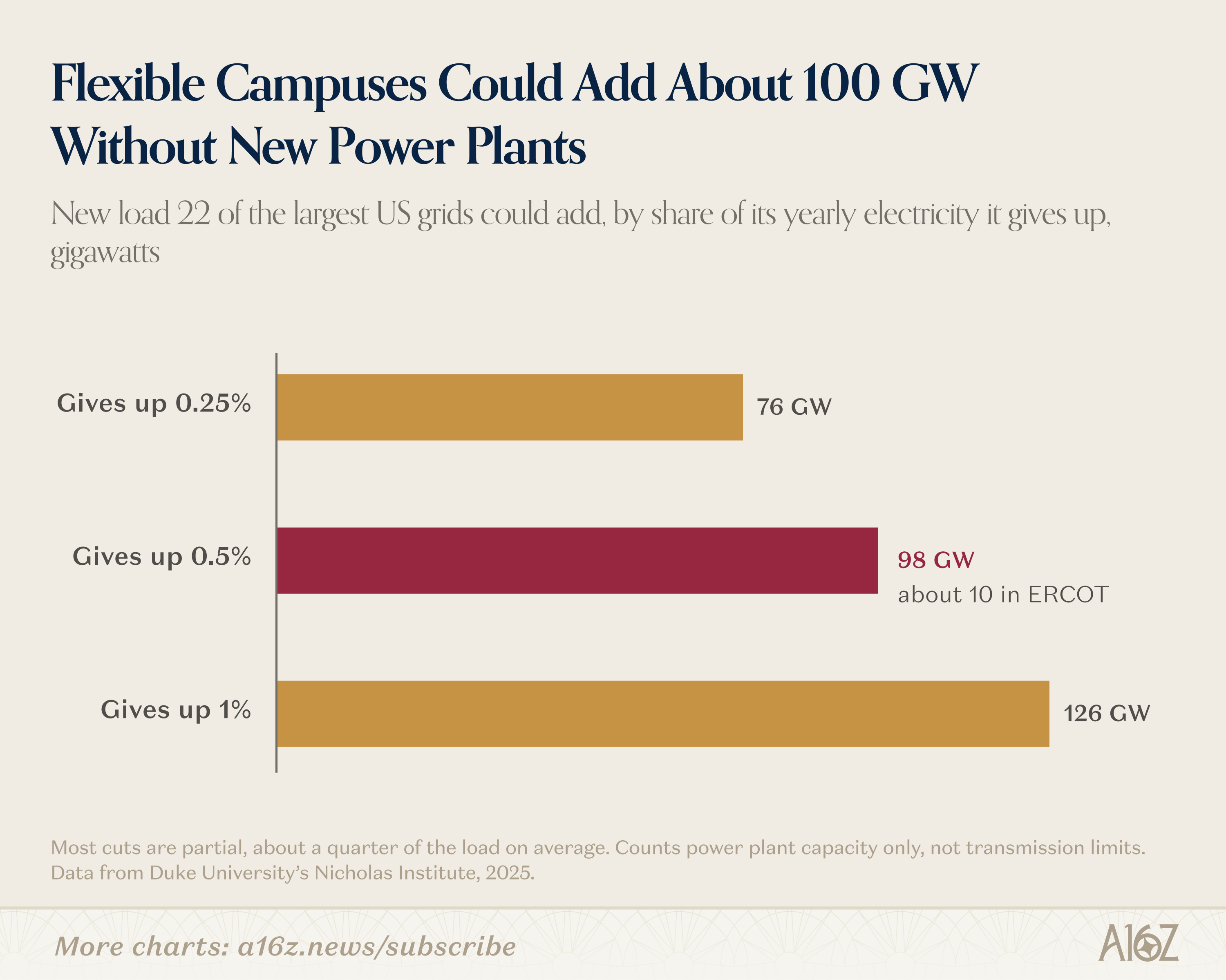
Batteries are only one way to flex. A campus can also shift computing to other hours or data centers, or switch to its own generators. So how much room could flexibility open up? Tyler Norris and colleagues at Duke estimated that, setting transmission limits aside, ERCOT could add about 10 GW of new load without new generation if that load gave up 0.5% of its yearly grid electricity. Since the average cutback lasts about two hours, it’s also conveniently battery-shaped. Building on this, a study of PJM (the largest US power market) by Camus, encoord, and Princeton found that for each GW of new data center load, making 20% of that load flexible would save other customers $78 million a year, while bringing its own capacity for the other 80% would keep another $326 million off their bills.
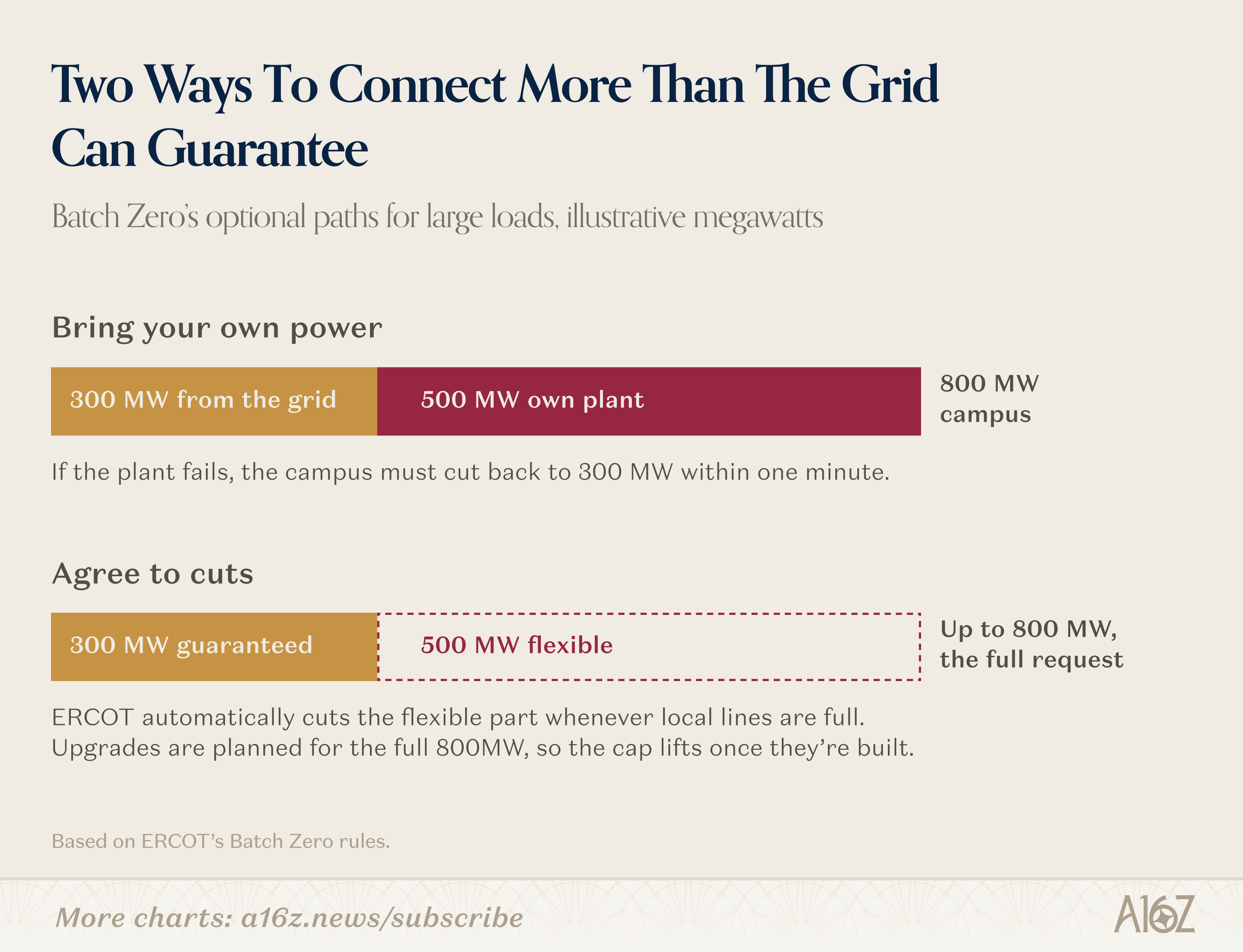
For flexibility to be valuable, it’s important that it’s always available when operators need it. In Texas, generators already work this way under connect-and-manage. Put simply, they can hook up early as long as ERCOT can cut them down when lines are congested. Generators can live with that because at worst they sell less for a while, but a data center that has promised its customers uptime is more challenging. Some loads, like Bitcoin miners, have made the trade anyway. Batch Zero gives large loads two optional paths here:
Bring your own power: A campus can count its own power plant toward its size as long as it can cut back within one minute if the plant fails. So far, 11 Batch Zero projects have picked this path.
Agree to cuts: A campus can draw up to the full amount it asked for, but ERCOT can automatically cut anything above its guaranteed share whenever lines are full.
A campus could also pay its neighbors to cut their load instead. In PJM, Google is funding Voltus to pool up to 100 MW of batteries, thermostats, and other flexible devices across a territory. But PJM only counts what it trusts the pool to deliver, and it’s a capacity deal that helps the whole grid at its peak, not a fix for any one congested line. That’s a harder sell in Texas, an energy-only market where transmission is the main bottleneck. Texas has also barred colocated campuses from getting paid for similar services, since under SB 6 they already have to shut off when ERCOT tells them.
Even so, Texas has been a leader in distributed resources. One Base Power fleet, run with the co-op GVEC, passed ERCOT’s pilot tests to sell directly into the wholesale market on its first attempt, and is now expanding to 50 MW. These pilots are important; planners need that kind of proof before they’ll design around these fleets. But once trusted, distributed resources can rapidly add capacity without waiting for an expensive new “peaker” power plant, lines, substations, or a lengthy interconnection process.
Other hardware can help, too. Unlike legacy steel units, a solid-state transformer uses semiconductor switches, so software can measure and steer the power flowing through it. Alongside network upgrades like reconductoring (restringing lines with higher-capacity wire) and dynamic line ratings (rating lines for actual weather instead of worst-case conditions), that greater visibility and control can squeeze more out of wires ratepayers already funded. It’s a big reason we backed Heron Power, which is set to install its solid-state transformers at a West Texas battery site with RWE.
The problem is that most of these tools help operators keep things running day to day, but planners don’t always count them when they size upgrades. Nothing in physics forces that, though. A September study by Piq Energy, using Base Power’s data on potential fleets, found that about 80 MW of home batteries, strategically sited to relieve transmission constraints, could resolve all overloads triggered by a hypothetical new 100 MW data center near Fort Worth.
Batch Zero doesn’t consider things like this yet. It still plans upgrades for a flexible campus’s full planned load, since that path is a bridge to firm service, and there’s no option to stay flexible for good in exchange for smaller upgrades. Planners could instead size the upgrades smaller by crediting flexibility and other resources that relieve the same bottlenecks, assuming they’re measured in real time and perform reliably.
All of this saves time and money by getting more out of what’s already in the ground, but no amount of flexibility gets the grid out of building more generation and wires for all the demand coming down the pipe.
Getting to hundreds of gigawatts
On-site power and flexibility will decide how the next few campuses energize, but the labs and hyperscalers I talk to worry most about scale. Their power teams tend to split in two: one picks sites and equipment for the next couple of years, and the other asks how to connect hundreds more gigawatts after 2030.
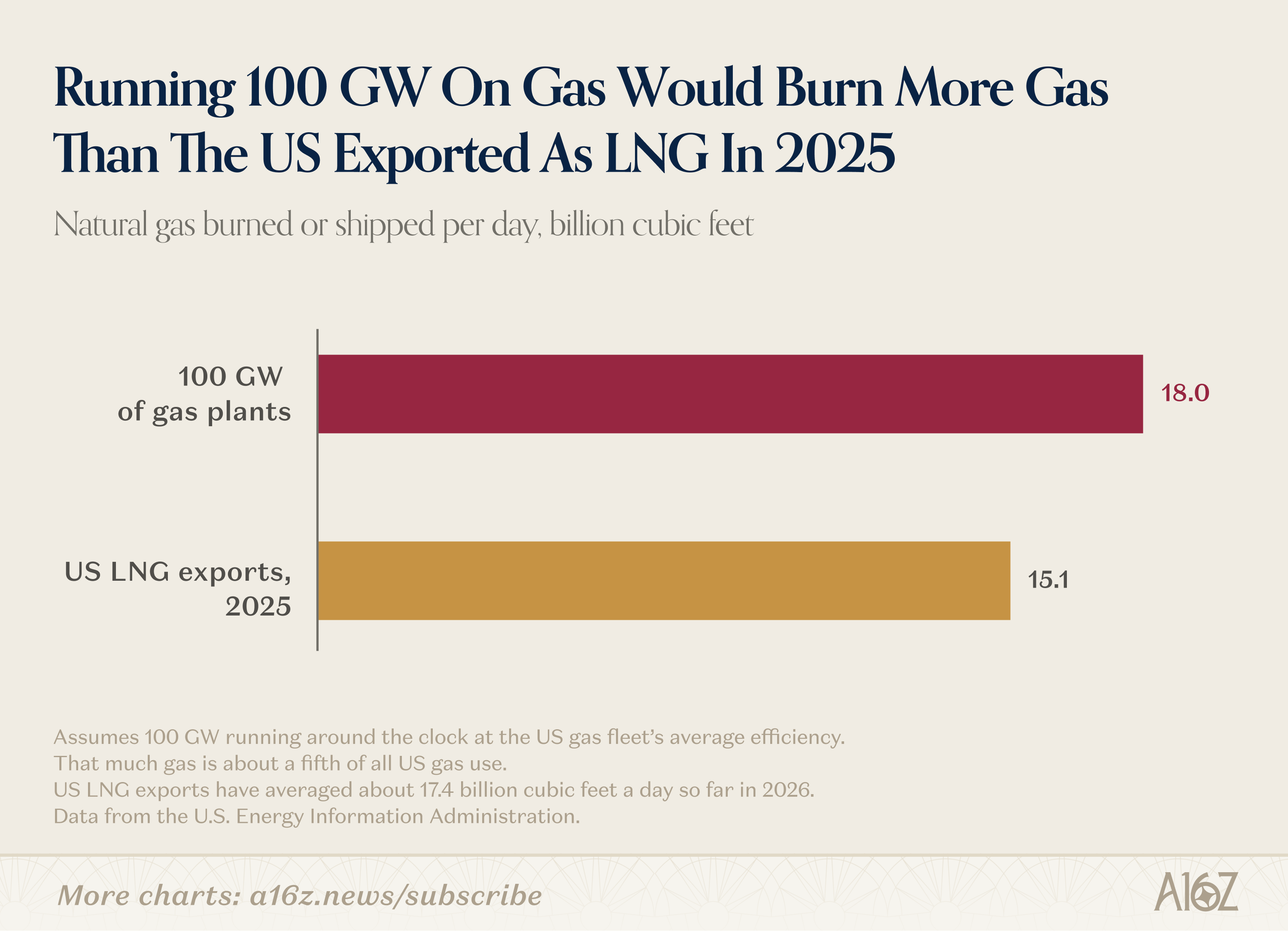
This is a lot! Run, say, 100 GW all year and it’s 876 TWh, about a fifth of what the country used in 2025. Here’s what power developers told the Energy Information Administration (EIA) they planned to add in 2026 across the entire grid.
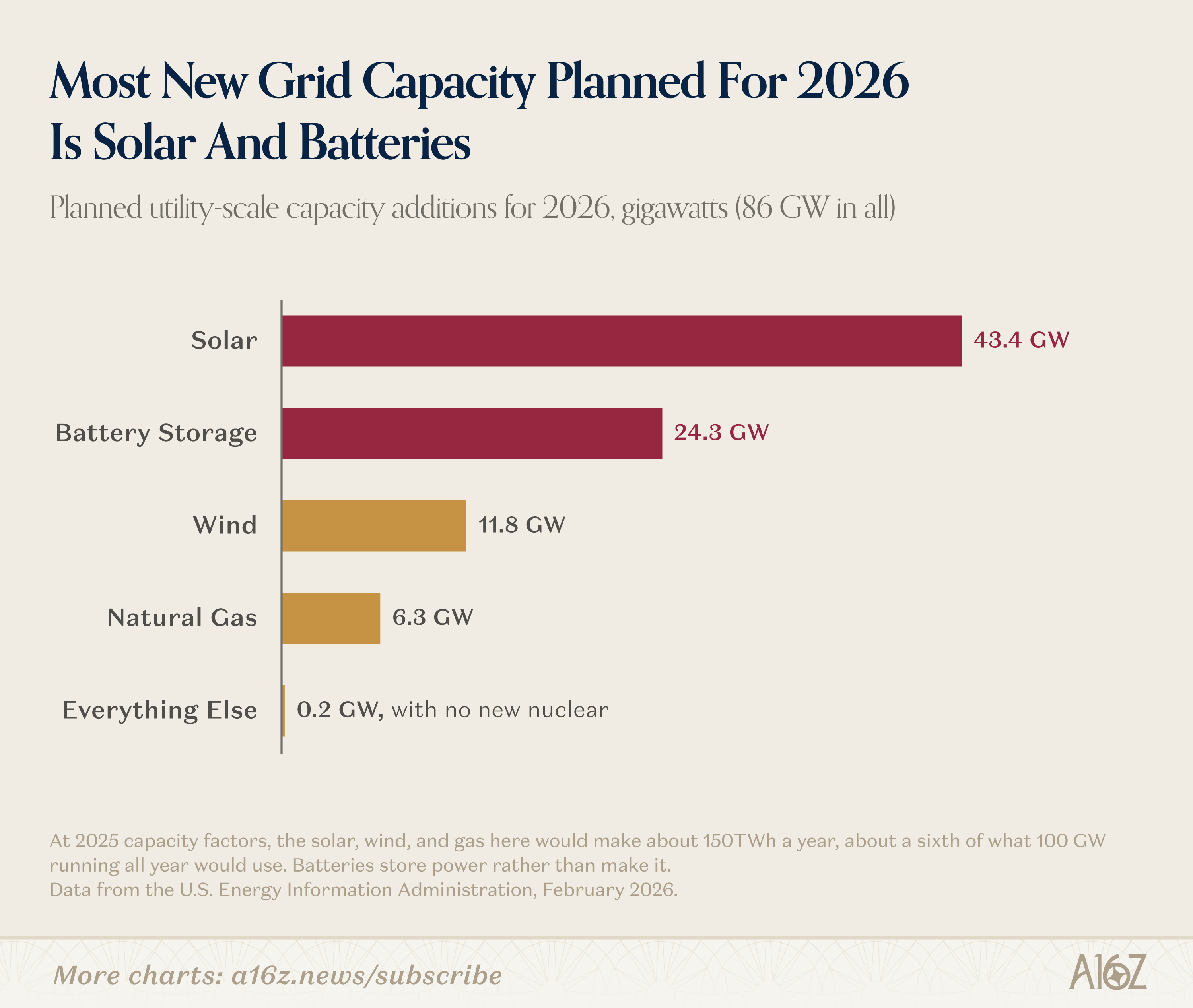
Every source helps, and much of it is headed to Texas anyway. But at last year’s average capacity factors (how much plants actually produce versus their maximum), the planned solar, wind, and gas plants would make around 150 TWh a year, or about a sixth of that 876 TWh.
To be fair, that gas bar likely understates what’s being built, since EIA’s survey only counts plants tied to the grid. In this way, much of the 75 GW of on-site power equipment already on order could be ghost capacity that charts like this one will miss. Still, gas remains popular because it generally runs whenever you need it. And because of that, the constraint is mostly getting the equipment in the first place, so buyers are turning to alternatives that can be easier to find, like reciprocating engines and fuel cells.
That said, gas feels like an incomplete answer to me. I’m no Greenpeace warrior, but running 100 GW around the clock at gas plants’ average rate would release nearly 8% of the country’s energy-related emissions. Often the easiest equipment to get is even less efficient, too. Moreover, operating such a fleet could seriously test our gas supplies.
Solar is compelling because it already has the production scale the labs are aiming for. The problem is that it’s mostly in China. The world added more than 600 GW in 2025, but China alone makes more than 80% of the world’s solar components and battery cells. From what I can tell, Chinese suppliers don’t mind selling to us that much, at least partly because they see our scale-up as “cute.” However, China reportedly weighed curbing exports of specific solar manufacturing equipment. Washington has also put on pressure, with forced-labor shipment holds, new tariffs, and a phaseout of wind and solar credits. Despite this, Elon is aiming for 200 GW a year of US solar manufacturing on his own, obviously solar-pilled.
Scaling firm power that isn’t gas is much more complicated. Uprates and restarts can squeeze a little more from the existing nuclear fleet, but the real upside is new reactors, as we’ve argued before. Meta and Amazon have signed big deals, but much of the capacity is still options and targets. So far, the military has been a stronger buyer to build microreactors on its bases, which is how factory-built reactors can learn to get faster and cheaper (blame EPC as much as the NRC). Geothermal could also leverage drilling (something Texas knows well) for repeatable power — Google and Meta appear quite interested.
Regardless of the power source, it all still ends up waiting on other equipment like transformers and switchgear, and all the crews to install them. Large power transformers now take more than two years to arrive, and the FCC has limited new foreign-made inverters alongside an August emergency order that could further bar Chinese-made equipment from the grid.
Someone also has to build the wires. In 2008, Texas regulators ordered the CREZ lines to carry West Texas wind, then spread their $7 billion cost across every ratepayer. Now they’re approving even bigger 765 kV lines, but it’s going slower than many would like. Some of that is just (unfortunately) typical construction, which is slow and expensive anywhere, but there’s also a myriad of additional regulatory hurdles on top. The federal permitting deal taking shape in Washington could help move things along if Congress can pass it.
Admittedly, I’m more confident that we’ll need a lot of power than I am about the exact shape it takes. My bet is that a handful of setups, depending on geography and flexibility, get built over and over. Maybe on-site gas and batteries carry a campus until its grid connection shows up, then stick around as backup to flex when the grid is tight. Solar gets layered on now where it fits, and geothermal and reactors come in once they prove out.
Past 2030, it’s even harder to say who ends up building and owning all that power. One answer is that the same company builds both the plant and the campus, which Google’s purchase of Intersect may signal. Another is that oil and gas companies, like Chevron or Williams, become broader grid builders, and it isn’t hard to picture them, or “neo-utilities” like NRG and NextEra, building private grids that serve several campuses, assuming the law enables it.
I don’t know which way it goes yet, but they’ll likely all be buying from the same equipment makers. That market is huge and surprisingly ill-equipped to meet inflecting demand. Given that, I see two major ways for startups to break in:
Integration: Some take familiar hardware and win on integration or business model, the way Base Power runs home batteries as a trusted aggregated resource.
Technology: Others bring new, superior technology that early adopters will take a chance on in a constrained market, which is what Heron Power is aiming to do with solid-state transformers.
A third pitch, crudely put as “worse but faster,” sells well in a shortage and can be immensely profitable, but I’d ask what those profits are being reinvested in, because it might get hard to compete if broader supply catches up.
Indeed, shortages like these are an opening for startups, but it helps to understand why incumbents aren’t quick to fill them. The last bet on a turbine boom ended in a $22 billion GE Power write-down and helped cost GE’s CEO his job. A startup has to survive the busts incumbents are planning around, as well as compete globally with Siemens Energy, Mitsubishi Power, and all sorts of suppliers in places like India and China. Customers may pay for speed today, but keeping them will take reliable, competitively priced equipment and a service team that knows what it’s doing.
Every step of site development is hard. Vendors like GE Vernova now take nonrefundable deposits just to reserve a manufacturing slot, leaving developers with a chicken-and-egg problem. Lenders want a long-term contract with a solid customer, who wants a credible timeline, and that timeline takes deposits the developer usually needs lenders to fund. Bring in an unproven vendor and the loop gets even harder to close (and markets notice fast when it breaks). Once it closes, everything else still has to go right.
For a new vendor, even getting into a campus’s first phase is difficult. As far as I know, hardly anyone has placed a large, firm order for data center power equipment without thousands of hours of operation. For example, FTAI’s big order rests on the CFM56, a jet engine that has logged more than a billion flight hours, while Crusoe stepped back from Boom as Boom’s first engine core was still gearing up for tests. So even credible teams building awesome technology face a cold-start problem. Thus, getting your product designed into a real project matters far more than early deposits or revenue.
After the pause
Let’s get back to Texas. I think it’s fair to check that projects in Batch Zero are what their developers swore they are, and credible projects should move ahead soon. The broad permit freeze is harder to defend, though I see the state’s logic if the goal is to approve nothing until the audit is done. That said, I don’t like that it makes a developer that has funded its first phase, even one bringing its own power, wait like a speculator. Texas should narrow it now by exempting generators permitted only for emergencies and projects that have funded their first phase. The October 19 update to the governor from the state’s environmental regulator is the obvious place to start this conversation.
Once the audit is done, the ongoing tests can be more straightforward. A developer that posts its security deposit, pays for the capacity it reserves, and hits phased milestones should get a connection date it can plan for. It should also connect sooner if it agrees to cut back when the grid is tight (Batch Zero already does some of this). Going further, the utility building upgrades should probably answer for delays much like a developer does. Perhaps Texas could open lines to competitive bids with cost caps and penalties.
Whatever Texas decides, power will likely stay tight for years while the bottleneck keeps moving. Importantly, data centers are not that unique in the equipment they need; they just hit these limits first. In this sense, they’re the perfect rehearsal, because much of what we want to (re)build in this country will run on the same stuff.
That also makes it an opportunity I’d hate to waste. AI companies will pay nearly any price for power and can build almost anywhere, so they can help fund upgrades the grid needs anyway. Analyst Hans Royal estimates inference could pay an absurd $5,600 per MWh for power and still earn a decent return, nearly 60 times what the average US industrial customer pays. That can strain local prices for gas, power, labor, and materials, but the infrastructure it funds can be worth far more. Admittedly, that argument can be a hard sell right now. In an August poll, 56% of Texas voters said more data centers would hurt local energy bills.
The worry is fair since the honest answer is that it depends on who pays. In a perfect world, developers cover all related upgrades and pay for the capacity they reserve, supporting shared infrastructure construction that improves the grid for all of us. Even just by buying a lot of power, a campus spreads a service territory’s fixed costs over more sales, shrinking everyone else’s share. Berkeley Lab found that from 2019 to 2025, the states with the most load growth generally saw average prices fall after inflation. Imagine all the money racing into AI helping the next factory connect and the next household electrify without an unaffordable bill (or a grid too tight for an EV, or a home robot). That household may never open a chatbot and still come away far better off. We’re already seeing early versions of this:
Indiana: The utility serving Amazon’s New Carlisle campus proposed using data center revenue to cut household bills by about $100 a year.
Alabama: A Tuscaloosa County campus will pay $270 million in community benefits over 20 years. In return, it gets about $314.5 million in tax breaks, though school taxes (about $131.5 million) aren’t abated.
Pennsylvania: One developer offered every household in Hazle Township $10,000 if its campus gets approved, which some residents (perhaps correctly) called a bribe.
I would not be surprised to see hyperscalers covering a whole town’s power bills as part of hosting a local campus. Most states, Texas included, don’t let a utility single out one town, but at a small utility where data centers use most of the power, like Oregon’s Umatilla Electric, covering a typical household’s bill for each of its roughly 17,000 meters would only cost about $30 million a year. Such an agreement could pencil because that’s less than 0.5% of what a 1 GW campus costs to own and run.
It’s also important to read the fine print when deals are made. In Arkansas, Google agreed to pay $443 million up front toward an Entergy solar plant for its data center. The catch is that Entergy counted it as prepayment for power, so it can still seek the plant’s full cost plus a return from all its customers. And Entergy sued two newspapers to stop them from reporting on the contract, then dropped the suit after a judge refused. Even if the deal is legal, this isn’t how you build trust with the community.
A campus that levels with its neighbors and actually follows through keeps people on its side, and the next one gets easier to welcome. Get that wrong and everyone else can end up paying for it. In PJM, the market monitor says data centers account for 38% of the latest capacity bill, some $6.3 billion. Let me be clear: none of that justifies a blanket pause. But it does mean getting the rules and incentives right as we scale up development. AI companies have pledged to pay their way, and most would rather connect to the grid than avoid it. It seems ideal for everyone that we let them do so instead of driving that spending into private islands, or pushing the infrastructure upgrades that we’ll need anyway onto everyone else’s bills.
Texas created the energy fast lane first; now it has the opportunity to show us a better one, and I expect it will. Power is where America finds out whether it can still build.
If you’re working on energy problems, I’d love to learn from you. Please reach out.


This newsletter is provided for informational purposes only, and should not be relied upon as legal, business, investment, or tax advice. Furthermore, this content is not investment advice, nor is it intended for use by any investors or prospective investors in any a16z funds. This newsletter may link to other websites or contain other information obtained from third-party sources - a16z has not independently verified nor makes any representations about the current or enduring accuracy of such information. If this content includes third-party advertisements, a16z has not reviewed such advertisements and does not endorse any advertising content or related companies contained therein. Any investments or portfolio companies mentioned, referred to, or described are not representative of all investments in vehicles managed by a16z; visit https://a16z.com/investment-list/ for a full list of investments. Other important information can be found at a16z.com/disclosures. You’re receiving this newsletter since you opted in earlier; if you would like to opt out of future newsletters you may unsubscribe immediately.
Ryan — the part of this that really jumps out is the distinction between project representation and earned reliance.
A developer can enter a queue, post security and clear an administrative milestone without necessarily establishing that the underlying load, customer, power strategy, timing or operating assumptions have become durable enough for planners to rely upon.
The same issue shows up with flexibility: demonstrated capability is evidence, but it is not permanent assurance that the capability will remain available under the conditions in which the grid later depends on it.
The missing layer seems to be:
Representation → Evidence → Dependency → Decision Gate → Material Change → Revalidation.
Project maturity determines whether a project has earned advancement. Revalidation determines whether the evidence that earned advancement remains true.
Really thoughtful piece.
Neil P. Osnato
Founder | Persistence Analytics Group LLC