



America | Tech | Opinion | Culture | Charts

To software CEOs, founders, boards, and the investor community: the comfortable middle is over.

Public markets have already repriced the sector, and for good reason. They are telling us software terminal value is not what it used to be. I do not know what moves every stock in the next quarter, but over the medium and long term I think there are only two credible paths to durable equity value creation.
Path one: accelerate revenue growth by 10+ percentage points, year over year, through genuinely new AI-native products over the course of the next 12-18 months.
Path two: rebuild the company to 40%+ true operating margins (ideally 50%), including stock-based compensation.
Strictly speaking, these initiatives are not mutually exclusive. But I suspect the 12-18 month plan needs to be one or the other. By the end of next year, everything between those paths of high growth and high profits will look like no-man’s land: growth pressure, persistent dilution, and multiple compression. CEOs today need clear initiatives to drive toward one of these as an output.
The Adjusted Jig Is Up
Public software has already lived through the first half of the transition. Growth rolled over and valuations compressed. But in most cases, true profitability still has not arrived.
Yes, free cash flow improved; GAAP margins improved some. Yet once you treat stock comp as a real expense instead of a permanent carve-out, much of the sector still sits in the difficult middle: too slow to deserve a premium growth multiple, too diluted to deserve a fortress multiple.
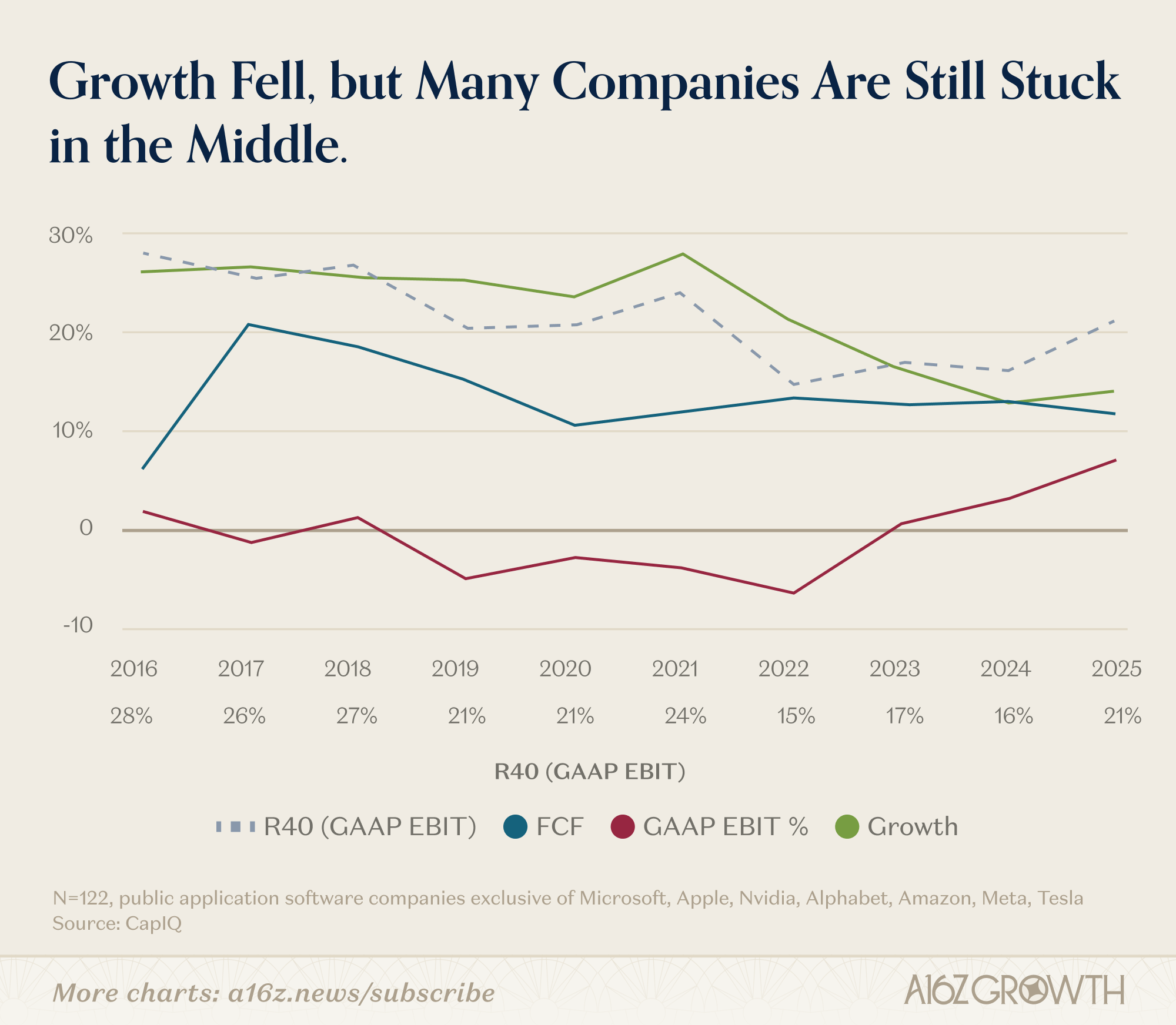
If topline growth is slowing down, we should be seeing more operating leverage, and again, while we’ve seen some, we haven’t seen enough.
The reality is that the time has come for bold management. And no, the “8% or 10% layoff” headline no longer counts. That is the weak form. The weak form trims the edge of the org chart and leaves most of the machine intact. The strong form is a redesign of the machine.
In the next 12 months, I expect we will get much more of the strong form. You have two options for how to do this, and the difference is in how you want to rebuild your company.




Path one: accelerate growth off new AI products
Accelerating growth with new AI products does not mean bolting on chatbots or copilot interfaces, attached to the old SKU list.
It means new products that can move the company’s total growth rate by 10 points within 12 months. And, just as importantly, it means you need to speedrun rebuilding your company - including your executive team - so that if you do find product market fit, you will actually capitalize on the opportunity.
The first thing you need to do is identify which people are going to be your leaders that help you pull this off. This is going to be a 12 month death march and you need to find out who is willing to go through the pain with you. There’s good news, though: somewhere in your org, there are ~five people who are going to deliver you 100x the amount of value you ever thought possible. Your first job is to figure out who these five people are (no matter how junior they are on paper!), explain the urgency of the situation with them, and give them the career opportunity of a lifetime to rebuild the company with you.
What do you do with these people?
First, you put them in charge of unglamorous, but critical information-gathering projects:
process-capture sprints around every high-value workflow;
harvest SOPs, tickets, transcripts, requirements docs, policies, CRM notes, support logs, event data, and approval paths.
Create a living context layer, not a pile of static PDFs. Treat documentation as product infrastructure. Instrument evals around accuracy, exception handling, latency, and cost. Get these five people on that task, each with their own scope of responsibility, immediately.
Over the next month, watch your VPs like a hawk to see who is on the bus with that team, and who is off the bus.
This will tell you everything you need to know about which half of your execs to keep for your imminent company rebuild, and which half needs to part ways. At the end of the month, have those tough conversations with the VPs and directors that need to go. Replace them with the crack team who just completed your information gathering sprint, and other AI-native up-and-comers in the company who’ve earned their shot. Now you have a refreshed and energized exec team, ready for the fight.
Meanwhile, you’re going to put 50% of R&D on net-new AI products.
Use four-person pods; collapse design, product and engineering into one working unit, start writing code on day one, and cap headcount, not compute. Reduce communication overhead to as close to zero as possible.
Make sure all of your best product managers are as customer-facing as possible. They can’t waste a minute. Their job is pure product discovery; make sure they’re unblocked by any legacy anything.
Your best engineers, meanwhile, are going to stay in the central engineering org, reporting directly to the CTO. Their job is to make sure that the company’s core engineering architecture can evolve as quickly as your vanguard PMs.
Mileage may vary by company here, but my advice is don’t put all your best engineering talent at the edges. It’s tempting to do so, but this will Balkanize your tech stack and create years of technical and organizational debt that will smother any early promising progress. Furthermore, with AI, you don’t need your best engineers to be on net-new product discovery; you just need people who ship and learn quickly. The best engineers should stay focused on the company’s overall tech architecture, but prioritizing the new stuff ruthlessly.
As a part of this sprint, your business needs to get really good at escalating contentious decisions to unblock progress. You will not pull off this transformation and successfully build new AI-native businesses in 12 months without making hard choices, every single week. So get good at this process, and make sure your newly reformed executive team is dedicating a LARGE percentage of their time (at least one whole day a week) exclusively to unblocking designers, PMs and engineers like the company depends on it.
In the course of unblocking your team, you’re going to figure out exactly what your new business model is. It will need to make money off of tokens / per use, rather than the old seat-based model. You do have some time; seat-based pricing isn’t going to go away overnight. But you need to take the challenge seriously: you can’t hand-wave a new pricing model and product interface. If an agent can’t consume and pay for your product autonomously, you probably aren’t there yet.
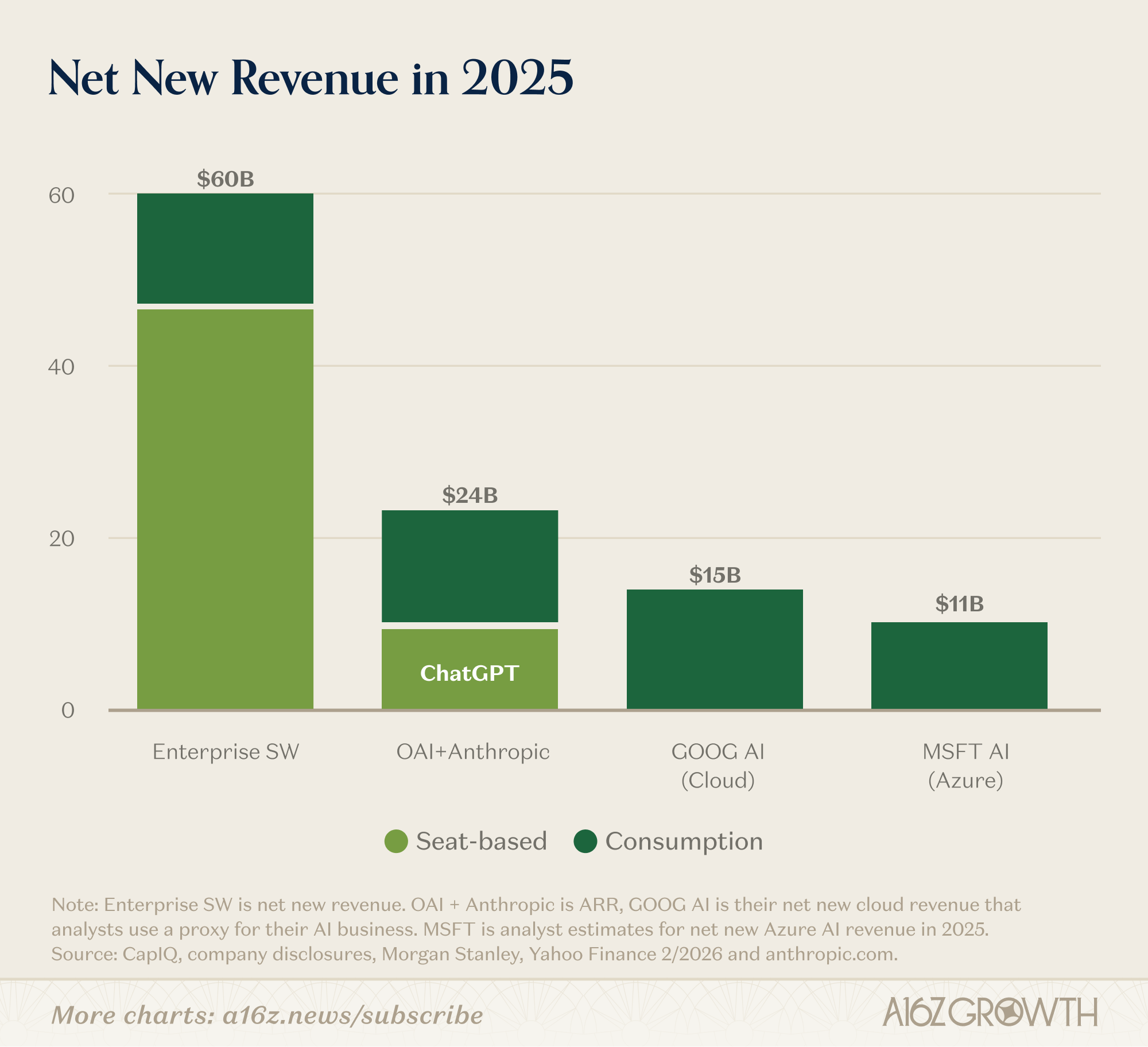
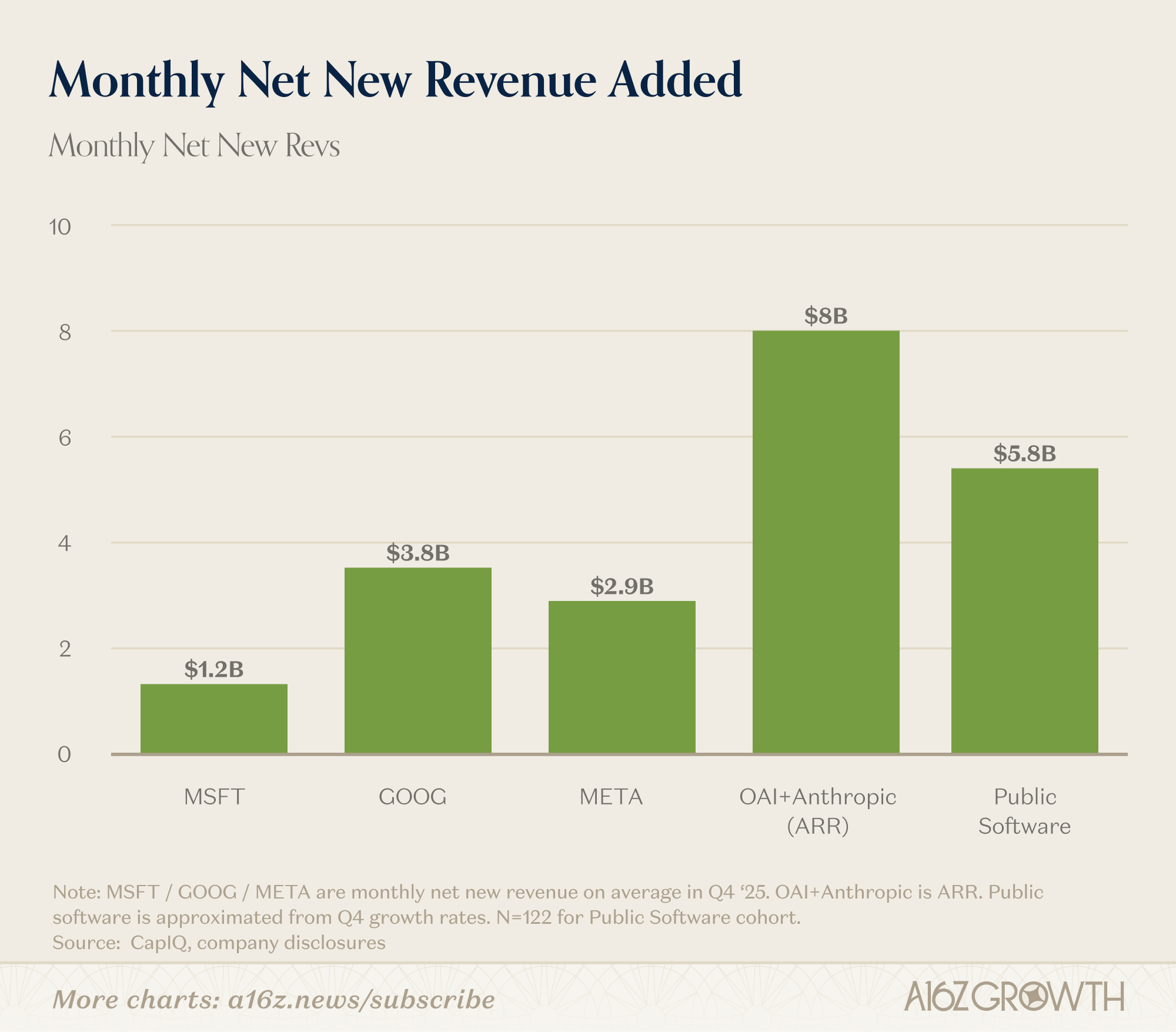
The budget for new spend is there. You can do this.
But remember that your customers’ first and most obvious source of AI savings is labor efficiency, which means seats are where they will look to take cost out. The new growth, by contrast, will increasingly sit in tokens, consumption, automations, outcomes, and machine-driven workflows.
If you are not in the token path, you are not standing in the fastest-growing part of the budget.
Not all companies are in a position to do this. You may assess your options and not see any credible line of sight to winning via Path 1. But if you do, and if you make it through this twelve month sprint, you will emerge as a focused, accelerating company with a new leadership team, and a “refounding moment” that your team will rally and reenergize from for years to come.
Path two: rebuild for 40%+ true margins
Software companies got very good at talking about free cash flow margins over the last decade. But if we are serious, we should stop excluding stock comp and pretending dilution is not an expense borne by owners. For companies that are not about to reaccelerate growth, I think the right target is 40% or even 50%+ true operating margins, including SBC, within 12-24 months.
Getting to 40%+ profitability requires more than 10% or 20% RIFs. It means flattening management layers, standardizing implementation, minimizing bespoke services, killing committees, raising price where you own the workflow or the switching cost, moving long-tail customers to higher floor pricing or letting them churn, and counting every share issued as a transfer from owners to employees.
AI should change the shape of the company. The cost structure should change with it.
This will take a similar level of effort to the first path. And even though your goals are different, you’re still going to aim for an AI-native company, whose engineers are maximally productive and efficient, in 12 months. From day one, you need to figure out what a smaller, but even more motivated and productive workforce looks like in your organization twelve months from now.
The first thing you’re going to do, counterintuitively, is radically increase the amount of budget you allocate for token spend per engineer. If your engineers are not spending real money on tokens, they are probably not pushing hard enough. A thousand dollars per engineer per month is not excessive; it is close to table stakes.
A useful working premise is that the ceiling on individual engineer output is moving much faster than most companies are organized to exploit. Some of the best operators already describe top engineers seeing order-of-magnitude productivity gains and managing 20 to 30 agents simultaneously. Whether 20x proves to be the edge case or simply the frontier, the organizational implication is the same: companies built for ten-person committees will lose speed to companies built for four-person strike teams.
Meanwhile, you need to prepare for a significant RIF - you already knew this.
You cannot just prune the leaves at the edges of the company: if you lay off a large percentage of the ICs in a company but leave the director and VP corps intact, you’re worse off than where you started. To be clear, it’s different from path 1; you’re not trying to build a “new” business. But you are still “refounding” the company along a new set of values around performance and shareholder mindset, so make sure you go on this journey with the right bench of leaders.
Another very important thing is that teams should be honest about which old moats are weakening.
Data alone is usually not enough.
Integrations are getting easier to reproduce.
Workflow and UI advantages matter less when agents can move across systems more easily. Migration is getting easier.
Competitors will increasingly come after each other’s modules, not just the edges. That means core-business price pressure is coming, so prioritize your strengths that will help you maintain pricing power and customer retention.
It Can Be Done: The Lesson of Broadcom
There is one public-market case study of the strong form, pre-AI: Avago/Broadcom under Hock Tan. It is a harsh model. It is not a cultural blueprint for every founder. But it is a reminder that radical cost discipline, product simplification, and price realization are possible. The strong form exists.

Path two may sound defeatist, but not every software company has a right to path one. If that right doesn’t exit, path two is the only path to value creation.
The pivotal question
Founders should put one question on page one of every board deck: which path are we on?
+10 points of revenue growth from net-new AI products? Or 40%+ true operating margins including SBC?
Investors should ask the same question more forcefully than they do now.
Where is the AI product engine that can move the curve? Where is the re-architecture of R&D around small, token-rich, customer-near teams? Where is the plan to build the dual human/agent interaction layer? Where is the explicit roadmap to 40-50%+ true margins? Where is the plan to bring dilution down as a share of revenue?
If the answer is some version of “a little of both” or “we are evaluating options,” I would expect the market to keep applying pressure.
Founders: you need to pick a path, and you need to decide quickly who on your team you want on the bus with you. You have the opportunity for a new founding moment for your company, your new team and your investors. Grow 10 or earn 40. Build the next product wave or build the cash machine. No middle lane. Good luck!



This newsletter is provided for informational purposes only, and should not be relied upon as legal, business, investment, or tax advice. Furthermore, this content is not investment advice, nor is it intended for use by any investors or prospective investors in any a16z funds. This newsletter may link to other websites or contain other information obtained from third-party sources - a16z has not independently verified nor makes any representations about the current or enduring accuracy of such information. If this content includes third-party advertisements, a16z has not reviewed such advertisements and does not endorse any advertising content or related companies contained therein. Any investments or portfolio companies mentioned, referred to, or described are not representative of all investments in vehicles managed by a16z; visit https://a16z.com/investment-list/ for a full list of investments. Other important information can be found at a16z.com/disclosures. You’re receiving this newsletter since you opted in earlier; if you would like to opt out of future newsletters you may unsubscribe immediately.
David — thanks! I want to add one layer you didn't cover that I think determines whether either path compounds or resets. A context layer captures WHAT people do. It doesn't capture WHY they decided to do it that way. When the CEO replaces half the exec team — as you rightly prescribe — the new leaders inherit processes without reasoning. They know what the company does. They don't know why, what was tried and abandoned, what assumptions must hold, or what would trigger a reversal.You also say: "Get really good at escalating contentious decisions to unblock progress." I've lived this. The problem is that in a 12-month death march with 50 hard calls per quarter, the reasoning behind Decision #7 is forgotten by the time Decision #22 contradicts it. Nobody notices because there's no record.
I've spent the last two years building the missing layer — what I call a Judgment Ledger. Version control for institutional reasoning: the decision, the criteria, the assumptions, the dissent, the reconsideration triggers. Not a knowledge base. Not a wiki. A system of record for the WHY behind consequential calls.Without it, both your paths create the same long-term risk: a brilliant 12-month refounding that produces zero retrievable reasoning for the team that inherits it 24 months later.Speed without reasoning capture is just faster amnesia. And both your paths run very, very fast.Thank you for writing this. It clarified my own thinking.
— Deepak Jha, Founder & CEO, Quantum Mosaic
Author, The Third Balance Sheet (https://quantum-mosaic.ai/book)
I think a lot of the product discovery needs to be about content as a service, (CAAS). So when software is cheap and easily accessible, it is what content it is paired with that defines it's success, so when you are doing product discovery - you are doing pitch discovery for customers. The right pitch discovery will lead to right content which is where most of the PMs need to be focused on. Software still has a lot of potential to increase revenue for customers by embedding intelligence the right way, so please choose A and be the wartime CEO you were always meant to be.