



America | Tech | Opinion | Culture | Charts
This keynote speech was given by Erin Price-Wright on February 5th, for the 2026 Tauber Global Operations Conference at the University of Michigan’s Ross School of Business.
Thank you very much for having me. I’m going to talk to you today about AI, and specifically about building and running factories with AI, which is one of the things we think about a lot on the American Dynamism team at a16z.
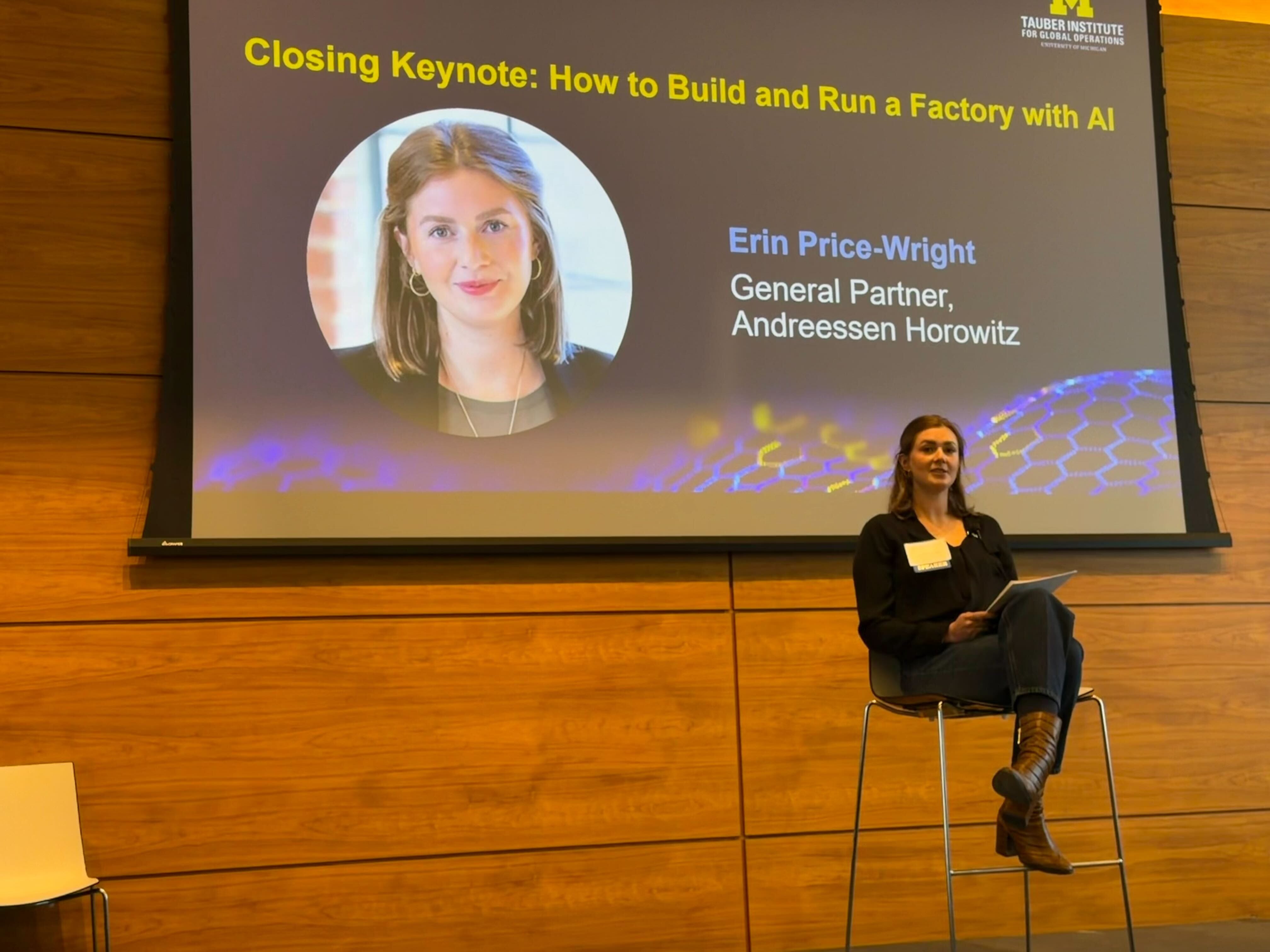
First I want to set a scene for you about why I’m here talking to you; why there is an American Dynamism team at all, and why these factories will matter.
Palmer Luckey - who here knows who that guy is? Anyone? If you don’t know, he founded Anduril, which is one of our portfolio companies. And he’s a great person to go to if you ever want some Hard Truths. One of those Hard Truths is how we as a manufacturing community, and we as a nation, were kinda sleepwalking towards the End of History until recently. The globalization of everything; the outsourcing of everything, the apparent triumph of market economics over national strategic interests. This probably sounds familiar.
Do you know the meme from the Simpsons where Moe the bartender throws Barney out of his bar, and then he reappears right behind him? Our version of that meme is where it’s Francis Fukuyama pronouncing “the end of history!” and then history really inconveniently shows up again. (This is unfair to Fukuyama, because if you actually read his book you’ll know that “The end of history” was an ironic bit, not a forecast. But the joke stuck.)
Anyway, one day we woke up and scrolled our phones and saw pictures of Ukrainian cities that look like they’ve been decorated with those fake halloween cobweb decorations, you know that ghostly white stuff that gets everywhere, until you look closer and you realize those are fiber optic cables - thousands upon thousands of miles of fiber optic cables - left over from drone warfare. The future is coming faster, and weirder, than anybody is ready for.
The conflict in Ukraine is just one of many, many examples where we in the United States have woken up from a long sleep and realized some version of, “if you can’t make your own bullets, you’re not really in charge.” We had this happy dream since the 90s where China would make the body of everything but we made the brains of everything, cause that’s where all the value is and it’s what you’re classically supposed to do in a rich economy. Factory work is supposed to be outsourced, right? Manufacturing has a hard time competing with consulting or investment banking, when it comes to your future contribution to the economy and to your family prosperity. I get it.
But here’s the thing, our intern Theo went to China over the holiday break and eagerly shared pictures back with us of him walking into a mall and going into the Unitree store for humanoid robots, probably manufactured within the week like they’re a piece of fresh fruit, where you could watch a demo boxing match between them, or carefully inspect their dishwashing skills, and then take one home with you for an alarmingly cheap amount of money. Theo was impressed.
Now, a great privilege of my job at a16z is getting to talk to founders here in America who are also building cool robots. I don’t want to suggest we don’t have anything like that going on here; Elon would like a word. But the overall contrast is undeniable, which is that bleeding edge manufacturing over there is something that iterates at the speed of culture and fast fashion, while the bleeding edge manufacturing over in Ukraine is quite a bit more literal, unfortunately. Here? We’re a bit behind the curve on making these human robots or frankly anything else. In China now they have these palatial buildings called “Dark Factories” where robots make Huawei phones completely in the dark, supposedly. Whereas in California some of our powerlines are over 100 years old, and they start fires all the time.
Related reading from the American Dynamism team:


The common cause behind all of this, everywhere you look, is we’re in this situation because we aren’t the manufacturing leader anymore, and all problems, all of them, keep coming back to “how are we going to pull this off and make American manufacturing good again?”
There’s this famous Winston Churchill line, “America always does the right thing… after exhausting all other options.” We’ve gone through some version of “denial, anger, bargaining…” (maybe we’re still bargaining?) and we all know what comes at the end of the sequence, which is we roll up our sleeves and fix the damn problem.
Now, I’ll get to the point here, which is that we need you to help us solve this problem, here in America. And there is a good news side to this story, too. Which is that we are so lucky to get to work on this problem, here in America. We’ve still got some things going for us. For one thing, we have the deepest and most adaptable and opportunistic capital markets in world history. Look how quickly the S&P reinvented itself around AI infrastructure buildout in less than 5 years; that’s a genuine miracle and few other countries in history could have a free market produce that result.
This is because America is the greatest country in the world at identifying people and ideas that seem important, and giving them a shot.
Now, I told you at the beginning of this talk that I was going to speak to you about using AI to design and build factories. And we’re going to get there, I promise.
So let’s talk about factories.
What even is a factory?
When I say the word “factory”, many people still conjure up an image of a Henry Ford assembly line from the early 1900s. Or they might think of sweatshops from the 1990s, or even photographs from the early iPhone factories in China. A factory includes buildings, plant & equipment, robots and humans, inputs and outputs. All of these things are part of what a factory does.
But a “Factory” is not a physical snapshot in time. It’s a concept. It’s a way of systems thinking derived from first principles. It’s about breaking down problems into composable parts, using technology to automate repetitive processes, then identifying bottlenecks and fixing them… And then doing that again and again and again at scale.
It’s finding the right arrangement of processes so that lithium goes in one side of the gigafactory and batteries come out the other side, and everything in the middle is a process of discovery and of constantly rederiving from first principles, “what do my raw materials cost, and what is the correct way to arrange those atoms so that out comes a battery?”
America is really good at rebooting and rederiving its systems from first principles. It is the best, and the most sacred and awesome part of our system that we are wired as a country to identify the people and ideas that seem important, and give them a shot.
Henry Ford revolutionized the factory a hundred years ago. Elon Musk did it again this century. This is something we can do, in 2026, and you will do, which is tackling challenges across mining, construction, manufacturing, any other big challenge, through an approach I call “the factory mindset.” You start with inputs, you need to get a really good output, and in the middle you’re going to apply all of your creativity, every advantage AI gives you, and all of the creative license that America gives you - to find the best output, and to do it over and over again, like off an assembly line.
Let me give you some examples, all the way through the journey of building a factory, starting with site selection.
Mariana Minerals is a “software-first minerals producer”, which really just means a mineral producer that was founded this century by smart people. They do interesting work like extracting lithium from oilfield waste, and make software for how to iteratively improve the way they do it; they’re a portfolio company of ours.
At one point recently, they needed to pick a site for a lithium extraction facility in Texas. Normally, the way you do this is you hire consultants, and they spend months going through water availability, power access, and local regulations, one site after another, until eventually they get back to you with a very expensive report that selects the safest, obvious option.
Mariana didn’t do this. Their AI platform looked through thousands of potential sites in parallel over the course of a couple hours and ended up selecting an amazing site. I know this seems like just one step in a big process, but those few months and millions of dollars at the very beginning of a risky venture will start you off on the back foot to such a degree that you have to play it safe and conservative through the whole rest of the project. It’s a lot better when you can just pick a site right now and get on with your actual job, which is building an innovative company.
Now let’s do permitting. Permitting a factory, if you’ve ever been through a process like this, is a really terrible experience if you do it the traditional way. The reason why is because, there’s so much human labor involved in documenting and certifying the parts of a factory that you assemble, that bugs and compliance problems that happen over a normal course of business will slow your whole certification process down to a “slowest common denominator” kind of struggle.
Hadrian, another a16z portfolio company which makes robot powered factories for manufacturers, took a first-principles look at this problem and said, look, if the AI is building the factory it should also be getting the factory ready for certification: go handle this; and sure enough it does - they now bring factories online in under six months, which is astoundingly fast for a process that usually takes years.
You also have to design all of the intricate processes and flows inside a factory. Diode is a company that designs circuit boards for aerospace, defence, and robotics companies, and it’s actually quite similar to designing a factory, just at smaller scale (and, really, a factory is made up of circuit boards; it’s turtles all the way down). This is the sort of work where you cannot make mistakes, because one mistake wrecks the whole board, and AI is just obviously, totally, changing how quickly and accurately you can get this work done.
Then you have build the factory. Castelion is a company of ours that makes rocket motors, they’re currently building a 1000 acre manufacturing campus in New Mexico. Guess how they’re building the factory? They’re building a machine-that-builds-the-machine, constantly figuring out what they should be doing, finding the right form of the factory, finding the best idea and giving it a shot that it never would have if built conventionally.
Finally, once the factory is built, you get to run it. And then here’s where the work of rediscovery honestly begins again, because now that you have this amazing factory, you’re going to be brimming with ideas for how to improve it already. “If only we’d thought about this assumption differently, or held that principle differently, we could’ve simplified and skipped all these steps…” You’ve all probably seen the famous picture of the three generations of SpaceX raptor engine? Where the first version is this nightmare Rube Goldberg machine, and the second version is a little better, but then the third version looks almost like a toy, it’s so simple. That’s factory mindset.
The important thing I want you all to take away from this talk is that the real way that AI is going to change your life, and change the way your businesses are going to run, is not just a story about “technology being smarter.” That’s a piece of it, but really the story of AI is about people and ideas getting a shot: at rethinking, reimagining, and radically improving the way factories work and the way the world works.
Imagine you leave this room and walk down the road to the nearest random mid-size business, and get a hold of the CEO and he asks you, “How is AI going to change my business?” There’s a wrong answer and a right answer. The wrong answer goes, “All of your business surfaces are going to be smart now.” which to him probably sounds like a nightmare.
The right answer goes, “There are four or five people in your company right now, and you don’t know who they are yet, but in the next year they are going to deliver you 100x times the amount of value you ever thought possible out of them. Because they are going to use AI to see a situation differently, and take charge of it differently, and just have impact that is wildly higher leverage than that individual used to be able to do.” And his job, in that moment, is to identify those people and promote them and give their ideas a shot, give them more responsibility.
Your job (it goes without saying, to all the students in this room) is to be that person who earns that shot. And you have to start practicing now. Use every AI tool you can, for the most difficult tasks you can. Build those muscles now; get your reps in. The rewards for doing this, for you personally, for your family prosperity, for your community and for your country, will be bigger than you can imagine.
Your takeaway from this talk is to remember that “factory mindset” is about thinking from first principles, and finding the best ideas (and people!) and giving them a shot. It’s about breaking down problems into composable parts, using technology to automate repetitive processes, then identifying bottlenecks and fixing them… And then doing that again and again, at scale.
The world is going to become a much stranger place than you think. No one had fiber optic cable snow on their Bingo cards; the world will be different in unpredictable ways. That’s why people applying first principles to problems, using every AI tool and every other tool to fix them, and getting the shot they need to do it, will always be in demand.
This story, of how we’re going to change manufacturing and building and all kinds of businesses, is the most American comeback story there is. You cannot keep a country down that is built for giving people a shot.
Thank you very much.

This newsletter is provided for informational purposes only, and should not be relied upon as legal, business, investment, or tax advice. Furthermore, this content is not investment advice, nor is it intended for use by any investors or prospective investors in any a16z funds. This newsletter may link to other websites or contain other information obtained from third-party sources - a16z has not independently verified nor makes any representations about the current or enduring accuracy of such information. If this content includes third-party advertisements, a16z has not reviewed such advertisements and does not endorse any advertising content or related companies contained therein. Any investments or portfolio companies mentioned, referred to, or described are not representative of all investments in vehicles managed by a16z; visit https://a16z.com/investment-list/ for a full list of investments. Other important information can be found at a16z.com/disclosures. You’re receiving this newsletter since you opted in earlier; if you would like to opt out of future newsletters you may unsubscribe immediately.
Inspiring writing! Your thoughts on the manufacturing move to China are mirrored in the documnetary on Shenzhen 'The Silicon Valley of Hardware', which illustrates the mindset behind 'China speed'. https://www.youtube.com/watch?v=SGJ5cZnoodY