



America | Tech | Opinion | Culture | Charts

Alex Danco
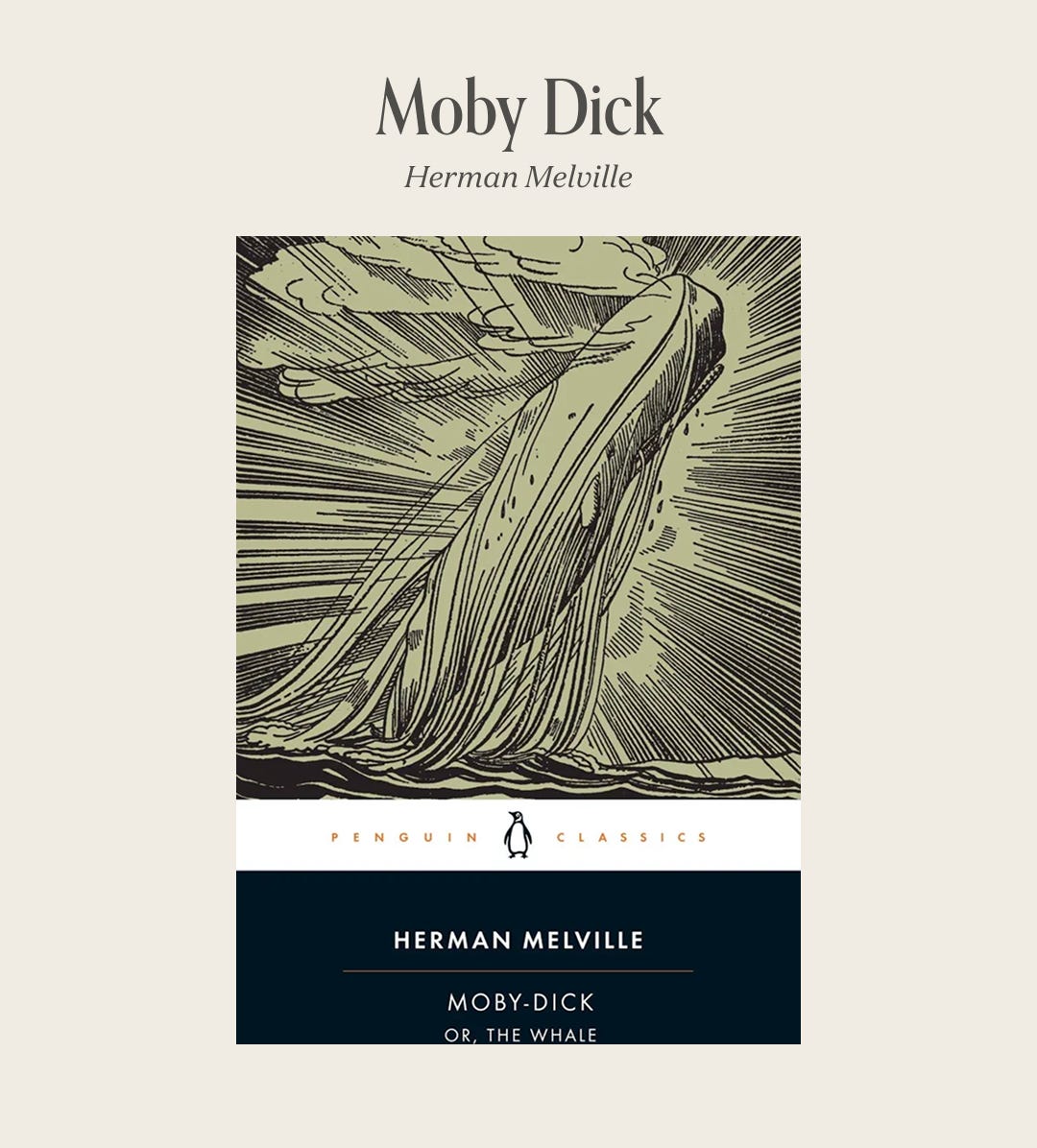
Moby Dick, by Herman Melville
Topic: Obsession, Revenge, Seafaring, Whale Anatomy, How to negotiate startup equity, American Dynamism
Length: 625 pages
Where to read it: On the beach, listening to crashing waves
Pair with: July 4th celebrations
Why you should read it: It’s the Great American Novel.
Really why: It’s so fun to read this book. It’s one of the great startup books of all time, and the whole point of reading it is for the obsessively detailed, tactile knowledge. (For example, you’ll read a few pages on how to coil a rope properly, so that there isn’t any latent tension in it that could violently unkink and throw someone overboard!) Also, this is one of those books that’s so referenced in popular culture (the “White Whale” as a metaphor for obsession, for example) that you’re basically required to read it once.
Best quote:
“Lad, lad, I tell thee thou must not follow Ahab now. The hour is coming when Ahab would not scare thee from him, yet would not have thee by him. There in that is thee, poor lad, which I feel too curing to my malady. Like cures like; and for this hunt, my malady becomes my most desired health.” - Ahab, to Pip
Reread rating: Probably one and done, but you must do it once
Anything else: Your reward for making it most of the way through the book is getting to meet one of the great bit characters in American literature, Captain Boomer
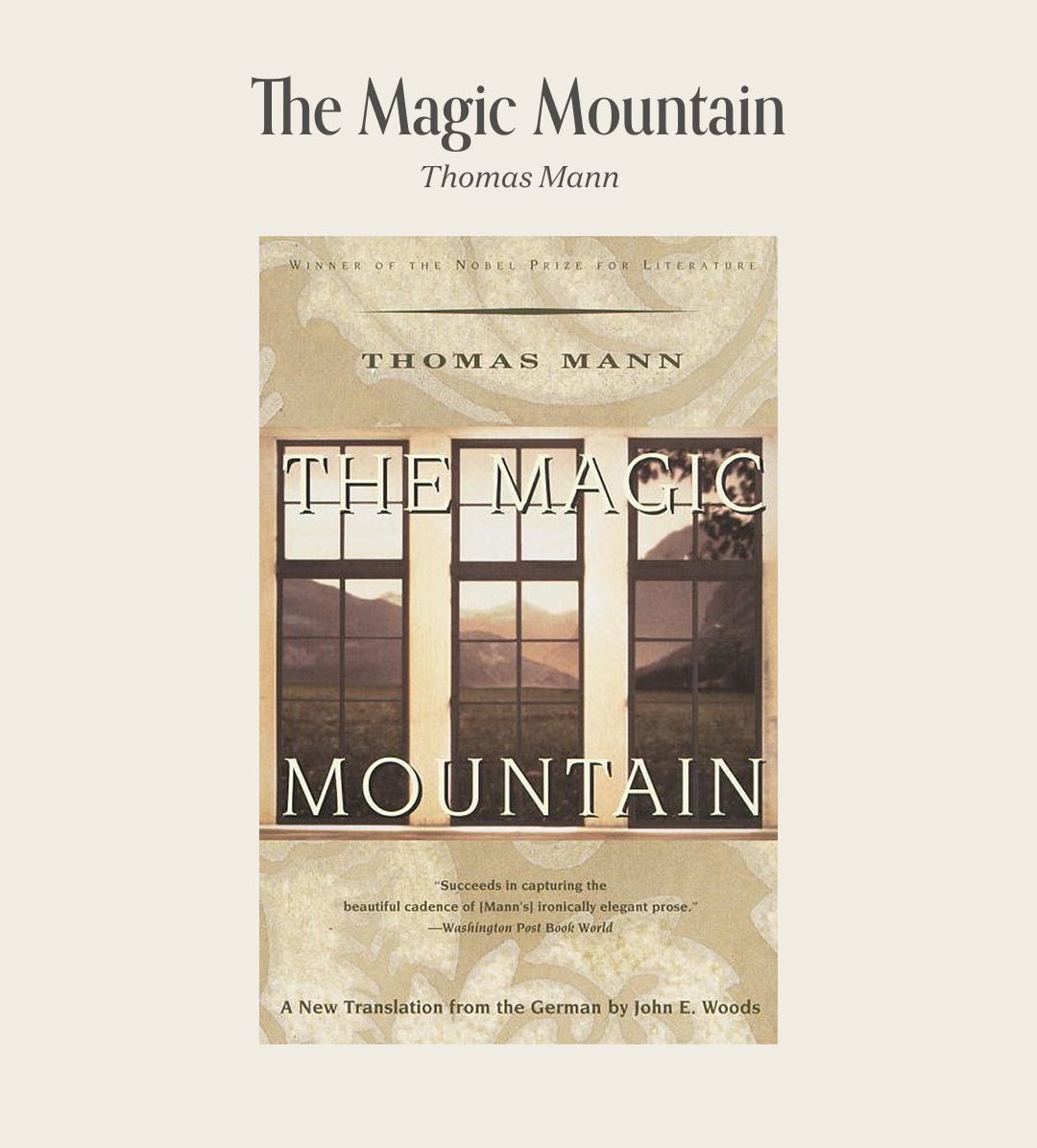
The Magic Mountain, by Thomas Mann
Topic: The passage of time, the meaning of the Western Canon, what you will do when you face Death
Length: 706 pages
Where to read it: At altitude
Pair with: A good vintage of Gruaud Larose
Why: The single most helpful book I’ve read for sorting out the Western Canon of Ideas in your head. Won the Nobel Prize for Literature
Really why: I enjoyed this book so much I gave an Interintellect salon on it once. The premise of the book is, this guy Hans Castorp goes to visit his brother in a sanatorium in Davos, and ends up staying there for 7 years, with all of these people who are caricatures of all of the European countries and their idiosyncrasies and problems on the eve of WW1. In particular, there are two Italian guys (named Settembrini and Naphta) who, over the course of the book, argue their way through the entire Western Canon, and the reader gets an incredible birds eye view as they fight over every big timeless issue. You will finish this book as a more educated person than when you started.
Quote:
“The bourgeoisie doesn’t know what it wants. They scream about doing something to half the decline in the birthrate, demand that the costs of raising and educating children be reduced - and all the while we’re suffocating in the throngs, and every profession is so overcrowded that the brawl over a few scraps of bread will soon eclipse all previous wars. Open spaces and green cities! Toughen the nation’s youth!” - Naphta
Hot take: You’ll think about current American electoral politics in a new light after reading this.
Reread rating: Reread once a decade
Anything else: Get the John E. Woods translation
Cola Gahm
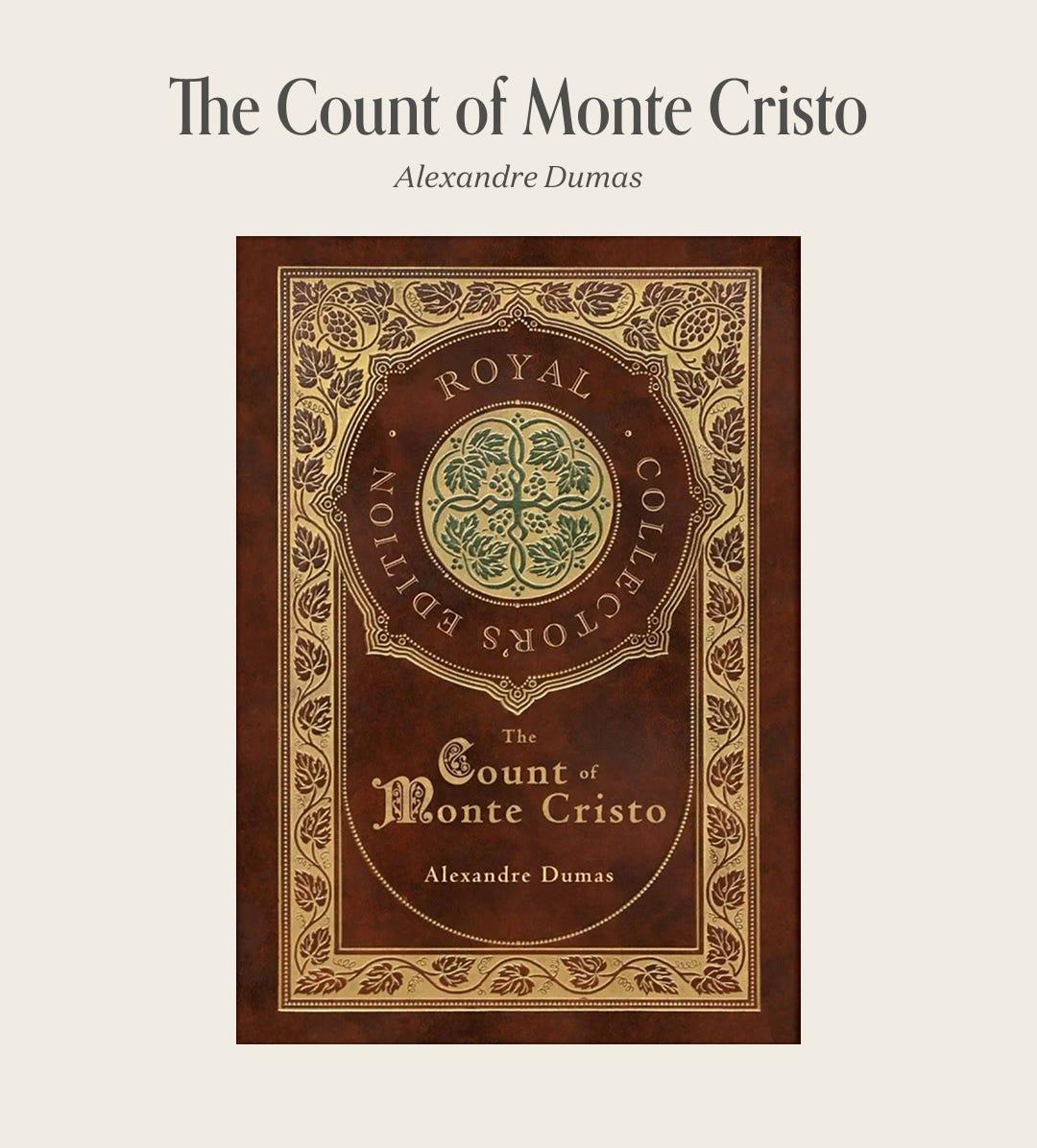
The Count of Monte Cristo, by Alexandre Dumas
Topic: Adventure, Historical Fiction, Revenge
Length: ~1,276 pages (or ~52 hours) AKA, not for the faint of heart.
Where to read it: On a long plane ride or in short stints
Why: I know no one will believe me (see: page count) but if you want adventure this summer, it is a shockingly fun and suspenseful read that keeps you turning the page!
Really why: “As for you, you meant evil against me, but God meant it for good.” (Genesis 50:20) This verse summarizes the whole of the book to me and has fundamentally changed my view of life. The story of Edmond Dantes is one of a man on the cusp of gaining everything, wrongfully accused, thrown in prison, and thus losing everything. When he emerges, he completely remakes himself to enact his revenge plot. Throughout the novel - and Dantes’ life - there is profound loss and despair, yet the persistent providential hand that seems to turn each evil thing into something unexpectedly good and beautiful. I would give this to anyone lost in life, unmotivated, despairing, or simply stuck. The intelligence and pure dedication with which Dantes remakes himself is inspiring and slightly terrifying. The providential hand that somehow redeems the darkest of situations is even more so.
Best quote:
“Live, then, and be happy, beloved children of my heart, and never forget that until the day when God shall deign to reveal the future to man, all human wisdom is summed up in these two words, — ‘Wait and hope.’”
Hot take: Unlike every movie or TV adaption, I would not change the ending at all.
Reread rating: Realistically, every few years because of the length. But I was ready to reread it as soon as I finished it.
Anything else: Adaptations are often a good watch in their own right, but don’t quite capture the heart of the story.
Elena Burger
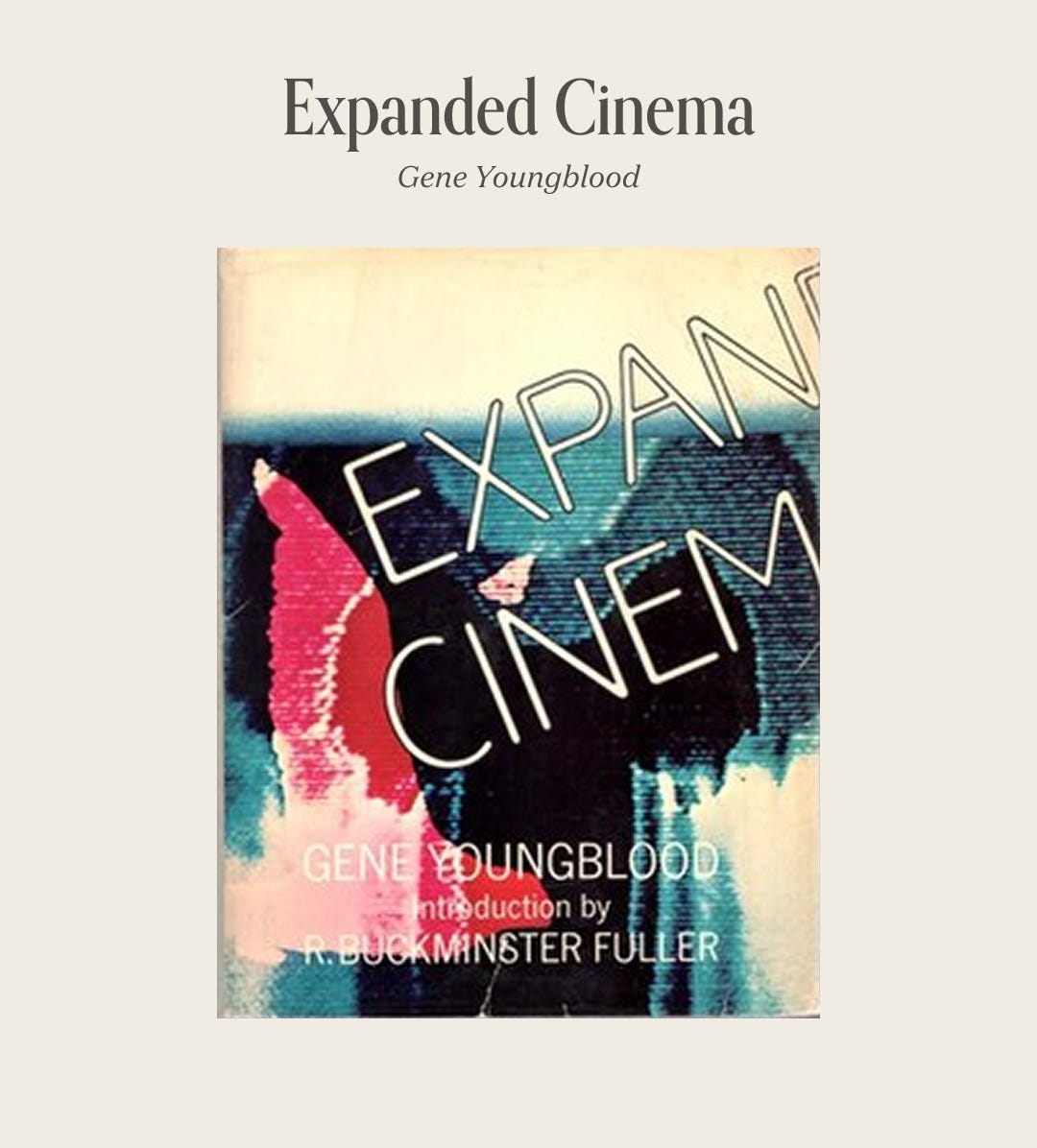
Expanded Cinema, by Gene Youngblood
Topic: Media theory
Length: 444 pages
Where to read it: Tompkins Square Park
Pair with: A screening of 2001: A Space Odyssey or the shorts of Stan Brakhage, Andy Warhol, Carolee Schneemann, etc.
Why: In this book, Youngblood asks what happens to human consciousness when images, networks, computers, video, and environments become part of how we think? There are a couple books I return to when trying to understand how new kinds of technologies create new kinds of people (Democracy in America by Alexis de Tocqueville is another example of this kind of book) and this is probably the main one.
Really why: I picked this up from one of those outdoor used booksellers on the corner of 7th street and 2nd ave in the East Village, sometime around 2018/2019. At the time, I wanted to make movies. At the time, I was also working as an equities analyst at an investment fund in Manhattan. Obviously some asymmetry there. Anyway, this book really trained me to look at art/new mediums as training regimes that get people to see the world differently. Youngblood was writing about narrative cinema, television, and experimental film (and beyond just the works themselves…the underlying mechanical and newly-created digital processes as well). But I think a lot of his observations can be applied to any new technology that introduces humanity to new forms of collective experience. When I encountered the book, I was thinking a lot about crypto and insurgent trading apps like Robinhood. Now, AI is what I think about when I revisit the book.
Best quote:
Just as every fact is also metaphysical, every piece of hardware implies software: information about its existence. Television is the software of the earth. Television is invisible. It’s not an object. It’s not a piece of furniture. The television set is irrelevant to the phenomenon of television. The videosphere is the noosphere transformed into a perceivable state. “Television,” says video artist Les Levine, “is the most obvious realization of software in the general environment. It shows the human race itself as a working model of itself. It renders the social and psychological condition of the environment visible to the environment.”
A culture is dead when its myths have been exposed. Television is exposing the myths of the republic. Television reveals the observed, the observer, the process of observing. There can be no secrets in the Paleocybernetic Age. On the macrostructural level all television is a closed circuit that constantly turns us back upon ourselves. (page 78)
Hot take: Better than anything Marshall McLuhan wrote.
Reread rating: Read at the steepest point in the S-curve.
Anything else: You might be tempted to skip over the longer sections where he recounts the plots of experimental films you probably haven’t seen. Resist the urge! Find the movies online and watch them.
Jason Saltzman
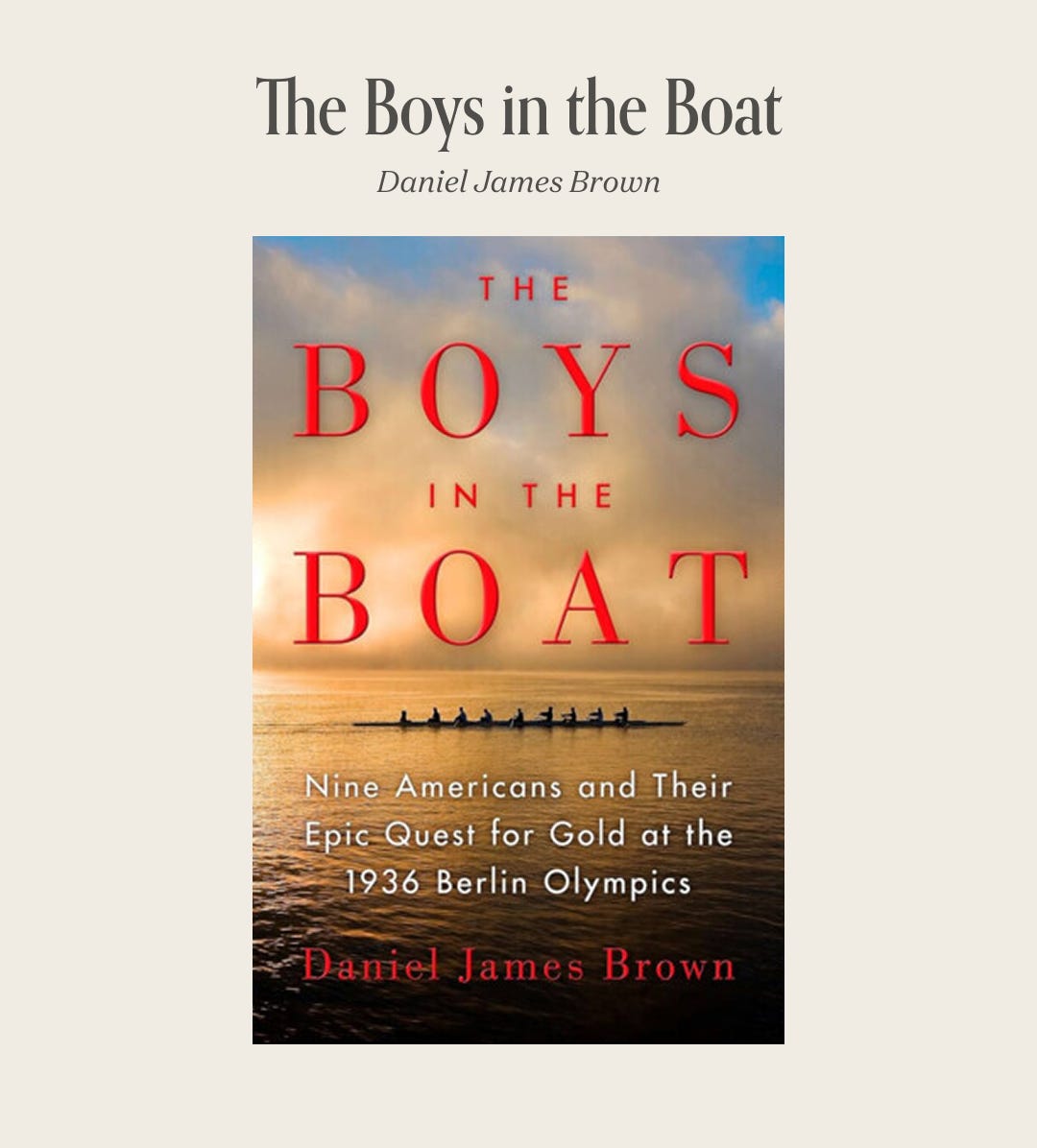
The Boys in the Boat, by Daniel James Brown
Topic: Narrative nonfiction / sports history. Nine working-class kids, an Olympic dream, and 1936 Berlin.
Length: ~400 pages (~14-hour audiobook)
Where to read it: On a dock with your feet in the water.
Pair with: A workout. Chaser book: Into Thin Air, John Krakauer.
Why: Not every summer has an Olympics but we can always use Olympic stories.
Really why: We’ve lost the amateur era of most things. The Boys in the Boat is its time capsule. Nine working-class kids with no scholarships, no sponsors, and no audience rowed themselves to Berlin on the eve of one of history’s darkest periods. The book also hands you a word, “swing,” for the moment a crew syncs so completely the boat goes weightless, doing the unglamorous work that actually moves the shell. I’d read it again just for George Pocock, the book’s quiet philosopher, and his reminder that you cannot fake the work because the water always knows. The fastest crew is the one where no one needs the credit. For anyone building a team, or anyone who has started measuring their life in metrics and forgotten why they began.
Best quote:
“It’s not a question of whether you will hurt, or of how much you will hurt; it’s a question of what you will do, and how well you will do it, while pain has her wanton way with you.” (George Pocock)
Hot take: George Pocock the boatbuilder is the best character in the book. The 2023 movie missed most of what makes the book great.
Reread rating: Every few years, with Pocock’s epigraphs on annual rotation.
Anything else: Audiobook is top tier. It was one of Edward Herrmann’s last recordings before he died, and his pacing is unhurried in exactly the right way.
Predictably Irrational, by Dan Ariely
Topic: Behavioral economics. Our weird little human operating systems.
Length: 384 pages (7.5-hour audiobook)
Where to read it: Anywhere you’d people watch (so you can watch passersby be irrational).
Pair with: A large coffee you bought because it didn’t seem that much more expensive than the medium. Chaser book: Thinking, Fast and Slow, by Daniel Kahneman.
Why: Our irrationality is consistent enough to predict. Once you see the patterns, you cannot unsee them in your own choices.
Really why: You’ll catch yourself reaching for the middle option on a pricing page, or rearranging the fridge so the junk food hides behind the fruit. You’ll watch the word ‘free’ talk you into something you never wanted, the first number in a negotiation quietly set the whole range, and a pricier glass of wine somehow taste better. You’ll keep three tabs open long after one would do, guard a mediocre chair you happen to own like an heirloom, and stop short of offering a host cash for a great dinner because some part of you knows it would offend. Once you start spotting these, they show up everywhere: in your inbox, your calendar, your spending, and most of all in the tidy stories you tell yourself about why you chose what you chose.
Best quote:
“We are pawns in a game whose forces we largely fail to comprehend.” (p. 243)
Hot take: It doesn’t really matter that a bunch of the experiments didn’t replicate. We can all have our N of 1 experiences to prove them “true”.
Reread rating: Let it stare at you from your book shelf to remind you of your oddities.
Anything else: Read the endnotes and listen at 1.25x.
Range: Why Generalists Triumph in a Specialized World, by David Epstein
Topic: The case for breadth and late specialization.
Length: 352 pages (10.5-hour audiobook)
Where to read it: The flight home.
Pair with: Hobbymaxxing and side quests. Chaser book: Outliers.
Why: People who sample widely and specialize late outperform the ones who picked a single lane at age six. You want 10,000 hours but maybe not all of one thing.
Really why: You learn something from everything you do, and almost none of it is wasted. In AI terms, range makes your personal context window bigger: a specialist works from a narrow prompt, while a generalist retrieves across everything they have ever done. The best solutions are often analogies from someone’s unrelated hobby. Let the detours you once apologized for become the reason you can connect two things nobody else can. When life’s rules of engagement keep moving, range is the hedge and curiosity is its own form of strategy rather than a distraction. For anyone who feels too scattered to be good at one thing, or anyone catching themself trying to optimize the wandering and wondering out of their life.
Best quote:
“Compare yourself to yourself yesterday, not to younger people who aren’t you.”
Hot take: The worship of early specialists is mostly recall and survivorship bias. The most durable people have unrelated skills that keep colliding into each other.
Reread rating: Every few years, or any summer you start to feel behind.
Anything else: Short on time? The first chapter and the “match quality” section are 80/20 the rest of the book. Natural follow-up: Epstein’s earlier book, The Sports Gene.
Jolie Gan
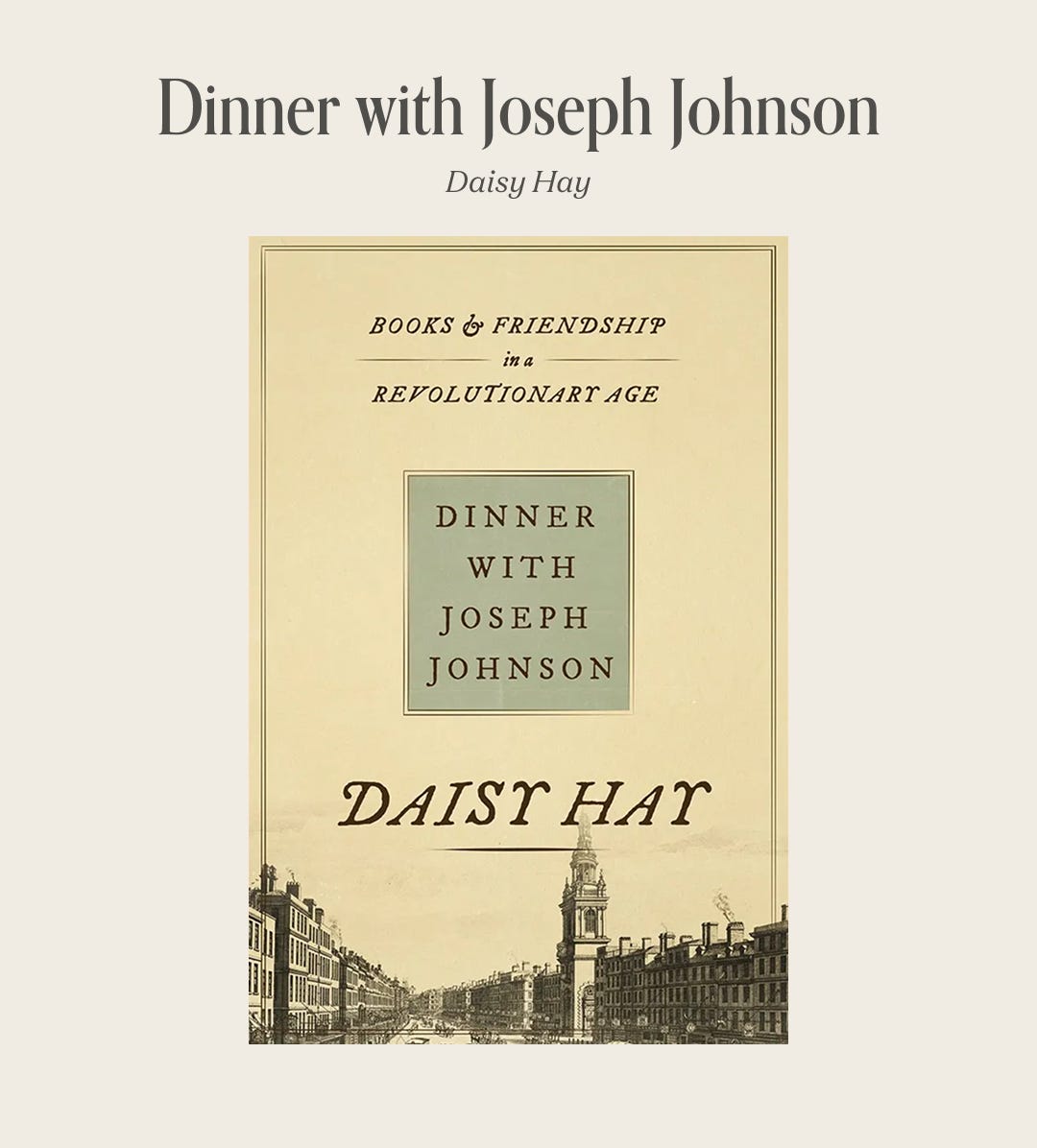
Dinner with Joseph Johnson by Daisy Hay
Topic: Biography / cultural history
Length: 536 pages
Where to read it: When you find yourself wondering how Ben Franklin or William Blake would have thought about AI and technology.
Pair with: Henry Fuseli’s The Nightmare — the painting hung over Johnson’s actual dining table.
Why: Before founder dinners, VC fellowships, and curated salons, there was Johnson’s closed circle guest list dinner table, where the most formative thinkers argued the next century into being. If you’re in SF because you believe great things happen by getting the right people together in rooms, this is the 18th century parallel to that.
Really why: The case for Dinner with Joseph Johnson is the case for scenius — Brian Eno’s word for the fact that genius usually isn’t a single person, but a scene. Once a week in late-18th-century London, above a bookshop in St. Paul’s Churchyard, Joseph Johnson set a famously bad table and an iconic guest list: Mary Wollstonecraft, William Blake, Joseph Priestley, Benjamin Franklin, Wordsworth, Coleridge. He wasn’t the smartest person in the room, but as a publisher, he was a convener who found these people, fed them, put their work into print, and kept it in circulation when the government was actively trying to shut them up (he went to prison for it). What came out of that table and the thinkers he “backed” included the founding text of modern feminism, the radical liberalism that fed the next century of politics, the late-Enlightenment science tipping into Romanticism. These happened because the right people were in the right city at the right moment, arguing at the same dinner. If you live in SF and believe the real edge of being here are the people and conversations you get early access to — this is the original version of that.
Best quote:
“A small group gathers around the bookseller. They are an artist, a former slave trader, an enquirer, a politician, and a poet… Over dinner, they talk of education, electricity, the nature of God, the cowardice of the Prime Minister, and the kidnap of Africans… The streets outside the shop can be dangerous at night, but for the men and women gathered around the table, there is security and strong walls in the company of others. Security offered by buildings is illusory… in the bookshop below, fire spreads through the paper stacked high, bringing with it destruction.” (pg. 11)
Hot take: The “lone genius” is a myth invented mostly by people who weren’t invited to the dinner. Every Great Man had a Joseph Johnson/early mentor and believer — we just don’t write books about the hosts.
Reread rating: One and done, but pass it on to the next generation.
Anything else: Starts slow and front-loads with names, dates, history, politics - dense but necessary context for setting the scene of the 1790s. Don’t try to memorize all the ensemble members at first mention – trust that the people you need to know will resurface. The relationships between the characters become richer the longer you read.
Michael McGuiness
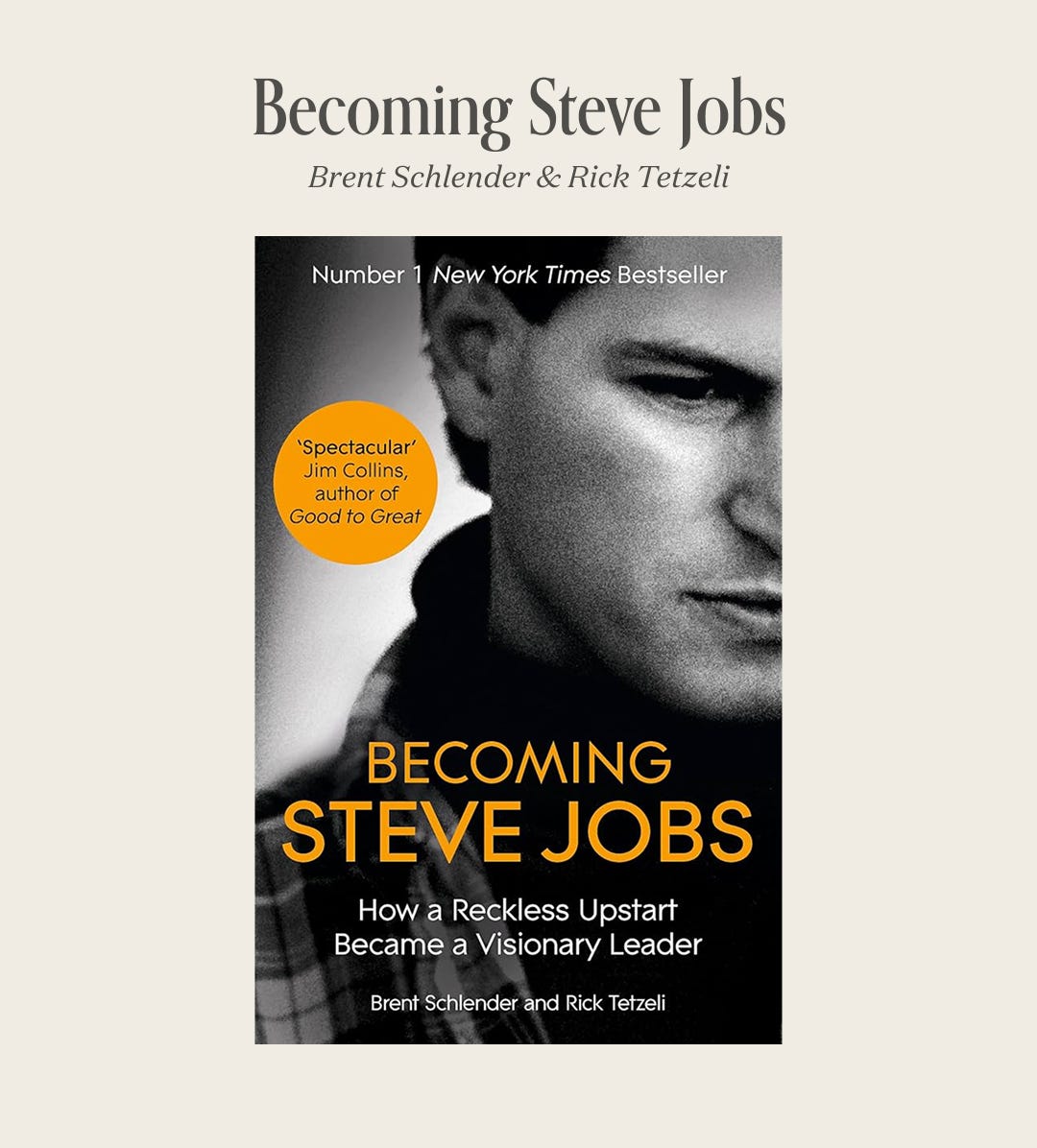
Becoming Steve Jobs, by Brent Schlender & Rick Tetzeli
Topic: Biography
Length: 480 pages
Where to read it: Wherever you are when you feel like giving up.
Pair with: One Too Many Mornings by Bob Dylan (Jobs’s favorite song)
Why: Must-read for founders. It’s the story of how adversity, far more than genius, is what made Steve Jobs great.
Really why: Becoming Steve Jobs is a must-read for founders. The book centers on the 12 “wilderness years” between Jobs’s firing from Apple and his triumphant return. For the better part of a decade, both NeXT and Pixar were failing while Jobs poured in more and more of his own money. It looked like he would squander the whole fortune from his first stint at Apple and refused to quit. Eventually Toy Story, the first fully computer-animated feature film, made Pixar’s 1995 IPO one of the most successful of the decade, and Apple acquired NeXT, whose operating system became the foundation of macOS. Those wilderness years turned out to be the most pivotal of Jobs’s life, forging him into the leader capable of taking Apple to unimaginable heights. Adversity, far more than genius, is what made him great.
Best quote:
“Restlessness is far more important and powerful than simple ambition or raw intelligence. It is the foundation of resilience, and self-motivation. It is fueled by curiosity, the ache to build something meaningful, and a sense of purpose to make the most of one’s entire life.”
Hot take: Better than Isaacson’s book
Reread rating: Every few years (or whenever it feels like your company is going to die)
Moses Sternstein
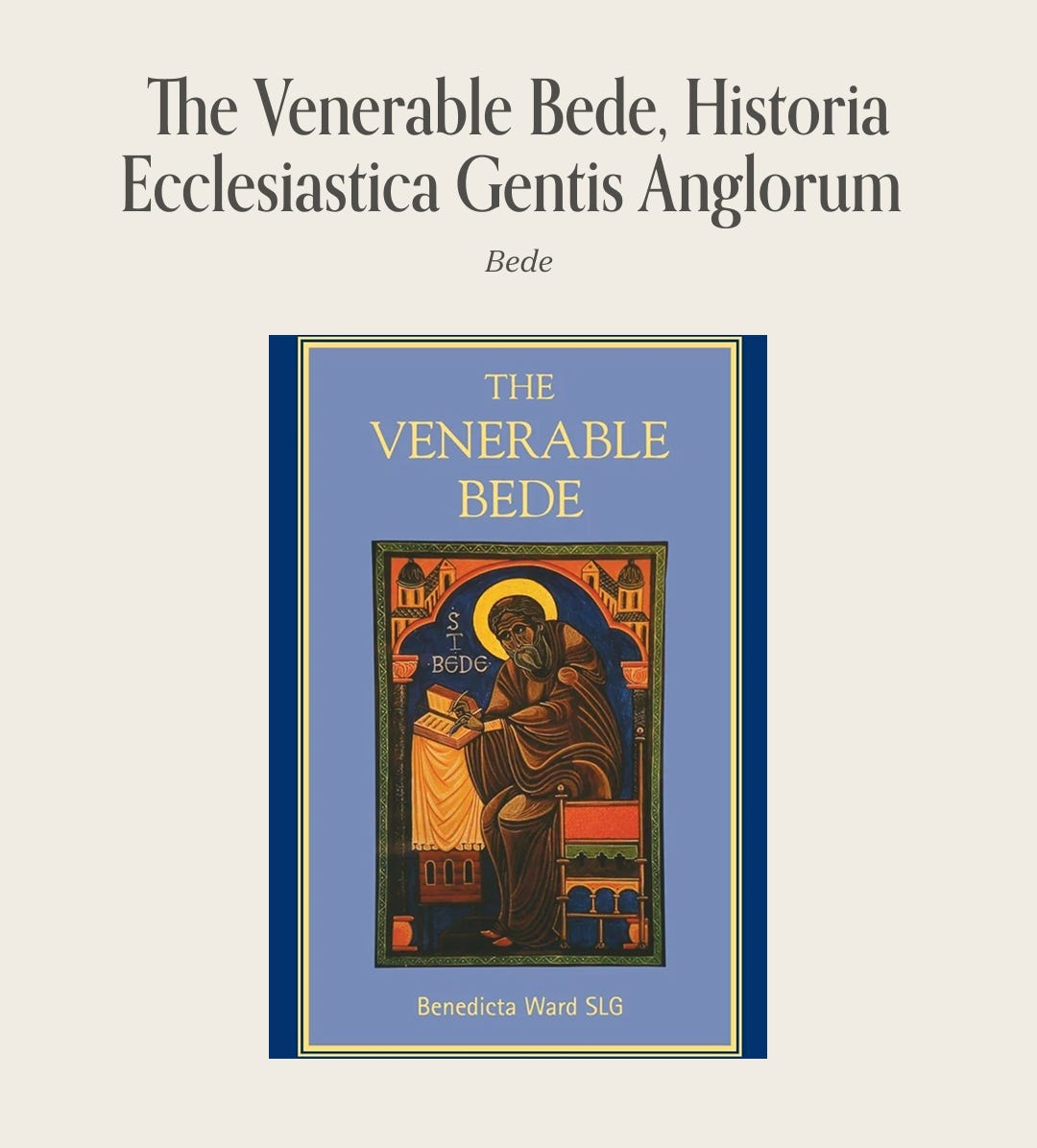
The Venerable Bede, Historia Ecclesiastica Gentis Anglorum
Topic: Early Medieval Poasting
Length: ~400 pages
Where to read it: Northumbrian Monastery
Pair with: Book-water, a potent anti-venom–good for snake bites.
Why: An Anglo-Saxon de Tocqueville, Bede undertook a saints and miracles beat, with colorful, rigorous and detailed accounts of the mystical and folkloric that illuminated key features of the nascent Gentis Anglorum (while never wasting an opportunity to dunk on the Britons, or other godless heathen).
Really why: The Dark Ages were pretty dark—full of war lords, plague, and slaughter. Still, the Venerable Bede was a genuinely curious observer, devout theologian, and capable polymath (and sometimes poet) who described (in vivid and colorful detail) a unified English People (the “Gens Anglorum”) before the English People would recognize themselves, as such.
Best quote:
“...with plenty came an increase in luxury, followed by every kind of crime, especially cruelty, hatred of truth, and love of falsehood. If anyone happened to be more kindly or truthful than his neighbors, he became a target for all weapons of malice…”
Hot take: Contrary to contemporary revisionism, the “Dark Ages” is a totally valid descriptor of the early Medieval period.
Reread rating: Read once in college, and once more recently.
Anything else: Easy to skip around? The Venerable Bede wrote chronologically (which was something of an innovation), but you don’t have to read it chronologically.



This newsletter is provided for informational purposes only, and should not be relied upon as legal, business, investment, or tax advice. Furthermore, this content is not investment advice, nor is it intended for use by any investors or prospective investors in any a16z funds. This newsletter may link to other websites or contain other information obtained from third-party sources - a16z has not independently verified nor makes any representations about the current or enduring accuracy of such information. If this content includes third-party advertisements, a16z has not reviewed such advertisements and does not endorse any advertising content or related companies contained therein. Any investments or portfolio companies mentioned, referred to, or described are not representative of all investments in vehicles managed by a16z; visit https://a16z.com/investment-list/ for a full list of investments. Other important information can be found at a16z.com/disclosures. You’re receiving this newsletter since you opted in earlier; if you would like to opt out of future newsletters you may unsubscribe immediately.
I feel like Moby-Dick is having a moment this summer. Loving reading+listening this version (free to access) including audiobook and generative notes and discussion, which are a lot of fun with a book of this depth and complexity: https://volume.pub/moby-dick?src=quo
Moby Dick and Lonesome dove trending for sure.