

SpaceX & the Sentient Sun
Earth is the cradle of humanity, and you cannot stay in the cradle forever.


America | Tech | Opinion | Culture | Charts
This is the inaugural issue of Profiles of the Future, a new monthly series from a16z that profiles the future of an industry through the lens of the company and founder defining it. - Alex Danco

Elon Musk’s compensation package at SpaceX is structured around two targets. The first award vests if the company reaches a valuation of $7.5 trillion and establishes a permanent human colony on Mars of at least one million people. The second vests if SpaceX operates data centers in space that draw at least 100 terawatts of power, more than 1,000x the consumption of every data center on Earth combined. Miss both, and Musk earns nothing but the $54,080 salary he has been paid since 2019.
The board members who signed this package spent two decades watching Musk make predictions about SpaceX that sounded impossible before they came true. He said SpaceX would put humans in orbit when no private company ever had; it now flies NASA’s astronauts routinely. He said it would land and reuse an orbital rocket when the entire industry treated boosters as disposable; SpaceX has since done it hundreds of times. He said a satellite internet business could be worth tens of billions when satellite internet was a graveyard of bankruptcies; Starlink’s revenue has climbed from zero to $11.4 billion in a few years. The predictions were often aggressive on timing but almost never wrong on direction. And the original direction, written down in 2002 as the company’s mission, was to make humanity multiplanetary. So the board tied his pay to the mission itself.
If that mission sounds like something from a science fiction novel, that might be because it is.
Iain M. Banks spent twenty-five years writing about a civilization called the Culture. It is, by most reasonable measures, the best utopian society ever imagined. Humans live alongside Minds, the superintelligent AIs that run orbital habitats the size of small worlds, in a relationship that is neither servitude nor rivalry but partnership. Nobody works who doesn’t want to. Nobody starves. The Minds handle the staggering computational load of running cities in space. Humans handle being human, which turns out to be a full-time job.
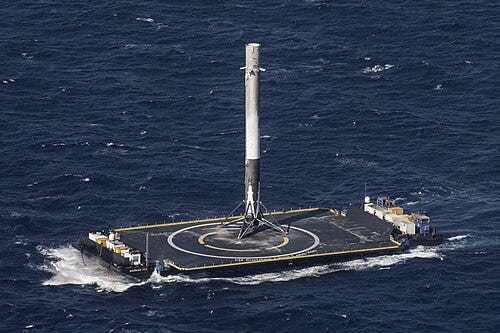
SpaceX’s three autonomous drone ships, the floating platforms in the oceans where Falcon 9 boosters land, are named after sentient starships in Banks’s novels: Of Course I Still Love You, Just Read the Instructions, and A Shortfall of Gravitas. In a 2023 interview at the UK AI Safety Summit, Musk was asked what a good AI future looks like. “The Banks Culture books are by far the best envisioning of an AI future,” he answered. “There’s nothing even close that’ll give you a sense of what is a fairly utopian or protopian future with AI.” He has been telling us, on the sides of his landing pads, exactly what he is trying to build.
The Culture is not a frictionless paradise. Banks’s novels are full of war, intrigue, and moral complexity. It is utopian because civilization has solved the prerequisites of survival well enough that trillions of humans are free to take care of, in the words of Banks, “the things that really mattered in life, such as sport, games, romance, studying dead languages, barbarian societies and impossible problems, and climbing high mountains without the aid of a safety net.”
A future like this has four prerequisites. First is access to a meaningful fraction of a star’s energy output (orders of magnitude beyond what human civilization produces today). Second is physical intelligence at scale: machines that can build, mine, refine, and repair anything, anywhere, without a human in the loop. Third is cheap digital intelligence that exceeds biological intelligence. And fourth is a way to move mass off the planet cheaply, frequently, and reliably, because none of the above scales on Earth alone.
Working Back from the Future
Most analyses of SpaceX work forward from the present: rockets, satellites, contracts, revenue. But to see what’s actually happening, it’s more useful to start at the destination and work backward.
The Mars city. The operational target is a self-sustaining city of a million people on Mars within the lifetime of people alive today. Self-sustaining is the hard part. It means the city has to survive if Earth stops sending ships, which requires manufacturing its own everything: food, water, air, energy, medicine, machinery, and eventually more humans. Getting a million people and millions of tons of cargo there over a few decades will take, by SpaceX’s own math, several thousand Starship flights at more than ten launches per day during each transfer window. Those windows, set by Earth-Mars orbital mechanics, are only a few weeks wide and open just once every 26 months.
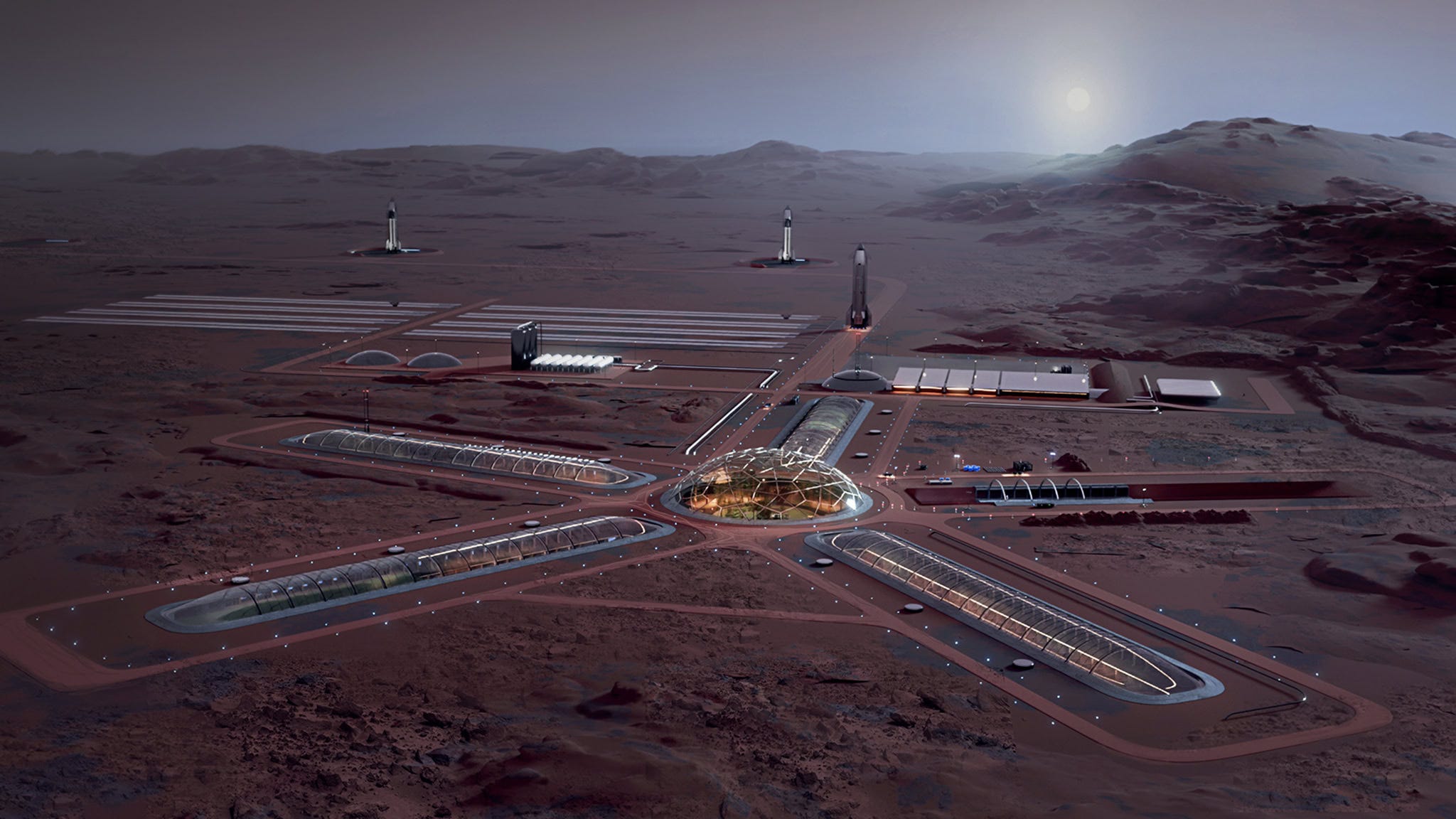
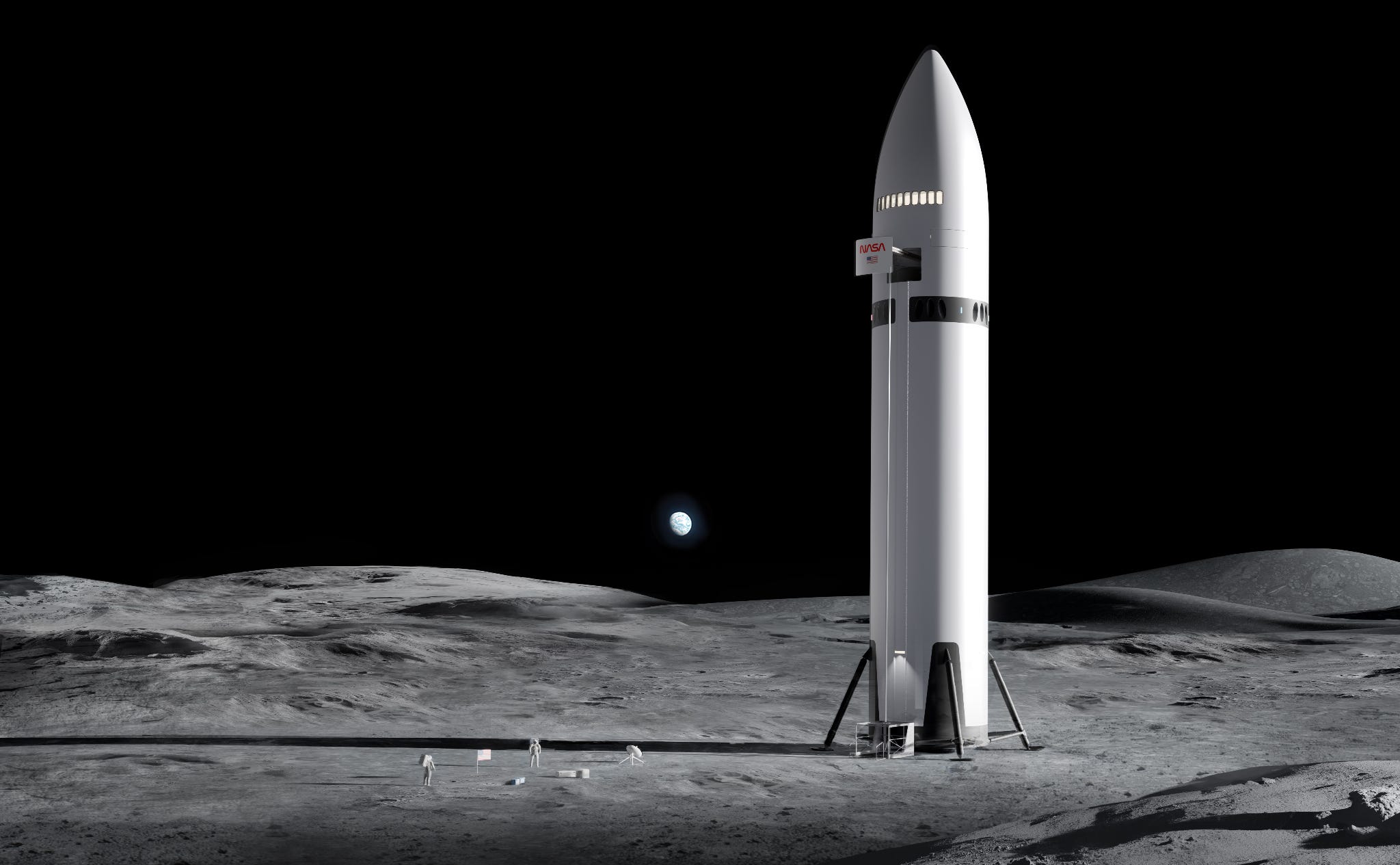
The Moon city. This is the closer, easier dress rehearsal. The lunar south pole has ice in permanently shadowed craters and continuous solar exposure on certain ridges, which makes it the natural site for a base. But Musk has talked about something more ambitious than a research outpost. He envisions factories on the Moon building AI satellites with a mass driver shooting them into space one after another. Another idea Musk has borrowed from science fiction, a mass driver is an electromagnetic launch system that exploits the Moon’s one-sixth gravity and absent atmosphere to fling solar-powered satellites into deep space at industrial scale. The satellites could be built on the Moon itself given that lunar regolith is roughly 20% silicon and 10% aluminum by weight, the two main inputs for solar cells and satellite structure. “If you want to go beyond a mere terawatt per year,” Musk explains, “you have to go to the moon.”
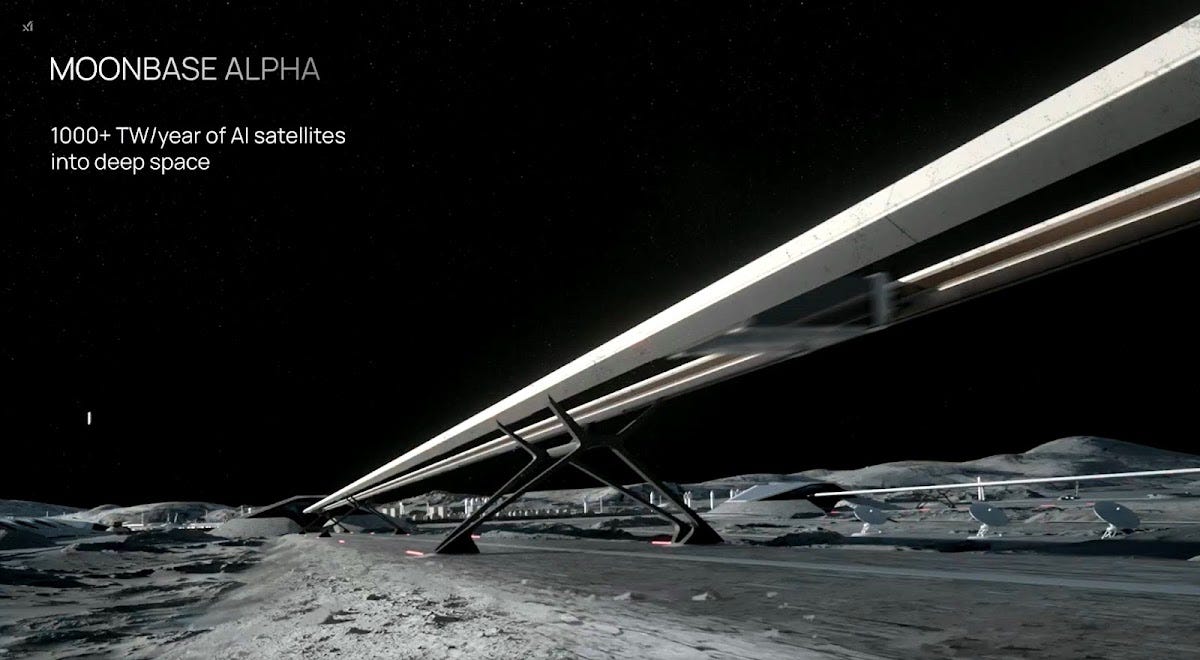
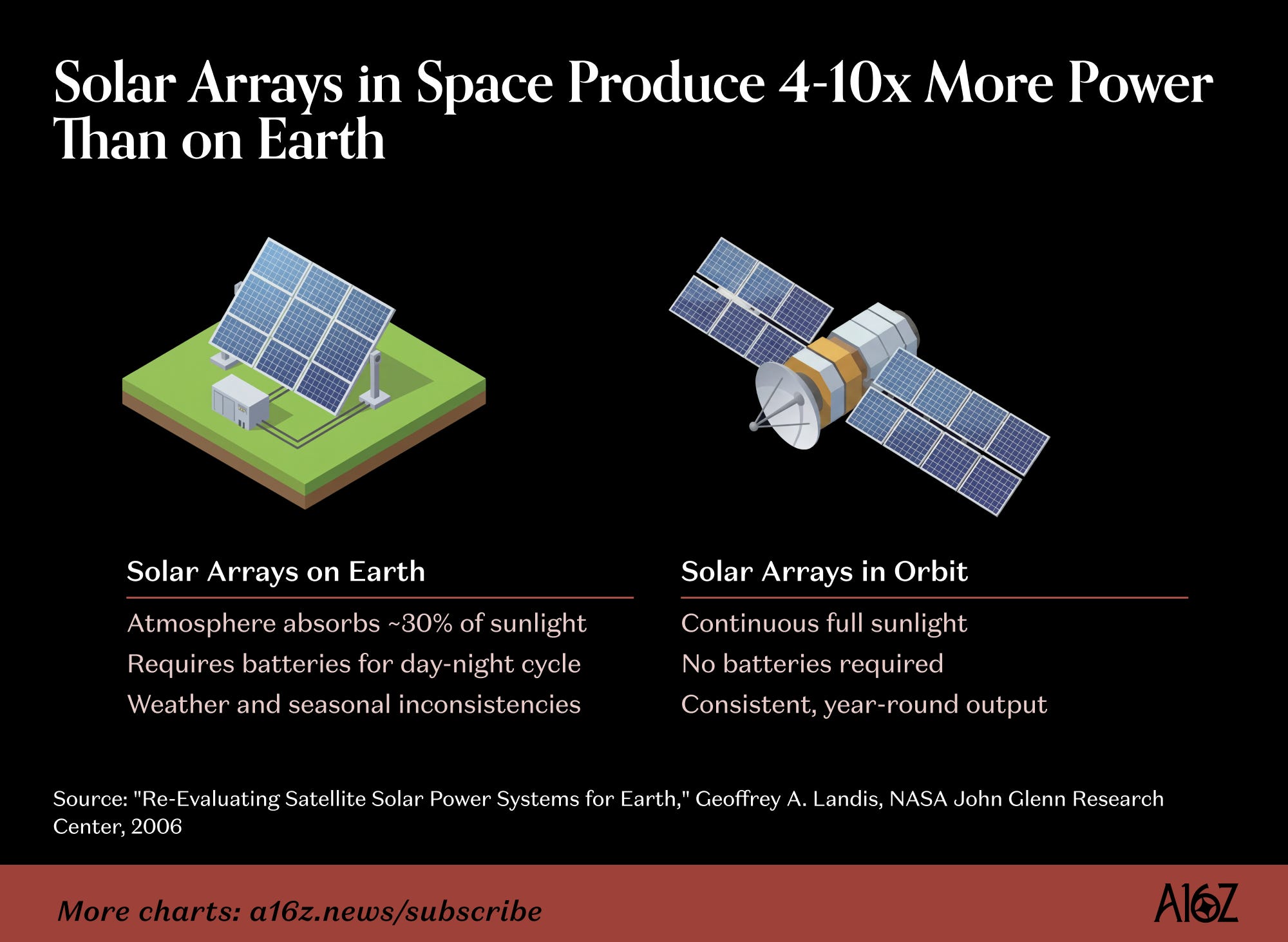
The orbital data centers. Musk is betting that in a few years the most economically compelling place to put AI data centers will be space. The bottleneck on AI is energy, which is barely growing outside of China while demand for AI compute grows exponentially. Solar panels in orbit deliver four to ten times more power than the same panels on Earth (depending on how sunny the ground location is) because there’s no atmosphere, no day-night cycle, no clouds, and no seasons. NASA worked this out decades ago, and rockets are finally cheap enough to make it real. In five years, Musk projects, SpaceX will be launching more AI compute to orbit per year than the cumulative installed base on Earth. This is why SpaceX merged with xAI in February. Rockets and intelligence are becoming the same problem.
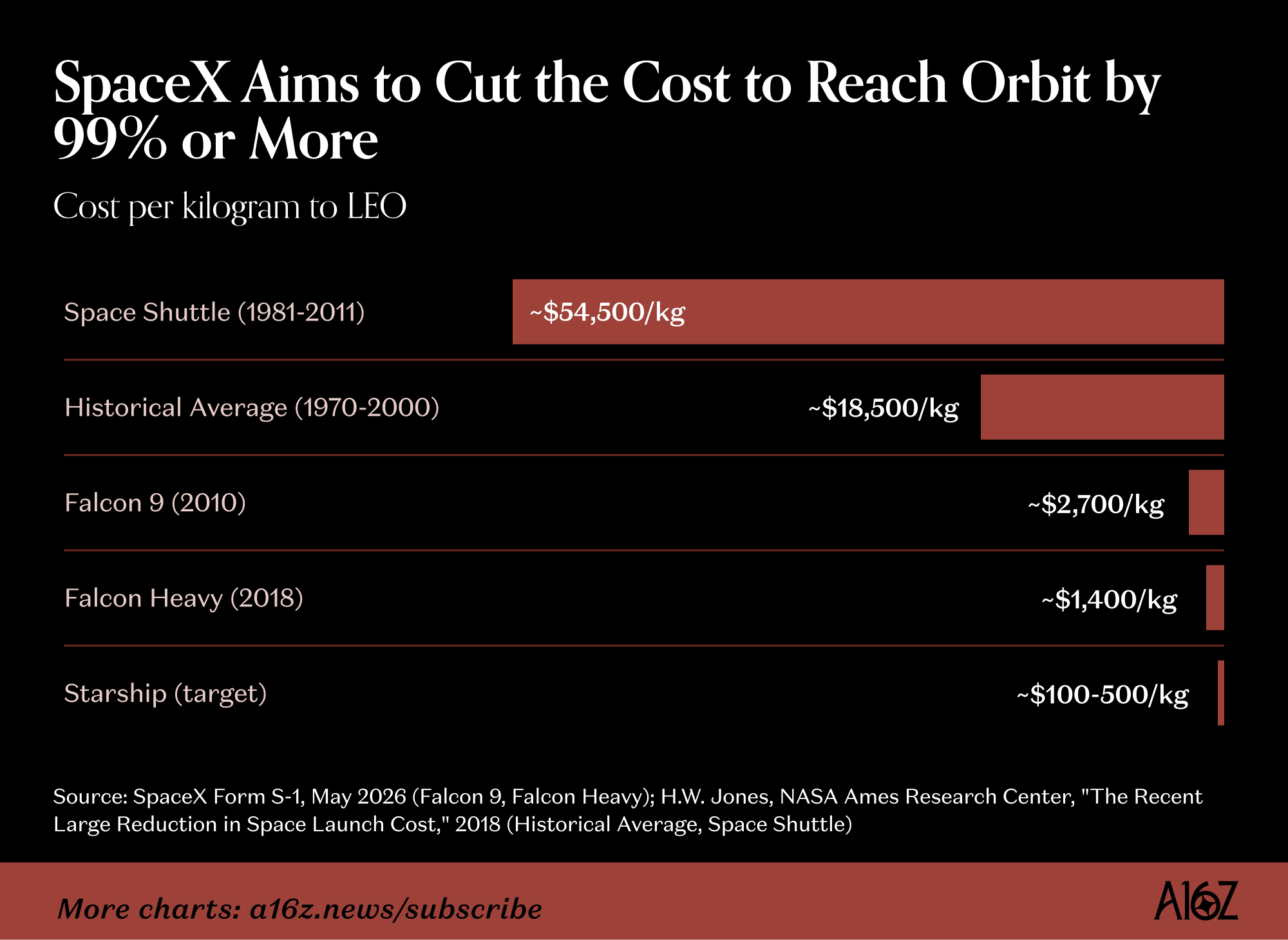
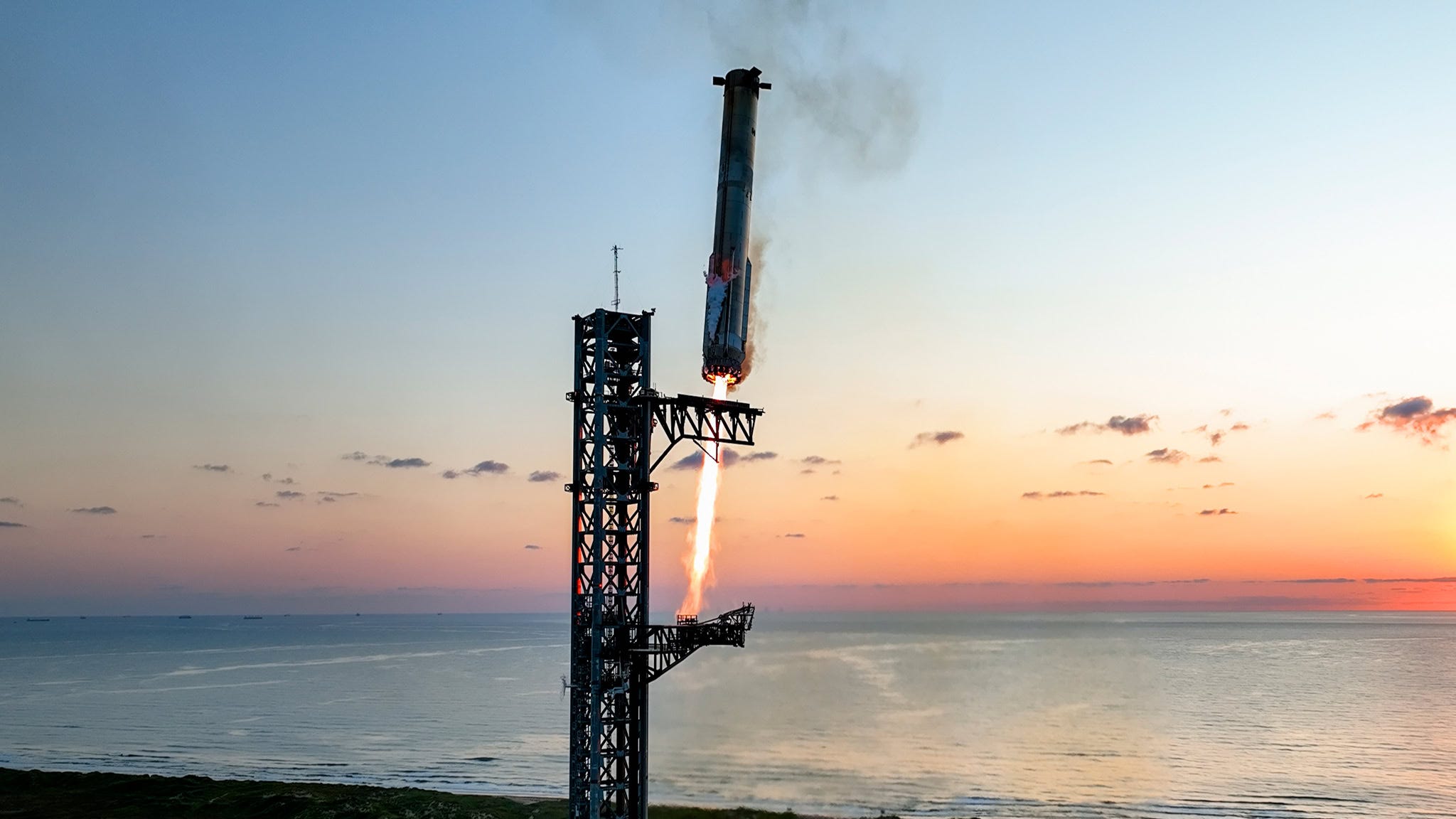
Starship is the vehicle that makes everything upstream possible. Starship V3, which made its debut flight this year, is the largest and most powerful rocket ever built – taller than a 40-story building and more than twice as powerful as the Saturn V that carried astronauts to the moon. By NASA’s accounting, reaching orbit historically cost around $18,500 per kilogram. In 2010, the first Falcon 9 brought that down by about 85% to roughly $2,700. In 2018, the Falcon Heavy cut it further to about $1,400. Starship, designed to be the world’s first fully and rapidly reusable spacecraft, aims to further reduce it to $100-500 per kilogram. Spaceflight that once cost billions per launch now costs in the tens of millions.
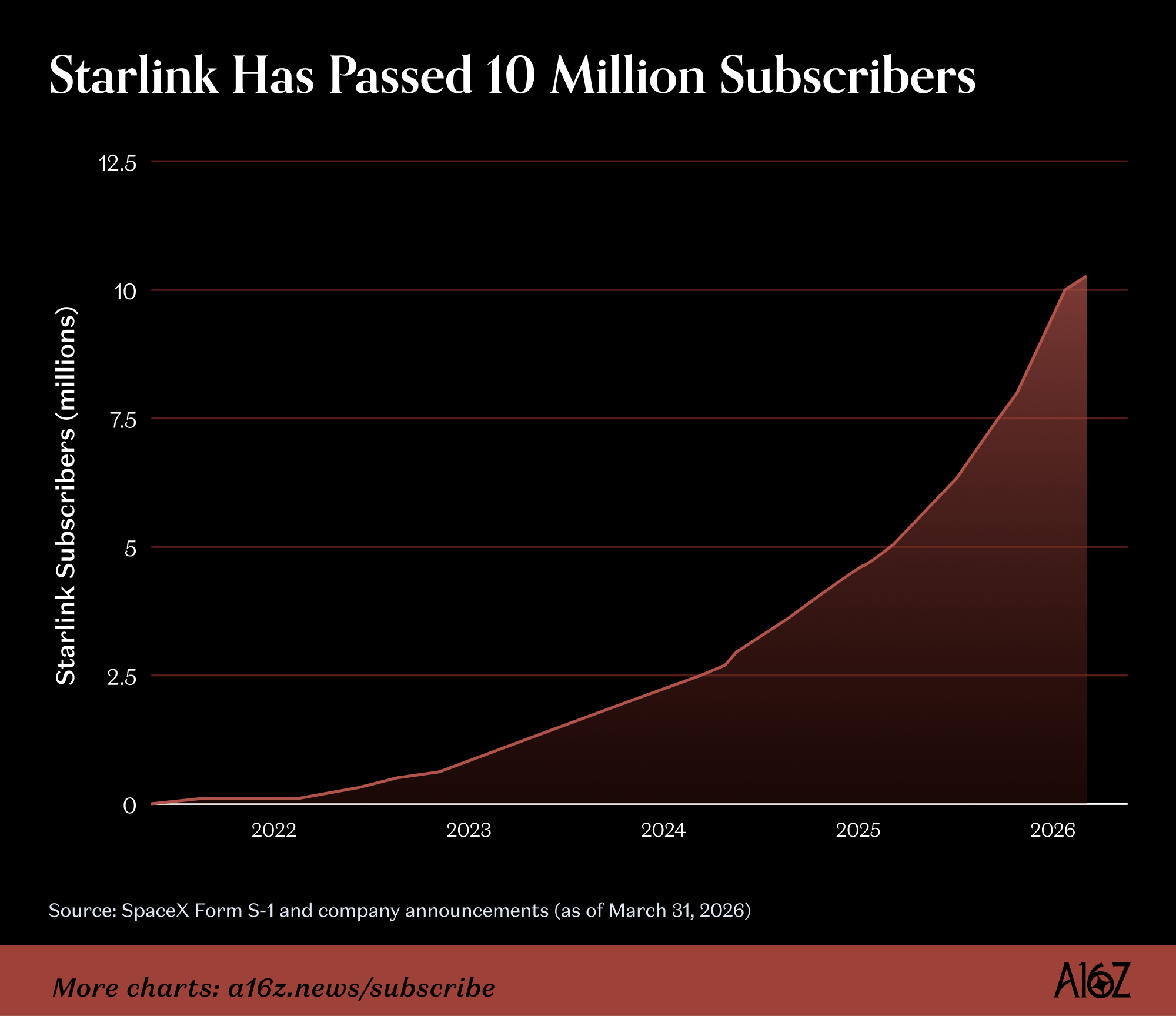
Starlink is the cash flywheel that helps pay for everything else. According to SpaceX’s IPO filing, the Connectivity segment (almost all of it Starlink) brought in $11.4 billion of revenue in 2025, up roughly 50% year over year, at an adjusted EBITDA margin north of 60%. As of March 2026, the service had 10.3 million subscribers in 164 countries running on more than 9,600 satellites. Starlink started as a side project to fill the company’s own launches, and it’s becoming one of the great consumer businesses in history. When a16z was doing diligence on SpaceX in 2019, several people told us the economics would never work. The dish required antenna technology previously reserved for F-22 fighter jets and Navy destroyers that were never mass-produced for consumers. SpaceX’s first units cost about $3,000 to build and sold for $499. But they figured out how to drive the manufacturing costs down and prove the skeptics wrong.
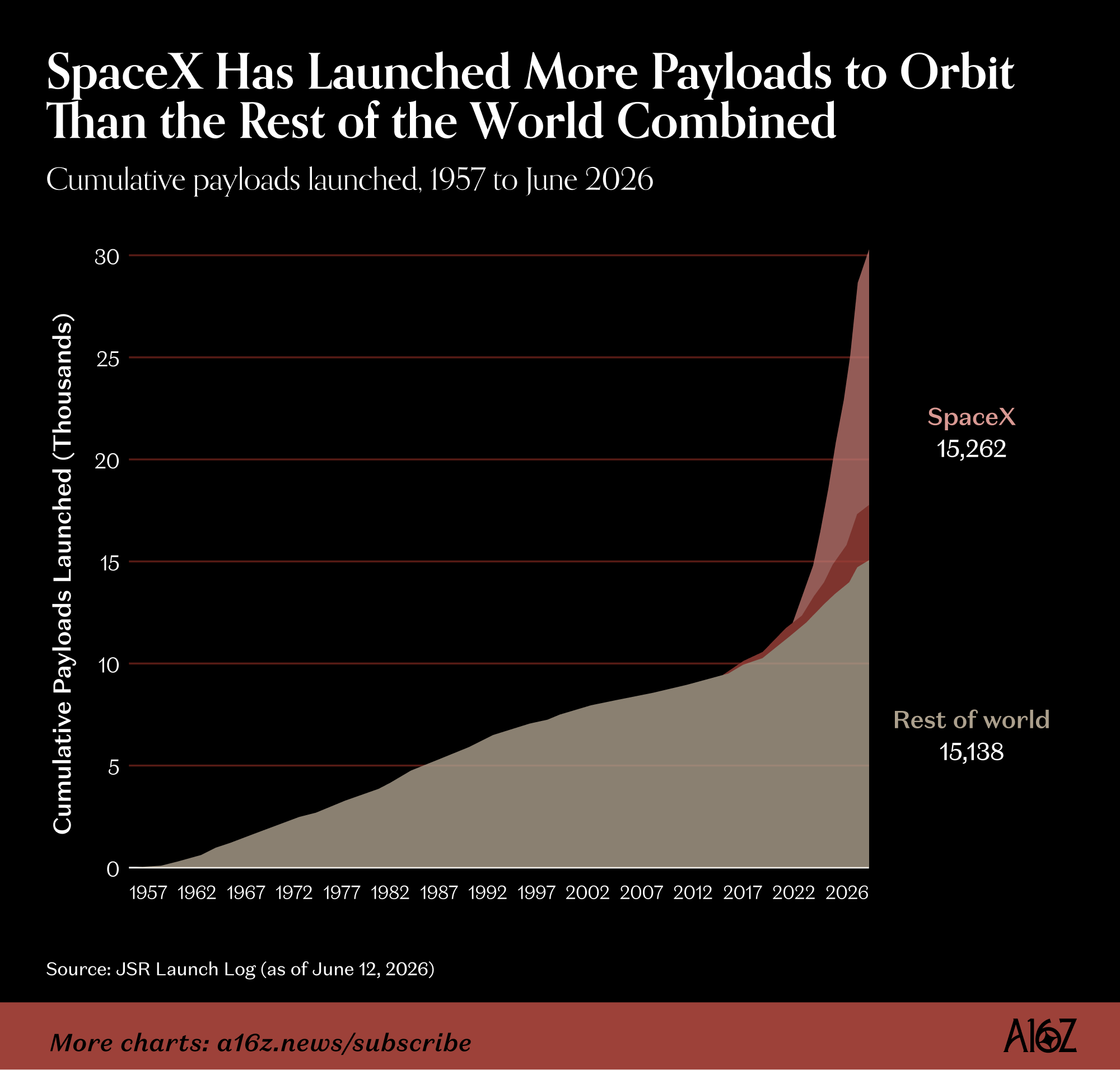
Falcon 9 is the workhorse that buys time for everything else. It is the only orbital-class booster on Earth reused at scale, with individual boosters routinely flying more than twenty missions each before retirement. In 2025, SpaceX launched 83% of the mass sent to orbit from Earth. The company has now launched more payloads to orbit than the rest of the world combined, despite giving everyone else a half-century head start.
That’s the stack, top to bottom. The Culture lives on top, generations from now. Falcon 9 and Starlink sit at the bottom, paying the bills today. Each layer makes the next one possible.
SpaceX CFO Bret Johnsen describes what it looks like from inside the company:
“[Musk] creates a culture where you set out what initially look like audacious goals, and then step-by-step, you realize that you’re marching toward something that is absolutely achievable… If I think about going to Mars, for example. When I first got here in 2011, people would be rolling their eyes when they talk about Mars and being a multiplanetary species. Nowadays when we say that, the response is literally, ‘What year?’... And I think what Elon has done a masterful job on is setting out these targets and creating a fantastic business model around each piece of IP that you need for that end goal.”
The Idiot Index and the Algorithm
Musk didn’t originally set out to build a rocket company. In 2001, a thirty-year-old Musk was figuring out what he wanted to do after PayPal. He had always been interested in space, and when he went looking for NASA’s plan to put humans on Mars, he was surprised to learn there wasn’t one. So he devised a plan to send a small greenhouse to Mars and broadcast the picture home. The idea was that a green sprout on a dead red planet might reignite public interest in space and the political will to fund a real Mars program. He just needed a rocket to get it there.
Later that year he traveled to Moscow to buy a refurbished intercontinental ballistic missile, the first of two trips. The meetings were reportedly fueled by vodka and a lot of posturing. “We’d all go in this little room and every single person had his own bottle in front of him,” Adeo Ressi, Musk’s best friend from Penn who came along on the trip, told Esquire in 2012. The Russians didn’t take Musk seriously, and on one occasion, a chief designer spat on him and his team in a display of contempt. On the second trip, in February, Musk asked how much a missile would cost. $8 million each, they said. When Musk countered with $8 million for two, Musk’s aerospace advisor Jim Cantrell remembers them saying something like “Young boy. No,” and implying he didn’t have the money. Musk decided they weren’t serious and walked out.
Cantrell figured the trip was over. He and Mike Griffin, who would later run NASA and had come along as an advisor on the second trip, ordered drinks on the flight home and clinked their glasses, glad to be out of Moscow. Musk sat in the row ahead of them, hunched over his laptop. Then he turned around in his seat. “Hey, guys,” he said, “I think we can build this rocket ourselves.” He showed them a spreadsheet listing the raw materials in a rocket – aluminum, titanium, copper, carbon fiber – and what each one cost. The materials cost only two percent of the quoted price, and as Musk would later put it, “clearly you just need to think of clever ways to take those materials and combine them into the shape of a rocket.”
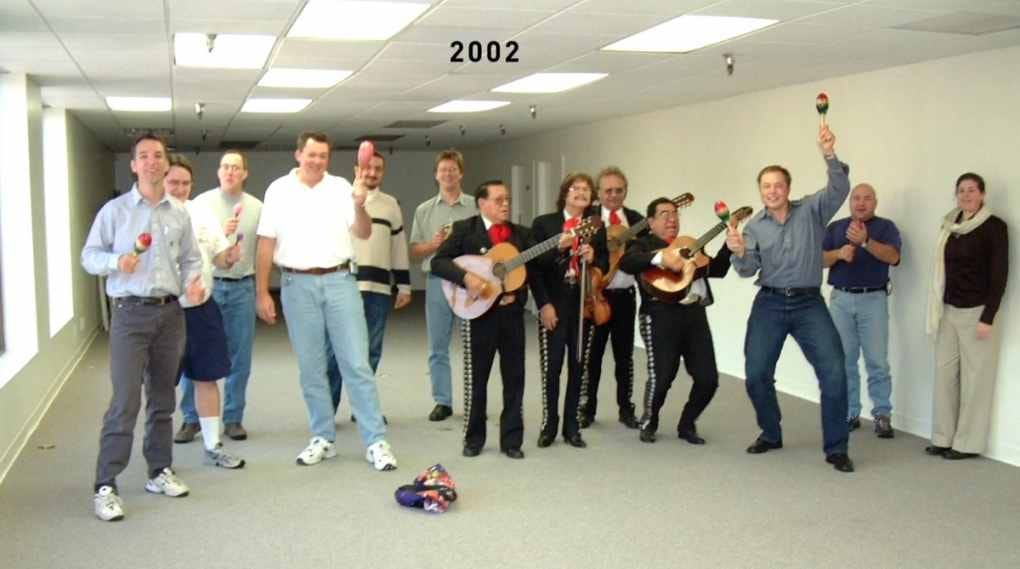
Within months, Musk decided he could risk $100 million on a rocket company (more than half of the roughly $180 million he would receive from the sale of PayPal), and founded SpaceX in a warehouse in El Segundo, California. He offered five people spots on the founding team. Three said no, including Cantrell and Griffin. The two who said yes were Tom Mueller, who became VP of Propulsion and employee number one, and Chris Thompson, employee number two, who took operations and production.
Years later, Musk would dub the principle underlying his spreadsheet diagnostic tool the “idiot index.” If the ratio of a part’s cost to its raw materials is high, you are either an idiot or you are working with idiots. This sounds like a joke, but it’s the foundation of SpaceX’s strategy.
Every part SpaceX bought was accompanied by an idiot index calculation. One of the legendary stories from the early days of the company involves Steve Davis, who joined SpaceX straight out of Stanford as the 14th employee and was tasked with sourcing an actuator to steer the Falcon 1 rocket’s upper stage. When he reported that a traditional aerospace supplier wanted $120,000 for the part, Musk laughed, telling him the component was no more complex than a garage door opener. Musk gave Davis a budget of $5,000 to build it from scratch. As biographer Ashlee Vance recounts, Davis spent nine months toiling over the design, ultimately producing a functional actuator for just $3,900. When Davis sent a technical breakdown of the triumph, Musk responded with a characteristically brief, two-letter email: “Ok.”
To drive the idiot index toward its theoretical lower bound, you must vertically integrate and control the process end-to-end. But vertical integration creates fixed costs that only pay off at high volume, and high volume in the rocket business required breaking with how the industry had always operated.
Traditional launch providers like ULA and Arianespace treated each mission as a custom job. The customer specified the orbit, the payload, and the integration requirements, while the launch provider designed a custom mission around the satellite. That model assumed a few launches per year at very high per-mission cost, and it made manufacturing at scale impossible.
SpaceX inverted this. They published a Falcon User’s Guide that defined the rocket’s exact specifications and told customers to design their satellites to fit. At the time, this was considered radical, and it cost SpaceX some early business. But it unlocked a manufacturing flywheel.
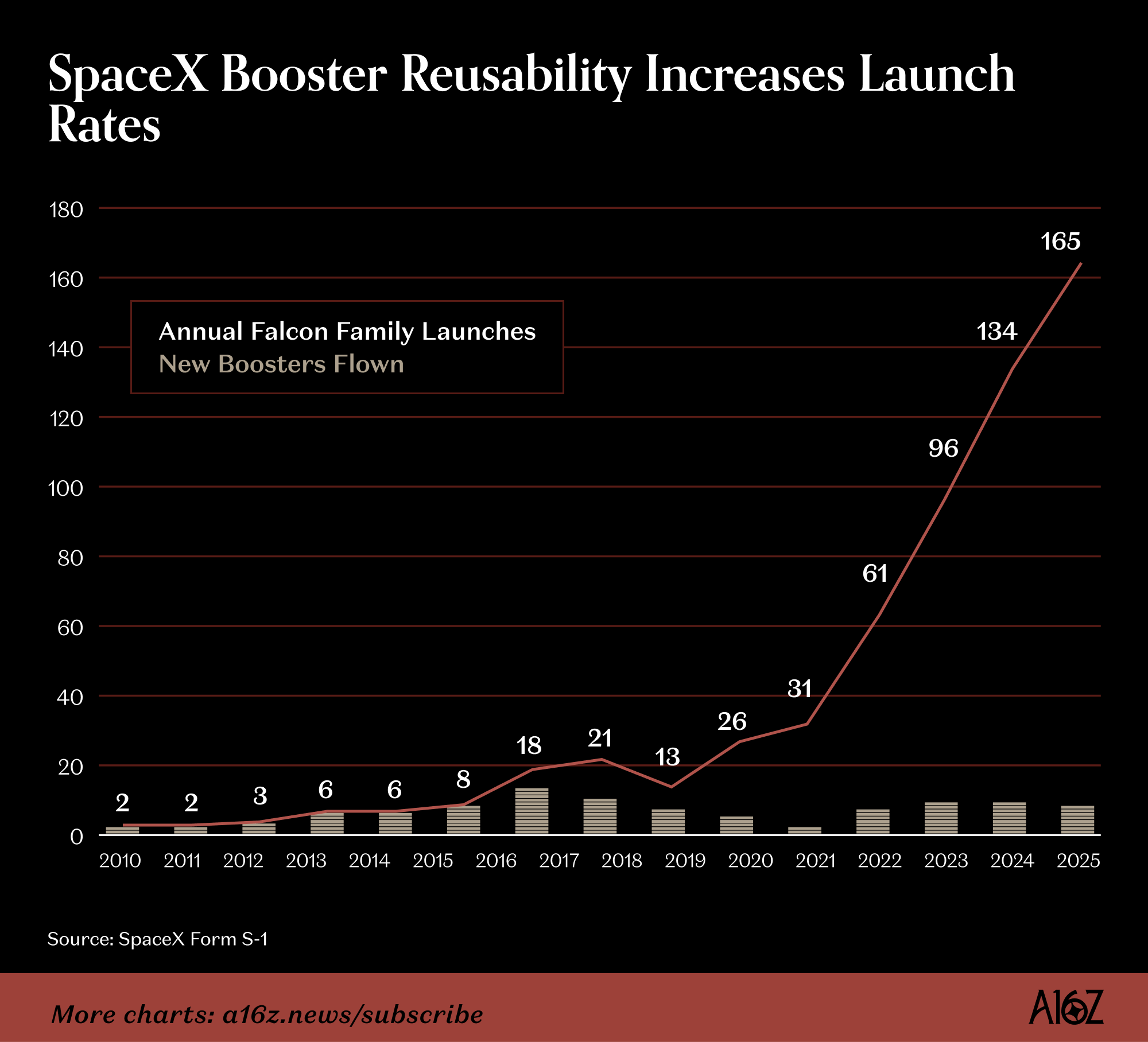
Standardization and reusability fed each other. Because every Falcon 9 was the same, a recovered booster could become a finished, qualified product ready to fly again. The first Falcon 9 booster to fly twice did so in 2017. By 2020, individual boosters were flying five times. By 2021, ten times. Today, the record-holding booster has flown 35 missions. This reusability has changed the economics of spaceflight, and it’s difficult to see how the competition catches up. In 2021, Musk estimated the Falcon 9’s best-case marginal cost of launch (excluding overhead allocation) for 15 tons to orbit was about $15 million, which he said was “about half to one third of the cost of alternatives.” Today, SpaceX launches a rocket every two to three days on reused boosters while competitors launch only a handful of custom rockets a year.
But SpaceX’s advantage is not just economies of scale, vertical integration, and a better strategy. It’s also speed and culture.
Traditional aerospace companies eliminate uncertainty through analysis. Boeing’s commercial crew program, in NASA’s polite phrasing, “utilizes a well-established systems engineering methodology targeted at an initial investment in engineering studies and analysis to mature the system design prior to building and testing.” Measure twice, cut once. SpaceX inverted this. The company builds many cheap prototypes, pushes them to failure, learns from the failure, and iterates. The Starship test campaign has produced more spectacular explosions than any rocket program in history, but each failure is a data point about where reality diverged from the model.
The contrast was visible to anyone who worked in both worlds. Garrett Reisman was a NASA astronaut who flew two Space Shuttle missions, then left NASA in 2011 to join SpaceX as a senior engineer. He has described the prevailing NASA view of SpaceX in those years: “They’re cowboys; they’re dangerous; they’re going to kill somebody.” What changed his mind was watching SpaceX work. “They were making things in a month that would have taken NASA like a year. We were just amazed.”
The clearest example is the Falcon 1 program. Between 2006 and 2008, SpaceX launched four Falcon 1 rockets from a tiny atoll in the Pacific called Kwajalein. The first three failed, but each failure was different and instructive. A fuel leak on flight one. A propellant sloshing anomaly on flight two. A separation collision caused by residual engine thrust on flight three. By September 2008, the company had funds for exactly one more launch. And it wasn’t Musk’s only company on the edge. Tesla, the electric car company Musk was building in parallel with SpaceX, was also weeks from bankruptcy, and he had to decide if he would consolidate his remaining PayPal cash behind one company or split it between both.
“That was a really tough decision. I decided in the end to split what I had to try to keep both companies alive, but that could’ve been a terrible decision that resulted in both companies dying,” Musk recalled. “I never thought I’d have a nervous breakdown, but I came pretty darn close.” He couldn’t choose because, in his worldview, both missions were essential – Tesla to accelerate the world’s shift to sustainable energy and SpaceX to make humans multiplanetary. “All available resources had to be plowed into the companies,” Talulah Riley, Musk’s then-fiancée, said in the BBC documentary series The Elon Musk Show. “He gave me an out. He said, ‘This is going to be the hard part, you don’t have to stay for it.’”
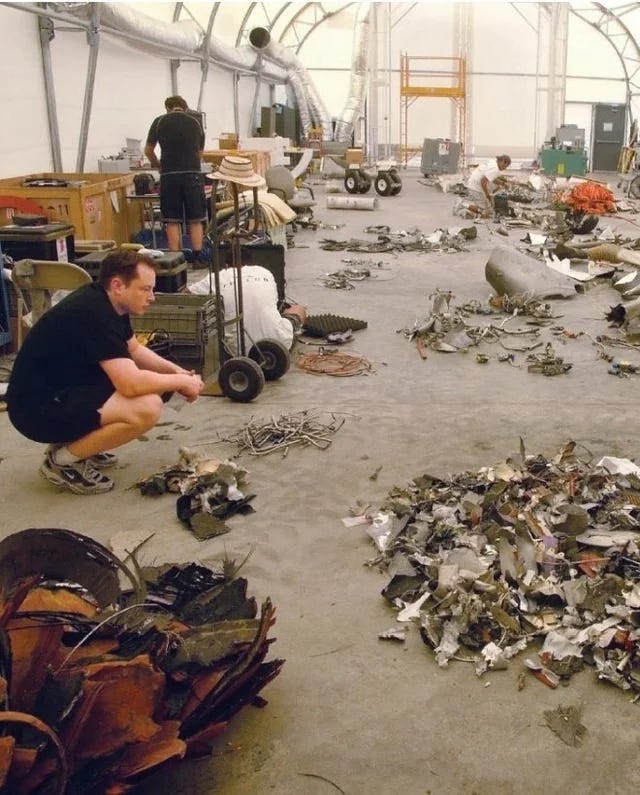
Flight four worked. That December, weeks before SpaceX would have run out of money, NASA awarded it a $1.6 billion cargo contract. When they called Musk to let him know, he was so overwhelmed with emotional relief that he blurted out, “I love you guys.”
The pattern that emerged from this experience of failing fast and correcting mistakes quickly became the culture of every program that followed. It is the same pattern that now lets SpaceX iterate on Starship between flights, while a traditional aerospace program takes years to go from a flight anomaly to a redesigned vehicle.
The reason this works better than the alternative is because you cannot think your way to perfect solutions for problems you do not fully understand. Reality is the only adequate validator, and the trick is making it cheap enough to consult often.
This is SpaceX’s iteration loop told through stories, but there’s also a written-down version. Musk has, over the past two decades, codified the SpaceX approach into a five-step operational process that the company calls the “Algorithm.” Tim Berry, who spent ten years at SpaceX leading the upper-stage production team for Falcon 9 and Falcon Heavy, has described it as “drilled into our minds.” Walter Isaacson published the canonical version of it in his Musk biography:
Question every requirement. Each requirement should come with the name of the person who made it. You should never accept that a requirement came from a department, such as the legal department or the safety department. You need to know the name of the real person who made that requirement, and you should question it no matter how smart that person is. Requirements from smart people are the most dangerous because people are less likely to question them. Then make the requirements less dumb.
Delete any part or process you can. You may have to add them back later. In fact, if you do not end up adding back at least 10% of what you deleted, you did not delete enough.
Simplify and optimize. This one should come after step two. A common mistake is to simplify and optimize a part or a process that should not exist.
Accelerate cycle time. Every process can be sped up. But only do this after the first three steps. In the Tesla factory, Musk has said, he mistakenly spent a lot of time accelerating processes that he later realized should have been deleted.
Automate. That comes last. The mistake at Tesla’s factories in Nevada and Fremont was that automation was attempted first, before the requirements had been questioned, the parts and processes deleted, and the bugs shaken out.
Most engineering organizations skip directly to step five. They take a process that should not exist and then automate it. SpaceX runs the steps in order, every time, on every part of the company. When the Algorithm has been run enough times on a piece of hardware, it starts to look like nothing else in the industry.
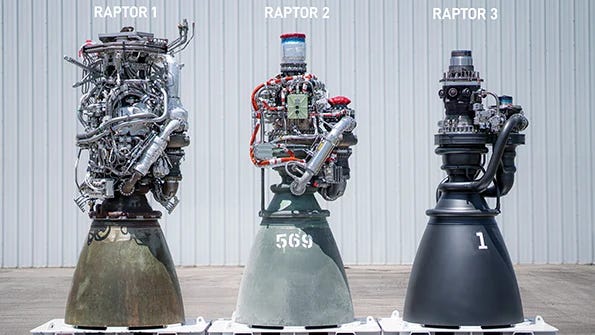
The Raptor 3 is what it produces when a team iterates on the same engine for ten years. It generates 22% more thrust than the Raptor 2, weighs 40% less, and requires no heat shield because the plumbing and wiring previously hanging on the outside have been fused into the engine’s metal structure through 3D printing. “The amount of work required to simplify the Raptor engine, internalize secondary flow paths, and add regenerative cooling for exposed components was staggering,” Musk has said. “Getting close to the limit of known physics.”
No known engine program in the history of aerospace has iterated this fast. The Space Shuttle Main Engine flew essentially the same design for the last thirty years. The RD-180 that powered the Atlas V is a derivative of an engine designed in the 1970s. SpaceX is on its third clean-sheet redesign of the Raptor in less than a decade, and each version is dramatically better than the last.
The same philosophy applies to people. By mid-2018, Falcon 9 reusability was on a reliable cadence, and Musk turned his attention to the satellite internet constellation that would eventually fund everything upstream. The Starlink team was based in Redmond, Washington, and many of its senior engineers had come from Microsoft, where development moved slower than Musk wanted. In June he flew to Redmond and fired the senior leadership team. He then transplanted young star engineers from the rocket side and gave them a year to launch the first operational batch. It was a cutthroat way to run the company, and from the press coverage of the firings, it looked like the division was imploding. But eleven months later, in May 2019, the first batch went up. Musk had cleared the bottleneck and could move on to the next problem.
This is how he runs everything. In 2018, when Tesla was in the middle of “production hell” trying to scale Model 3 manufacturing and burning cash at a rate that was existential, Musk literally moved into the factory. “I was living in the factory in Fremont and the one in Nevada for three years straight,” he recalled in an interview years later. “I slept on the floor under my desk so that during shift change, the entire team could see me. This is important because if the team thinks their leader is off somewhere having a good time, drinking Mai Tais on a tropical island, it’s demoralizing. Since the team could see me sleeping on the floor during shift change, they knew I was there. That made a huge difference, and they gave it their all.” He later made it a company-wide rule: the more senior you are, the more visible your presence must be.
To find a comparison for how Musk operates as a CEO, you have to go back in history to the industrialists of the late 1800s and early 1900s: Henry Ford, Andrew Carnegie, Thomas Watson, Andrew Mellon, Cornelius Vanderbilt. What makes Musk’s operating style distinctive is his relationship to the work. He reportedly shows up every week at each of his companies, identifies the biggest problem, and fixes it. He does that every week for 52 weeks in a row and then each of his companies have presumably solved the 52 biggest problems that year.
One engineer who joined SpaceX from another aerospace company described the experience as “being dropped into a shocking zone of competence. Everybody around me is so absolutely competent.”
The Constellation
SpaceX looks like a company, but it’s more useful to think of it as the central node of a constellation of companies, all run by the same person, building toward the same long-term mission, and almost impossible to disentangle from one another. Musk has spent over two decades assembling a set of companies that each addresses one constraint that would otherwise bottleneck the others. And they are beginning to compound.
The merger with xAI in February is the epitome of what SpaceX is becoming. If compute ends up in orbit, which is Musk’s bet, SpaceX has the most credible path to deploying it at the scale AI will need. Moving mass to orbit and producing intelligence at scale could be the two defining capabilities of the next few decades, and they now reinforce each other under one roof.
xAI brings Grok, a frontier model that is uniquely positioned on real-time information through its access to X’s data firehose. It also brings the engineers who built the Colossus 1 and Colossus 2 supercomputers faster than many in the industry thought possible.
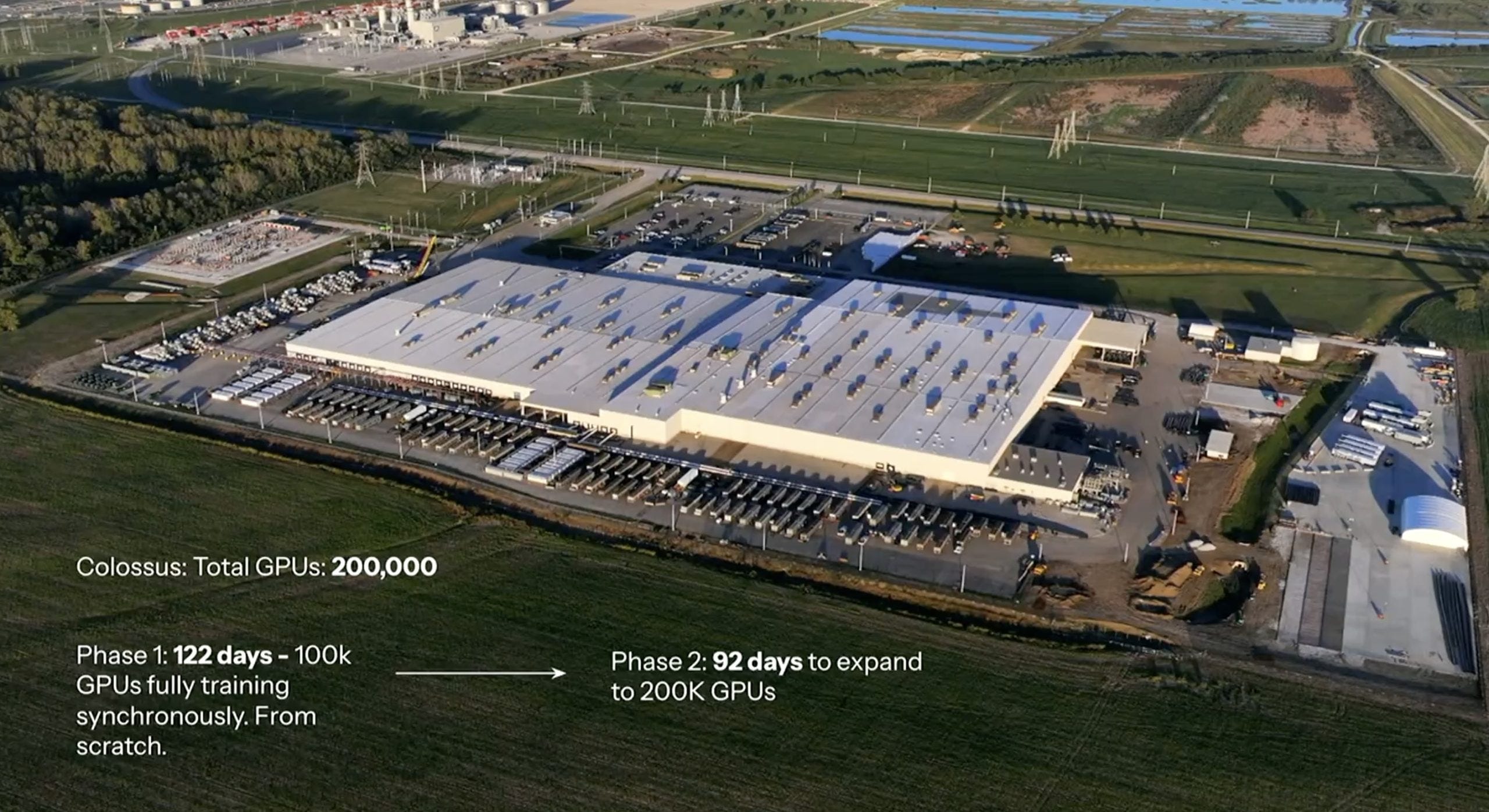
The Colossus buildout is worth pausing on. xAI took over an old factory in Memphis and had 100,000 GPUs training in 122 days. Once the racks started arriving, it took just 19 days to get the cluster up and running. “From the moment of concept to building a massive factory, liquid-cooled, energized, permitted, in the sort of time that was done, that is superhuman,” Nvidia CEO Jensen Huang said of Musk. “And as far as I know, there’s only one person in the world who could do that. What they achieved is singular. It’s never been done before. 100,000 GPUs is easily the fastest supercomputer on the planet as one cluster [in 2024]. It’s a supercomputer that would normally take three years to plan, then they deliver the equipment, then it takes one year to get it all working.”
A project that would have taken the rest of the industry at least four years took Musk and the xAI team four months.
In May of this year, Anthropic agreed to pay SpaceX $1.25 billion per month for all of the compute from Colossus 1. Weeks later, in an amendment to its IPO filing, SpaceX disclosed that Google will pay $920 million per month for access to 110,000 GPUs, about half the compute Anthropic is getting. Together, the two deals represent roughly $26 billion a year in revenue, from just two customers, for a business SpaceX didn’t have until it absorbed xAI early this year. Chips, power, and land are all scarce, and SpaceX is emerging as one of the few companies with enough AI infrastructure to both lease compute capacity to others and pursue its own ambition of building a leading frontier model.
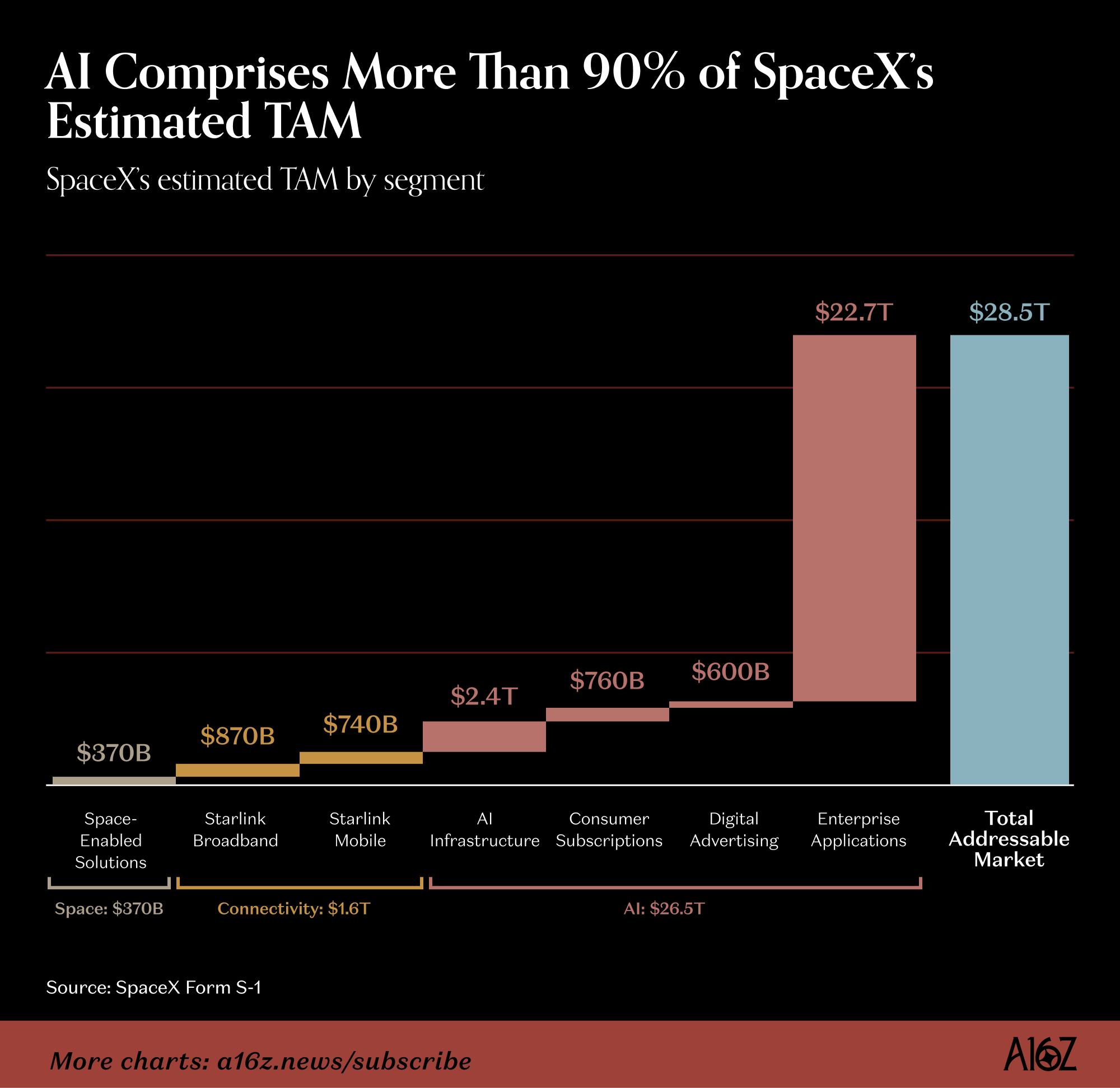
What xAI gets from SpaceX is a more durable solution to the power constraint that Musk believes will bottleneck AI in the coming years. Producing enough electricity to meet the demand he anticipates for intelligence would require grid buildout, new power plants, and years of permitting the industry doesn’t have. Solar energy in orbit, in his view, is the way out because it’s effectively unlimited. And SpaceX is the only company with a vehicle that can put compute there at scale. Whether he’s right is one of the most important open questions in technology, but SpaceX’s IPO filing shows how seriously the company is taking this bet: it projects AI to be its largest future market by far. The space business that built the company looks almost like a rounding error next to these ambitions.
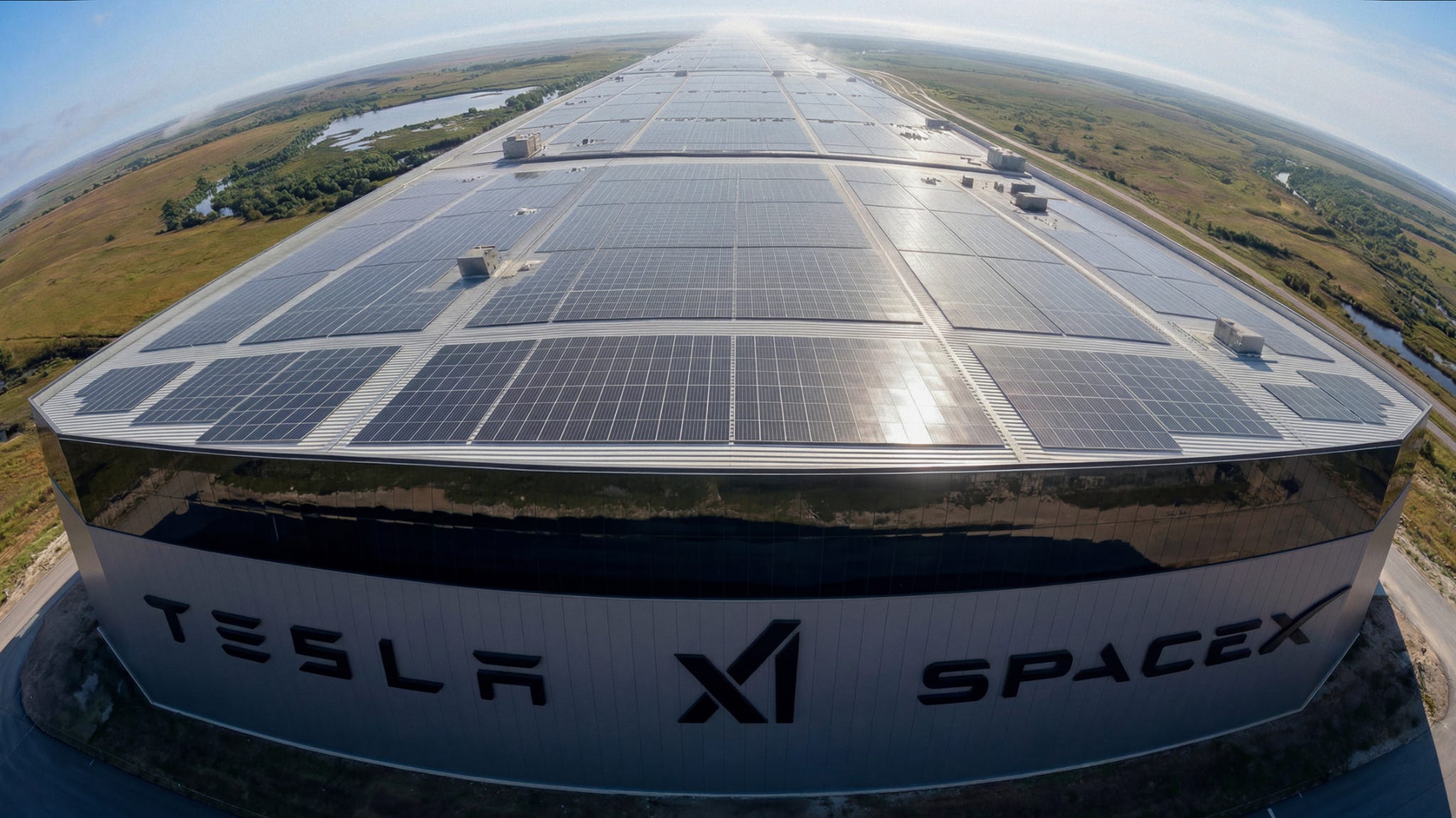
Tesla is the other major piece of the constellation, and the integration there runs deep in a different way. Tesla and SpaceX share a founder, a talent pool, an operating culture, and an increasingly overlapping set of technology roadmaps.
Tesla provides three things to the SpaceX-xAI side of the constellation. First, chips: the AI5, AI6, and Dojo3, designed in-house at Tesla. Musk has been explicit that these are not just for cars but building blocks of the broader constellation compute stack. The AI5 handles self-driving inference, the AI6 is built for Optimus and AI data centers, and the Dojo3 (paired with a planned AI7) is engineered for orbital compute. Second, robots. Tesla’s bet is that Optimus becomes the physical AI layer for factories, warehouses, homes that want to operate without human labor, and eventually for the Moon and Mars cities Musk envisions. Third is solar. Musk has said that Tesla and SpaceX are separately building toward 100 gigawatts per year of solar-cell production to power the AI buildout on Earth and in orbit.
Then there is the TeraFab. In April, Tesla disclosed that it had begun ordering equipment for a research semiconductor fab on the company’s Giga Texas campus. “This is something we expect to be probably a $3 billion-ish initiative, and capable of maybe a few thousand wafers per month,” Musk told investors on Tesla’s Q1 2026 earnings call. SpaceX, separately, is funding the initial buildout of a much larger facility designed to produce on the order of a million wafers per month at maturity because no existing fab can scale fast enough for what Musk has in mind. And what he has in mind is measured in gigawatts. “This is not a promise of what we’ll do,” Musk said last week. “This is what we’ll try to do and think we probably can do, which is to get to roughly an annualized rate of a gigawatt per year by the end of next year in terms of space AI compute. Then, aspirationally, scale that by an order of magnitude per year. So in two and a half years, hitting an annualized rate of 10 gigawatts a year in space. In three and a half years, maybe 100 gigawatts. Then, depending on progress in chipmaking in the rest of the world and with the TeraFab, going beyond that to scale to a terawatt per year, which is 1,000 gigawatts. That’s twice the electricity consumption of the United States.”
The Gilded Age comparison gets at something real, but it also points to what’s different. Carnegie built steel; Vanderbilt built railroads. Each dominated one sector of the era’s industrial base. Musk is attempting several at once – space, energy, artificial intelligence, robotics, tunneling, brain-computer interfaces, autonomous cars – and bending all of them toward a single goal most people consider fanciful. Whether it all works is genuinely unknown; plenty of it may not. But the attempt itself has no historical precedent and may be the staging ground for a different kind of century.
The World SpaceX Enables
A kilogram of cargo to orbit cost roughly $54,500 on the Space Shuttle before it was retired in 2011. On Starship at maturity, Musk projects $100 per kilogram. When the cost of getting to space falls by a factor of more than five hundred, every industry that could theoretically exist in space starts becoming economically possible. There are many.
The closest historical parallel might be the Transcontinental Railroad. Before 1869, traveling from New York to San Francisco took six months by wagon, cost roughly a year’s wages, and came with a material chance of death. After 1869, the trip took a week. The railroad itself was a remarkable engineering feat, but the real story was everything it enabled: Sears Roebuck, meatpacking giants like Swift and Armour, Standard Oil, and eventually U.S. Steel, which consolidated the industrial empires born during the rail boom.
If the Falcon 9 is the Transcontinental Railroad equivalent for space, Starship could be an upgrade on par with the airplane. The railroad opened a continent. The jet age opened the planet. Starship will open the solar system.
The Industrial Moon
The Moon has been scientifically interesting for as long as humans have looked up at it. It is now becoming economically interesting because it is an entire world made of the raw materials of industry.
Start with how you get things off it. As described earlier, the Moon’s one-sixth gravity and absent atmosphere make a mass driver, not a rocket, the natural way to move cargo off the surface. That changes the economics of shipping completely. Once the track is built, the marginal cost of delivering manufactured goods is dominated by electricity, not fuel, and electricity on the Moon is just sunlight. A package gets flung off the surface, reenters Earth’s atmosphere behind a heat shield, pops a parachute, and lands at a recovery site. At sufficient throughput, the marginal cost starts to look less like spaceflight and more like freight.
Then there’s what you make there. The same lunar regolith that yields silicon and aluminum for solar cells and satellites is the feedstock for an entire industrial base. The space revolution of the 2030s and 2040s could feature autonomous mining vehicles working the regolith around the clock, refineries turning out aluminum and silicon, and factories assembling satellites, solar panels, and the chips to run them. Most industries on Earth have a lunar version waiting to be built, and SpaceX can’t build all of it alone. The people who build the lunar Alcoa, the lunar Caterpillar, and the lunar Union Pacific will be among the titans of the twenty-first century.
Compute in the Sky
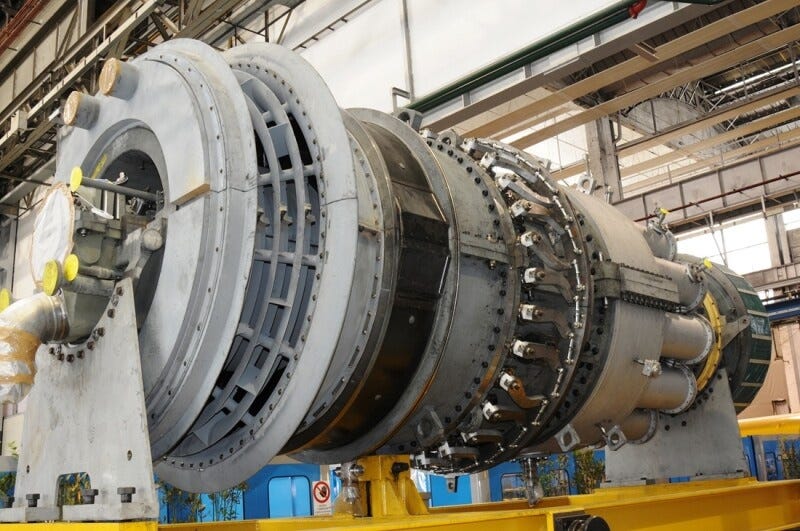
The bottleneck on artificial intelligence in 2030 likely won’t be chips but electricity. The obvious response is to build more solar in Texas or Nevada, but this hits a wall faster than people realize. One terawatt of continuous solar power requires roughly 1% of the land area of the United States, and permits for new utility interconnects take a year or more. The xAI Colossus buildout in Memphis required deploying a fleet of temporary gas turbines, fighting state permit battles, and standing up a separate power hub across the state line in Mississippi to bring a single gigawatt online. Scaling that to the hundreds of gigawatts the AI buildout will need is a non-starter. Even the vanes and blades in the gas turbines that would back up the solar are backlogged through 2030.
The solution is to move compute to where the sunlight already is. Once Starship is flying daily and orbital deployment becomes routine, that becomes easier. And the economics improve with the cost curves of rocket launches, solar panels, and chips. “We’re ramping up factories and benefiting from silicon cost reductions, so our costs are going to go down over the next few years,” SpaceX CFO Bret Johnsen explains. “If you look at the terrestrial solutions, the curve is going the other direction. Everything is getting more expensive: the way you’re doing the cooling, power bills are not going down, and land/regulatory is getting more challenging.”
One common objection comes from people who hear “data centers in space” and imagine launching a building the size of Colossus into orbit, but that’s not what it is. “It’s probably about the size of a Blackwell rack, and it has these solar wings that are probably 500 feet long on each side. You keep it in a sun-synchronous orbit so the solar panels are always in the sun,” says early SpaceX investor Gavin Baker. “I’ve spent a lot of time at Starbase over the years and I’ve talked to a lot of SpaceX engineers. I do think it is the most talented group of engineers on planet Earth, and they’re very confident they have solved this.”
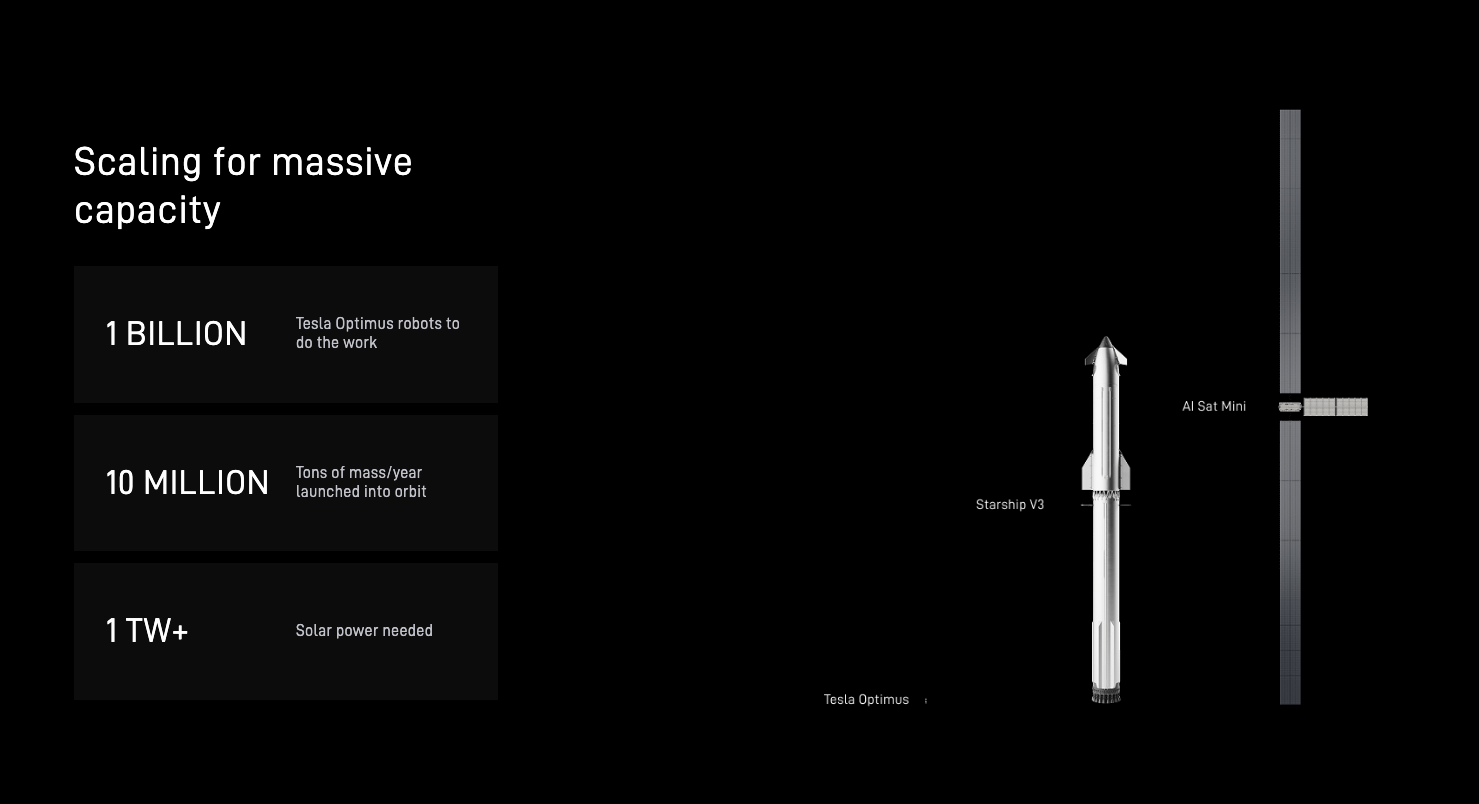
In fact, Musk believes that the AI Sat Mini will be easier to build than a Starlink satellite. “You still have some laser links but you don’t need all of the super complex antennas on a Starlink satellite,” Musk explains. “Given the two, the easier one to design for is the AI satellite… There’s not some magic that’s necessary for the AI satellites. A lot of this is technology we’ve already made for the Starlink V3 satellites. We don’t think this is a super hard problem compared to things we already do.”
He projects that within five years, SpaceX will be launching more AI compute to orbit each year than the cumulative installed base on Earth. The math is roughly 10,000 Starship launches per year, or more than one launch every hour, around the clock. By the late 2030s, with the lunar mass driver online, the petawatt threshold comes into view: a thousand times the compute deployed in 2030, launched into deep space at a cadence of one satellite every few minutes.
Mars
The Mars trajectory was supposed to start this year. Musk announced in September 2024 that SpaceX would launch five uncrewed Starships to Mars in the November 2026 transfer window, carrying Optimus robots that would test landing systems, scout for ice, and begin setting up the infrastructure for a future human mission. He said in May 2025 there was a 50-50 chance of hitting it, but that changed earlier this year.
In an X post on February 8th, Musk announced that SpaceX was deferring its Mars timeline and shifting its near-term focus to a self-sustaining city on the Moon. The reasoning was that the Mars launch windows open every 26 months and require six-month transit times, whereas the Moon is reachable every ten days with a two-day transit. “This means we can iterate much faster to complete a Moon city than a Mars city,” he wrote. “That said, SpaceX will also strive to build a Mars city and begin doing so in about five to seven years, but the overriding priority is securing the future of civilization, and the Moon is faster.”
On the surface this looks like a pivot, but it is actually the moment a path to a million-person city on Mars became clear.
The orbital data center thesis, which sharpened over the course of late 2025 and early 2026, gave the Moon a new role. Reaching petawatt-class orbital compute requires lunar mining, lunar refining, and lunar manufacturing of solar panels, radiators, and satellite structures, launched into orbit by a mass driver powered from the lunar surface. An industrial base of that scale requires a permanent population, which requires a city. And that city can be funded entirely by the orbital compute industry while serving as the dress rehearsal for Mars. Every problem SpaceX has to solve to build a self-sustaining city on Mars – radiation shielding, life support, in-situ resource utilization, governance of a permanent off-world population, supply chains across a gravity well – is a problem they have to solve first to build the Moon city. Building the Moon city teaches SpaceX how to build the Mars city with a much faster iteration loop.
The first uncrewed lunar landing demonstration is targeted as soon as 2027, and the Moon city will follow in less than a decade, on Musk’s stated timeline. The mass driver, the lunar industry buildout, and the lunar manufacturing of orbital compute infrastructure all spin up in parallel. Then Mars.
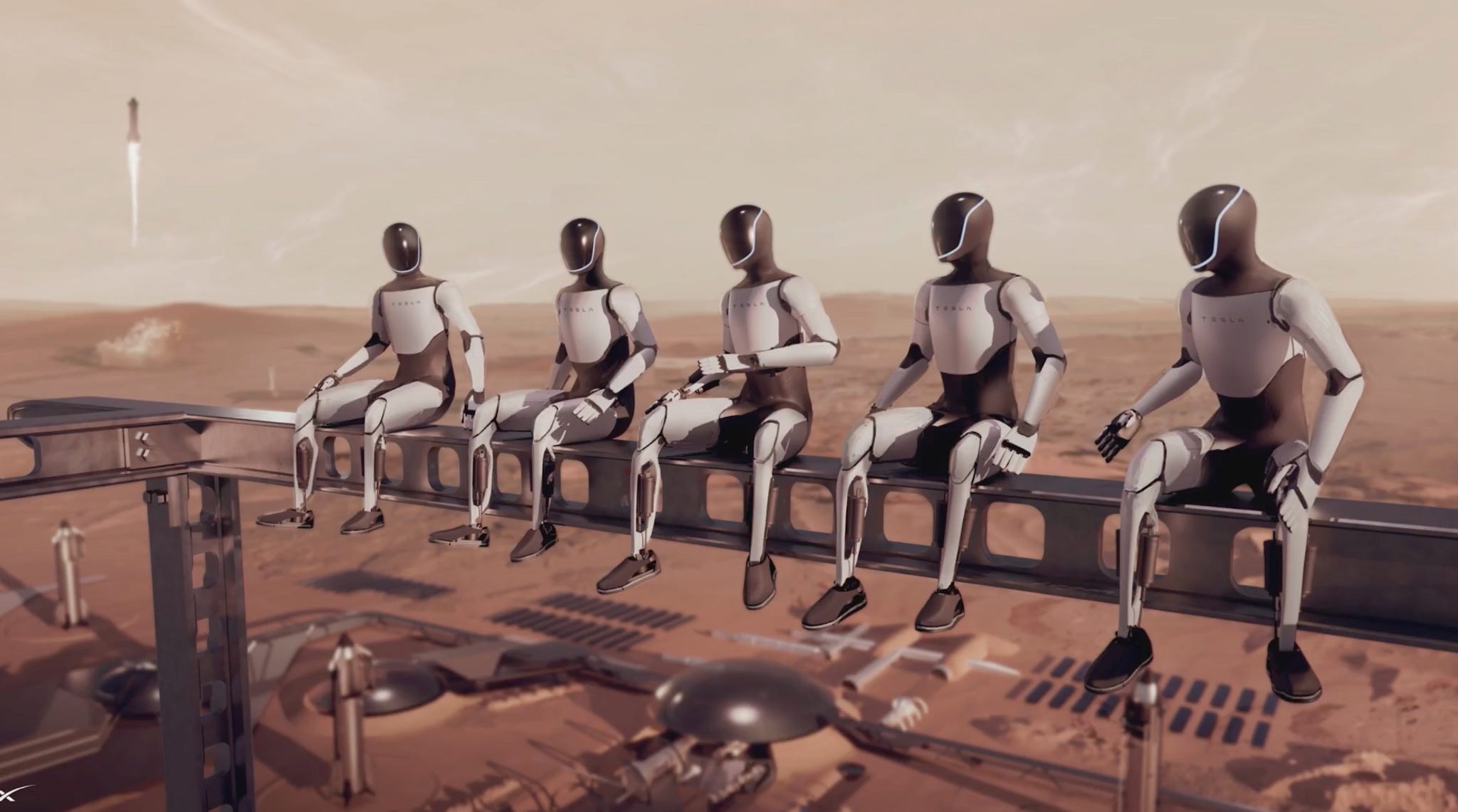
But the hardest part won’t be transporting people. It will be building Mars-side infrastructure that can absorb them. The Moon dress rehearsal will help. So will Optimus. The plan, repeated by Musk in his May 2025 Mars presentation at Starbase, is for the early uncrewed Starships to carry Optimus robots that scout for resources and begin setting up the infrastructure for human arrivals. The company is building a one-million-unit-per-year line at Fremont and a ten-million-unit-per-year line at Giga Texas. The robots are still in early production and have not yet done meaningful useful work in Tesla’s factories, but the production capacity coming online over the next two to three years will be essential for bootstrapping the initial Mars base.
The Sentient Sun
The mission statement SpaceX adopted when it absorbed xAI in February reads: scaling to make a sentient sun to understand the Universe and extend the light of consciousness to the stars.
This is, depending on how you read it, either the most ridiculous thing a serious company has ever put on its mission page or the most honest. We think it’s the latter.
If you squint at the org chart, SpaceX is a launch provider with an internet subsidiary and a recently-acquired AI lab. If you squint at the technology roadmap, it’s the only company on Earth assembling the full prerequisite stack for the post-scarcity transition. If you squint at the mission statement, it’s a serious attempt by one of the most operationally capable founders of our time to push humanity through the bottleneck that ends with us either as an interplanetary species sharing the cosmos with intelligent machines we built, or as a footnote on one rocky planet that didn’t make the leap.
By the time the first child born on Mars asks her parents why their family is there, Starship will have been flying daily for thirty years. The factory down the street will be staffed by Optimus robots running a descendant of Grok that has been self-improving for two decades. The compute that keeps her city alive will come from data centers in space, manufactured from lunar regolith by other robots, launched by a mass driver that has been flinging satellites into deep space at one every few minutes for the better part of a generation. Her parents will have come to Mars on a vehicle named after a starship in an Iain M. Banks novel, because somewhere in the early twenty-first century a man who read those books as a teenager decided to spend his life making them real.
Banks understood something about the people who will choose to go to Mars. The Culture is paradise, but his most interesting characters are the ones who leave it. The civilization solves scarcity, and what’s left over is the human appetite for hard journeys. The frontier is where meaning lives, even when paradise is available next door.
The pitch to early Mars colonists, Musk has said, will be the Shackleton pitch, after the famous recruitment ad placed for the 1914 Trans-Antarctic Expedition: “Men Wanted for Hazardous Journey. Small wages, bitter cold, long months of complete darkness, constant danger, safe return doubtful. Honour and recognition in case of success.” The ad is almost certainly apocryphal, but the story has been retold for a hundred years because it captures something true about those who choose to go.
Why does anyone find this appealing?
“Life cannot just be about solving one miserable problem after another,” Musk says. “There need to be things that inspire you, that make you glad to wake up in the morning and be part of humanity. Earth is the cradle of humanity, and you cannot stay in the cradle forever. It is time to go forth and become a star-faring civilization, to be out there among the stars, to expand the scope and scale of human consciousness. I find that incredibly exciting. That makes me glad to be alive. I hope you feel the same way.”



This material is solely for educational purposes and is not investment advice or an offer of investment advisory services. This material should not be used as the basis for an investment decision. a16z is an investor in SpaceX through its managed funds, and thus has a financial interest in the company’s performance and future prospects. In particular, a16z benefits if the company grows in value; and a16z funds will receive any customary dividend payments in connection with their status as a shareholder of the company. However, a16z is not being compensated by SpaceX for this material.
This newsletter is provided for informational purposes only, and should not be relied upon as legal, business, investment, or tax advice. Furthermore, this content is not investment advice, nor is it intended for use by any investors or prospective investors in any a16z funds. This newsletter may link to other websites or contain other information obtained from third-party sources - a16z has not independently verified nor makes any representations about the current or enduring accuracy of such information. If this content includes third-party advertisements, a16z has not reviewed such advertisements and does not endorse any advertising content or related companies contained therein. Any investments or portfolio companies mentioned, referred to, or described are not representative of all investments in vehicles managed by a16z; visit https://a16z.com/investment-list/ for a full list of investments. Other important information can be found at a16z.com/disclosures. You’re receiving this newsletter since you opted in earlier; if you would like to opt out of future newsletters you may unsubscribe immediately.
Marc, this is a compelling profile of SpaceX and Elon Musk’s vision in “SpaceX & the Sentient Sun.” I appreciate the big-picture thinking and the nod to the Culture series. Those drone ship names still make me smile. The piece captures the audacity and the engineering discipline that turned a spreadsheet on a flight back from Moscow into the most consequential space company in history.
That said, one small but personal correction: I am Jim Cantrell, and I did accept the position at SpaceX. I am happy to share copies of my employment documents and share certificates to prove it. I served as Elon’s aerospace advisor during those early Moscow trips and became the company’s first Vice President of Business Development. It was an extraordinary time, raw ambition, late nights, and the belief that we could build rockets far cheaper than the incumbents thought possible. I was (and remain) a huge believer in making space accessible and in the power of private enterprise to drive progress. I’ve said publicly for years that SpaceX was always about Mars, even when most people thought the idea was insane.
My path diverged for reasons unrelated to doubting the mission or the team. I wasn’t fully aligned with the near-term focus on human Mars missions at the expense of broader space-capitalism opportunities, and I knew Elon needed a leadership team 100% locked in on his vision. Gwynne Shotwell stepped in and provided exactly the steady, world-class leadership the company needed. I left on good terms and have never regretted the decision. It allowed me to contribute in other ways, including co-founding companies like Skybox Imaging, PlanetIQ, Phantom Space, and York Space, and helping build ventures like ICEYE that continue to push the frontier.
The broader thesis of the piece is spot on: SpaceX has repeatedly done what others dismissed as impossible. Reusable orbital rocketry at scale, Starlink’s global impact, and the relentless drive toward a multiplanetary future are reshaping what’s possible. The “idiot index” mindset Elon applied from day one, questioning why things cost orders of magnitude more than their raw materials, remains a powerful lesson for any hard-tech founder.
Keep aiming for the stars (and the sentient sun). The journey is far from over, and the rest of the industry, including those of us building complementary capabilities, is better for it.
Left out is the fact that Elon Musk, via dismantling of USAID, will cause the preventable deaths of 14 million people (most children five years of age and under) by the end of 2030, according to The Lancet. This is twice the number of people killed in the Nazi Death Camp system. Musk has reverse-engineered an administrative genocide that will kill more people than all of the wars, so far, in the 21st century. This, not SpaceX, will be Musk’s legacy and will follow him to his grave. He already senses this, given his post on X complaining about Bruce Springsteen reminding concert goers about the fatal consequences of Musk’s dismantling of USAID. Musk lied multiple times about advance monitoring for outbreaks of Ebola by USAID contractors, as the world is now learning. All of Musk and Rubio’s lies are documented in a new book by Nicholas Enrich: “Into the Wood Chipper: A Whistleblower’s Account of How the Trump Administration Shredded USAID.”
What does it say when the world’s richest man willingly cause the preventable deaths of millions of children and finds it an opportunity for humor, posting on X: “Could have gone to parties this weekend. Instead tossed USAID into the wood chipper.”
Note to Musk: This crime won’t go away. In fact, it will get worse with numerous agencies and nonprofits tracking the death toll.
Tick, tick, tick . . .