



America | Tech | Opinion | Culture | Charts

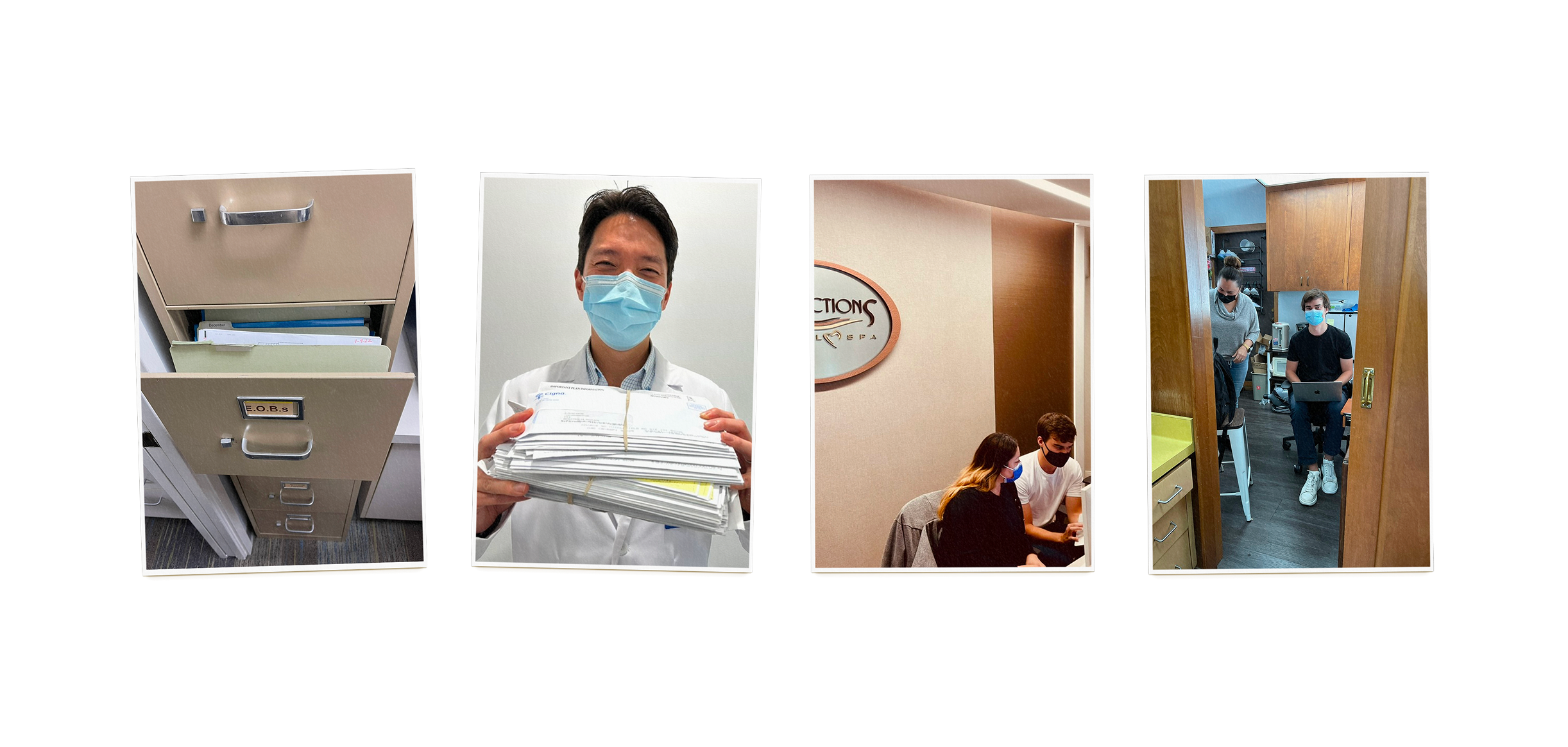
Truth be told, when I immigrated from Amsterdam to San Francisco ten years ago, spending 15,000 hours with hundreds of small business owners was not on my bingo card. Yet, after leaving Robinhood as one of its first product managers, I spent months working 9-to-5, first in a dental office in Menlo Park and then for a gastroenterologist in Scranton. Why? Because after my own dentist walked me through how he runs his business, my jaw dropped. Every single month, he and his team spent 200 hours on administration.
He’s not alone. There are over 500,000 doctors’ offices in the same boat. Businesses that spend roughly $200,000 a year on staff that the owners can barely find, let alone keep. I couldn’t help but dig in and do the actual work myself.
I felt like Jim Halpert from The Office. My days started with downloading a monstrous PDF with hundreds of payments from an insurance portal. The next several hours would be spent entering them, one by one, into a practice management system. After that, I’d print a 40-page list with the names of hundreds of patients that the system flagged as needing a bill. I spent hours reviewing, checking balances, and generating the statements.
These experiences were not unique; they were (and still are) the status quo. The more small business owners we spoke with, the more we realized they don’t differ that much from each other:
Most are reluctant operators: doctors want to help patients, the plumber wants to fix your sink, and the manicurist wants to do your nails. The paperwork is the last thing they want to spend time on.
They all have to do the same fundamental work to stay in business: enter data in a system of record, get data in and out of that system, and interact and transact with customers.
Until now, software has not removed this work; it merely rearranged it. It gives you a dashboard, a queue, a form, and maybe a better place to click. But someone still has to click.
AI changes that. For the first time, software can actually understand messy context, move across systems, and do the job. So we asked ourselves: can we build software to let a small business run itself?
Who cares
Let’s start with why this matters: most businesses are small businesses. They clean your teeth, fix your toilet, and polish your nails. Because they struggle to find people to handle their administration, the owners often have to step in. Imagine how many more customers they could help, and how much their service would improve, if that busywork were gone.
I remember my first meeting with Dr. Ed Zuckerberg. He shared the story of how crazy his life was when he owned his own practice in Dobbs Ferry, NY. After a full day at work, after dinner with his family, and after his kids were in bed, he’d head down to his home office at 11 PM to handle the paperwork himself.
Or take my dentist, Dr. Kwon. Together with his team, he spent 2,400 hours a year on everything but helping patients. By simply eliminating this busywork, he could see twice as many patients, spend more time with them, and still enjoy his family evenings at home.
AI can do a lot today. It writes software, passes bar exams, and generates realistic videos from simple prompts. But it can do so much more. It can help small business owners do their best work and live their best lives. It raises the question: if AI is so powerful and valuable, why is it barely present in these businesses?
Why this is hard
Building these agents is not easy.
For starters, you need autonomous systems that can predictably run an entire business. It’s a daunting task. How do you teach them to do the work people don’t want to do, the work that keeps them from their real jobs and higher purpose? It has to be done completely and correctly. That’s even more true when handling sensitive information or operating in regulated industries.
An owner of a doctor’s office needs to trust that the system correctly files their claims, interacts with their patients, and updates their system of record with the claims their insurance companies send back. Getting that right takes more than a passing understanding of complex systems; it takes understanding what it actually takes to run the business.
On top of that, the system has to make many services collaborate and communicate as a single, unified entity. For a doctor’s office, that means dozens of insurance portals, multiple clearinghouses, a system of record, a bank account, and much more. Each one operates in its own way, and each one fails with its own cadence.
And even if you can build such agents, reaching these owners is an uphill battle. Anyone who’s sold into small businesses knows this: they’re notoriously hard to reach and have very little time. It’s not their fault. In our experience, they love technology that actually works, but most of their days (and nights) are spent with customers and paperwork.
Once you do reach them, non-technical users need to be able to install the agents quickly, and the agents need to deliver value even faster. Otherwise, people won’t give them a try, let alone build the habit of keeping them running daily. One of the things that impressed me at Robinhood was how relentlessly the team worked to onboard new users with little to no manual account approval (one of the first broker-dealers to do it). Similarly at Superhuman, where my co-founder Frédéric was the first product hire, the team obsessed over removing friction at the critical moment when people first touch the product.
For agents that partner with busy small business owners, getting this right is essential.
We are building autonomous systems for SMBs
These autonomous systems are not a pipe dream. They already are a reality and living up to the promise of displacing $200,000 a year in administrative spend on churning staff and business owner burnout.
Today, Lassie is operating in over 700 small businesses across 49 states and growing rapidly, helping dozens of new ones each month primarily through word-of-mouth. On average, we provide each business owner with about 30 hours of labor per practice, every month. We provide some practices up to 190 hours. Lassie does the work quietly and reliably. Doctors see more patients, go home on time, and actually take vacations. One of our customers told us that we saved his marriage.
We’ve done the hard and unglamorous schlep. Together with the early team, we became experts in how doctors’ offices run. Not by hiring a consulting firm or going out to coffee with business owners. We worked in these businesses. Not for a weekend, or even a week, but for months. We reconciled millions of dollars in insurance payments, submitted thousands of claims, and billed hundreds of patients. This is how we understood the pain points, the challenges, and the opportunity of what an autonomous system that runs the business should look like. The result, in the words of our customers: a product that is an order of magnitude better than anything else. Word got around quickly.
We took the “Collison installation“ to the extreme. We installed the product, in person, in the first hundred practices we worked with. Helping people onboard by looking over the shoulders of business owners from Florida to Kansas to Oregon, we learned how customers link their systems of record, bank accounts, and other relevant data sources to themselves. Armed with this experience, we figured out how to onboard new customers onto an autonomous system.
After watching 700 businesses rely on Lassie to do a big part of their busywork, I am convinced that the future is bright and that the lump-of-labor fallacy is exactly that. They use the time we save them to grow the practice, improve patient experiences, and do the work that should have mattered most.
We’re just getting started. Millions of owners still don’t know this is even possible. Our next job is getting the word out faster, and making the setup so simple that any owner can turn these systems on themselves. From there, we go deeper. The systems will do more. They will connect to more of the tools a business already runs on. Securely, reliably, every time.
If you value craft, rigor of thought, and share our ambition that small businesses should run themselves, come build Lassie with us.


This newsletter is provided for informational purposes only, and should not be relied upon as legal, business, investment, or tax advice. Furthermore, this content is not investment advice, nor is it intended for use by any investors or prospective investors in any a16z funds. This newsletter may link to other websites or contain other information obtained from third-party sources - a16z has not independently verified nor makes any representations about the current or enduring accuracy of such information. If this content includes third-party advertisements, a16z has not reviewed such advertisements and does not endorse any advertising content or related companies contained therein. Any investments or portfolio companies mentioned, referred to, or described are not representative of all investments in vehicles managed by a16z; visit https://a16z.com/investment-list/ for a full list of investments. Other important information can be found at a16z.com/disclosures. You’re receiving this newsletter since you opted in earlier; if you would like to opt out of future newsletters you may unsubscribe immediately.
I wrote an essay on this a few months ago. We will see a lot more small businesses succeeding and operating as agencies using AI as their operating infrastructure. https://rmeerasahib.substack.com/p/ai-and-the-unbundling-of-white-collar?r=1n9qpn&utm_campaign=post&utm_medium=web
The 'next frontier' is already running in China. Doubao hit 120 trillion tokens per day last month. The use cases driving that number are exactly what you describe: dental clinics, logistics operators, commercial contractors using AI to handle paperwork, supplier renegotiations, collections. The Doubao number matters because it tells you the stage Chinese SMBs are at. Western SMBs are a year or two behind the same adoption curve, not a decade. I scan 100+ Chinese sources daily to track exactly these deployment patterns.