


America | Tech | Opinion | Culture | Charts
NEW: Revolut files US bank charter application, names Cetin Duransoy as US CEO

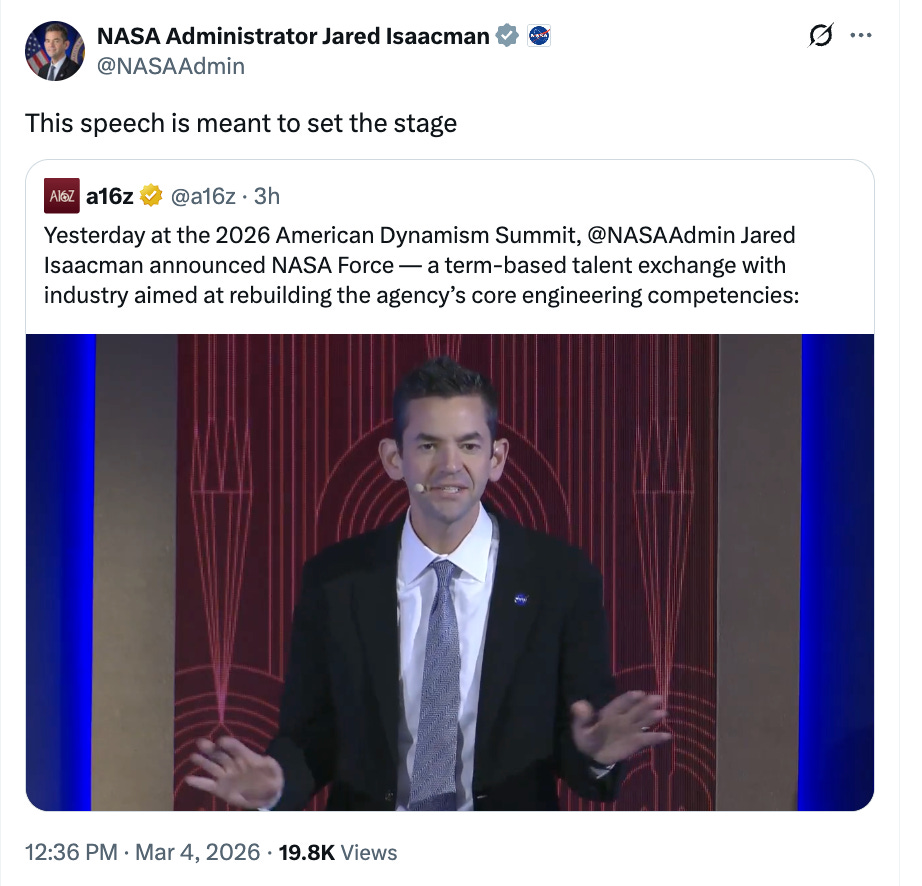
At Tuesday’s American Dynamism 2026 Summit, NASA Administrator Jared Isaacman announced NASA Force: a new initiative to rebuild NASA’s core personnel capabilities. Here is Jared’s speech:
Thank you. It’s great to be here with so many entrepreneurs, operators, investors, and policymakers who are helping us build the next golden age of space exploration. I love being around the people who not only look up and imagine what is possible, but possess the experiences and the will to bring ideas into reality. There is no organization I can tell you that appreciates that kind of determination more than NASA.
On that note, in the weeks ahead, America will send the Brave Artemis 2 astronauts potentially farther into space than any humans have ever traveled in generations: flying around the moon on a 10 day mission to test the space launch system rocket and Orion spacecraft before returning home to Earth.
Now, president Donald Trump took the decisive steps in establishing the Artemis program during his first term. He recently - in fact, it was the day that I was sworn into this position - reaffirmed America’s commitment to space superiority, giving NASA a clear mandate and a focus to return to the moon, build the base, so this time we return the stay.
Thanks to historic investment secured and the Working Families Tax Credit Act. NASA has received nearly $10 billion in support of that national imperative. The bipartisan commitment signed into law by the President gives us the resources to move forward with purpose and urgency, knowing American leadership in the high ground of space is on the line.
So we have the presidential mandate, we have the resources, we certainly have the historic experience. We have plenty of hardware, we have domestic and international partners. So why does it all take so long? Why does it cost so much, and what are we gonna do about it?
Lots of those answers are because we have lacked real competition for decades. After the last space race we were the only game in town. So we built partnerships all over the world to spread goodwill. We spread ourselves thin with broad-based science. We took on lots of sidequest projects, some of which are very cool, but ultimately distract from the world-changing mission that taxpayers have entrusted us with.
It costs a lot because we outsourced a lot of our core competencies. Industry consolidated. We let stakeholders set the priorities to serve constituent interests, and adopted policies in the attempt to make everyone happy - maybe make everyone happy other than the American people, and really people all over the world that were waiting for the headlines that only NASA was capable of making.
As a result, you get moon rockets that fly only every 3+ years. The worst cadence by far of massive design rockets. Hardware that is obsolete by the time it’s delivered. 51 nuclear propulsion programs that have never flown! Less flagship science and discovery missions. Less X planes, less astronauts in space, less kids dressing up as astronauts for Halloween.
I don’t like this. President Trump doesn’t like it. Clearly President Trump doesn’t like it, given what he’s trying to accomplish in national space policy. But maybe this was tolerable to some, when there were no geopolitical rivals capable of challenging American, the most important strategic domain. But that’s not the case anymore. Not anymore.
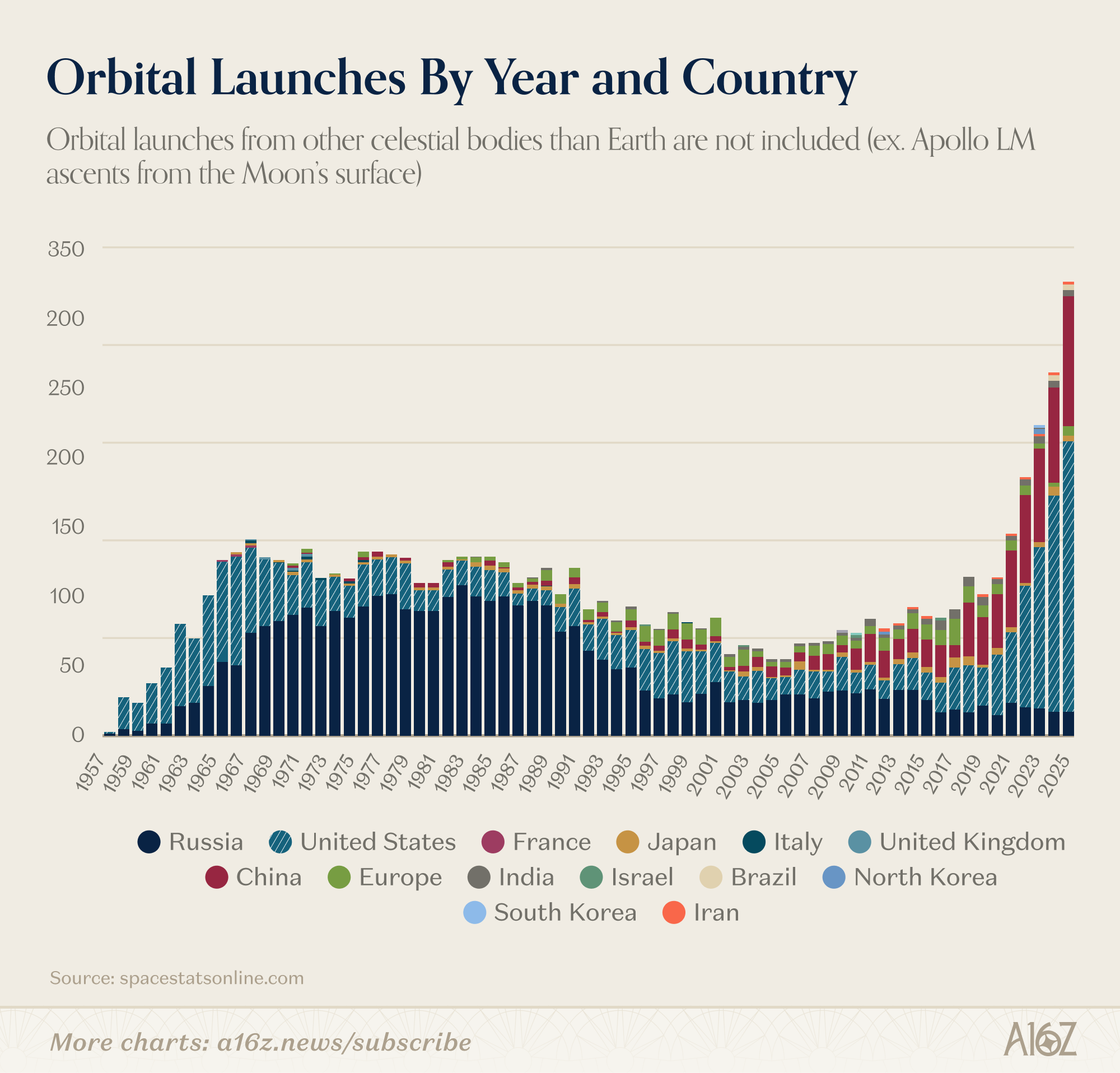
NASA stated: we will achieve the national imperative to return to the moon and establish an enduring presence before the end of President Trump’s term. Now, our rival has stated before 2030, so it’s not hard math. That’s less than one year of margin. And they might be early. And if recent history says anything, we certainly might be late. President Trump does not like to lose, and if I’m doing my job right at NASA, that won’t happen.
Now I’ve spent the first few months getting my arms around the challenges and the opportunities, and it generally revolves around ensuring that the extraordinary resources that are made available - I mean, NASA’s budget is $25 billion a year - are concentrated on the most pressing objectives. Clearing out needless bureaucracy and really any obstacles that impede progress to empower the workforce and make sure our capital allocation is done in a thoughtful way that ensures desired outcomes are achieved and ideally ahead of schedule.
So to that end, we are standardizing the SLS Rocket, increasing launch cadence from years to months. We’re inserting a new mission in 2027 to buy down risk and increase confidence for lunar landing attempts in 2028. As I’ve said many times, Artemis is a program. Where we begin with SLS is not where we end. There will be dozens of missions, living on long past where Apollo 17 ended, with the aim of affordable and repeatable crew and cargo missions for the surface for decades into the future.
We are also going to stop leaping right to the “dream state as a service” and build a moon base step by step in an evolutionary approach. We’re gonna start with CLPS Programs and LTV style landers and rovers. We’re gonna provide a strong demand signal to industry for launch, landers, rovers, that we can outfit with power, navigation, communication, surface improvement capabilities, scientific and other capabilities that we can experiment with to ultimately inform the phase two infrastructure and move towards long-term habitation.
So the folks in this room, if you’re ever coming to pitch me on the “Mars base dream state as a service” where the only customer is NASA, and costs billions of dollars and it’s never been done before, I can assure you I probably won’t be that receptive. We’re not gonna force an economy where it doesn’t exist. But I can certainly provide a demand signal for what we need in line with President Trump’s national space policy. And we are gonna do everything we possibly can to ignite the space economy that we all know is inevitable.
When we return to the moon, America will not look down on the prime lunar real estate while our arrivals occupy it. NASA astronauts will be on the surface building President Trump’s moon base, and we will realize the scientific, economic and national security potential surface operations provide. NASA will achieve the lunar objectives and do the other things. We will invest in nuclear power and propulsion in space so we can undertake the next giant Deep Tomorrows. We will ignite the orbital economy and launch more missions of science and discovery. We never pursue these grand endeavors alone. We have international partners, we have commercial industry, like many of those in this room. But we also require the scientific, the software development, the engineering, technical and operational talent to execute on the mission.
So I’m pleased to announce with the immense support of OPM Director Scott Kupor, we are launching NASA Force: to rebuild NASA’s core competencies. These term based appointments from an industry partner will provide mentorship and training, and help season and rebuild the core competencies within the NASA workforce.
Similarly, these programs offer exchange opportunities for NASA talent to rotate through industry. At NASA, we have no excuses. We have the policy, the resources, the will, the support of the most technologically forward-feeding industry, and we have the winning playbook that achieved the near impossible on July 20th, 1969.
It starts with having a very focused plan. Concentrating resources again on the most challenging objectives. Staying organized, assembling the best and brightest around the nation, instilling a culture in them that requires immense competence, extreme ownership and urgency. Partnering with industry, taking meaningful steps towards a larger goal, constantly listening to data and learning, and never accepting defeat.
This is how NASA once changed the world, and this is how we’re gonna do it again.
Thank you.


This newsletter is provided for informational purposes only, and should not be relied upon as legal, business, investment, or tax advice. Furthermore, this content is not investment advice, nor is it intended for use by any investors or prospective investors in any a16z funds. This newsletter may link to other websites or contain other information obtained from third-party sources - a16z has not independently verified nor makes any representations about the current or enduring accuracy of such information. If this content includes third-party advertisements, a16z has not reviewed such advertisements and does not endorse any advertising content or related companies contained therein. Any investments or portfolio companies mentioned, referred to, or described are not representative of all investments in vehicles managed by a16z; visit https://a16z.com/investment-list/ for a full list of investments. Other important information can be found at a16z.com/disclosures. You’re receiving this newsletter since you opted in earlier; if you would like to opt out of future newsletters you may unsubscribe immediately.
About time! Go Trump!
Amazing