



| America | Tech | Opinion | Culture | Charts |
a16z Culture is pleased to share this piece from Ross Calvin, who is currently working on the American Colossus project, and who took time to share some of his thoughts with us on California’s ongoing identity. Our culture in tech (and our art, our self-concept…) is upstream of our actions and our outcomes; and a16z Culture is eager to highlight new ideas at the technological and cultural frontier. And Ross’s idea and challenge of “Exit as ideology” gave me a lot to think about. -AD
Northern California suffers from a stark contradiction. California has always been dependent on the American megaproject – aqueducts, railroads, the US military, the NYSE, American high-trust culture and globalization. However, both the actual major innovations and California’s cultural history have revolved around “Exit”. Exit from financial repression, exit from media-driven frauds, exit from religious oppression and even from middle class social mores.
What it lacks in oikophilia and ethnophlilia it makes up for in its membership in a greater American Hellas, even while often begrudging it. An industry based on the concept of Exit and dematerialization must exist within something nonetheless. This pretense toward Exit naturally nests within a disdain for symbols because they represent the mythos of a dominant culture. Not necessarily the dominant American culture but any dominant culture at all.
It’s remarkable how the heroic entrepreneurial inventor psyche is invoked to solve these social and governance problems – humanity’s only and last line of defense. A club of precious outsiders solving the world’s most challenging problems is actually materialization of the most important interior elements of this dominant American culture. Exit, autarky and inspired creative will are the quintessence of Manifest Destiny and the Pursuit of Happiness.
In many ways the culture of entrepreneurial excellence is the absolute best of what America has to offer. The ethos around shipping product as the fundamental expression of a business culture is legitimate as a feature of the microclimate, but there is a great and profound power which inures to those who look also deeper into the climatological and mythic depth of Man’s nature. Shipping product might be “good enough,” but only just. The technology industry’s combined intellectual superiority and complacency cause it to bypass the critical importance of cultural meaning.
Casting technology as Exit cedes cultural dominance
A business culture which deigns itself the purveyor of so much largess upon the world seems conspicuously allergic of symbols because they represent power and excellence. Not because it feels itself to be post-symbol, but because it believes itself to be post-culture and post-meaning. This has meant that an industry which has an intense in-group bias nonetheless still has very little oikophilia.
Casting technology as Exit fundamentally cedes cultural territory, when in fact technology should be an expression of cultural dominance. The underlying structures of meaning of a people are the primordial blueprint for what emanates as technological power. The ambrosia climate of Palo Alto and the materialist transiency have not been tested before like they will be in the next 25-30 years. A transient people do not fight for home turf.
Yes: Cultural. Dominance. There are many words for why this makes the technology industry and also many in the West uncomfortable. The internalized inferiority of one’s own culture and values is upstream from materialist transiency and antithetical to a business culture based on Exit. Instead it’s a parochial product of in-group bias. A way of making off with the economic druthers without standing for anything.
To dominate means to make a home of something. The planter of the garden must break the earth and kill the animals which destroy the crops. Culture should be understood as a base layer technological primitive, a phenomenon that fosters meta-coordination into deeper time which transcends the nearest product shipment. It is also a strategic asset. Not so much a political asset, but one which invokes profundity. For without this, there is no destiny and no future upon which exit multiples can rely. To be cynical about this is to be dependent on another dominant culture to provide the culture instead. So much for Exit indeed.
We must fight very hard for the entrepreneurial achievement we seek. Entrepreneurship is in a major way a war on reality, and technology is our arsenal. Feality also exerts entropy over time for which culture is the techne. It is one of the most beautiful and noble aspects of Man. It’s not enough to advertise yourself to your in-group that you are contrarian – you must be one in fact. True contrarians don’t need anything from an in-group and don’t kowtow to it. At least at one time, this was the central ethos of the industry.
“Exit” from our present situation
In the mythos of Prometheus, Zeus sends his eagle to destroy the self-regenerating, future-seeing power of Prometheus. The soulful consciousness of Man which generates a blueprint for the future and enacts that blueprint through heroic entrepreneurship is what is meant by the liver of Prometheus. In a grandiose or archetypal sense, the liver is his own sense of Freiheit, his spirit of Manifest Destiny and his birthright Pursuit of Happiness. Vengeful Zeus had no such qualities, so he had to steal them from their rightful owner. Wealth tax, anyone? In a personal and deeply humane sense, the liver is consciousness. It is this same consciousness which is stolen from so many Americans on the streets of the Bay Area through narcotics. It is weaponized against the state treasury metastasizing in profligate programs. The homelessness and opioid catastrophe is traceably downstream from the dematerialized transiency and Exit of the City Fathers. Sacramento is a globally strategic asset for America and its integrity should be treated with extreme gravity, not glib Exit.
Several people criticized the Alcatraz monument for not being a Bay Area homelessness solution instead. Of course, if the culture of the Bay Area were sufficiently strong, the complex of drivers for the abject scandal its maddening homelessness challenge would have been solved long ago. The City Fathers are as transient as the homeless in this way. The technology industry seems to have no power to address this fundamental issue. It is too busy checking on the in-group and gazing into the ether, and asks a New Mexican to handle it instead. Where San Francisco goes, so does America. The destruction of San Francisco under the nose of the world’s most powerful industry is America forfeiting itself.
Silicon Valley has proven incapable of culturally reinforcing the basic mechanics of the sanctity of human consciousness in its own hometown, even though it is these very mechanics which define and undergird technology and entrepreneurship. It has no business telling the world how clever it is. Shipping product is inferior to the paternal Promethean act to imbue Man with self-sovereignty, agency and techne.
New Florence
We’ve heard tell of San Francisco as a new Florence, an innovation cluster, a city on fire. It’s an oxymoron, “Originalism 2.0.” “Not X but Y” AI speak. In many ways we supersede Florence, though in critical ways we fall dramatically behind.
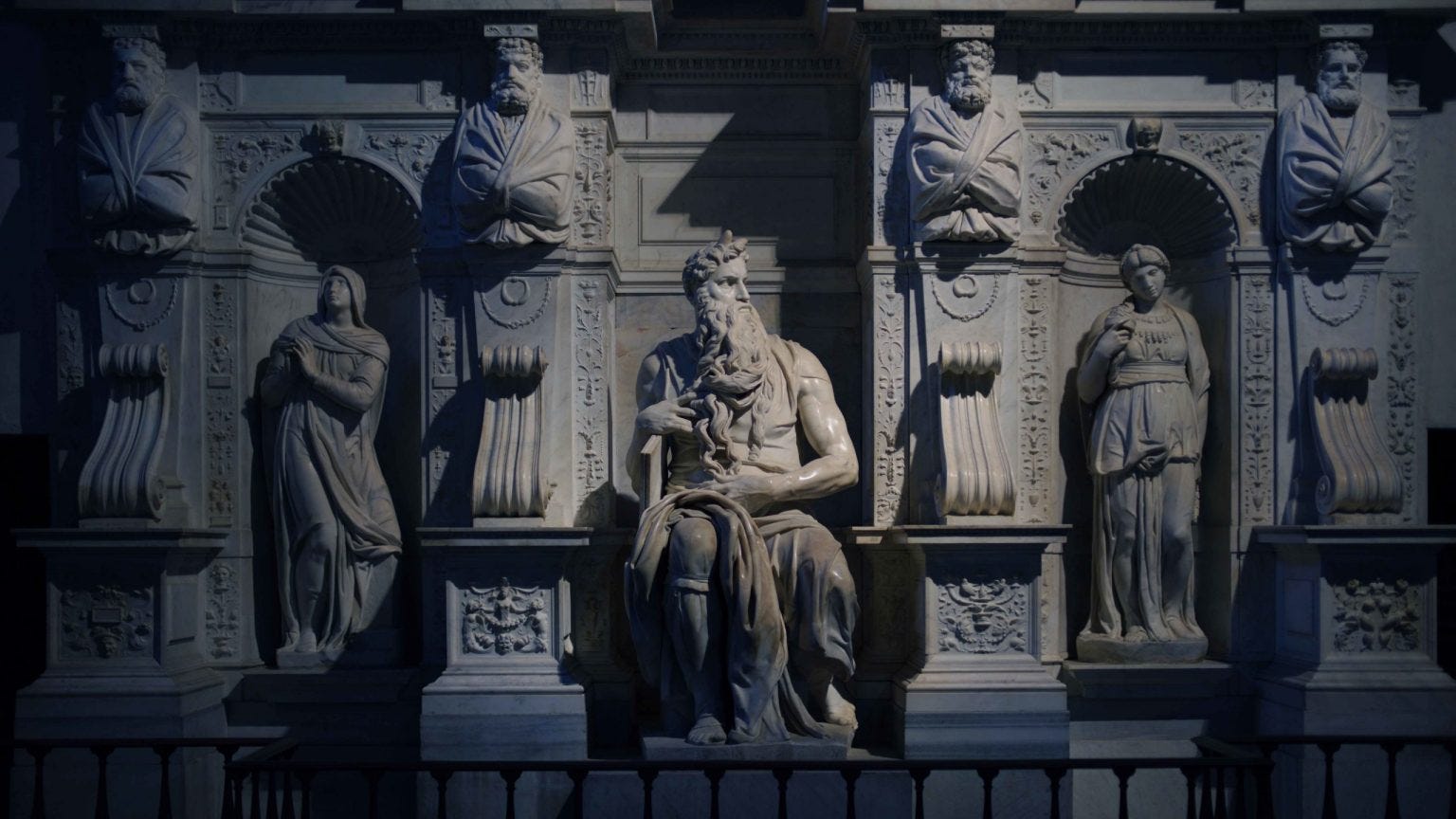
Michelangelo’s Tomb of Pope Julius II
Florence was deeply concerned with cultural power. It was also a naturalistic, Dionysian cultural power which flouted the plantation management architecture of Rome. Florence recast the God of Rome as a more Greek and Lombard/German figure, in opposition to His Middle Eastern origins.
This Florentine version of Exit is very underappreciated today - the Renaissance of course was Exit itself. But it was an Exit of mythos. Silicon Valley, in stark contrast, seems to eschew and have disdain for cultural power. Instead of insisting that our current Rome in Northern Virginia be colonized with a Florentine technological conception of divinity, for all of its history until 2024, Silicon Valley has depended on our own version of Roman largess and had very little paternalist instinct or concern over the culture it claims to be remaking. California in some sense is still a land of children and wonder after all. But one cannot ignore the tar of disdain toward fly-over country present on Sand Hill.
Where Florence and Rome vying for the intangibles of cultural power, Silicon Valley seeks exit from modern Rome altogether. California as a long-time bastion of the collusion between socialists and corporatists, largely allied with DC (Rome) in its transition to more beta-driven allocations.
The reluctance of most entrepreneurs in Silicon Valley to support Trump in 2016 and 2020, and the large swing in his favor in 2024 demonstrates this prioritization of in-group vs. disruption. It’s plain that our culture of disruption requires cultural and political engagement and that we cannot remain siloed on our island of plenty. The AI/digital asset push which reclaimed narrative dominance in order to align regulatory conditions with disruptive ideals demonstrated the necessity for maturation in in-group biases toward broader coalitions. It may be that influence of the crypto and AI faction was simply not strong enough early on. This group combined with the major allocations into critical minerals and defense tech demonstrates the first real Florentine-style move to reconfigure the abstract intangibles of DC just as the Medici did to Rome before it. It is no doubt this is why Sacramento’s wealth tax is hitting this year and not 10 years ago.
This lack of paternalistic care for the American heartland seems to include the streets of San Francisco as well. But Florentine cultural power was also a means of avoiding Exit, of staying and fighting, of exerting an alchemical transformation from within. Ideological and aesthetic leadership was just as important as military technology. Silicon Valley is a transient place full of non-voting immigrants and does not have an explicit embedded political theory. The same is true for its myths and symbols if any. Granted it is far more possible to be transient today than in Renaissance Florence. But the transience, the technical and engineering-minded disposition, the globalism, the model dependency on public market excess, the snobbery toward Main St. culture, and the predominance of capital-light digital over capital-heavy machinery all conspire towards a disembodied disinterest in cultural power, symbolism, mythos and aesthetics that is decidedly anti-Florentine.
A Gleaming Torch above the Fog
Symbols, monuments, a culture of archetypal shared meaning, etc. are artifacts of psychological infrastructure; they are not dispensable add-ons. They claim our place in the physical world and in the metaphysical world. For the technology industry to reach cultural maturity and enduring transformative authority, it must move upward from shipping products alone and begin crafting totemic meaning, architectural statements and materialization of the greatest archetypes which inspire the courage, wonder, and audacity at its core. The American people must understand its sacred power.
The truth about the American technology business is that it is in fact a sacred artifact of all Man’s existence. Few involved from the inside will see its true archetypal power. But it is one of the most important engines of Man’s destiny. It should be treated as sacred, not merely profitable. It should be cherished as incredibly rare and precious, like a Promethean flame in a fragile fennel stalk carried on into the dark. Technology’s humanistic ambitions are not crisp enough at all in the minds of Americans nor the world. Without symbols and enduring iconography, which valorize it as a sacred flame, the industry risks remaining a collection of companies rather than a true civilizational force.
Monuments may feel old-world, hierarchical, even authoritarian—antithetical to the move-fast-and-break-things ethos. But this is a strangely uncreative and backward-looking perspective. A move-fast-and-break-things, Exit and permissionlessness ethos elevated by monuments may very well carry a new kind of aesthetic as well.
Monuments are meant to uplift and be beautiful. By nature, they are meant as markers of cultural chauvinism. All art is this way to some extent even if not publicly displayed. We instinctively know this. Prometheus is the Titan of disruption and move-fast-and-break-things versus in-group. California must not forget its roots.
This newsletter is provided for informational purposes only, and should not be relied upon as legal, business, investment, or tax advice. Furthermore, this content is not investment advice, nor is it intended for use by any investors or prospective investors in any a16z funds. This newsletter may link to other websites or contain other information obtained from third-party sources - a16z has not independently verified nor makes any representations about the current or enduring accuracy of such information. If this content includes third-party advertisements, a16z has not reviewed such advertisements and does not endorse any advertising content or related companies contained therein. Any investments or portfolio companies mentioned, referred to, or described are not representative of all investments in vehicles managed by a16z; visit https://a16z.com/investment-list/ for a full list of investments. Other important information can be found at a16z.com/disclosures. You’re receiving this newsletter since you opted in earlier; if you would like to opt out of future newsletters you may unsubscribe immediately.

this is grade A bullshit right here:)
"The truth about the American technology business is that it is in fact a sacred artifact of all Man’s existence. Few involved from the inside will see its true archetypal power. But it is one of the most important engines of Man’s destiny. It should be treated as sacred, not merely profitable. It should be cherished as incredibly rare and precious, like a Promethean flame in a fragile fennel stalk carried on into the dark. Technology’s humanistic ambitions are not crisp enough at all in the minds of Americans nor the world. Without symbols and enduring iconography, which valorize it as a sacred flame, the industry risks remaining a collection of companies rather than a true civilizational force."
The essay raises an important tension: Exit can feel adolescent if it never grows into stewardship.
But I’m not sure cultural dominance is the missing ingredient. In a pluralistic society, the deeper challenge may be building shared civic infrastructure that allows many cultures to coexist without one needing to dominate the others.
Instead of monuments, maybe what we need are composable trust systems and visible norms – infrastructure that supports meaning rather than prescribing it.
If tech is maturing, perhaps the next step isn’t dominance, but designing the civic layer we all live on.