



America | Tech | Opinion | Culture | Charts
Today’s guest post is by Ruby Thelot, a professor at NYU and astute tech observer. You can watch his recent appearance on MTS here.

Every year, more people use and spend more time on Big Tech platforms. It is fashionable to hate on social media and to pontificate about how it’s worsened, because the intellectual accoutrement du jour is being a conscientious (™) tech critic. This stated preference does not match the general public’s behaviours.
“Enshittification” describes the progressive deterioration of platforms in service of business goals over user needs. In the writer Cory Doctorow’s original definition from his 2022 blog post, he uses the term to describe how platforms die: “First, they are good to their users; then they abuse their users to make things better for their business customers; finally, they abuse those business customers to claw back all the value for themselves. Then, they die.”
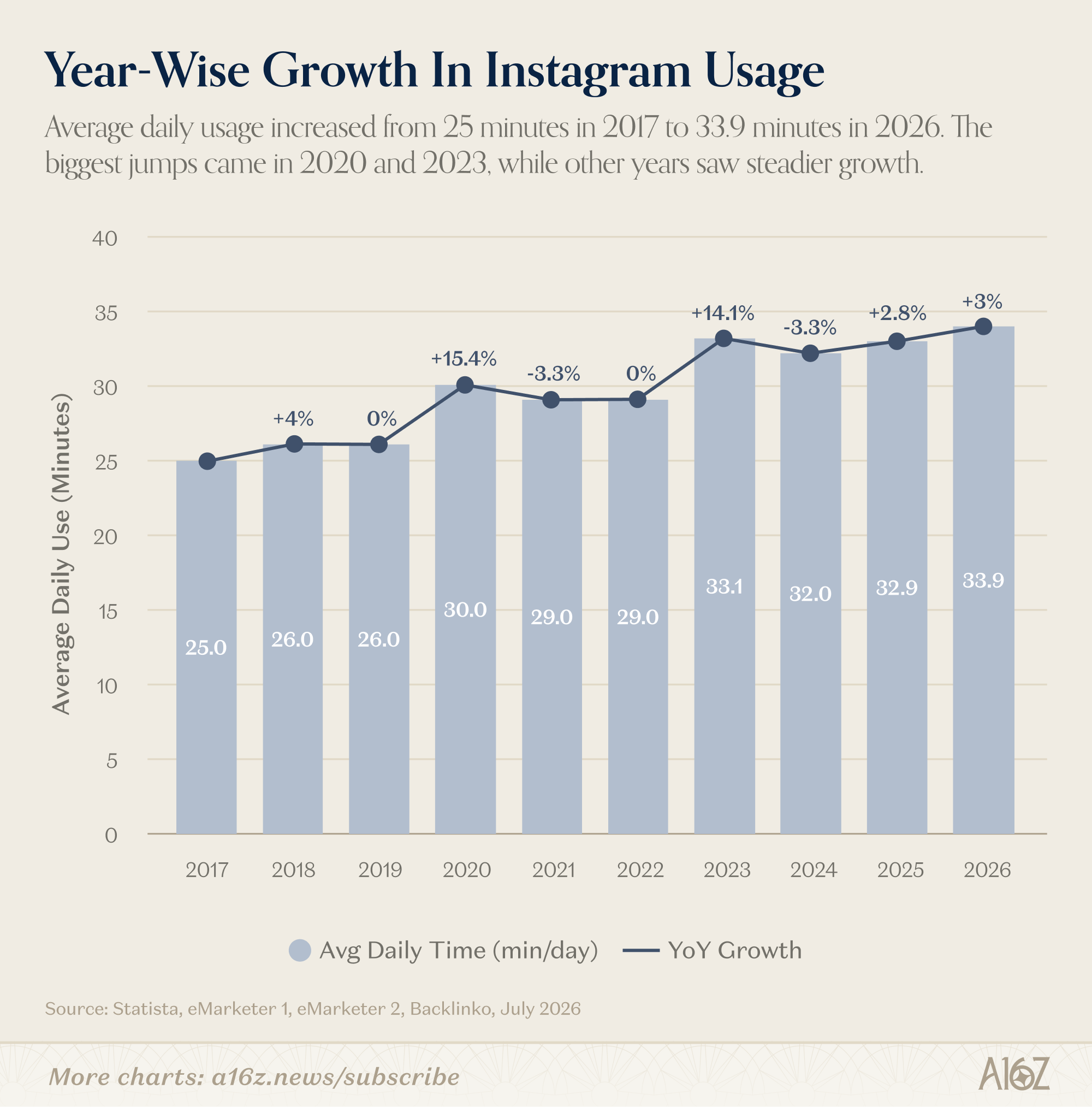
I do not believe, no matter how compelling it is as a theory, that it holds up to scrutiny. Simply put, more people use Instagram every year, they use it on average longer every day, year over year and, finally, their reported satisfaction has also grown over time, indicating no decrease in overall satisfaction, stated or revealed.
For our purposes, let’s focus on Instagram, whose logo was just redesigned to many online commentators’ chagrin. Certain people just hate when platforms change.
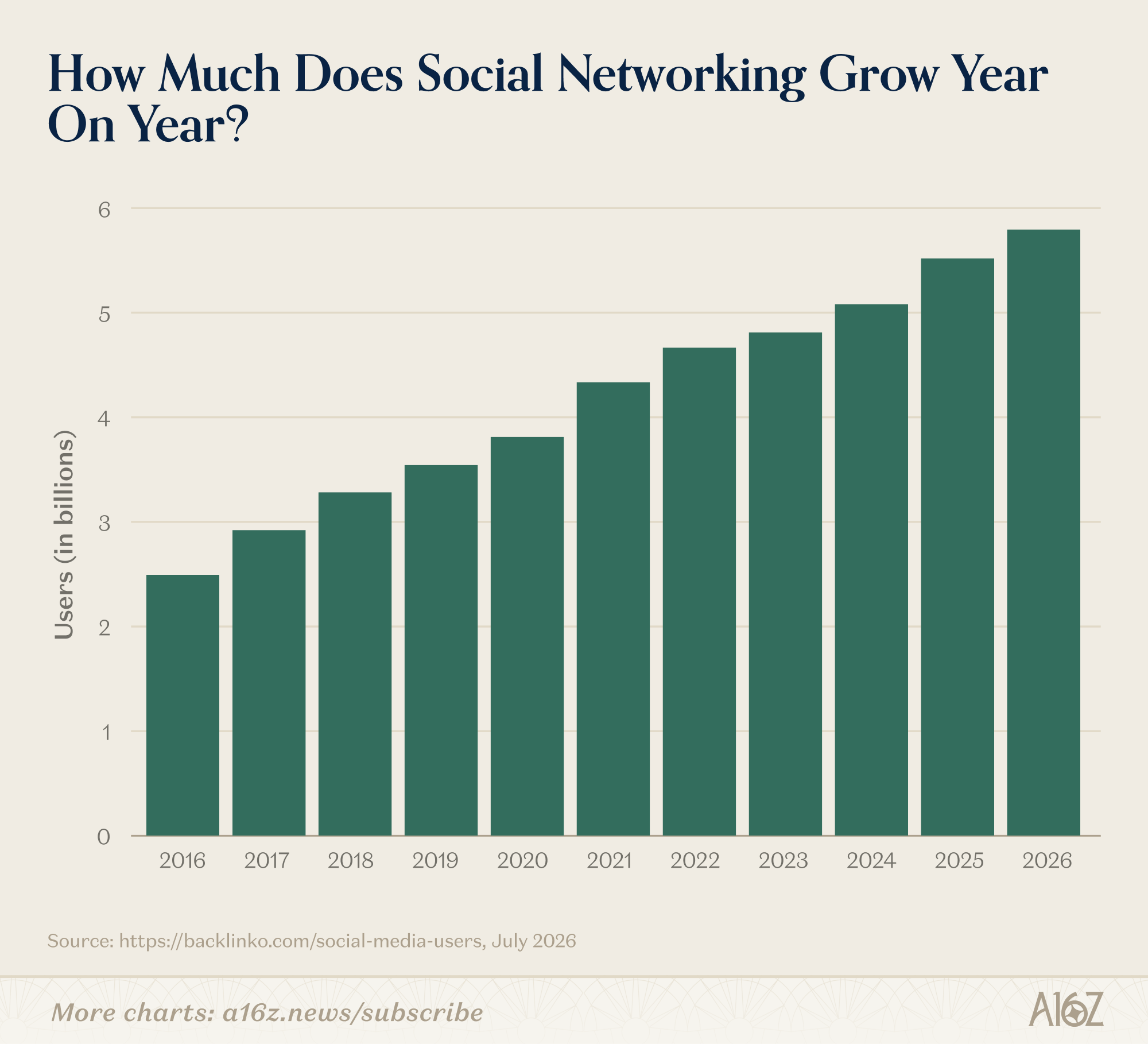
People en masse are getting on social media, by choice. From 2016 until now, the number of social media users has grown from 2.5B to close to 6B people. Enshittification isn’t real. It’s three TikToks in a trenchcoat, and, maybe, a book deal. It’s good for discourse but does not describe actual reality and user patterns.
Returning to Instagram. The average daily usage showcases an increase in time spent on Instagram every day as well. Users are coming back for more, in a highly competitive attention arena, year after year.
To be fair, certain people do feel like platforms have gotten worse, this perceived feeling describes the progressive dislocation between the platform’s main features and the user’s needs. Let’s take Facebook for example. Doctorow was probably in his thirties when Facebook started, he probably lived in an urban area, he had a specific set of needs, and that set of needs (or user goals) was met by Facebook, namely adding friends, at some point sharing images, and communicating through the wall.
Instagram has indeed changed. A look at its interface over the years showcases severe and notable differences as it evolved.
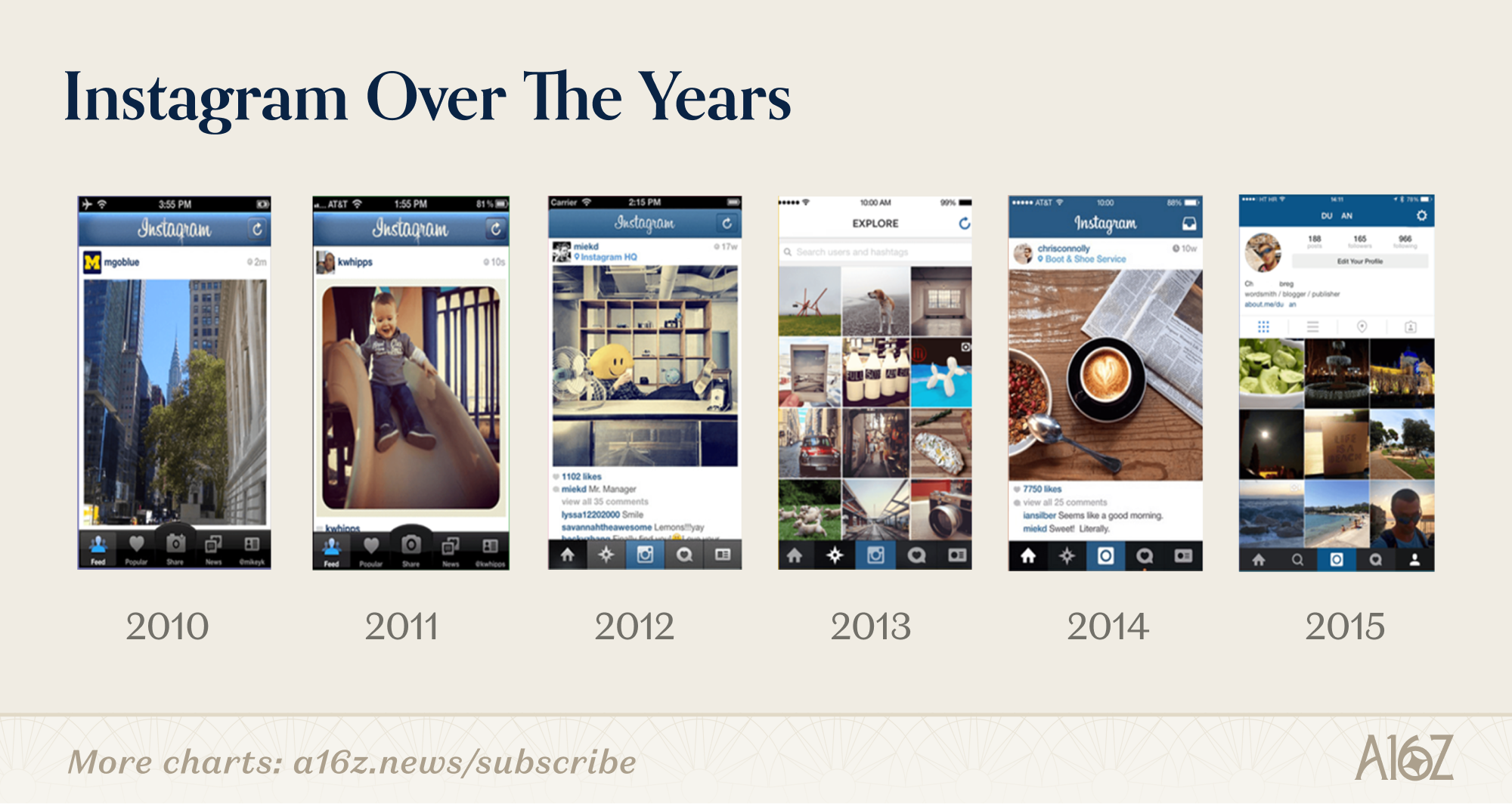
In its first five years, icons were altered, their positions were switched.
Its main functionality also changed. Notably, the feed went from chronological to algorithmic, to many’s chagrins, but algorithmic feeds show users the things they are predicted to engage with. The UX has been altered because the function of social media has changed. People now use Instagram as a means to get “entertainment”, it is no longer purely “social” media, as it used to be in yesteryears. Instagram has now taken on the role of social coordination as well. Events, book clubs, concerts all use the platform to broadcast logistical updates and keep community members informed. The “channel” feature is a good demonstration of this need. Nonetheless, the amount of time people spend on social media is increasing every year. The revealed preference is clear.
Facebook is a good example of that shift. If you pull the timeline of features that were dropped on Facebook over time—the Wall (2004-2011), the introduction of News Feed in September 2006, the Like button (2009), the shift to an engagement-based algorithm in 2009, Timeline itself in 2011, Story Bumping in 2013, and the prioritization of friends and family over brand pages in 2015—you can see that at some point, Facebook changes from being a tool that’s used specifically by college students and young urbanites to something much bigger in order to accommodate a larger and more global public. The platform evolves as its user base diversifies.
In other words, platforms start with a pretty constrained set of personas, i.e. a narrow set of user goals, but as the user base grows, as the number of monthly active users increases, there is a multiplication of personas, and therefore, a multiplication of goals. The job of the product managers becomes more difficult as the user goals become more varied, more heteroclite.
There is a third and more pragmatic argument against the enshittification hypothesis. At a company like Meta, platforms are shaped by the emergent outcome of thousands of small, motivated, data-driven product decisions. A large platform is, in practice, an enormous behavioural machine. Growth PMs, designers, researchers, and executives are constantly watching what people actually do. An interesting recurring instance of platform narcissism is that with each rollout, tech critics and certain people on social media do complain. Undeterred, the company rarely rolls things back and lets the numbers play out. Oftentimes, they expose the gap between stated preference (what people say they like and dislike) and revealed preference (how they behave numerically on the platform).
People complained about Stories, Reels, algorithmic feeds, recommendations, the intrusion of shopping and ads, suggested posts, and then, through the blunt and vulgar clarity of revealed preference, they still use them. They do not have to. The platform changes because the quantified flows of user behaviour pull it in that direction. Of course, some of these decisions are balanced with business goals, this tightrope act is quite literally the job of the PM. The point being that “I hate this” is not the same thing as “users hate this,” and “everyone I know hates this” is often just another way of saying “my cohort is no longer the platform’s central desired persona.”
This last segment is the crux of platform narcissism and the dislocation felt by early adopters in the West. This is especially true on large platforms, where you have global growth, and, thus, geographic diversification. Simply put, users in the Philippines don’t want the same things as the users in an urban centre in America want. Even at a smaller scale, users in Missouri similarly don’t want the same thing as a user who lives in Bushwick.
What people call enshittification is the feeling of feature-need dislocation. In this case, it is felt by mostly geriatric millennials. The platforms are more popular than ever. You can see it in the Monthly Active Users (MAU) growth mentioned above, 140% in ten years. The revealed preference is that people are using them more and more. Moreover, satisfaction surveys such as ACSI indicate that satisfaction with social media has remained consistent in the last 8 years, with a slight increase in the last three years, from 2020 to 2025, satisfaction grew from 70 to 75 (out of 100).
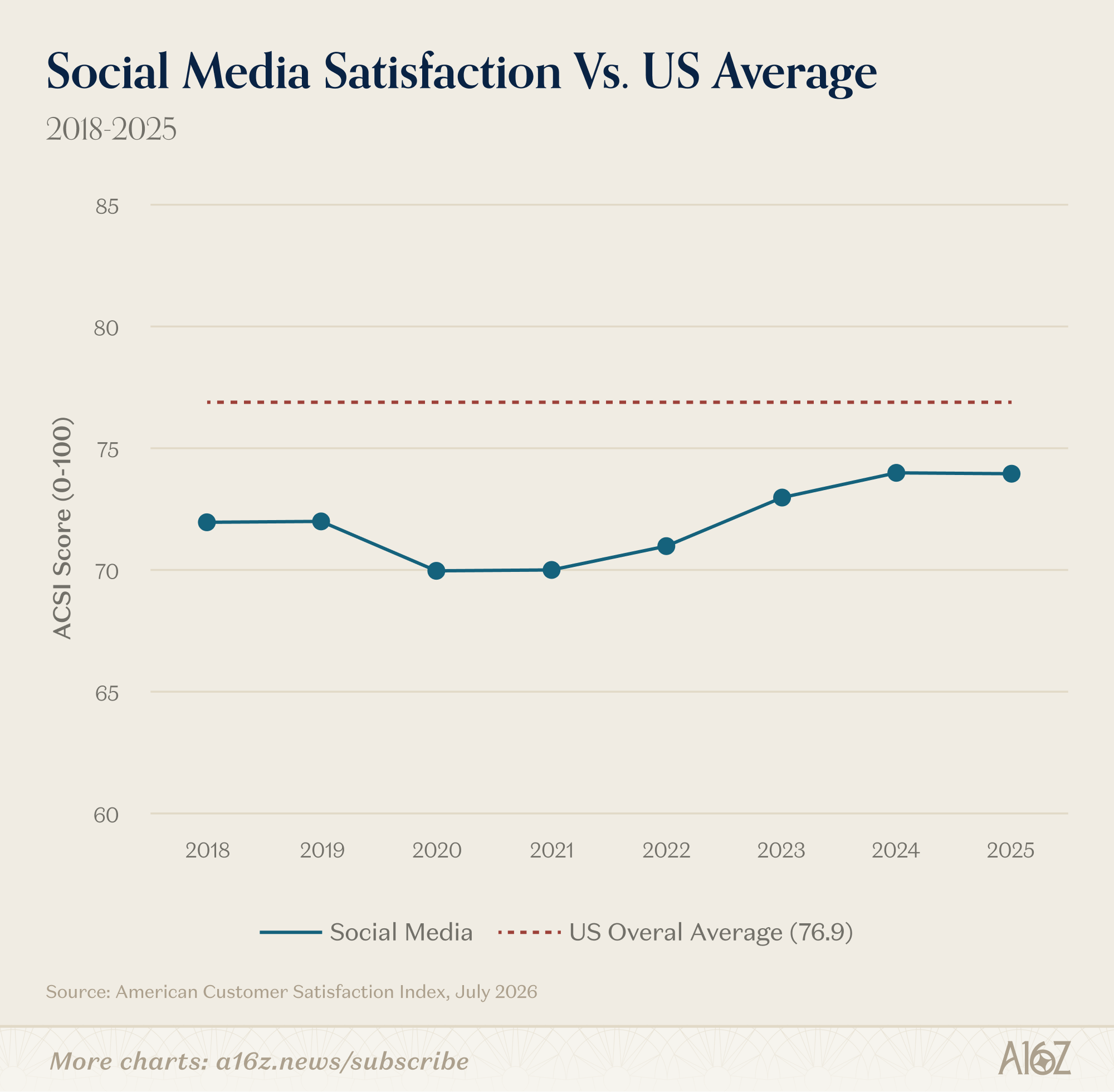
Contrary to the enshittification narrative, when broken down by platform, all platforms show increases in satisfaction. Usually, with contentious issues, one expects a divergence between stated and revealed preference, when something is perceived as more virtuous, they may claim that they do it, but in reality, their revealed behaviour showcases that they do not follow their claim. This is notably not the case here, both usage and claimed satisfaction have increased.
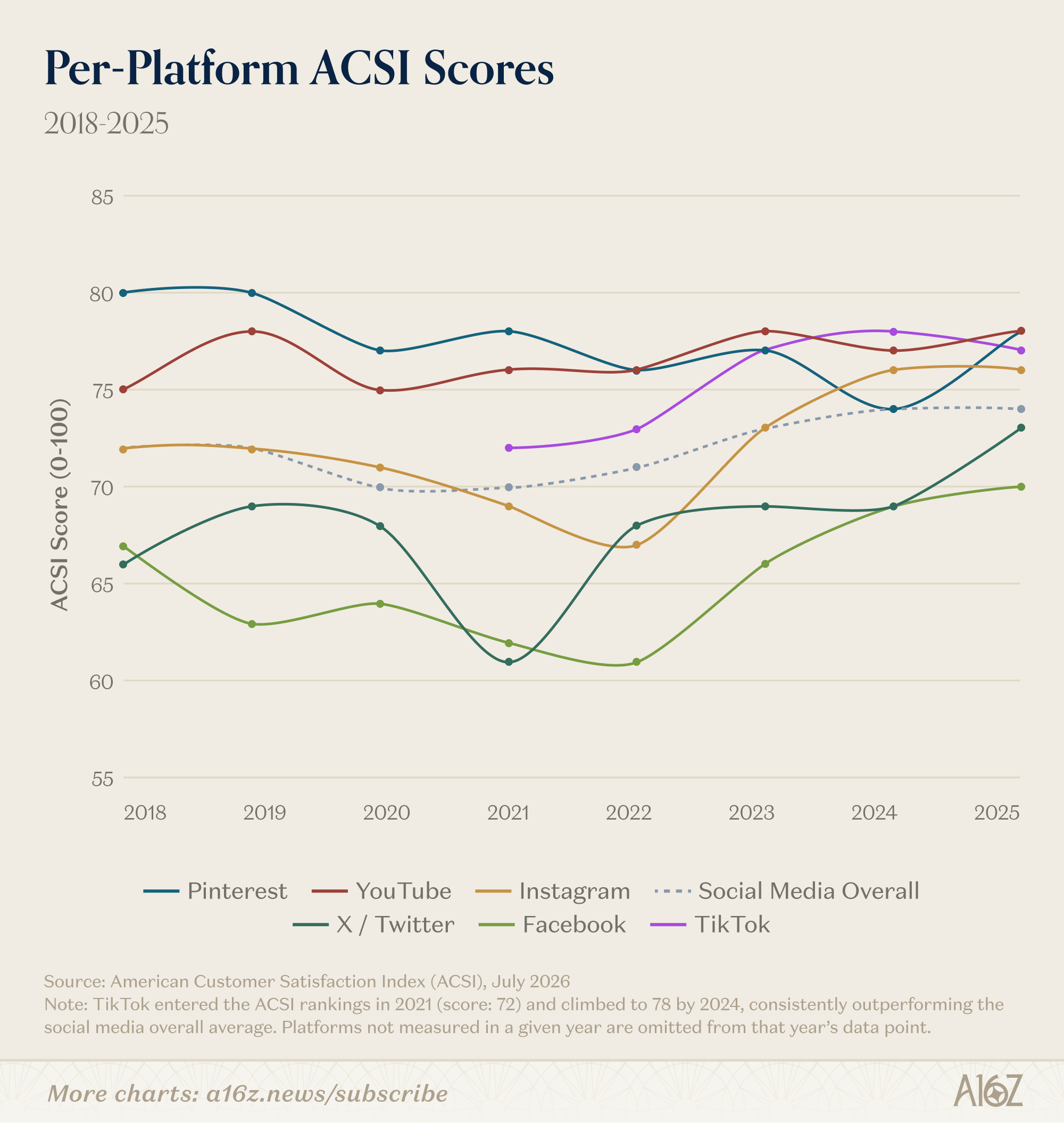
A misaligned platform could in theory trap its existing user base, but it would fail to attract new ones. Doctorow claims that platforms favor advertisers (or whomever they get their money from) and often price gouge their users, but, with social media, the big social media platforms are still free. The broad behavioural and satisfaction data do not support the sweeping claim that platforms are simply getting worse for users as a whole. Moreover, we would see decreases in overall use (time spent) and DAU numbers. The claim that the overall quality has decreased is subjective and specific to a narrow demographic of tech critical users such as Doctorow.
Platform Narcissism
Platform narcissism: the belief that the platforms one uses should continue to respond to one’s idiosyncratic user needs.
Perhaps the reason why the platform seems worse is because your life has changed. Over the same period of time, your goals have changed, and they no longer fit with the platform’s new features. Why the hell would a fifty-five year-old be watching Reels? Go take care of your kids.
The platform needs to respond to the needs of new users, who, from a demographic standpoint, often outnumber the original early adopter cohort and are now usually more engaged. Because they have different desires, different wants, executives make a conscious choice to expand in the direction which they think best suits their business goals and aligns with newer cohorts. This is the dislocation which causes the feeling of enshittification: the evolution of the platform away from a group or an initial user base.
Many will claim that platforms have trapped users, that the cost of departure or logging off is too onerous. If that were the case, this would be reflected in the satisfaction scores. Services with treacherous lock-ins tend not to score well in consumer satisfaction. My theory is that the dislocation is most felt by the chronically online, which includes the media class. Due to the nature of their work, they feel trapped. However, for the average Instagram user, who has ~675 followers, this isn’t a real problem. Additionally, as one can see from the per-platform chart, many options exist. People have the power, the autonomy, and the agency to pick the one that best serves them. Anecdotally, when it stopped serving them, Western millennials and Gen Z left Facebook.
The more interesting question, then, is not why platforms change, but why the language of platform decay has become so emotionally satisfying and so virally successful. A person can believe, all at once, that Instagram is worse, that using Instagram is embarrassing, that the platform is culturally corrosive, and that they personally are still using it more than ever. At the heart of the belief in platform decay is a form of cognitive dissonance. Many detractors of platforms are still very active users of the platforms they supposedly hate.
Hypotheses like enshittification provide an absolution for the platform narcissists. It is safe to wager that the platform narcissist is still online, they’re still using the platforms, but they need terms like enshittification to encapsulate their feelings and explain why they are still on the platform. The enshittification narrative resolves the contradiction by relocating agency towards the platform. Often, highlighting that users are trapped on these awful platforms against their will. Crying-worse allows the user to use the platform performatively half-heartedly and outsource the guilt. Critics such as Doctorow offer then a psychic service, a sort of societal exutory for all the amassed angst felt by platform narcissists. They are high priests of the terminally online platform narcissists and their indulgences are views on short form content railing about platforms and book sales.
In sum, the platforms are not worse. There is no such thing as enshittification. It is merely platform narcissism. What is platform narcissism? It is the belief that the platforms you used for the last few years should continue to respond to your specific needs. And frankly, they don’t need to.
Your favourite restaurant can stop serving your favourite dish. Your favourite store can stop selling your favourite brand. It’s just the way it is. These things change. And, for some reason, we think we’re beholden to some kind of static nature of these platforms because we were on them when we were sixteen or twenty-five. No. They’re going to evolve. And if you don’t like it, uninstall them, and move on. Vote with your thumbs, as they say.


This newsletter is provided for informational purposes only, and should not be relied upon as legal, business, investment, or tax advice. Furthermore, this content is not investment advice, nor is it intended for use by any investors or prospective investors in any a16z funds. This newsletter may link to other websites or contain other information obtained from third-party sources - a16z has not independently verified nor makes any representations about the current or enduring accuracy of such information. If this content includes third-party advertisements, a16z has not reviewed such advertisements and does not endorse any advertising content or related companies contained therein. Any investments or portfolio companies mentioned, referred to, or described are not representative of all investments in vehicles managed by a16z; visit https://a16z.com/investment-list/ for a full list of investments. Other important information can be found at a16z.com/disclosures. You’re receiving this newsletter since you opted in earlier; if you would like to opt out of future newsletters you may unsubscribe immediately.

Enshittification also includes the misuse of algorithms to maximize outrage, appeal to users' vanity and thus exploit the worst impulses in people - a Meta speciality. It's very real.
You're providing both a definition of enshittification and cherry-picking a use case domain (Facebook & Instagram) that suits your statement. FB and Instagram are already free products for consumers. You're mentioning whatever features and algorithm changes as 'people complaining' without discussing the now constant barrage of ads across every feature they provide.
Domestic US Airlines nickle-and-diming for everything, ads in increasing number of places across streaming services with price increases (and increases to the basic plan price as a higher floor) etc. is exactly enshittification. There are many products and businesses where quality is on a monotonic decrease and new ways to charge for previously free experiences are introduced. Ridiculous