



| America | Tech | Opinion | Culture | Charts |
Agents start to make an impact?
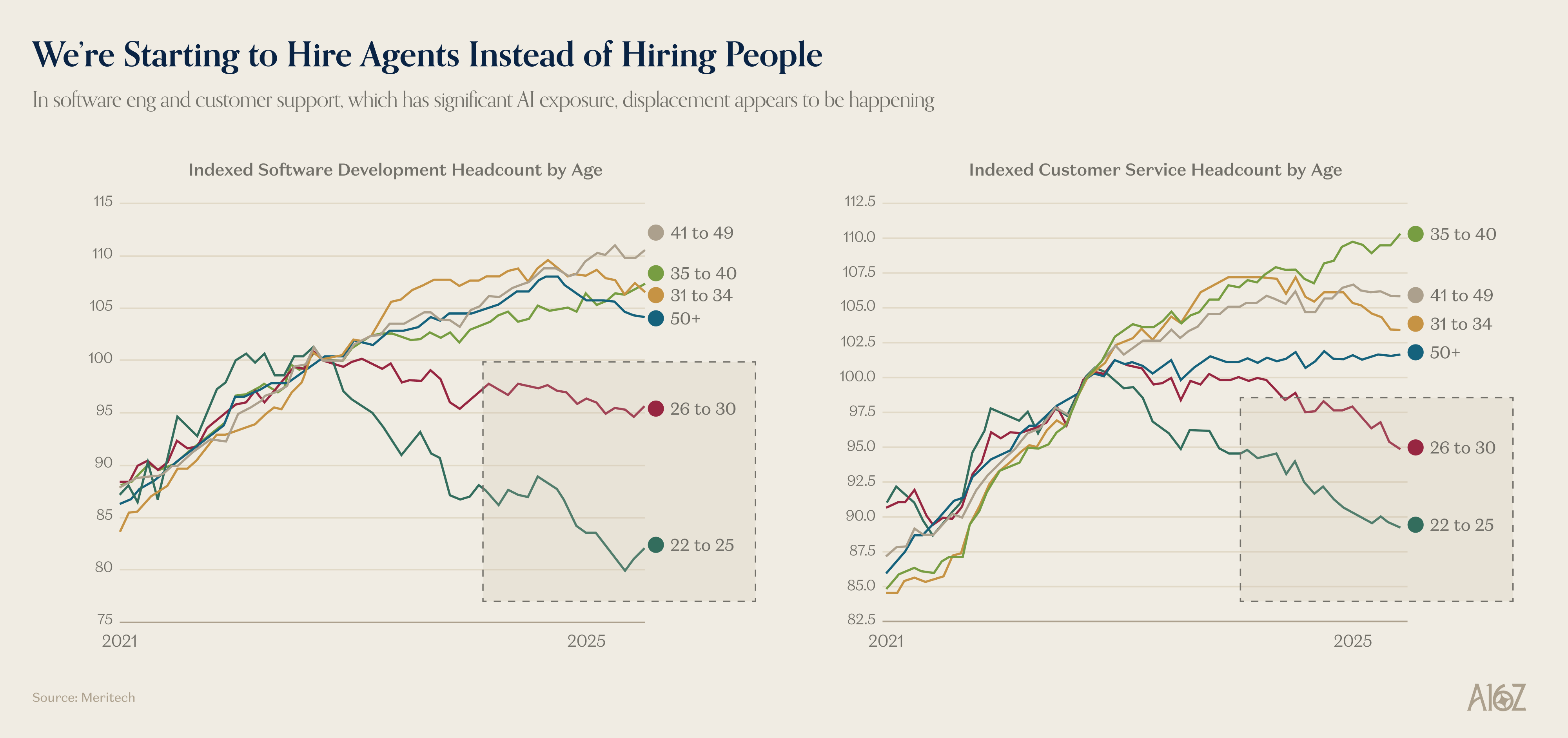
It looks like we’re starting to see the employment impacts of AI agents. As people have predicted for a while, they’re hitting junior employees and not senior ones.
They’re also concentrated in industries that revolve around work that can be done entirely on a computer – so software development and customer service.
In these industries the employment of young people (aged between 22 and 30, with those under 26 particularly hard-hit) has declined significantly over the last few years.
Of course, it’s not clear that this is entirely an AI story. The decline started around when ChatGPT was released – but was GPT-3.5 really good enough to start replacing knowledge work? This is also roughly when the Federal Reserve started raising interest rates. But even if the initial decline was a rates story and not AI, it seems that ever-improving capabilities will make it harder for young people to get computer-centric jobs.
Is energy actually going to be an AI bottleneck?
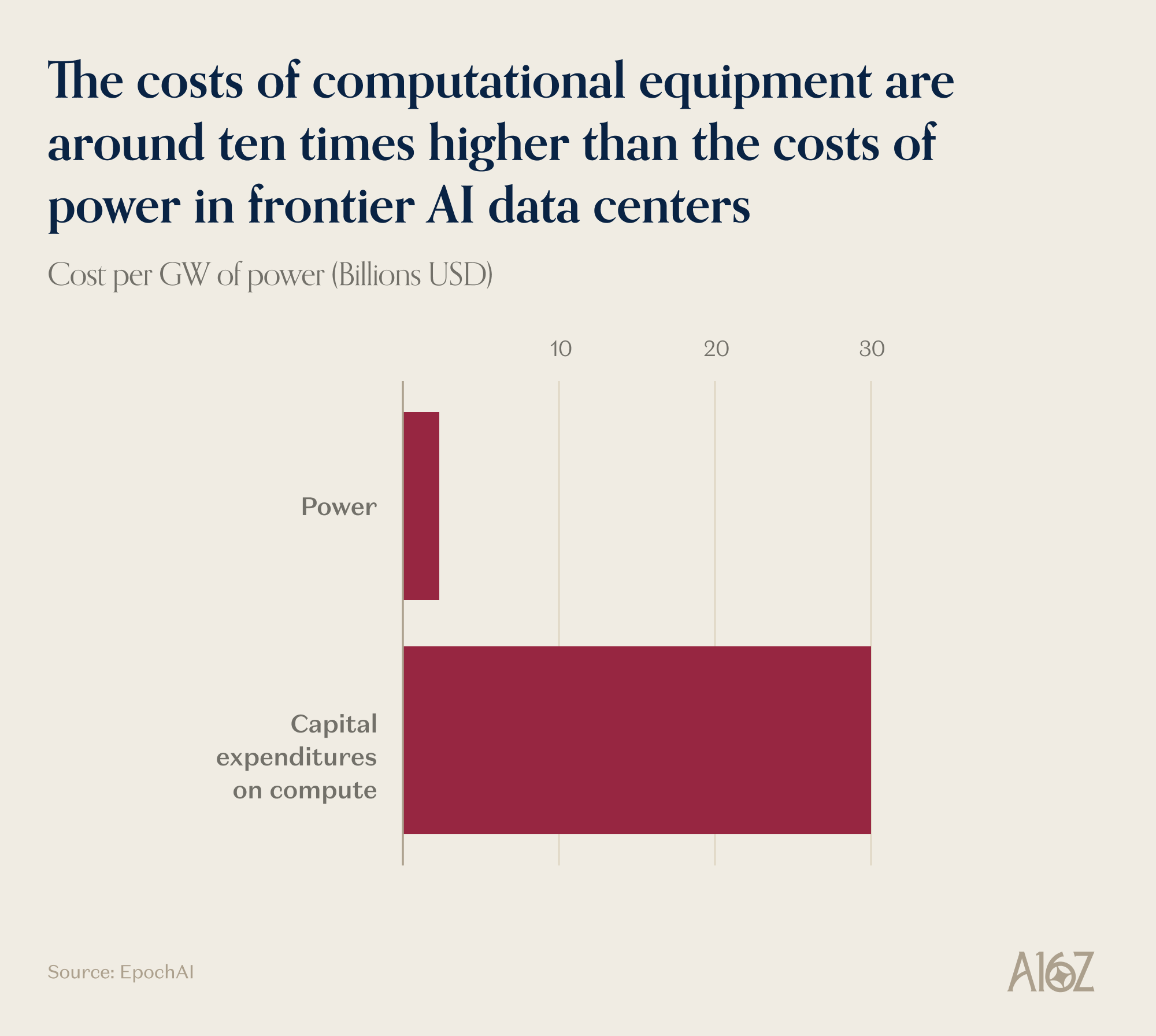
Speaking of AI: Epoch has an interesting new report casting doubt on claims that energy will be the main bottleneck to AI, and that China – which has built out a lot more energy than the U.S. over the last few years – is advantaged in the AI race as a result.
The report argues that flat energy generation of the last few decades is a choice, not a barrier – it’s a product of stagnant demand: “the problem wasn’t an inability to expand supply; rather it was that demand remained stagnant for most of the last few decades.”
If AI actually needs as much energy as it appears and the tech giants are willing to expend the resources to get it done, it won’t be as hard to start generating a lot more energy as it might first appear.
Conversely, is AI going to alleviate energy bottlenecks?
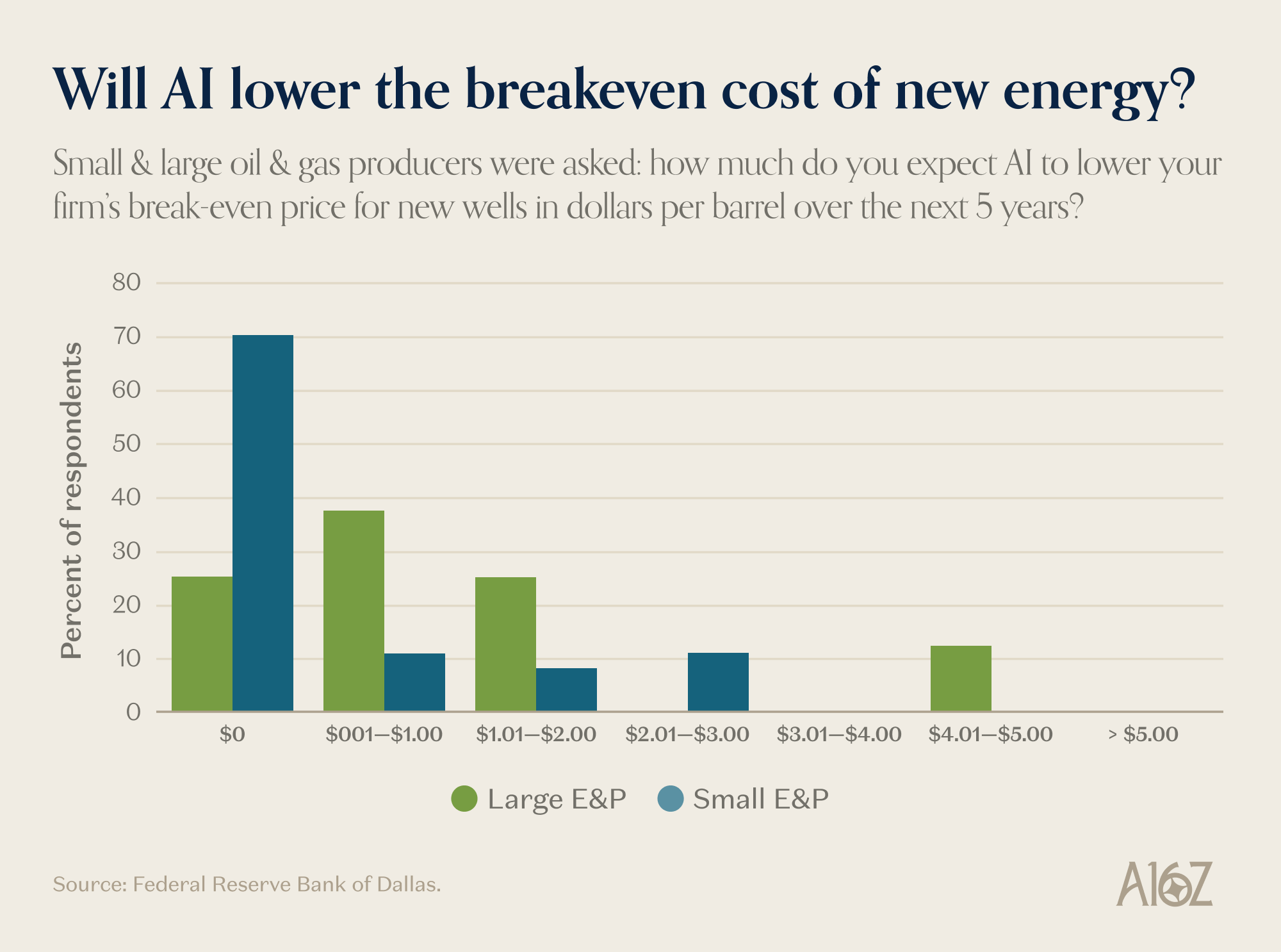
Small and large oil & gas exploration & production firms were asked: “Do you think AI is going to meaningfully lower your breakeven price of energy production?”
The short version of the answer was, large producers think “yes, kind of”, small producers think “no”. (I want to know which large firm answered “More than $4 per barrel!” That’s a lot!)
Energy has always been a David vs Goliath story. Big supermajors have all of the expertise and expensive sustaining technology; whereas the small independent producers have historically won with underappreciated, disruptive technologies like fracking.
So this chart tells us one thing, anyway: E&Ps think of AI as a sustaining technology: one that helps big operations extract more resource more efficiently, rather than a disruptive one that creates opportunity for creative new entrants.
Chatbot popularity
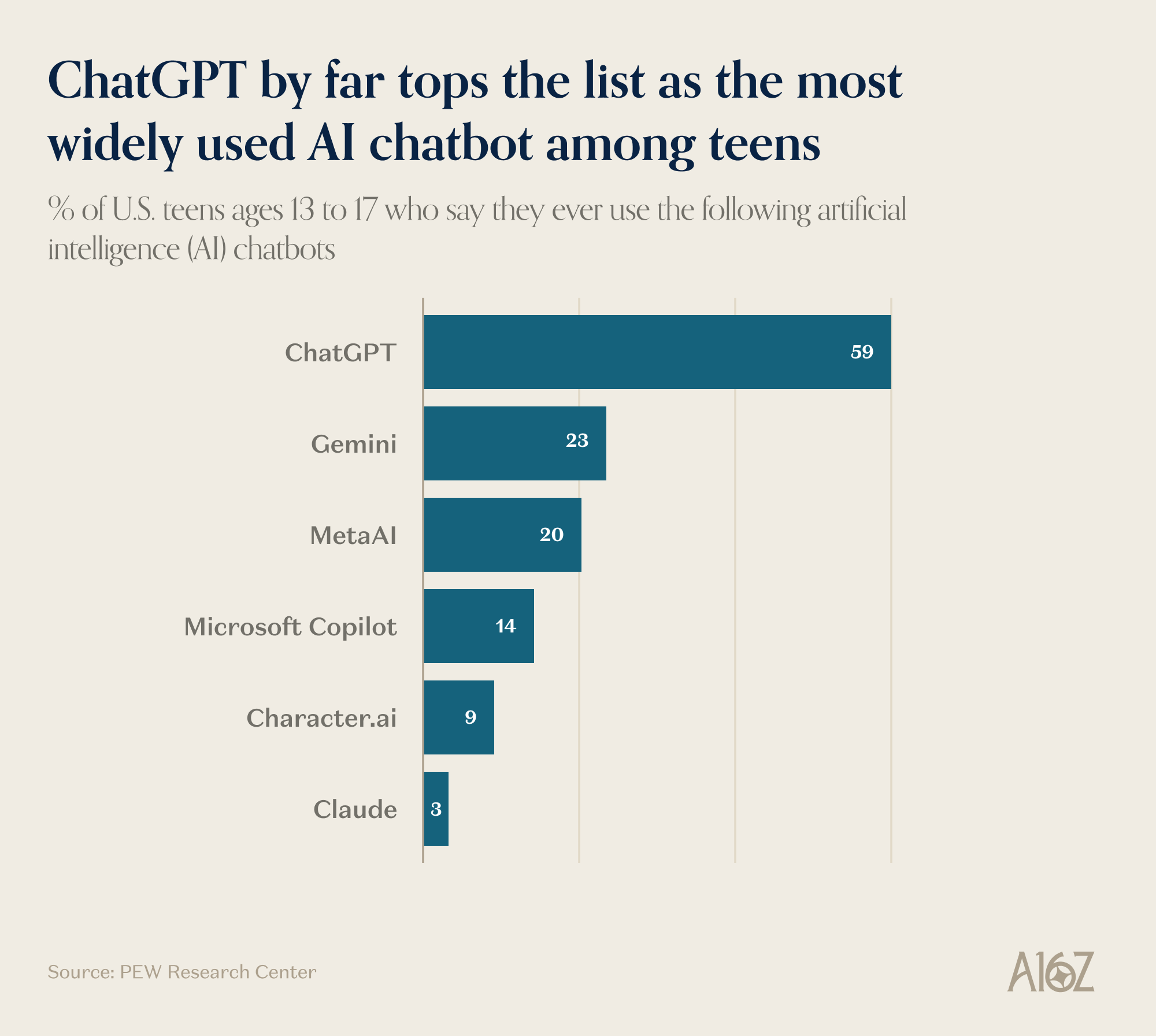
And a bit more on AI. Pew released its survey of the most popular chatbots among U.S. teenagers. Unsurprisingly ChatGPT has a commanding lead, followed by Gemini and Meta.
This was conducted in late September and early October, so things might have shifted a bit since then. But given that teen usage of chatbots seems to have a lot to do with homework help and personality – something that’s not very sensitive to which model is currently the agreed-upon leader – that seems unlikely.
The big surprise might be that Copilot is doing as well as it is. Is this just a product of a lot of schools using Microsoft technology?
Anthropic’s Claude is at the very bottom. Anthropic has found its footing with enterprise-focused coding agents and doesn’t seem to care much about chatbot use, so this shouldn’t be a big surprise.
Doctors are really burnt out
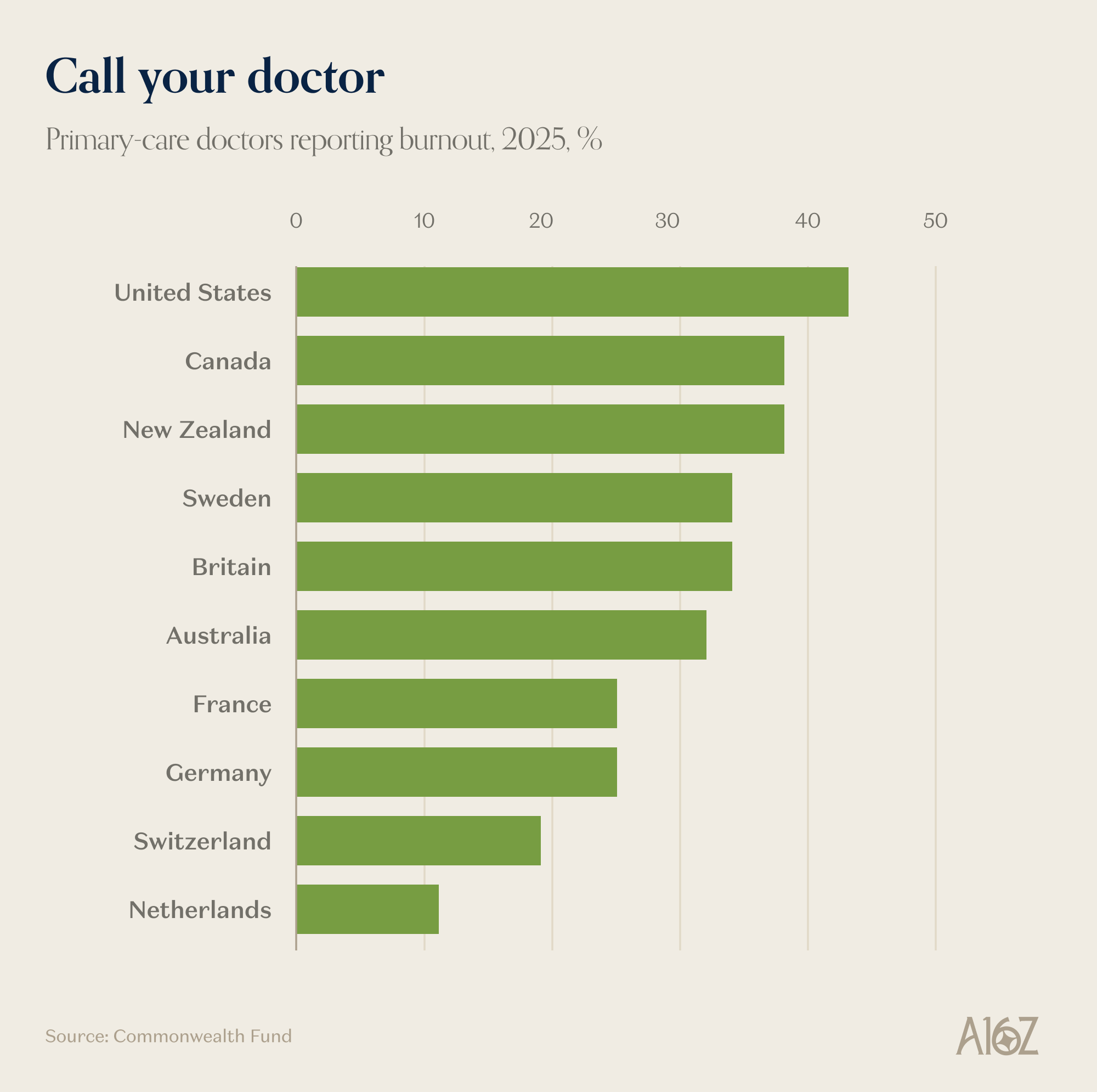
More than 40 percent of U.S. doctors are reporting burnout. The U.S. is the global leader in doctor burnout, but Canada and New Zealand report similarly high levels. The least burnt-out doctors are in the Netherlands.
Why are American doctors so burnt out? Perhaps because of how bureaucratic American medicine is. A huge amount of doctors’ time is devoted to administrative paperwork that has very little to do with curing patients.
This is a good example of how AI might help make bureaucracies function better. There’s simply a huge amount of human labor devoted to things that can be done by intelligent systems that don’t necessarily need to make judgements – like the reams of paperwork that doctors have to spend their time dealing with. Hopefully it can make American doctors’ lives easier!
Europeans love getting sick
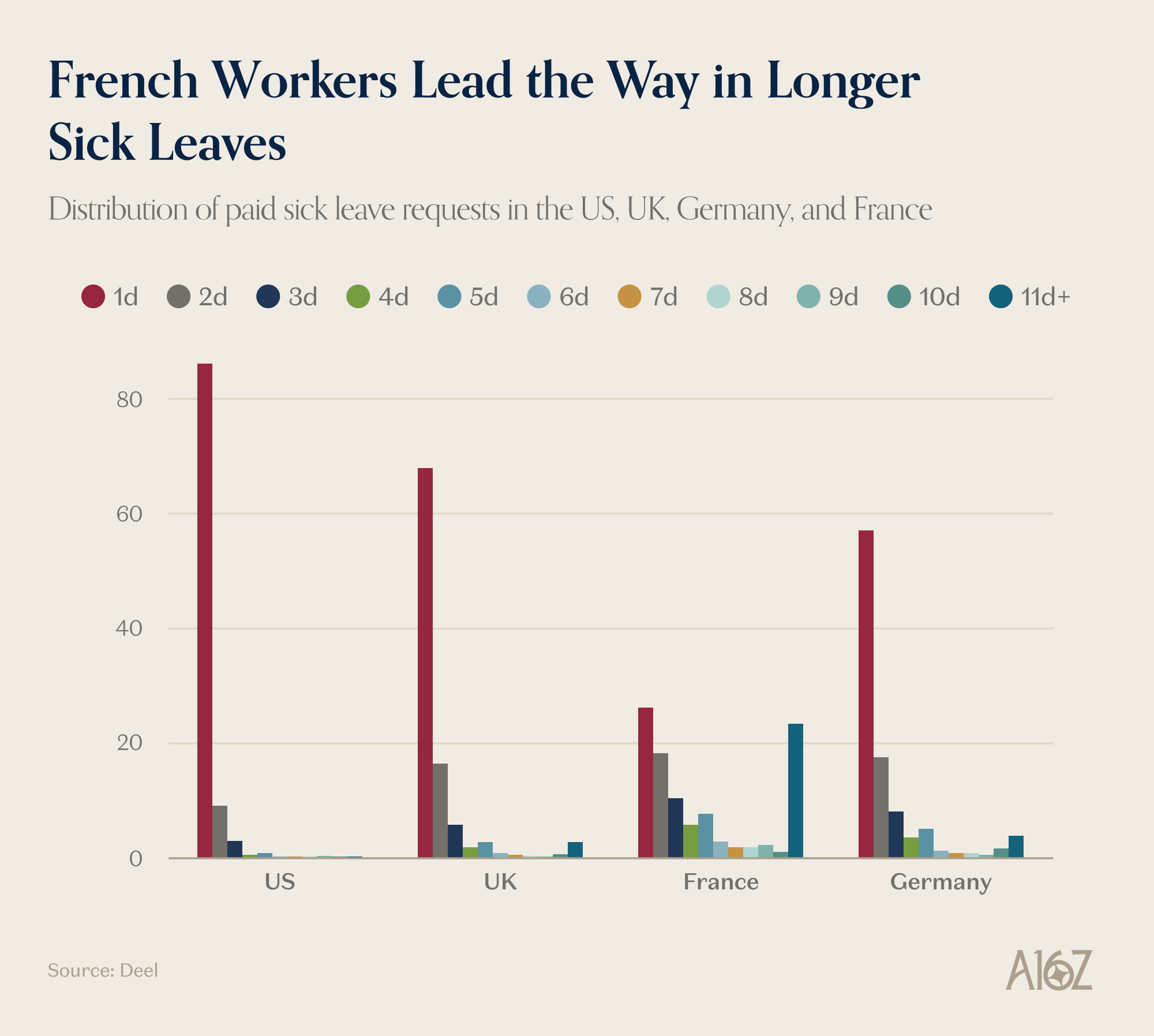
Speaking of rest and relaxation as we approach the end of the year: Deel (an a16z portfolio company) has some data on how employees in different countries take sick leave. About 90 percent of sick leaves in the U.S. are for one or two days. Sick leaves tend to be somewhat longer in the United Kingdom, but there’s still a bias toward short leaves.
But in continental Europe we get a totally different picture. In Germany a huge share of sick leaves take three days or longer. And France is the king of sick leave: more than 20 percent of sick leaves in France take more than eleven days, almost as many as those that take one day.
It seems that French workers are in the habit of acquiring severe illnesses that prevent them from working for weeks at a time.
…and Americans (especially San Franciscans) love starting big companies
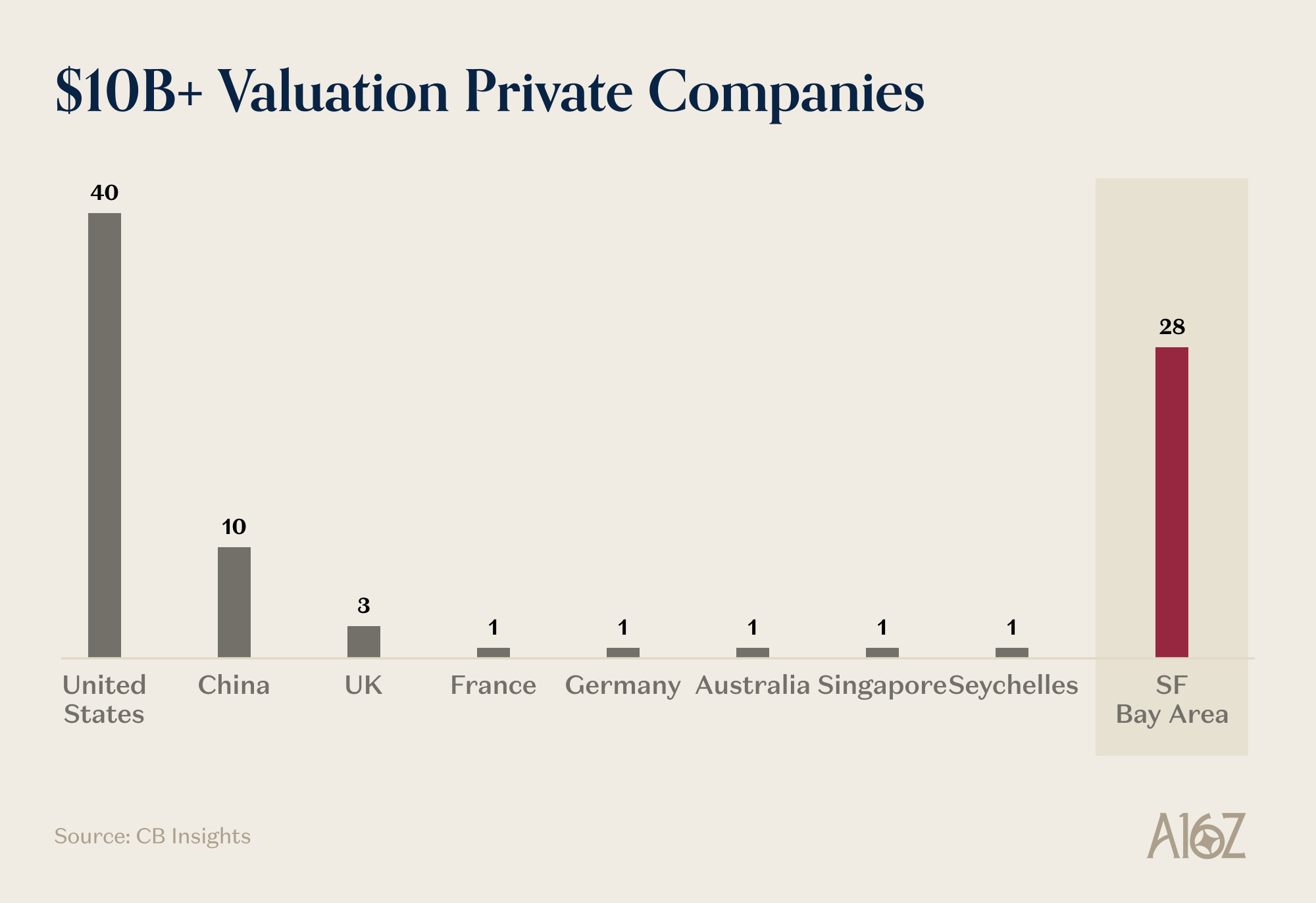
Almost every private company with a valuation over ten billion dollars is based either in the United States or in China.
Of course, this doesn’t include every private company in the U.S., because a lot of private companies don’t receive outside investment and thus don’t need to be valued. If we look at the Forbes list of America’s top private companies, the biggest private company in America by revenue is the agricultural giant Cargill, followed by Koch, Publix, and Mars.
But of the private companies that do raise outside revenue and get valuations as a result, the large majority are in the U.S. There are more of them in the Bay Area than in China and Europe combined.
This newsletter is provided for informational purposes only, and should not be relied upon as legal, business, investment, or tax advice. Furthermore, this content is not investment advice, nor is it intended for use by any investors or prospective investors in any a16z funds. This newsletter may link to other websites or contain other information obtained from third-party sources - a16z has not independently verified nor makes any representations about the current or enduring accuracy of such information. If this content includes third-party advertisements, a16z has not reviewed such advertisements and does not endorse any advertising content or related companies contained therein. Any investments or portfolio companies mentioned, referred to, or described are not representative of all investments in vehicles managed by a16z; visit https://a16z.com/investment-list/ for a full list of investments. Other important information can be found at a16z.com/disclosures. You’re receiving this newsletter since you opted in earlier; if you would like to opt out of future newsletters you may unsubscribe immediately.
The article’s framing is internally inconsistent: the title and lead graphic promote a narrative that the conclusion itself undercuts. This is compounded by a misleading timeline—Fed rate increases coincided with the start of mass layoffs, and at that time even leading AI labs were not pursuing agentic systems as a performance strategy. Stripped of this context, the headline and visuals invite sensationalized interpretations that the article’s own analysis does not support, undermining accuracy and responsible reporting.
"Almost every private company with a valuation over ten billion dollars is based either in the United States or in China."
In the US, at least, I imagine this is driven by a) more companies/startups per capita than elsewhere and b) a higher success rate in scaling them to > $10bn (or other value).
But does anyone have data to prove/disprove this hypothesis?