



America | Tech | Opinion | Culture | Charts
September 11, 2001 was 25 years ago, today. Never Forget.

The brain of a venture capitalist can be succinctly summarized as:

In venture, no one talks about the mistakes of commission: investing in companies that didn’t return as promised. There’s no scoreboard for how many of your checks get buried behind the back of the shed - it’s part of the job. In fact, our losses on investments equate to just 15 cents for every dollar invested across the funds we manage. But a single winner can have an outsized impact. Our stake in Databricks alone represents 20% of our total AUM.1
There are other kinds of mistakes that we do consider fatal. Investing in the right category, but in the wrong company. Worse yet, choosing to sit out on a company like a SpaceX, an OpenAI, or a Stripe. As my partner Marc Andreessen reminds us: if you invest in a company that unfortunately goes belly up, at least, at a certain point, you stop hearing about it. If you pass on a company and the company succeeds, you never stop hearing about it–you see it constantly in the press, on X, and in your nightmares. It haunts you every single day and every VC can recount those misses more than the successes. Our brains are wired for it.
The irony, however, is that the mistake LPs may be making today is one of commission, driven by a seemingly prudent question: Is my portfolio appropriately balanced across asset classes?
A “cottage” no more
Every week, I come across an LP who has nearly zero exposure to the three current frontier models (SpaceX, Anthropic and OpenAI). And they don’t have exposure to the leading open source ones. So how did so many LPs miss this initial wave of AI?
A few hypotheses. To start, venture allocations were historically “right-sized” to reflect the “cottage industry” nature of the business. Venture is typically a subset of a private alternatives allocation and targeted to be 5-10% of an overall portfolio. For endowment LPs, historically the most long-dated and aggressive allocators to venture, their exposure can be somewhere between 25-40%. And for some, that’s mostly through NAV appreciation vs active primary $s deployed to that percentage.
But the day SpaceX went public, historical asset allocation went out the window. Technology is the dog that caught the bus and at ~$2T market cap today, SpaceX is the largest venture-backed IPO by a factor of 10x2 and right around the corner is Anthropic (valued at $965B, rumored to be going public shortly at $2T) and OpenAI (most recently valued at $852B). That’s roughly $3.8 - $5T of combined equity value cultivated largely in the private markets and for those LPs who don’t have exposure to it, they have a lot of ‘splaining to do to their boards and investment committees.
Moreover, the biggest companies in the world are technology companies and they are getting bigger, more quickly than ever before. What was once success in venture (a unicorn) is now your average Wednesday and private companies are generating $1B+ in revenue on a timeline measurable in quarters.

While this is happening, the asset allocation frameworks LPs have relied on for decades have started to fracture. I’m reminded of something Robert Smith, CEO and founder of Vista Equity Partners, one of the great software buyout funds, famously once said: “Software contracts are better than first-lien debt”.
It turns out, the next wave of disruption can make recurring revenue less durable than expected. And we may be seeing this reflected in buyout returns, where average and top quartile returns are near 15-year lows.

For prudent institutional investors, who have historically “right-sized” their venture exposure to a small piece of their overall alternatives pie, the landscape has changed, and this is a call to resize again.
Power Law is now the shape of our economy
It’s hard to overstate how a small number of companies are now capturing a monstrous share of everything. NVIDIA chips are now even being used to broker peace deals. Take a look at the evolution of the S&P 500 below, where 8 out of the top 10 most valuable S&P 500 companies are tech companies (and turnover in the top 10 is more dynamic than ever before):

Even in credit markets, tech is the main event now:

So, tech is getting bigger, and more central to the economy, and as everyone knows by now, companies are staying private longer.
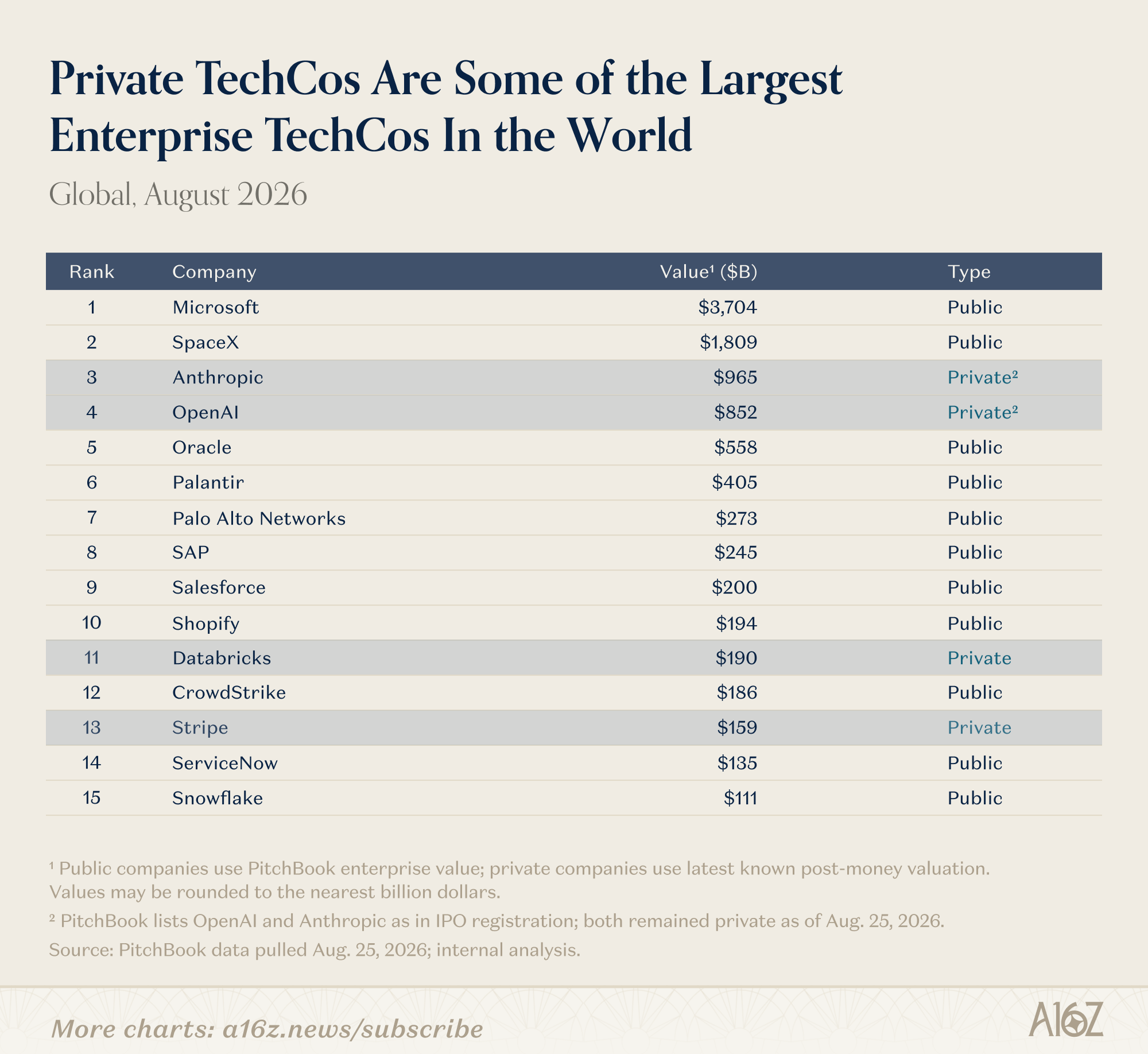
~1/3rd of technology companies valued $150B+ are privately-held and for the second-largest public tech co (SpaceX), the lion’s share of enterprise value creation happened on the private side.
Further down, the companies with real momentum are moving up at an accelerating pace: median time between rounds for actively-raising unicorns compressed to just one year in Q1 2026, down from 1.5 years in 2024, while over half the private companies that once cleared unicorn status (51.2%, per PitchBook) haven’t raised in more than two years.
The fact is that tech companies are getting larger, especially at the tail, and that growth is happening in private markets:

In the good ol’ days (2004), Google went public with a ~$1.67B offering and closed its first day at a “bubbly” $27B market cap. Adjusted for inflation, that’s roughly $3B and $48B, respectively. Today, that offering wouldn’t crack the 20 largest completed VC financings recorded by PitchBook since January 2025, and its first-day market cap would amount to just a third of those companies’ $75B median reported post-money valuation. In other words, this would be a rounding error in the news cycle.
When venture eats the world
PE has historically captured a much larger share of alts allocation, but venture outcomes are simply changing the math:

Private equity and venture capital have maintained roughly equivalent exit counts for a long time, but exit value for VC-backed companies just tripled PE’s high watermark.
The largest, majority-PE-owned company to go public was Medline in December 2025.3 $54 billion based on first-day closing market cap. SpaceX, the first of the new AI generation, private juggernauts stepping onto the public markets, closed its debut at approximately $2.1 trillion—roughly 39 times as much.
What about M&A? In July 2026, Aligned Data Centers became the largest, majority-owned, private equity backed M&A exit by enterprise value at $40B (according to Pitchbook). The biggest venture-backed M&A exit? Cursor to SpaceX at $60B.

A single venture IPO (SpaceX) can be roughly ~39x the largest PE outcome on record. Multiply that by 2 more $1T+ potential IPOs in the pipeline, and you can see where I’m going with this.
Case in point: consider CalPERS. In late 2022, the largest public pension fund in the U.S., reworked its private equity book. Buyouts fell from 91% of new commitments in FY2020-21 to 58% in FY2023-24, while growth equity and venture together rose from 9% to 43%. Its PE program went from ranked 30th to ranked 1st among the 30 largest US pension PE programs in just three years, and their growth equity and venture program is now its single strongest-performing segment.4
Other public pension plans are starting to follow suit, including MassPRIM and North Carolina Treasurer, just to name a few.
Machine intelligence compounds the trend
If nothing else, we can all agree that the train has left the station on machine intelligence. We have already seen exponential improvements in capability, autonomy and cost—and this is all before robotics really arrives. Innovation will likely continue to expand faster than any of us, investors or LPs, can map in advance.
Fortunately, this is the kind of ambiguity venture is designed to thrive in. Unlike private equity, the power law in venture absolves all sins. We don’t need to save every portfolio company to generate great returns and in fact, while we don’t invest with this expectation at the outset, the majority of the portfolio can go to zero and we can still generate outperformance from a small handful of power law winners.
The legitimate case against venture
So if the case is so clear for venture, why isn’t everyone making a drastic change to their portfolio?
Show me the money
The critique of venture that hits hardest is, of course, liquidity (even if that’s not unique to venture). As one of our partners once said to me, “I’m knee deep in TVPI, but where is DPI?”
For some managers, secondaries may be the only answer to post up liquidity and stay in the game between fundraises. It’s a fair strategy, but remember, VC firms typically generate their returns from a small batch of winners, so you might be pruning your roses to water your weeds. Even still, secondary capital is still a rounding error in the scheme of things and the vast majority is targeting a very small subset of companies. And there is absolutely no discount for the assets you actually want:

In my experience, most LPs would prefer to hold compounding assets. An example I’ve shared publicly with Packy McCormick before: a few years ago, we offered our LPs liquidity in our older vintages. Fund I had a seed position in Stripe and Fund III invested in the first round of Databricks.5 We offered various structures to give LPs liquidity on those names, and do you know what happened? Not a single LP chose to sell. Ironically, receiving money back is sometimes a burden for LPs because then they have to reinvest the capital. Can they find a comparable asset that can continue to compound at that expected rate? Even if they can, why pay interim taxes instead of letting it grow?
Returns over marks
Here’s another one we hear all the time: venture valuations are too opaque. And how do LPs calibrate to a legacy portfolio of companies from the last technology cycle that may be worth less than what their last round valuation was?
Somewhat fair, but let’s unpack. Venture marks are kept close to the vest because, rightly or wrongly, they’re often viewed as a vote of confidence (or not) in one company over another. The mark is a signal that affects both relationships with founders, and founders’ relationships with their employees and prospective hires. The reality is that the valuation process for all private assets is complex. Almost every single venture manager holds the same company at different valuation, which makes it even more confusing. As this oldie, but goodie from Scott Kupor posits, when is a “mark” not a mark? At the end of the day, the only true mark is cash in the bank account after an exit. DPI speaks for itself.
Plus, this phenomenon isn’t unique to venture. Private equity and private credit aren’t “mark-to-market” either, and now that AI is re-writing the leaderboard for enterprise value, there may be a whole lot of pain in PE.
Similarly, private credit was the coupon-like antidote to PE’s illiquidity. ‘Equity-like returns, with debt-like downside,’ they said. There’s nothing wrong with that, and credit where it’s due (pun intended), the fundamentals have largely held, and the asset class is evolving in real time, moving up the stack to underwrite the AI infrastructure buildout itself.
But for those earlier cohorts of loans, especially to supposedly uncorrelated PE-backed software companies, where AI has compressed multiples, growth has slowed, rates have moved higher, and refinancing is around the corner? There likely will be (and likely already have been) write-offs, and likely no power law of outlier upside to make up the difference, either.
Platform shifts may keep the other guys up at night, but for venture, it’s where the opportunity is.
Proximity is not participation
My last point is crucial because it’s often a trap for allocators who are feeling the weight of the argument so far. Too often, the folks I speak to feel like they are already overexposed in venture, with decades of legacy portfolios sitting with managers who have zero incentive to sell or re-value their book.
But, in continuing the theme of power law, it’s not just a smaller number of companies generating the returns. It’s a smaller number of funds with exposure to those companies:

Once again, the fat-tail of outcomes is happening within a small group of companies held by a small group of funds.
Top-quartile 5-year IRR is now double the median for the most recent vintage:

Even more recently, the top decile funds by IRR have never been farther away from the top quartile:

Manager dispersion is becoming even more pronounced.
And it’s not just paper returns–top decile’s got your DPI, too:

Top decile DPI for nearly 10 year-old funds is 2-3X larger than the top quartile (and 4-10X larger than the median). Median just isn’t good enough. Top-quartile ain’t it either.
It shouldn’t be any surprise that a small handful of funds are capturing an outsized share. After all, winning begets winning: a fund that lands one behemoth gets the follow-on rights, the founder referrals, and the information edge that make it more likely to land the next one. Access compounds the same way outcomes do.
In the bigger scheme of things, diversification is something we’ve all been taught to be prudent. But this is perhaps one of the few times where that logic doesn’t land. In a recent podcast, Aram Verdiyan from Accolade Partners revealed that based on Accolade data, 3,000 venture capital firms in the US, and only 20 have achieved consistent 3X net returns over the last two decades. Furthermore, a September 2026 PitchBook screen of 2,143 global VC funds with 2000–2018 vintages and reported DPI revealed that, only 365—or 17.0%—had returned at least 2x invested capital. Just 143 funds, 6.7%, reached 3x, and only 51, 2.4%, reached 5x. Put differently, 83% of funds failed to return 2x and nearly 98% fell short of 5x. So it’s worth saying out-loud that only the best funds have the access, the power, or the muscle to repeatedly find, nurture and exit a behemoth.
Ripping it to studs and starting over again
Institutional money isn’t missing the argument for venture. Many LPs are making this exact argument internally to their boards and investment committees themselves. Tech will drive an outsized share of value-creation, before maturing into some of the largest businesses the world has ever known. As Marc says, “technology is the dog that caught the bus”. But if left unchanged, “prudent” asset allocation to a “cottage” industry that has outgrown the cottage, may miss the bus altogether.


The above reflects the subjective views and beliefs of a16z Capital Management, L.L.C. (“a16z”) or its respective affiliates, and is not, and is not intended to be, an offer to sell -- or a solicitation of an offer to buy -- any securities, and may not be used or relied upon in evaluating the merits of any investment. It should not be construed as or relied upon in any manner as investment, legal, tax, or other advice. Any projections, estimates, forecasts, targets, prospects and/or opinions expressed in these materials are subject to change without notice and may differ or be contrary to opinions expressed by others. Any charts provided here or on a16z content distribution outlets are for informational purposes only, and should not be relied upon when making any investment decision. Certain information contained in here has been obtained from third-party sources. While taken from sources believed to be reliable, a16z has not independently verified such information and makes no representations about the enduring accuracy of the information or its appropriateness for a given situation. All content speaks only as of the date indicated. There can be no assurances that a16z’s investment objectives will be achieved or investment strategies will be successful. Any investment in a vehicle managed by a16z involves a high degree of risk including the risk that the entire amount invested is lost. Any investments or portfolio companies mentioned, referred to, or described are not representative of all investments in vehicles managed by a16z; visit https://a16z.com/investment-list/ for a full list of investments. Other important information can be found at a16z.com/disclosures.
As of June 30, 2026.
The next largest venture-backed IPO was Alibaba’s at approximately $168 billion, based on its $68 per share offering price in September 2014.
Pitchbook, Capital IQ; 9/10/26.
Per their statements at the March 17, 2026 Investment Committee meeting.
The investments shown are a selected sample and are presented for illustrative purposes only. They are not representative of all investments made by a16z-managed funds. There can be no assurance that any investment will be successful or achieve comparable results.
Nice take
Very interesting to see how venture is evolving; certainly seems like its becoming the driver of the economy in the US and abroad.